
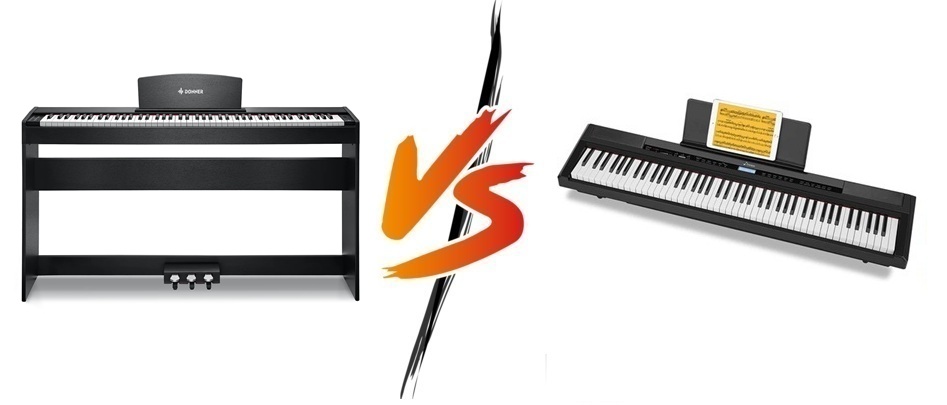
If you’ve been shopping for a beginner-to-intermediate digital piano lately, there’s a good chance you’ve come across Donner. The company has become one of the most visible budget piano brands online, mainly because it packs a lot of features into instruments that cost significantly less than Yamaha, Roland, or Kawai alternatives.
Two of the most interesting options in their lineup right now are the Donner DDP-50 and the Donner DEP-20. On paper, they seem aimed at similar buyers: people who want an affordable 88-key weighted digital piano with decent sound, modern features, and realistic piano feel. But once you spend time looking deeper, these two instruments are actually built for very different kinds of players.
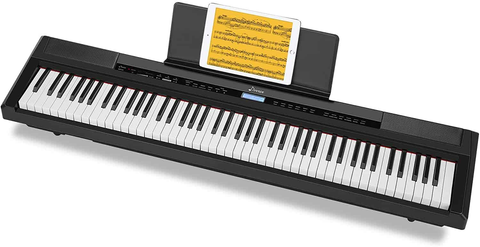
The DEP-20 is essentially a portable digital piano/workstation hybrid. It tries to do a little bit of everything. It’s packed with sounds, rhythms, accompaniment features, recording tools, and connectivity options. It’s designed for flexibility and affordability first.
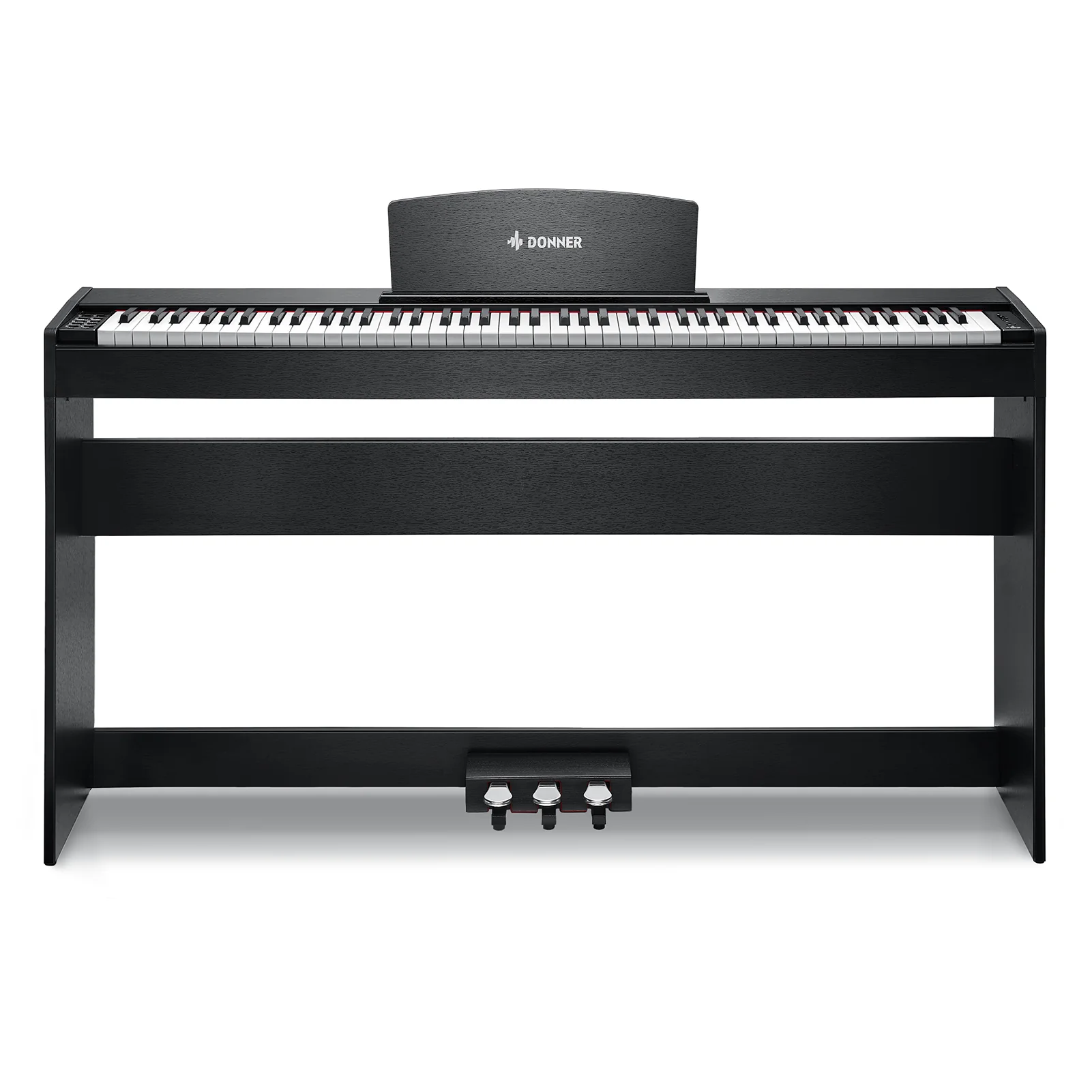
The DDP-50 takes a different approach. It leans more toward the “home piano” experience. It’s furniture-style, more visually refined, more focused on piano realism, and aimed at people who primarily want to sit down and play piano rather than browse hundreds of tones and arranger functions.
So which one is better?
The answer depends heavily on what kind of player you are.
If you want the short version:
- The DEP-20 is better for buyers who want maximum features for the money.
- The DDP-50 is better for buyers who care more about piano experience, aesthetics, and long-term home use.
But there’s a lot more nuance than that. And honestly, there are areas where both pianos surprise you in good and bad ways.
Here’s the full breakdown.
Donner DDP-50 vs Donner DEP-20 Comparison Chart
If you click the links below, under the product images, you will be redirected to Amazon.com. In case you then decide to buy anything, Amazon.com will pay me a commission. This doesn’t affect the honesty of this review in any way though.
| Feature | Donner DDP-50 | Donner DEP-20 |
|---|---|---|
 |  | |
| Check the best price on Amazon | Check the best price on Amazon | |
| Piano Type | Furniture-style digital piano | Portable digital piano |
| Keyboard | 88-key graded hammer action | 88-key fully weighted hammer action |
| Key Feel | More piano-focused and refined | Slightly heavier and more mechanical |
| Polyphony | 256-note | 128-note |
| Sound Library | Approx. 375 tones | 238 tones |
| Rhythms / Accompaniments | Approx. 100 rhythms | 200 rhythms |
| Main Focus | Realistic piano experience | Versatility and functionality |
| Cabinet Design | Integrated furniture cabinet | Portable slab-style body |
| Pedals | Integrated triple pedal unit | Sustain pedal included/supports pedal input |
| Speaker System | Cabinet-integrated stereo speakers | Dual built-in speakers |
| Speaker Character | Fuller and warmer | Louder but less refined |
| Volume Performance | Smooth at high volume | Can become harsh at louder levels |
| Bass Response | Fuller and more resonant | More limited low-end depth |
| Sound Character | Warmer and more natural | Brighter and more digital |
| Piano Realism | Higher | Moderate |
| Display | Minimal/streamlined interface | LCD display with controls |
| Split Mode | Yes | Yes |
| Layer Mode | Yes | Yes |
| Recording Function | Yes | Yes |
| Metronome | Yes | Yes |
| Touch Sensitivity | Adjustable | Adjustable |
| USB MIDI | Yes | Yes |
| Bluetooth | Available on some versions | Limited/varies by model |
| Headphone Jacks | Yes | Dual headphone outputs |
| Audio Inputs/Outputs | Yes | Yes |
| App Compatibility | Yes | Yes |
| DAW Compatibility | Yes | Yes |
| Portability | Low | High |
| Weight | Heavier cabinet-style unit | Lightweight portable design |
| Best For | Serious home piano practice | Beginners and casual players |
| Ideal User | Piano-focused learners | Feature-focused users |
| Setup Style | Permanent home setup | Flexible portable setup |
| Aesthetic Appeal | More elegant and furniture-like | Functional and keyboard-like |
| Learning Curve | Simple and focused | More feature-heavy |
| Practice Experience | More immersive | More flexible |
| Strengths | Realism, feel, design, immersion | Features, value, portability |
| Weaknesses | Less portable | Less refined sound and action |
| Overall Personality | Traditional digital piano | Multifunction music workstation |
| Value Proposition | Better long-term piano experience | Maximum features for the money |
| My individual reviews | Donner DDP-50 review | Donner DEP-20 review |
Design & Build Quality
When people shop for a digital piano, they usually focus first on things like key action, sound quality, or features. That makes sense. Those are the aspects directly tied to playing. But design and build quality matter far more than many buyers initially realize, especially if the piano is going to live in your home for years.
A digital piano is not just a musical instrument. It’s also furniture, technology, and part of your daily environment. The way it looks, the materials it uses, how sturdy it feels, and even how the controls are laid out can shape your overall experience more than the spec sheet suggests.
This is one of the biggest differences between the Donner DDP-50 and the Donner DEP-20. Even before you play a single note, the two pianos communicate very different priorities.
The DEP-20 feels like a modern electronic keyboard built around flexibility and portability. The DDP-50 feels like an attempt to recreate the atmosphere of a traditional home piano. Neither approach is inherently better, but they appeal to different types of buyers.
Donner DEP-20 Design Philosophy
The DEP-20 is designed primarily as a practical, affordable, feature-rich digital piano. You can tell that almost immediately from the way it looks.
It follows the classic portable digital piano formula:
- slim rectangular body
- lightweight plastic chassis
- control-heavy front panel
- LCD display
- onboard function buttons
- detachable or optional stand
Visually, it resembles many entry-level keyboards currently on the market. If you’ve ever seen a beginner Casio or Yamaha portable piano, the general idea will feel familiar.
The first impression is functional rather than elegant.
That’s not necessarily criticism. Donner clearly prioritized usability and affordability over premium aesthetics, and for many buyers that’s perfectly reasonable. In fact, some players actually prefer this kind of straightforward design because everything feels accessible. You sit down, see all the buttons, and immediately understand that the piano is meant to do more than just imitate an acoustic instrument.
The layout is busy compared to the DDP-50, but intentionally so. The front panel includes quick access to tones, rhythms, recording functions, metronome controls, accompaniment settings, and sound customization tools. If you enjoy experimenting with different features, the DEP-20 makes that process convenient.
However, the downside is that it also looks more “electronic.”
There’s no real attempt to disguise the fact that it’s a digital keyboard. The screen, buttons, and plastic surfaces constantly remind you that this is a multifunction instrument rather than a pure piano experience.
For younger players or casual users, this may not matter at all. But adults looking for something that blends naturally into a living room or studio space may find the DEP-20 visually plain.
Materials and Physical Construction of the DEP-20
Considering its price range, the DEP-20 is reasonably well assembled.
The plastic chassis doesn’t feel alarmingly cheap, and the keyboard frame is sturdy enough for regular home use. There’s some flex if you intentionally push on parts of the casing, but nothing unusual for a budget portable piano.
The keys themselves are fairly solid. They don’t wobble excessively, and they avoid the toy-like looseness found on extremely cheap keyboards. That’s important because poorly stabilized keys can make an instrument feel unreliable even if the sound engine is decent.
Still, this is clearly an entry-level construction.
The texture of the plastics, the feel of the buttons, and the general finishing details all remind you that Donner had to hit a very aggressive price point. The controls work fine, but they don’t feel especially premium or satisfying. Some buttons have a slightly hollow or clicky feel compared to higher-end digital pianos.
The music stand is functional but not particularly luxurious either. It does the job, though it lacks the sturdiness and polish you’d expect from more expensive instruments.
One thing the DEP-20 does exceptionally well, though, is weight management.
Because the piano is relatively lightweight, it’s easy to move around the house. This becomes a huge advantage for:
- students living in apartments
- players with limited space
- musicians who occasionally travel
- families that need flexibility
You can place it on a stand, move it into storage, or reposition it without turning the process into a major project.
That practicality is a genuine strength.
The DEP-20 as a Portable Instrument
Portability changes the entire ownership experience.
A lot of first-time piano buyers underestimate how important this can be. Large furniture-style digital pianos look attractive online, but once assembled, they’re difficult to relocate. If you move apartments frequently or rearrange your living space often, portability becomes extremely valuable.
The DEP-20 handles this situation much better than the DDP-50.
You can use it:
- on a keyboard stand
- in a bedroom studio
- in classrooms
- at rehearsals
- at small performances
- in temporary setups
That flexibility gives it broader usefulness overall.
In many ways, the DEP-20 behaves more like a musician’s tool than a permanent furniture piece.
The tradeoff is visual sophistication. Even when mounted on a furniture stand, it still resembles a detachable keyboard rather than a fully integrated piano.
Donner DDP-50 Design Philosophy
The DDP-50 takes almost the opposite approach.
Instead of emphasizing portability and multifunction controls, it focuses heavily on creating a more traditional piano experience. The moment you see it, the difference is obvious.
The cabinet-style design immediately makes the instrument feel more substantial and mature.
Rather than looking like a large keyboard sitting on a stand, the DDP-50 resembles an actual upright-style home piano. The integrated stand, fixed pedal unit, and cleaner front panel create a much more cohesive visual identity.
This matters psychologically more than people expect.
When you sit at the DDP-50, it encourages a different mindset. The experience feels closer to sitting at a real piano rather than operating a digital device.
That distinction may sound subtle, but over months and years of ownership, it becomes significant.
The DDP-50 fits naturally into:
- living rooms
- home offices
- dedicated music spaces
- family rooms
It looks intentional rather than temporary.
For adult learners especially, this can increase motivation to practice. There’s something satisfying about walking past an instrument that actually invites you to sit down and play.
The DEP-20 feels practical.
The DDP-50 feels aspirational.
Cabinet Quality and Aesthetic Appeal of the DDP-50
Within its price category, the DDP-50 looks surprisingly attractive.
It obviously doesn’t reach the craftsmanship level of high-end Yamaha Clavinova or Roland LX series instruments, but Donner did a respectable job creating a cabinet that feels more expensive than expected.
The cleaner lines help a lot.
Unlike the DEP-20, which places functions and controls front-and-center, the DDP-50 keeps things visually restrained. The design avoids unnecessary clutter, giving the piano a calmer and more elegant appearance.
The integrated triple-pedal system also contributes heavily to the illusion of a “real” piano.
This is one of those small details that dramatically changes the overall feel. Portable sustain pedals sliding around on the floor can make even good digital pianos feel temporary and improvised. Fixed pedals instantly make the setup feel more serious.
The bench and cabinet combination also creates a more unified playing station overall.
Another advantage is cable management. Furniture-style digital pianos generally hide cables much more effectively than portable keyboards. The DDP-50 benefits from this cleaner setup, making the entire instrument feel tidier in a room.
Build Stability and Long-Term Feel
Because of its furniture-style frame, the DDP-50 feels physically more stable while playing.
This is especially noticeable during energetic passages or heavier playing styles. Portable keyboards on X-stands can sometimes wobble slightly or feel mechanically disconnected from the floor. The DDP-50 avoids that issue almost entirely.
The fixed cabinet creates a more grounded playing experience.
That stability contributes directly to realism. Acoustic pianos feel anchored and substantial, and the DDP-50 does a better job reproducing that sensation.
However, there’s an obvious downside:
it sacrifices mobility almost completely.
Once assembled, the DDP-50 is not something you casually relocate. Moving it usually requires partial disassembly or at least multiple people.
For some buyers, that’s completely acceptable because the piano becomes a permanent part of the room. For others, especially renters or students, it can become inconvenient.
Which Design Is Better?
This really depends on what you value most.
The DEP-20 wins on:
- portability
- flexibility
- practicality
- feature accessibility
- compact storage
- multifunction usability
The DDP-50 wins on:
- aesthetics
- realism
- stability
- furniture integration
- premium feel
- long-term home presence
Neither design is objectively superior.
But emotionally, the DDP-50 creates a stronger sense of ownership and permanence. It feels more like a piano you grow with over time.
The DEP-20 feels more like a versatile musical tool designed to adapt to changing needs.
That distinction ultimately defines the entire personality of both instruments.
Keyboard Action and Playing Feel
If there’s one area that matters more than anything else when choosing a digital piano, it’s the keyboard action. Features, sounds, rhythms, Bluetooth connectivity, and speaker systems are all important to some degree, but the way the keys actually feel under your fingers determines whether the instrument is enjoyable to play over the long term.
This is also the area where many budget digital pianos succeed or fail.
A piano can have hundreds of sounds and modern features, but if the keyboard feels lifeless, overly springy, inconsistent, or mechanically awkward, players eventually lose motivation to practice. On the other hand, even a fairly simple digital piano can become deeply satisfying if the key action feels natural and responsive.
The Donner DEP-20 and Donner DDP-50 both attempt to offer an authentic piano experience at affordable prices, but they approach the playing feel somewhat differently. On paper, both feature 88 fully weighted hammer-action keys, which already places them above cheaper semi-weighted keyboards designed more for casual keyboard playing than actual piano technique.
However, once you spend time with both instruments, the differences become more noticeable.
The DEP-20 focuses on delivering convincing weighted keys at the lowest possible price while still maintaining versatility. The DDP-50, meanwhile, feels more intentionally focused on recreating a traditional piano-playing experience, even if it sacrifices some of the multifunction flexibility found on the DEP-20.
First Impressions of the DEP-20 Keyboard
The first thing many beginners notice about the DEP-20 is that the keys genuinely feel weighted.
That may sound obvious, but in the budget category, it’s actually a major advantage. Many low-cost keyboards advertise “piano-style” keys while still feeling noticeably light and springy. The DEP-20 avoids that problem reasonably well.
When you sit down and play it for the first time, there’s immediate resistance under the fingers. The action has enough weight to encourage proper hand positioning and finger strength development. For someone transitioning from an unweighted keyboard, the difference feels dramatic.
This is one reason why the DEP-20 has become popular among beginner players. It delivers a much more realistic experience than cheap entry-level keyboards without demanding the higher prices associated with Yamaha, Roland, or Kawai instruments.
The keyboard also includes adjustable touch sensitivity settings, allowing players to modify how responsive the piano feels based on playing style or personal preference. That’s useful for beginners still developing finger control, as well as for players who prefer either a lighter or heavier response.
At first, the action can actually feel surprisingly impressive for the price.
The problem is that longer playing sessions begin revealing the compromises.
The DEP-20’s Mechanical Character
The DEP-20’s action feels somewhat heavy and mechanical compared to more refined digital pianos.
That doesn’t necessarily make it bad. In fact, some beginners may even prefer a slightly heavier action because it creates the impression of seriousness and resistance similar to an acoustic piano.
But there’s a difference between realistic weight and mechanical stiffness.
The DEP-20 occasionally crosses into the second category.
The keys can feel a bit sluggish during fast passages, especially when playing advanced classical music or technically demanding pieces. Repeated notes don’t rebound quite as fluidly as they do on higher-end actions, and subtle dynamic control can become difficult at times.
This becomes most noticeable in softer playing.
On acoustic pianos and stronger digital actions, it’s possible to create extremely delicate dynamic variations with fine finger control. The DEP-20 can struggle slightly in this area. There’s less nuance available between very soft and medium-soft playing, making expressive phrasing feel somewhat compressed.
For beginners, this probably won’t matter immediately.
Most new players are focused primarily on:
- learning notes
- building coordination
- improving timing
- developing finger independence
The DEP-20 handles those tasks perfectly well.
But intermediate players may eventually begin noticing that the keyboard fights against subtle expression rather than supporting it naturally.
Key Texture and Surface Feel on the DEP-20
The surface texture of the DEP-20 keys is fairly standard for the price range.
The white keys have a smooth matte-like finish that helps prevent excessive slipperiness during longer sessions. They don’t fully replicate the ivory-textured surfaces found on more expensive digital pianos, but they’re comfortable enough for regular practice.
The black keys feel slightly more plastic-like, though still acceptable overall.
One thing the DEP-20 does reasonably well is consistency across the keyboard. The keys don’t feel wildly uneven or unstable, which is an issue that sometimes appears on ultra-budget instruments.
Key wobble is also controlled fairly well. While there’s still a bit of side-to-side movement if you intentionally test for it, it rarely becomes distracting during normal playing.
Again, the important thing to remember is price context.
The DEP-20 isn’t trying to compete with professional digital piano actions costing several times more. Its goal is to provide a legitimate weighted-key experience at a very accessible price, and in that respect, it succeeds.
The DDP-50’s More Piano-Focused Feel
The DDP-50 immediately feels different from the DEP-20, even before analyzing technical details.
The action feels more controlled, more balanced, and slightly more refined overall. The difference isn’t massive at first touch, but it becomes increasingly noticeable during longer playing sessions.
Where the DEP-20 sometimes feels like a keyboard simulating piano weight, the DDP-50 feels more intentionally designed around piano playing itself.
The graded hammer action on the DDP-50 appears smoother and more consistent throughout the dynamic range. Soft playing feels easier to control, while louder passages maintain better responsiveness without becoming overly stiff.
This creates a more natural relationship between finger pressure and sound output.
That connection is extremely important because it directly affects musical expression. A good digital piano should respond predictably and organically to touch. Players should feel like they’re shaping sound rather than simply triggering volume levels.
The DDP-50 does a better job creating that illusion.
Graded Weighting and Realism
One area where the DDP-50 stands out more clearly is graded weighting.
Like an acoustic piano, the lower keys feel slightly heavier while the upper register becomes lighter and quicker. This transition feels smoother and more convincing than on the DEP-20.
Acoustic pianos naturally behave this way because larger bass strings and hammers require more mechanical resistance. Digital pianos attempt to recreate this sensation electronically and mechanically.
Budget instruments often exaggerate or simplify the effect.
The DDP-50 handles it more gracefully.
This contributes significantly to the overall realism of the playing experience. Scales, arpeggios, and dynamic transitions feel more natural because the keyboard behaves more like a real piano mechanism.
Again, this may not matter much to complete beginners during the first few months of practice. But as technique improves, players become increasingly sensitive to how an instrument responds.
The DDP-50 provides more room for that growth.
Dynamic Response and Expressiveness
One of the most important differences between beginner-level and more advanced digital pianos is dynamic expression.
Can the instrument accurately translate small differences in finger pressure into musical changes?
This is an area where the DDP-50 performs noticeably better.
The keyboard allows greater control over:
- pianissimo playing
- gradual crescendos
- expressive phrasing
- tonal shaping
- emotional nuance
The DEP-20 can still handle basic dynamics, but the DDP-50 feels more responsive and fluid overall.
This becomes especially noticeable in slower music.
When playing lyrical pieces, ballads, or classical repertoire requiring emotional sensitivity, the DDP-50 simply feels more satisfying under the fingers.
The DEP-20 can occasionally feel slightly binary by comparison:
soft or loud, rather than a fully continuous spectrum.
That sounds harsher than it really is, because the DEP-20 remains very playable for its price. But side-by-side, the DDP-50 clearly feels more mature.
Fatigue During Long Practice Sessions
Another subtle but important factor is physical comfort over time.
Some heavier budget actions can become tiring during long sessions because they require excessive force without delivering corresponding nuance or realism.
The DEP-20 occasionally falls into this category.
After extended practice, especially involving repetitive exercises or technically demanding pieces, the action can begin feeling slightly fatiguing.
The DDP-50 handles this better.
Its smoother response and more balanced weighting reduce the sense of mechanical resistance. The keyboard feels less like something you’re pushing against and more like something working with your hands.
That difference matters enormously for:
- serious students
- adults returning to piano
- players practicing daily
- intermediate musicians
Comfort influences consistency, and consistency influences progress.
Noise and Mechanical Sound
No digital piano action is completely silent.
Whenever keys move, internal mechanisms produce some level of physical noise. The question is whether the noise becomes distracting.
The DEP-20’s action is somewhat louder mechanically than the DDP-50’s. During quiet headphone practice, you may notice more key thumping and internal mechanical sound, especially during fast or forceful playing.
This is fairly common in lower-cost hammer actions.
The DDP-50 still produces mechanical noise, but the cabinet structure and slightly more refined action help reduce the perception of harshness.
For apartment practice or late-night sessions, this can actually matter quite a bit.
Which Keyboard Feels Better Overall?
The answer depends partly on experience level and expectations.
For beginners on a strict budget, the DEP-20 offers genuinely solid value. It provides authentic weighted keys, decent realism, and enough resistance to support proper piano development. Compared to unweighted keyboards or cheap semi-weighted alternatives, it’s a major upgrade.
But the DDP-50 is the more satisfying instrument to actually play over time.
Its action feels:
- smoother
- more expressive
- more balanced
- less mechanical
- more piano-like
The keyboard encourages musicality rather than simply allowing it.
That distinction is important.
The DEP-20 succeeds as an affordable weighted digital piano with impressive functionality. The DDP-50 succeeds more convincingly as a true piano-playing experience.
For casual users or feature-focused buyers, the DEP-20 remains attractive.
For players serious about developing technique and expression, the DDP-50 is the stronger long-term choice.
Sound Quality
Sound quality is one of the hardest things to evaluate when buying a digital piano online. Almost every manufacturer uses polished demos, studio recordings, and marketing language that makes their instrument sound richer and more realistic than it may actually feel in person.
And unlike keyboard action, which you notice immediately with your hands, sound quality reveals itself gradually. At first, many beginner digital pianos sound impressive simply because they’re clean, loud, and modern. But after weeks or months of playing, differences in realism, depth, tonal variation, and speaker performance become much easier to hear.
This is especially true when comparing two instruments like the Donner DEP-20 and Donner DDP-50.
At a quick glance, both pianos seem capable enough. Both include sampled piano sounds, built-in speakers, multiple voices, and headphone support. But their priorities are very different.
The DEP-20 focuses heavily on variety and versatility. It wants to give players as many sounds and functions as possible for the price.
The DDP-50 takes a more focused approach. Rather than emphasizing quantity, it aims for a more immersive and piano-centered sound experience.
That distinction affects nearly every aspect of how these instruments sound during actual use.
The DEP-20’s Overall Sound Character
The DEP-20 is designed to impress buyers with sheer functionality.
One of its biggest selling points is the huge number of included tones and rhythms. You get hundreds of sounds ranging from acoustic pianos and electric pianos to strings, organs, synths, basses, and accompaniment styles.
For casual players, this can be genuinely exciting.
You sit down at the instrument and suddenly have access to:
- bright pop pianos
- mellow electric pianos
- church organs
- string ensembles
- layered synth textures
- drum grooves
- backing rhythms
That versatility makes the DEP-20 feel entertaining right away.
It’s the kind of keyboard that encourages experimentation. You can jump between genres, layer sounds together, and explore different musical styles without needing external software or additional gear.
For beginners especially, that can help maintain interest and motivation.
However, the tradeoff becomes obvious once you focus specifically on the main acoustic piano sound.
The DEP-20’s Main Piano Tone
The primary piano voice on the DEP-20 is perfectly usable, especially considering the price range. It sounds clean, modern, and recognizable as a digital grand piano sample.
For beginner practice, casual playing, pop music, and basic repertoire, it gets the job done without major problems.
The issue is realism.
Compared to stronger digital pianos, the DEP-20’s piano tone can sound somewhat thin and synthetic, particularly during sustained notes and expressive passages.
The tonal complexity is limited.
On higher-quality digital pianos, individual notes contain subtle layers of resonance and harmonic variation. The sound evolves naturally depending on how hard or softly you play. Acoustic pianos are incredibly dynamic instruments, and premium digital pianos attempt to replicate those shifting tonal characteristics.
The DEP-20 simplifies much of that behavior.
When playing softly, the sound is decent but somewhat compressed. When playing loudly, the tone can become brighter without necessarily gaining much depth or richness.
This creates a slightly artificial feeling over time.
The piano sounds good enough initially, but prolonged listening reveals that the sound engine lacks some of the nuance and realism found in more refined instruments.
That doesn’t make it bad. In fact, for many beginners, the difference may barely matter at first.
But intermediate players will likely notice:
- less tonal depth
- simpler dynamic transitions
- less natural sustain
- reduced harmonic richness
Sustain and Resonance on the DEP-20
One of the biggest challenges for affordable digital pianos is recreating the complex resonance behavior of acoustic pianos.
When you press the sustain pedal on a real piano, strings vibrate sympathetically with one another. Harmonics interact naturally throughout the instrument, creating warmth and dimensionality.
Budget digital pianos often struggle to simulate this convincingly.
The DEP-20 is no exception.
The sustain effect works adequately from a functional perspective, but it lacks the richness and organic blending found in more advanced sound engines.
Long sustained chords can sometimes feel slightly static or artificial rather than alive and evolving.
This becomes particularly noticeable in:
- classical music
- cinematic piano pieces
- slow ballads
- ambient playing
- expressive solo performances
The notes sustain, but they don’t fully bloom.
Again, context matters here. At the DEP-20’s price point, expecting premium acoustic realism would be unfair. The instrument performs reasonably well for casual and beginner use.
But the limitations become easier to hear as your ears develop.
Speaker Influence on the DEP-20’s Sound
The DEP-20’s built-in speaker system plays a major role in how the piano ultimately sounds.
One thing the instrument does well is volume.
The speakers are surprisingly powerful for an affordable digital piano, and they can easily fill a small or medium-sized room. This makes the DEP-20 suitable for:
- home practice
- small gatherings
- lessons
- casual performances
- accompaniment use
At moderate volume, the sound remains fairly pleasant overall.
The problem appears when pushing the speakers harder.
At higher volumes, the DEP-20 can lose clarity and detail. The sound becomes slightly harsher and less controlled, especially in the upper register or when layering multiple tones together.
Bass frequencies also lack some fullness and definition.
This creates a flatter listening experience compared to more refined cabinet-style digital pianos.
The instrument sounds functional rather than immersive.
For headphone practice, the weaknesses become somewhat less obvious because you bypass some of the limitations of the onboard speakers. Still, the underlying sound engine remains relatively basic compared to stronger digital piano systems.
The DDP-50’s More Focused Sound Philosophy
The DDP-50 feels noticeably different from the moment you begin playing.
Where the DEP-20 emphasizes sound quantity, the DDP-50 emphasizes sound cohesion.
Its primary piano tone feels fuller, warmer, and more natural overall. Instead of overwhelming players with endless sound options, it concentrates more heavily on creating a satisfying core piano experience.
This approach makes sense given the instrument’s target audience.
The DDP-50 is aimed more at players who primarily want to sit down and play piano rather than experiment endlessly with arranger features and sound banks.
As a result, the piano sound itself receives more attention.
Tonal Character of the DDP-50
The DDP-50’s main piano tone feels more mature and balanced than the DEP-20’s.
The differences are not dramatic in a casual side-by-side demo, but over time they become increasingly noticeable.
The DDP-50 produces:
- smoother tonal transitions
- richer sustain
- fuller midrange
- warmer overall character
- more natural decay
The sound reacts more convincingly to changes in playing dynamics.
Soft passages feel gentler and more expressive, while louder playing gains body without becoming excessively brittle or harsh.
This creates a much more satisfying emotional experience during longer practice sessions.
A good piano sound should encourage you to keep playing. It should feel rewarding enough that you lose track of time while practicing.
The DDP-50 achieves that more successfully.
Polyphony and Layer Handling
One technical advantage the DDP-50 appears to hold is higher polyphony.
Polyphony determines how many notes the digital piano can produce simultaneously before older notes begin cutting off.
This matters more than many beginners realize.
When using sustain pedal heavily, layering sounds, or playing complex classical passages, low polyphony can create unnatural note dropouts.
The DEP-20’s 128-note polyphony is already respectable for the price, but the DDP-50 reportedly increases that further, allowing more graceful handling of sustained passages and layered textures.
In real-world playing, this means:
- smoother sustain behavior
- fewer cut-off notes
- cleaner overlapping harmonies
- more realistic pedaling
The effect is subtle but important.
Players may not consciously identify polyphony limitations, but they often feel the difference subconsciously through smoother musical flow.
Speaker Integration on the DDP-50
The DDP-50 also benefits significantly from its furniture-style cabinet design.
Unlike portable slab keyboards, cabinet-style digital pianos allow speakers to interact more naturally with the instrument’s body and surrounding space.
This improves:
- sound projection
- bass response
- tonal dispersion
- room-filling presence
The result is a more immersive listening experience.
The sound doesn’t simply fire outward from small speaker openings. Instead, it feels more integrated into the room itself.
This gives the DDP-50 a more acoustic-like character overall.
Even at moderate volumes, the instrument feels fuller and less constrained than the DEP-20.
Headphone Performance
Both pianos support headphone practice, which is essential for apartment living and late-night sessions.
Interestingly, headphone use narrows the gap between the two instruments slightly because it removes some speaker limitations from the equation.
The DEP-20 sounds cleaner through headphones than through its onboard speakers, and some players may actually find it perfectly satisfying this way.
However, the DDP-50 still retains advantages in tonal richness and dynamic realism even when monitored privately.
The stronger sound engine remains noticeable.
Variety vs Realism
This comparison ultimately comes down to priorities.
The DEP-20 is the more versatile instrument sonically.
It gives players:
- hundreds of sounds
- rhythm accompaniments
- layering possibilities
- genre flexibility
- entertainment value
For many casual users, that’s extremely appealing.
The DDP-50 is less interested in variety and more interested in quality of experience.
Its sound design feels more intentional and piano-focused.
You spend less time browsing sounds and more time simply enjoying the act of playing.
Which Piano Sounds Better?
Strictly in terms of realistic piano experience, the DDP-50 is the stronger instrument.
Its sound is:
- warmer
- fuller
- more expressive
- more cohesive
- more immersive
The DEP-20 remains impressive for its price and versatility, but its piano tone feels more digital and less emotionally engaging over time.
That doesn’t mean the DEP-20 sounds bad. In fact, for beginners and casual players, it may sound completely satisfying, especially considering how affordable it usually is.
But the DDP-50 creates a more convincing illusion of playing a real instrument rather than operating a feature-packed electronic keyboard.
And for many players, that distinction becomes increasingly important the longer they practice.
Speakers and Volume Performance
Speaker quality is one of the most overlooked aspects of buying a digital piano. Most people focus heavily on keyboard action and piano samples, which makes sense because those are the headline features manufacturers advertise. But the built-in speaker system has a massive influence on how the instrument actually feels in everyday use.
A digital piano can have an excellent sound engine internally, but weak speakers can make the entire instrument sound thin, harsh, or artificial. On the other hand, a well-designed speaker system can make even a modest sound engine feel warmer, fuller, and more enjoyable.
This is especially important because most buyers in the beginner-to-intermediate category rely heavily on onboard speakers. Not everyone uses studio monitors, amplifiers, or high-end headphones. For many people, the built-in speakers define the entire experience of owning the instrument.
The Donner DEP-20 and Donner DDP-50 take noticeably different approaches here, and their physical designs play a huge role in the results.
The DEP-20 focuses on portability and affordability while still trying to deliver strong output power. The DDP-50 benefits from a larger furniture-style cabinet that naturally supports fuller sound projection and better acoustic integration.
The result is that both pianos can get reasonably loud, but they create very different listening experiences.
The DEP-20’s Speaker Setup
One thing the DEP-20 does surprisingly well is raw volume.
For a relatively affordable portable digital piano, the onboard speaker system is impressively powerful. The piano uses dual speakers with enough output to comfortably fill a small or medium-sized room without needing external amplification.
For many beginner players, this is more important than ultra-detailed tonal realism.
A weak speaker system can make practice frustrating because the instrument feels lifeless or underpowered. The DEP-20 avoids that problem reasonably well. It sounds energetic and capable right away, which contributes heavily to the strong first impression many buyers have when testing it for the first time.
The piano can easily handle:
- home practice
- lessons
- small gatherings
- accompaniment use
- casual performances
- rehearsals
That versatility is one reason the DEP-20 became popular among budget-conscious buyers.
You don’t immediately feel like you’re compromising on power.
Loudness vs Clarity on the DEP-20
However, loudness and sound quality are not the same thing.
This is where some of the DEP-20’s limitations become more noticeable.
At moderate volume levels, the piano sounds fairly balanced and pleasant overall. The speakers reproduce the main piano tones cleanly enough for regular practice, and most casual players will probably feel satisfied.
The problems start appearing when the volume increases.
As the DEP-20 gets louder, the speaker system begins losing refinement. High frequencies can become somewhat brittle, while the overall soundstage flattens out slightly.
Instead of sounding larger and richer as the volume increases, the instrument sometimes sounds more compressed and aggressive.
This is especially noticeable when:
- playing bright piano tones
- layering multiple sounds
- using accompaniment rhythms
- performing energetic music
- playing in larger spaces
The speakers simply reach their comfort limit.
This doesn’t mean the piano suddenly sounds terrible at higher volume. It remains perfectly usable. But compared to stronger speaker systems, the DEP-20 reveals its budget-oriented design more clearly under pressure.
Bass Response on the DEP-20
Bass response is another area where the DEP-20 shows its limitations.
Lower notes are audible and reasonably clear, but they lack the depth and resonance that create a truly immersive piano experience.
Acoustic pianos naturally generate rich low-end vibrations because of their physical size and string resonance. Digital pianos attempt to simulate this through speaker design and sound processing, but smaller portable cabinets face clear physical limitations.
The DEP-20’s bass frequencies feel functional rather than emotionally impactful.
You hear the notes, but you don’t really feel them.
For beginners, this usually isn’t a major issue. But more experienced players may notice that the lower register lacks warmth and authority during:
- classical pieces
- cinematic piano music
- jazz ballads
- left-hand-heavy arrangements
The bass can sound slightly thin compared to larger cabinet-style digital pianos.
Again, context matters. At this price range, expecting room-shaking acoustic realism would be unrealistic. But side-by-side with stronger systems, the limitations become easier to hear.
Stereo Imaging and Sound Dispersion on the DEP-20
Portable slab-style digital pianos often struggle with stereo imaging because the speakers are mounted in relatively small enclosures with limited spacing and resonance support.
The DEP-20 performs decently here, but the sound still feels somewhat localized.
In simpler terms, you’re aware that the sound is coming directly from speakers inside a keyboard.
The instrument doesn’t fully disappear into the room the way stronger digital pianos sometimes can.
This affects immersion more than many people realize.
On higher-quality instruments, the sound spreads naturally through the environment, creating the illusion that the piano itself is resonating acoustically. On the DEP-20, the sound feels more electronically projected.
That’s not unusual for a portable digital piano, but it’s one of the reasons the DDP-50 feels more realistic overall.
The DDP-50’s Cabinet Advantage
The DDP-50 benefits enormously from its furniture-style cabinet design.
This is one of the biggest practical advantages cabinet pianos have over portable slab instruments. The larger body allows for better speaker placement, improved resonance behavior, and more natural sound projection.
Even before discussing technical details, the DDP-50 simply sounds more grounded and room-filling.
The sound doesn’t feel trapped inside a compact keyboard chassis.
Instead, it spreads outward in a smoother and more organic way.
This immediately creates a more immersive playing experience.
You feel more surrounded by the piano sound rather than listening to speakers firing directly toward you.
That distinction sounds subtle in writing, but in person it changes the emotional experience of playing quite dramatically.
Fuller Midrange and Better Warmth
One of the DDP-50’s strongest qualities is tonal warmth.
The speaker system reproduces the middle frequencies more naturally than the DEP-20, which helps the piano sound fuller and more balanced overall.
This matters because much of the emotional character of piano music lives in the midrange.
If the midrange sounds thin or overly bright, the instrument can become fatiguing over time. The DDP-50 avoids that issue more successfully.
Its sound feels:
- softer
- smoother
- more rounded
- less aggressive
- more natural in sustained passages
The cabinet itself likely contributes to this effect by supporting resonance and reducing the harshness often associated with smaller portable speakers.
Volume Handling on the DDP-50
The DDP-50 also handles higher volume levels more gracefully.
Where the DEP-20 can become somewhat sharp or compressed at louder settings, the DDP-50 maintains better tonal balance and clarity.
This makes a significant difference during expressive playing.
When you play dynamically on the DDP-50, louder passages feel expansive rather than strained. The instrument sounds more comfortable operating at higher output levels.
That creates a stronger illusion of acoustic behavior.
Real pianos naturally become richer and more resonant as you play harder. Inferior speaker systems often do the opposite, becoming thinner or harsher under pressure.
The DDP-50 performs better in this regard.
Low-End Presence on the DDP-50
The bass response is also noticeably stronger.
Again, this doesn’t mean the DDP-50 suddenly produces concert-grand-level low frequencies. It’s still an affordable home digital piano.
But compared to the DEP-20, the lower register has:
- more weight
- more warmth
- more resonance
- more room presence
Left-hand passages feel more satisfying, and sustained bass notes carry greater emotional impact.
This contributes heavily to the overall realism of the instrument.
Even simple chord progressions feel fuller and more immersive because the low frequencies support the sound more effectively.
Speaker Noise and Distortion
Budget speaker systems sometimes introduce distortion or rattling during loud playback, especially when reproducing lower frequencies.
The DEP-20 occasionally approaches this territory at aggressive volume levels or with bass-heavy sounds.
The DDP-50 feels more controlled overall.
Its cabinet structure likely helps reduce unwanted vibrations and mechanical harshness, allowing the speaker system to operate more comfortably.
This creates a cleaner listening experience during:
- fortissimo playing
- layered sounds
- sustained pedal use
- energetic performances
Headphone Use vs Built-In Speakers
Interestingly, the gap between these pianos narrows somewhat when using headphones.
Headphones bypass many of the physical speaker limitations, allowing both instruments to present cleaner sound directly to the player.
The DEP-20 especially benefits from this.
Its sound engine itself is capable enough that good headphones improve the experience noticeably. Some of the harshness and thinness associated with the onboard speakers become less obvious.
However, the DDP-50 still maintains an advantage in tonal cohesion and realism.
Its piano samples and sound shaping remain more natural overall.
Still, players who practice mostly with headphones may find the DEP-20 more competitive than they would through speakers alone.
Room Interaction and Physical Presence
One thing difficult to communicate through specifications is how differently these pianos interact with a room.
The DEP-20 behaves like a keyboard with speakers.
The DDP-50 behaves more like a self-contained instrument.
That distinction affects atmosphere and immersion.
When sitting at the DDP-50, the sound feels integrated into the physical experience of playing. The cabinet, pedals, keyboard, and speakers all contribute to a more unified sensation.
The DEP-20 feels more electronic and direct by comparison.
Again, neither approach is objectively wrong. Some players may actually prefer the clearer, more immediate projection of the DEP-20.
But for traditional piano realism, the DDP-50 clearly feels more convincing.
Which Piano Has Better Speakers?
Strictly in terms of speaker quality and listening experience, the DDP-50 is the stronger instrument.
Its cabinet design allows for:
- fuller sound projection
- smoother tonal balance
- stronger bass response
- better room presence
- more immersive playback
The DEP-20 still deserves credit for delivering impressive power and functionality at its price point. Its speakers are absolutely usable for practice, learning, and casual performance situations.
But they prioritize loudness and versatility over refinement.
The DDP-50 prioritizes musicality and immersion.
And over long-term ownership, that tends to matter more than sheer volume alone.
Features and Functions
This is the category where the Donner DEP-20 and Donner DDP-50 diverge most dramatically in philosophy.
Some digital pianos are designed to be straightforward instruments that focus almost entirely on recreating the feeling of an acoustic piano. Others try to become all-in-one music workstations packed with sounds, rhythms, learning tools, recording options, and entertainment features.
The DEP-20 clearly belongs to the second category.
It’s a feature-heavy instrument designed to impress buyers with versatility and functionality. Donner wanted this piano to feel like a complete music station rather than just a digital piano, and in many ways, it succeeds surprisingly well for the price.
The DDP-50 takes a much more restrained approach.
It still includes modern digital features, but they feel secondary to the core piano-playing experience. Instead of overwhelming the player with endless options, the DDP-50 focuses on keeping the instrument streamlined and immersive.
Neither approach is inherently better.
The right choice depends entirely on how you plan to use the piano.
Some players love exploring hundreds of sounds and accompaniment functions. Others just want to sit down, turn the instrument on, and play piano without navigating menus or scrolling through tone banks.
This section is really about understanding which philosophy fits your personality and musical goals.
The DEP-20’s “Everything Included” Approach
The DEP-20 immediately stands out because of the sheer number of included functions.
At this price point, the amount of content packed into the instrument is honestly impressive.
The piano includes:
- hundreds of instrument voices
- accompaniment rhythms
- recording functions
- split and layer modes
- metronome tools
- MIDI support
- touch sensitivity adjustments
- LCD interface
- teaching functions
- transposition controls
For beginners especially, this can feel exciting right away.
You’re not limited to a single piano sound. You can explore electric pianos, strings, organs, synths, bass sounds, choirs, percussion kits, and many other presets. That variety makes the instrument feel entertaining from the very beginning.
And entertainment matters more than many serious musicians like to admit.
One reason beginners quit piano is boredom. Practicing scales and exercises on a plain instrument can become repetitive quickly. The DEP-20 attempts to solve that problem by giving players lots of ways to experiment and stay engaged.
Sound Variety on the DEP-20
The huge sound library is one of the DEP-20’s defining characteristics.
Having access to hundreds of tones opens creative possibilities that many traditional digital pianos simply don’t prioritize.
For example, you can:
- layer strings under piano
- experiment with synth textures
- use electric piano sounds for jazz or pop
- create split keyboard setups
- play along with rhythm accompaniment
- explore different genres easily
This flexibility makes the DEP-20 appealing not only to piano learners but also to casual music creators and hobbyists.
A younger player interested in modern music production may actually find the DEP-20 more inspiring than a stricter piano-focused instrument.
That said, there’s an important caveat.
The DEP-20 prioritizes quantity over depth.
Many of the included sounds are usable, but not especially detailed or professional-grade. Some tones feel more like bonus features than carefully crafted instruments.
That’s common in budget keyboards.
Manufacturers advertise huge sound counts because large numbers look impressive on product pages, even if many voices receive minimal refinement.
Still, for casual exploration and home use, the sound library remains genuinely enjoyable.
Rhythm and Accompaniment Features
The DEP-20 also includes accompaniment rhythms and arranger-style functionality, which adds another layer of versatility.
This is something many traditional digital pianos completely ignore.
You can select backing rhythms in various genres and essentially play along with a built-in virtual band. For beginners practicing timing or chord progressions, this can actually be very useful.
It transforms practice from isolated note-playing into something that feels more musical and interactive.
For example:
- beginners can practice rhythm consistency
- singer-songwriters can sketch ideas
- hobbyists can improvise more easily
- casual players can make practice more entertaining
These features help the DEP-20 feel approachable and fun rather than intimidating.
However, experienced musicians will probably recognize that the arranger functionality is relatively basic compared to dedicated arranger keyboards from Yamaha or Korg.
The accompaniment patterns work well enough for learning and casual enjoyment, but they’re not sophisticated enough for serious live arranger performance.
Still, considering the price category, their inclusion is impressive.
Split and Layer Functions
The DEP-20’s split and dual-layer modes add another level of flexibility.
Split mode allows players to divide the keyboard into separate sections with different sounds assigned to each side. For example:
- bass in the left hand
- piano in the right hand
This is particularly useful for:
- small performances
- practice exercises
- songwriting
- experimenting with arrangements
Layer mode allows multiple sounds to play simultaneously, such as piano combined with strings or pads.
Again, these are features more commonly associated with versatile keyboards than traditional home pianos.
The DEP-20 embraces that identity fully.
For creative players, this makes the instrument feel much larger and more flexible than its price suggests.
Recording and Practice Tools on the DEP-20
Another major strength of the DEP-20 is its collection of learning and practice functions.
The built-in metronome is straightforward but useful, especially for beginners developing timing and rhythm consistency.
The onboard recording function is also surprisingly valuable.
Being able to record yourself and listen back changes the learning process significantly. Many players improve faster once they begin hearing their own mistakes objectively.
The DEP-20 allows users to:
- record practice sessions
- sketch musical ideas
- evaluate timing and dynamics
- save simple performances
These recording tools are basic compared to professional production software, but for beginner and intermediate players, they’re extremely practical.
The piano also supports MIDI functionality, allowing integration with external learning apps and music software.
That dramatically expands its usefulness.
The DEP-20’s User Interface
The DEP-20’s LCD screen and control layout reinforce its multifunction identity.
The interface gives users direct access to:
- sounds
- rhythms
- tempo settings
- recording tools
- split functions
- MIDI settings
This is convenient for players who enjoy adjusting settings frequently.
However, there’s also a downside.
The front panel can feel cluttered.
Some users may find the large number of buttons and options distracting, especially if they mainly want a traditional piano-playing experience.
This is a common tradeoff with feature-heavy keyboards:
more flexibility usually means more complexity.
The DDP-50’s Simpler Philosophy
The DDP-50 takes a far more focused approach to features.
Instead of trying to function as a portable arranger workstation, it concentrates on supporting a realistic and distraction-free piano experience.
This immediately changes how the instrument feels to use.
The cleaner interface creates a calmer environment. You spend less time navigating menus and more time simply playing.
For many adult learners and serious students, this is actually preferable.
Too many features can become mentally noisy. The DDP-50 avoids that problem by keeping the experience streamlined.
Core Features of the DDP-50
The DDP-50 still includes modern digital piano functionality, including:
- multiple instrument voices
- metronome
- recording functions
- layering capabilities
- touch sensitivity settings
- MIDI compatibility
- pedal support
- headphone functionality
So it’s not a stripped-down instrument by any means.
The difference is emphasis.
These features feel supportive rather than central.
The piano itself remains the primary focus.
This creates a more mature user experience overall.
Feature Quality vs Feature Quantity
One subtle but important distinction between these instruments is the difference between feature quantity and feature integration.
The DEP-20 offers more obvious functionality immediately visible on the surface.
The DDP-50 feels more refined in how its features support actual piano playing.
For example:
- the integrated triple pedal system feels more authentic
- the cleaner interface reduces distraction
- the cabinet design encourages focused practice
- the controls feel less overwhelming
The DDP-50 behaves more like a dedicated instrument and less like a multifunction entertainment device.
That difference becomes increasingly important for long-term practice.
Bluetooth and Modern Connectivity Features
Depending on the specific package or regional version, the DDP-50 may also include Bluetooth functionality and app integration features.
These additions help modernize the instrument without changing its overall philosophy.
Wireless connectivity can be useful for:
- learning apps
- backing tracks
- casual streaming
- interactive practice tools
Importantly, these modern features are integrated subtly rather than dominating the experience.
Which Piano Has Better Features?
Objectively, the DEP-20 offers more features.
There’s really no debate there.
If your priority is maximizing:
- sounds
- rhythms
- experimentation
- arranger functions
- versatility
- creative options
…the DEP-20 wins comfortably.
It gives players an enormous amount of functionality for the money.
However, the DDP-50 arguably delivers the better overall user experience for serious piano practice.
Its features feel more intentional and less distracting.
The instrument encourages:
- focused playing
- consistent practice
- musical expression
- long-term development
rather than constant feature exploration.
Which Feature Set Is Better for Different Players?
The DEP-20 makes more sense for:
- casual hobbyists
- younger players
- experimenters
- songwriters
- users who enjoy variety
- beginners unsure about long-term commitment
The DDP-50 makes more sense for:
- dedicated piano learners
- adult students
- traditional players
- home musicians
- long-term practice-focused users
Ultimately, this category reflects the broader identity of each piano.
The DEP-20 wants to be an affordable all-in-one music machine.
The DDP-50 wants to be a convincing digital piano first, with modern features quietly supporting the experience rather than defining it.
Connectivity
Connectivity is one of those digital piano categories that many buyers ignore at first and then suddenly care about a lot later.
When beginners start shopping for a piano, they usually focus on the obvious things:
- key action
- sound quality
- price
- speakers
- design
But after a few months of ownership, many players begin connecting their instrument to other devices and realizing how important proper connectivity actually is.
Maybe they want to:
- use piano learning apps
- record music into a computer
- practice silently with headphones
- connect external speakers
- work with MIDI software
- use virtual piano plugins
- play along with backing tracks
At that point, the digital piano stops being just an isolated instrument and becomes part of a larger music setup.
This is an area where both the Donner DEP-20 and Donner DDP-50 perform reasonably well, especially considering their prices. Donner understands that modern players expect more than basic piano functionality, and both instruments include the essential ports and digital integration options most users need.
However, the two pianos approach connectivity with slightly different priorities.
The DEP-20 feels more production-oriented and multifunctional. It behaves more like a versatile electronic keyboard designed to interact with external devices frequently.
The DDP-50 takes a more streamlined approach centered around home practice and traditional piano use, while still supporting modern digital workflows.
Neither is bad. But depending on how you plan to use your instrument, one may fit your setup better than the other.
The DEP-20’s Connectivity Philosophy
The DEP-20 is clearly designed with versatility in mind.
This becomes obvious the moment you look at the available ports and functions. Donner wanted the instrument to work not only as a standalone piano, but also as a flexible controller and home music workstation.
For a budget digital piano, the DEP-20 includes a surprisingly useful collection of connectivity options.
The piano typically supports:
- USB MIDI
- headphone outputs
- sustain pedal input
- audio input/output
- external speaker compatibility
- computer connectivity
For many buyers, that already covers nearly everything they’ll realistically use.
What makes the DEP-20 appealing is not just the existence of these features, but how accessible they feel.
The piano encourages experimentation with external devices and software rather than limiting the player to the onboard experience.
USB MIDI Functionality on the DEP-20
One of the DEP-20’s strongest features is its USB MIDI support.
This may sound technical to complete beginners, but it’s actually extremely important in modern music learning and production.
USB MIDI allows the piano to communicate digitally with computers, tablets, and music software. Instead of transmitting actual audio, it sends note and performance information.
That opens a huge number of possibilities.
For example, players can:
- use piano learning apps
- control virtual instruments
- record MIDI performances
- compose music in DAWs
- practice with notation software
- access higher-quality piano plugins
This dramatically extends the life and usefulness of the instrument.
Even if the onboard piano sound eventually feels limited, the keyboard itself can still function as a controller for professional software instruments.
That’s a major advantage for budget-conscious musicians.
The DEP-20 works especially well for beginners interested in:
- music production
- home recording
- digital composition
- software-based practice
It behaves more like a modern hybrid instrument than a traditional digital piano.
Learning App Compatibility
The DEP-20’s MIDI capabilities also make it highly compatible with modern learning platforms.
Apps like:
- Simply Piano
- Flowkey
- Playground Sessions
- Synthesia
- GarageBand
- MuseScore
can all benefit from MIDI integration.
This changes the learning experience significantly.
Instead of merely listening through a microphone, these apps can track:
- exact notes played
- timing accuracy
- dynamics
- hand positioning exercises
For beginners, this interactive feedback can make practice more engaging and structured.
The DEP-20’s strong connectivity support makes it a particularly attractive choice for self-taught learners using online tools and modern educational apps.
Headphone Connectivity on the DEP-20
Another practical advantage of the DEP-20 is its headphone support.
Silent practice is one of the biggest reasons people buy digital pianos in the first place. Apartment living, shared spaces, and late-night practice sessions all make headphone functionality essential.
The DEP-20 includes dual headphone outputs, which is a genuinely useful feature.
This allows:
- student-teacher practice sessions
- duet practice
- shared listening
- collaborative learning
without requiring external splitters or adapters.
The front-facing placement of the headphone jacks is also more convenient than rear-mounted designs found on some digital pianos.
That sounds minor, but daily usability matters.
Nobody enjoys crawling behind a keyboard repeatedly to plug headphones in and out.
Audio Inputs and Outputs
The DEP-20 also supports audio connectivity for external playback and amplification.
This flexibility matters more than many beginners initially realize.
For example, you can:
- connect external speakers
- route the piano through amplifiers
- use studio monitors
- play along with external audio
- integrate the piano into recording setups
This makes the DEP-20 more adaptable for evolving musical needs.
A beginner may start using only onboard speakers and headphones, then later expand into:
- home studios
- recording environments
- live amplification
- external sound systems
The DEP-20 handles those transitions relatively well.
The DEP-20 as a MIDI Controller
Interestingly, one of the DEP-20’s long-term strengths is its usefulness as a MIDI controller keyboard.
Even if players eventually outgrow the onboard sound engine, the weighted keyboard can still serve as an affordable controller for premium virtual piano software.
That extends the instrument’s practical lifespan considerably.
For budget-minded musicians, this adds substantial value.
The DDP-50’s Connectivity Approach
The DDP-50 supports modern connectivity too, but its overall philosophy feels different.
Where the DEP-20 behaves like a multifunction digital workstation, the DDP-50 behaves more like a traditional piano enhanced with modern conveniences.
Its connectivity options focus more heavily on:
- practice
- home use
- app integration
- clean setup simplicity
rather than production flexibility.
This fits the instrument’s identity perfectly.
The DDP-50 is designed primarily for players who want a realistic home piano experience first and digital expansion second.
MIDI and Computer Integration on the DDP-50
Like the DEP-20, the DDP-50 includes MIDI support, allowing connection to computers and external software.
This ensures compatibility with:
- DAWs
- notation software
- virtual instruments
- learning platforms
- recording applications
So from a core functionality standpoint, both pianos cover the basics effectively.
However, the DDP-50 feels less aggressively marketed toward producers and experimenters.
The digital features are present, but they stay quietly in the background rather than defining the instrument.
That creates a cleaner and more focused ownership experience overall.
Bluetooth and Wireless Features
Depending on the specific version or market region, the DDP-50 may also support Bluetooth functionality.
Wireless connectivity has become increasingly common in modern digital pianos, especially for casual integration with mobile apps and smart devices.
Bluetooth can simplify:
- streaming backing tracks
- app-based lessons
- wireless practice setups
- home entertainment use
The advantage of Bluetooth isn’t necessarily professional audio quality. It’s convenience.
For casual users, removing cables from the setup can make practice feel easier and more approachable.
The DDP-50 benefits from this because its entire design philosophy emphasizes simplicity and home integration.
Cleaner Cable Management
One underrated advantage of the DDP-50’s cabinet design is cable organization.
Portable keyboards like the DEP-20 often create messy setups once headphones, pedals, power cables, and MIDI connections are added.
The DDP-50 hides connections more elegantly because the cabinet structure naturally conceals much of the wiring.
This contributes significantly to the premium home-piano feel.
A cleaner setup may sound like a small detail, but visually clutter-free environments often encourage more consistent practice and room integration.
External Speaker and Audio Expansion
The DDP-50 can also connect to external audio equipment if needed, though most buyers will probably rely primarily on the built-in speaker system.
Because the onboard audio experience is already fuller and more immersive than the DEP-20’s, there’s slightly less pressure to upgrade immediately with external monitors or amplification.
Still, having expansion options remains useful for:
- recording
- performances
- studio integration
- larger rooms
Which Piano Has Better Connectivity?
Purely from a flexibility standpoint, the DEP-20 probably has the edge.
It feels more adaptable, more workstation-oriented, and more comfortable functioning as part of a broader digital music setup.
Its strengths include:
- versatile MIDI functionality
- accessible controls
- strong app compatibility
- multiple audio options
- beginner-friendly integration
- production flexibility
The DDP-50 still performs well, but its connectivity feels more supportive than central.
It focuses on:
- clean home integration
- streamlined functionality
- app compatibility
- silent practice
- traditional piano workflows
rather than becoming a multifunction production hub.
Which Piano Fits Different Users Better?
The DEP-20 is the stronger choice for:
- music producers
- tech-oriented beginners
- app-heavy learners
- composers
- DAW users
- flexible studio setups
- players wanting maximum versatility
The DDP-50 is better suited for:
- traditional piano learners
- home-focused users
- minimalist setups
- players prioritizing aesthetics
- long-term piano practice
- cleaner living-room integration
Long-Term Connectivity Value
One important thing both pianos do well is future-proofing.
Many cheap beginner keyboards become obsolete quickly because they lack proper MIDI or software integration. Once players improve, the instruments lose usefulness.
Both the DEP-20 and DDP-50 avoid that problem reasonably well.
Even years later, they can still function as:
- practice instruments
- MIDI controllers
- learning tools
- recording keyboards
- software interfaces
That adds significant long-term value.
Final Thoughts on Connectivity
Connectivity may not be the most glamorous category, but it has a huge impact on how adaptable and future-proof a digital piano feels.
The DEP-20 approaches connectivity aggressively, positioning itself as a flexible modern music tool capable of handling a wide variety of workflows and creative setups.
The DDP-50 approaches connectivity more quietly, integrating modern digital features into a more traditional and focused piano experience.
Both strategies work.
But they reflect the broader personalities of these instruments:
- the DEP-20 wants to do everything
- the DDP-50 wants to do the important things elegantly and without distraction
Conclusion
The Donner DDP-50 and Donner DEP-20 may seem similar at first glance because both offer 88 weighted keys, modern digital features, and relatively affordable pricing, but after spending time comparing them closely, it becomes clear that they are designed for very different kinds of players.
The DEP-20 is the more versatile and feature-heavy instrument. It’s built for buyers who want maximum functionality at the lowest possible cost. With its huge collection of sounds, accompaniment rhythms, recording tools, MIDI support, and portable design, it offers tremendous value for beginners, casual players, hobbyists, and anyone who enjoys experimenting with different musical styles. It’s the kind of piano that keeps things fun and flexible. For many people entering the world of digital pianos for the first time, that can be extremely appealing.
The DDP-50, however, feels more mature and focused.
Rather than trying to overwhelm you with features, it concentrates on delivering a more convincing piano-playing experience. The cabinet design, improved sound projection, more refined keyboard feel, and cleaner overall presentation make it feel closer to a traditional home piano. It encourages longer practice sessions, more expressive playing, and a stronger emotional connection to the instrument itself.
That distinction ultimately defines this comparison.
The DEP-20 is a great budget-friendly all-rounder that does a little bit of everything surprisingly well.
The DDP-50 is the better choice for players who care more about realism, immersion, and long-term piano development.
If your main goal is affordability and versatility, the DEP-20 is difficult to beat for the money.
If your goal is to create a more authentic and rewarding piano experience at home, the DDP-50 is the stronger instrument overall.
Neither piano is perfect, and both involve compromises typical of their price range, but each succeeds well within its intended role. The best choice simply depends on what kind of player you are and what kind of experience you want every time you sit down to play.