

If you’ve chosen to get a digital piano, good for you!
However, now you’re probably feeling overwhelmed with all the various names and models, CLP this and FP that and PX whatever. Websites are all saying different things, some say Yamaha is the best, others that it’s Roland, and then there’s the person on Reddit who recommends a $200 keyboard from Amazon that will supposedly be totally fine.
But let’s be real, it won’t. I’ve personally tried out a ton of different digital pianos, from the cheapest ones that are essentially just portable slabs to the super expensive, fancy ones that cost over $4,000 and look like they were made for a movie. I’ve also formed some strong opinions about them. If you’re a complete beginner who is looking for a new instrument, an experienced player trying to take your skills to the next level, or just someone who wants the best possible piano that still fits in your home, this article is for you.
I’ve made a list of all the digital pianos I really think are worth considering in 2026. They’re all arranged by how much they cost, so you can quickly find the one that’s a good match for you.
These Are My Absolute Favorites:
- Best Overall for Beginners: Yamaha P-145
- Best Budget Beginner: Roland FP-10
- Best Sounding for Beginners: Kawai ES60
- Best for Skill Development: Roland FP-30X
- Best Slim & Stylish: Casio PX-S1100
- Best Intermediate Portable: Kawai ES920
- Best for Gigging: Casio PX-S3100
- Best Budget Console Piano: Kawai KDP120
- Best Mid-Range Console Piano: Yamaha CLP-835
- Best Premium Console Piano: Yamaha CLP-885
- Best High-End Portable Piano: Roland FP-90X
Best Digital Pianos under $500 (Best for Beginners)
If you’re just starting out, it doesn’t have to cost a lot of money, but you do need to use an acoustic keyboard with the right kind of keys. They’ve got to be weighted, if not, you’ll end up with bad habits and when you do move on to a proper piano, it’ll be like going from a tricycle to a motorbike. Here are my recommendations for those who want something that’s essentially a piano.
1. Yamaha P-145 – Best Digital Piano for Beginners
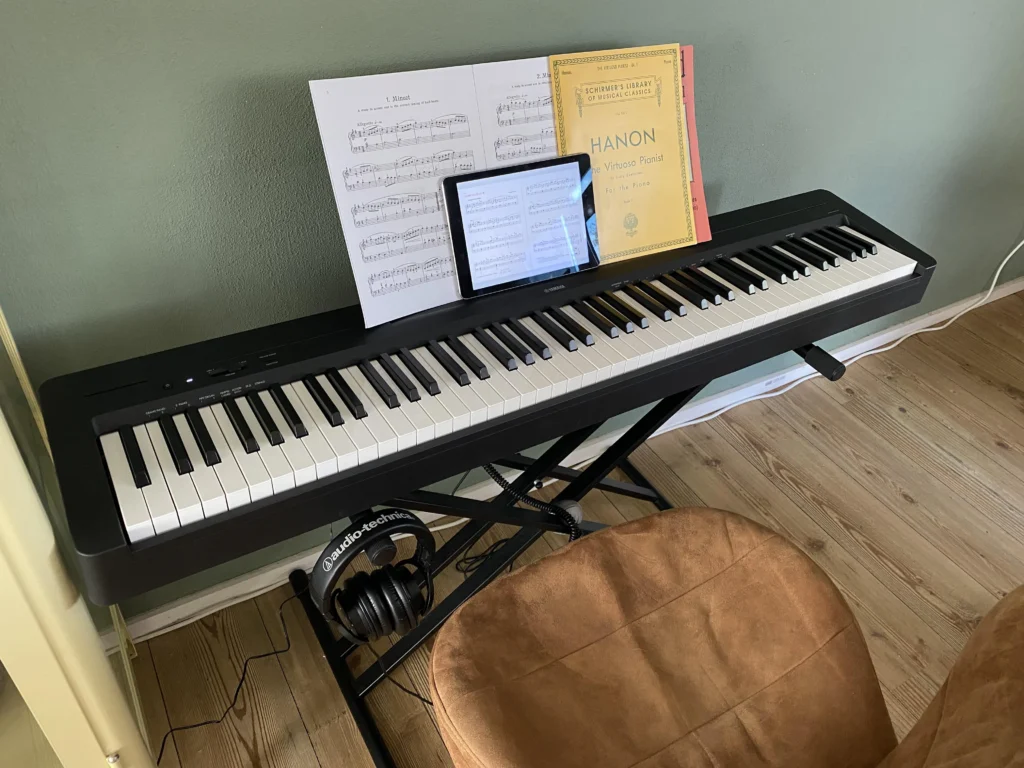
I’m a big fan of this one, in fact, if you’ve read my in-depth review of the Yamaha P-145, then you already know how much I like it. It essentially does everything that a more expensive piano does, without any extra frills. Its action is based on the Graded Hammer Compact system, which gives you a very authentic playing feel, it’s stronger on the left hand side and lighter on the right, just like a proper acoustic piano. And the sound? It’s both clear and has a nice warmness to it, taken from the renowned CFX concert grand.
Relevant Features:
- 88 fully weighted keys (GHC action)
- Yamaha CFX-sampled piano voice
- 24 instrument voices
- USB to Host for app connectivity
- Built-in speakers (7W + 7W)
- Super lightweight at just 24 lbs
If you’re a complete start, I always recommend the Yamaha P-145BT. It’s a no-frills, no-nonsense digital piano that’s about as close to the real thing as you’ll find. Sure, its built-in speakers are just average and it doesn’t have all the extra features, but for a new player, that’s probably a good thing, less can be more. If you team it with a good pair of cans (headphones) and a half-decent stand, you’re all sorted. This will last you a couple of years.
2. Roland FP-10 – Best Budget Piano for Beginners
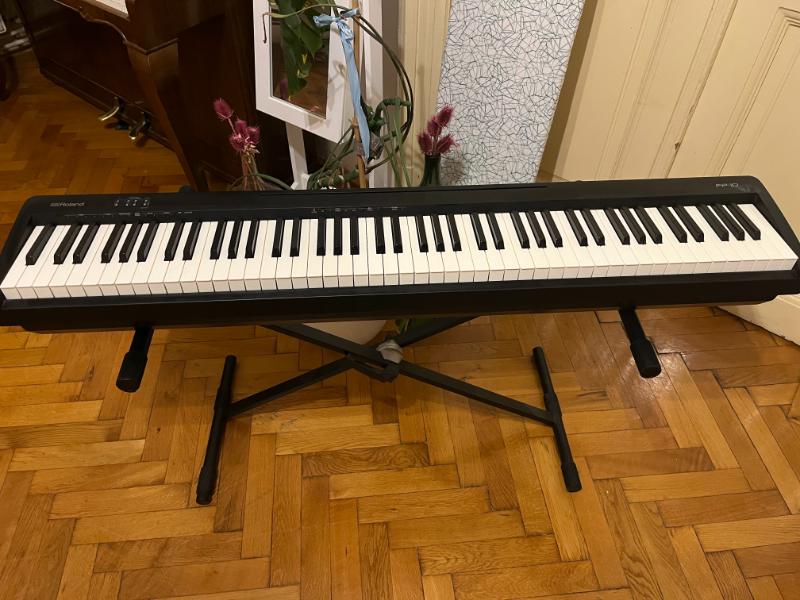
If you’re looking for a good reason to get the FP-10, here it is: it’s basically like buying the more pricey FP-30X, which is $200 more, but with some features taken out. Essentially, you’ll get the same Roland key feel, which is what really matters, at a much lower cost. Of course, you’ll have fewer built-in sounds and there will be no wireless audio and less to the speaker system. However, if all you really care about is how the keys feel when you press them, then this is still a great option. Plus, it has Roland’s “SuperNATURAL” sound, which produces a natural and expressive piano sound. It also happens to do well with variations in how hard or softly you hit the keys.
Relevant Features:
- 88 keys with PHA-4 Standard action
- Roland SuperNATURAL sound engine
- 15 tones
- 96-note polyphony
- Bluetooth MIDI (via Roland Piano Partner app)
- USB to Host
- Built-in speakers (6W + 6W)
If you’re a total newby to playing the piano or a parent looking to buy one for your kid, this keyboard is an awesome option. Plus, if you’re on a tight budget then this is a very good pick. Although, you’ll have to make some trade-offs. For example, it doesn’t have many features, with just 15 different sounds, and it doesn’t have the ability to connect to your phone via Bluetooth. Also, the built-in speakers are not that big and there isn’t any 3D sound effect when you use headphones.
3. Kawai ES60 – Best Sounding for Beginners
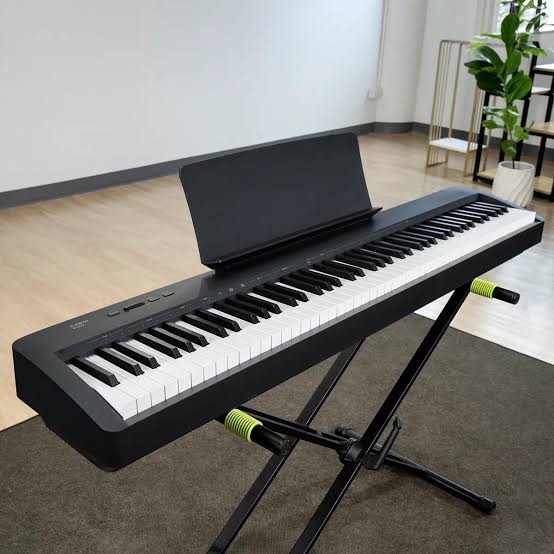
Kawai has now joined the group of pianos under $500. They came out with the ES60 which takes some of the sounds from their top-of-the-line SK-EX. This is a hand made concert grand that is right up there with the best, like Steinway and Bösendorfer in the best performance spaces. For a relatively low price tag of $499, you can have this same sound at home. The action, called the RHL, is on the lighter side, but it still feels great and is very smooth. Plus, it only weighs 24 pounds. So you can pick it up and take it with you in a gig bag.
Relevant Features:
- 88 keys with Responsive Hammer Lite (RHL) action
- Shigeru Kawai SK-EX concert grand piano samples
- Harmonic Imaging sound engine
- 17 instrument voices
- 192-note polyphony (massive for this price)
- Dual and Split playing modes
- 30 built-in drum rhythms
- USB-MIDI for app connectivity
- Dedicated stereo line outputs
- Built-in speakers (10W + 10W)
If you’re a new player who wants the best possible sound from your piano, then this is the one for you. It’s also a good choice if you’re on a tight budget but want a Kawai, which is essentially a high-end brand. However, there are a couple of things that are not so great about it. First, it doesn’t have the option of connecting with Bluetooth, so you’ll have to use a cord to connect to any music or app. Also, the type of action (the mechanical part of the keys) in this one isn’t as even and responsive as some other Kawai models. On top of that, there is no way to record sounds directly from the piano. In my opinion, if what really matters to you is how the piano sounds, then the ES60 is the best you can get right now and is worth considering.
Best Digital Pianos under $2000 (Best for Intermediate)
So by now, you must have a bit of experience with playing. You probably even started with a beginner’s keyboard and it has its own set of problems. The keys are not very sensitive and the sound just doesn’t have the same depth as you’d like. It’s probably time to look for a better option.
1. Roland FP-30X – Best for Skill Development
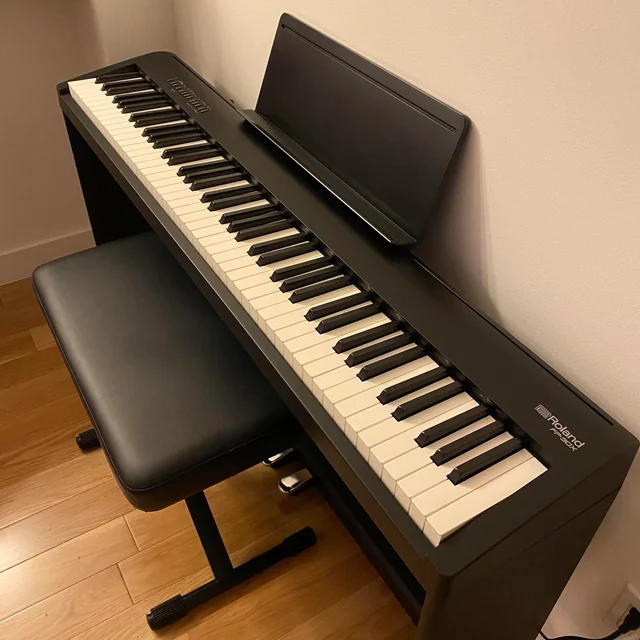
I highly recommend the FP-30X, it’s a great choice for someone who is going to stick with the piano. It’s priced at around $695, which is on the cusp of the beginner and intermediate levels. For that price, you get a much better playing experience than the cheap alternatives. The PHA-4 Standard key action with a proper escapement and Ivory Feel keytops is essentially like the real thing, you get a slight click when you press the keys because of the way it’s designed. Essentially, it imitates what goes on inside an actual grand piano. Plus, it has all the latest tech: you can play along with your favorite songs that are coming through the piano’s own speakers via Bluetooth. And with no cables needed, you can connect to apps like Simply Piano or Flowkey. This is basically where we’re headed with our pianos now, and it’s really cool.
Relevant Features:
- 88 keys with PHA-4 Standard action (escapement + Ivory Feel)
- Roland SuperNATURAL sound engine
- Bluetooth MIDI + Bluetooth audio
- 256-note polyphony
- 56 instrument voices
- Built-in recorder and metronome
- Headphone 3D ambience
If you’re looking for a piano that will last you for several years before you need to get a new one, then this one is a great choice. It’s especially good for people who are already familiar with playing the piano. However, at around $695 to $700, it’s a bit more expensive than the very basic models. Also, it’s a bit on the heavy side, which might be a problem if you like to move your piano around. I think that if you can afford to spend more than $500 on a piano, then this one is well worth the extra cost. It has a really nice feel for its price and the fact that it has Bluetooth is a big plus, it makes practicing more enjoyable.
2. Casio Privia PX-S1100 – Best Slim & Stylish
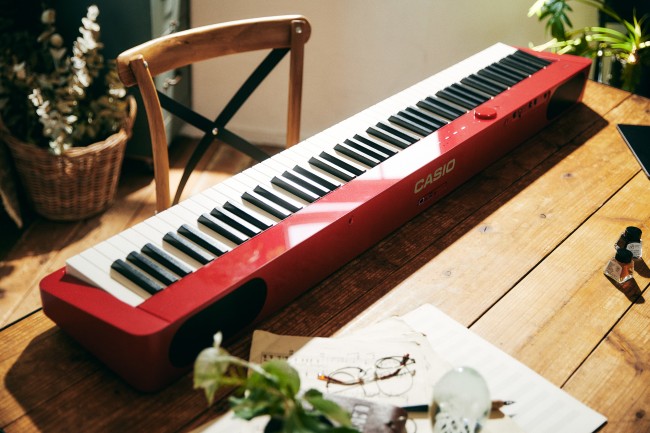
I really like this one, in fact, I already mentioned it in my article about beginner pianos. It’s essentially a super-skinny digital piano, but what’s even more impressive is its keyboard. It has this feature called Smart Scaled Hammer Action which gives you a very natural playing experience. You might expect from a full size piano, not from a tiny one like this. The sound of the piano comes from Casio’s special sound technology that can change and shape itself. And to be honest, it’s a great sound. It has a nice and clear high part and a nice and warm low part, and it can also play fairly loudly and quietly. Also, it can connect with other devices using Bluetooth, which is great if you want to play along with the song you like.
Relevant Features:
- 88 fully weighted keys (Smart Scaled Hammer Action)
- Multi-Dimensional Morphing AiR sound engine
- 18 voices
- 192-note polyphony
- Bluetooth audio
- USB-MIDI
- Available in black, white, or red
- Incredibly slim and light (25 lbs)
If you live in an apartment, are into the latest fashions, or just want a piano that won’t over power its surroundings then this one is perfect for you. A couple of things to note: it takes a little time to get used to controlling the sound with the sensors rather than actual buttons. You’ll probably end up changing the settings when you’re cleaning the keyboard. Also, while the keys feel pretty good, they’re not quite on the same level as those from Roland or Kawai which cost the same as this one. My view is that if you have a small space or if how your piano looks really matters (and I’m guilty as charged), then the PX-S1100 is a great option. It shows that a piano can be both lovely and practical.
3. Kawai ES920 – Best Portable Piano for Intermediate Level
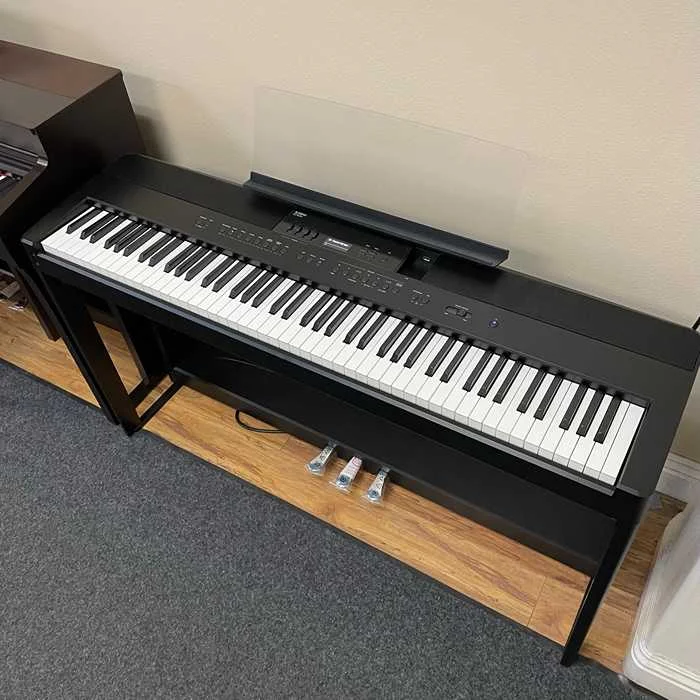
I think Kawai is a brand that sort of flies under the radar for new players, but they’re basically the top choice in the middle and upper levels. The ES920 has Kawai’s best hammer action, which is called the Responsive Hammer III. It has 88 keys, and it’s got three ways of detecting how you play them, and it also has something called “counterweights” and a “let-off” setting. All this makes it feel amazing. Kawai took the sound from their top-of-the-line concert piano, which is the SK-EX, and used it in the ES920. What comes out is a very full and very good at expressing all the emotions you put into it.
Relevant Features:
- 88 keys with RH III action (triple sensor, counterweights, let-off)
- Harmonic Imaging XL sound engine (SK-EX samples)
- 256-note polyphony
- Bluetooth MIDI + audio
- 38 instrument voices
- Line out, USB, MIDI
- Onboard recorder
- Powerful speakers (20W + 20W)
If you’re an experienced player who wants a high-end keyboard at a small size and weight, then this is worth looking at. It’s also a good choice if you perform and need something from which you can get a very good sound and feel. On the other hand, it will cost about $1,950, and because it isn’t a Yamaha or a Roland, it might be hard to find a place to try one out before you buy. For 95 I think it would be a good idea. When I first played it, I was really impressed, the way it plays and its overall sound are both first class.
4. Casio PX-S3100 – Most Versatile Choice
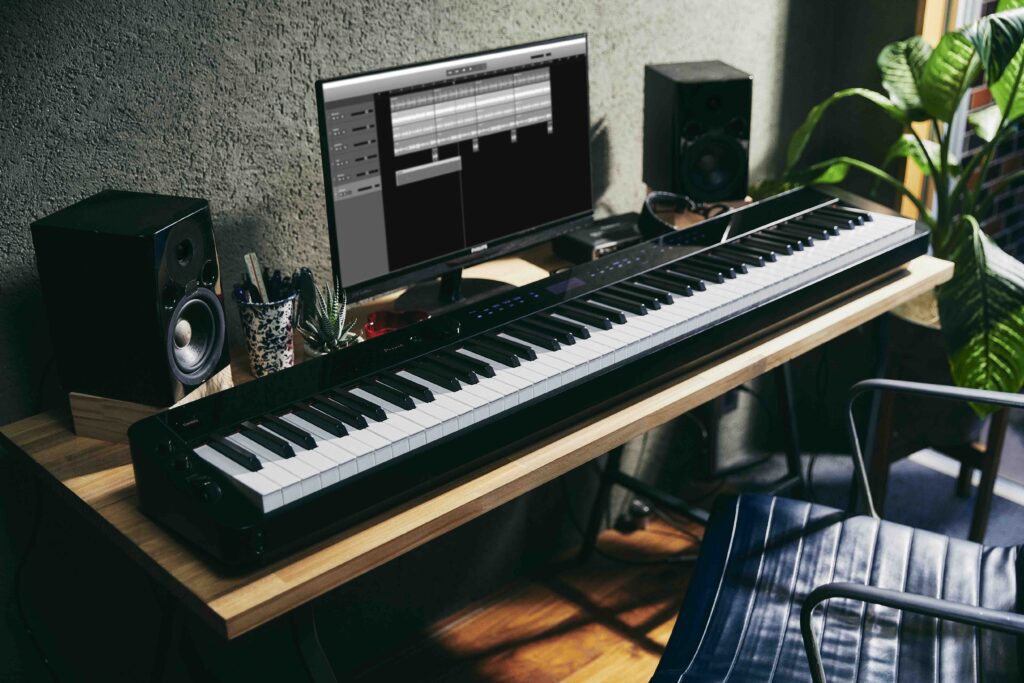
I Really Love This Keyboard, the PX-S3100 is essentially the same size and has the same feel as the more basic PX-S1100, but with a lot more going on. It gives you over 700 different sounds and 200 various rhythms, and you also get a pitch bender and two knobs for adjusting the sound in real time. Essentially, it’s like having a multi-instrument in one. And the best part? It’s still only around 24 pounds! It’s essentially a portable workhorse.
Relevant Features:
- 88 fully weighted keys (Smart Scaled Hammer Action)
- 700+ tones (including synths, organs, strings, and more)
- 200 built-in rhythms with auto-accompaniment
- Pitch bend wheel and 2 assignable knobs
- Bluetooth MIDI + audio
- Mic input with vocal effects
- USB audio recording
- Battery operation option
If you’re a musician who plays live or makes your own music, or if you’re a producer, then this thing is perfect for you. It’s not that it doesn’t have its downsides, some people who are super into playing the actual piano might say that it doesn’t have the same level of quality as some other pianos on the market, especially from brands like Kawai or Roland. They’re also saying that with over 700 different sounds available, using it can be a bit confusing at first. My two cents: I don’t think of this as just a digital piano. I see it as a very useful tool that can help you create all sorts of new and interesting sounds. If all you play is classical piano, then you don’t need anything like this.
Best Console Digital Pianos
If you have a piano that will stay in the same place in your house then a console is usually the way to go. It has proper legs and a full set of three pedals and its speakers are a lot better than those on a smaller, portable one. And it will give you a much more like playing on a real acoustic piano. Yes, they do cost more but essentially you’re paying for a more authentic sound and feel.
1. Kawai KDP120 – Best Budget Choice in Console Pianos
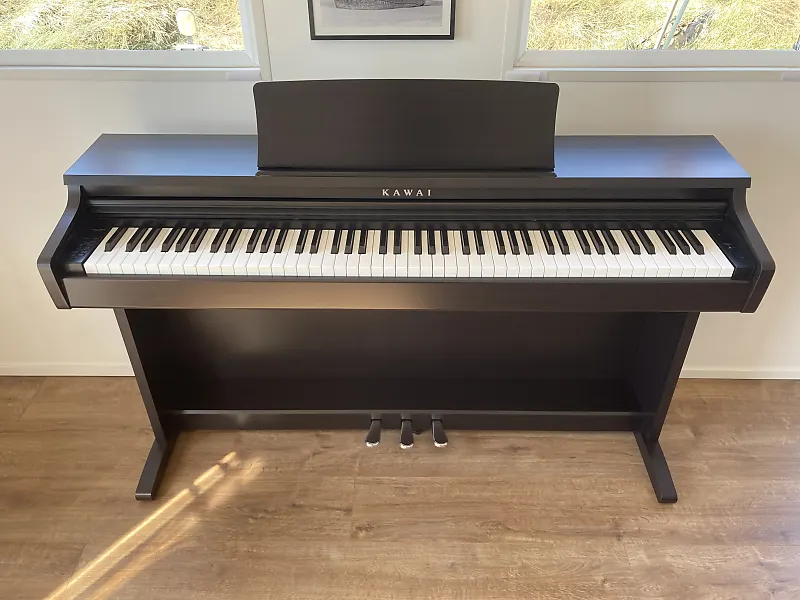
If you’re after a “real” feel from your piano without the hefty price tag that comes with most home models, then the KDP 120 is the way to go. For under $2000, Kawai has included their Responsive Hammer Compact II action, which may not be as flash as what you get in the ES 920, but still delivers a very enjoyable and life-like playing experience. You’ll also get a more full sound from the two 20W speakers and Kawai’s Harmonic Imaging technology, which offers 15 different sounds. And as a bonus, some versions of the KDP 120 come with a matching stool.
Relevant Features:
- 88 keys with RH Compact II action
- Harmonic Imaging sound engine
- 15 instrument voices
- 192-note polyphony
- Built-in 3-pedal unit
- Elegant furniture cabinet
- Headphone jacks x 2
- USB to Host
This is a great choice for new and not-so-experienced people who want to play a console piano at home but can’t afford the higher-end prices. It does have some downsides, though, for example, it can’t be connected via Bluetooth and it doesn’t have all the extra features like a built-in recorder, the ability to play two different songs at once, or more. Also, the sound isn’t as detailed as the more expensive CLP-835 or CN301 models. All in all, I think this piano is a good option for anyone who has a small budget and is looking for something that will still look nice in their main living area.
2. Yamaha CLP-835 – Best Intermediate Console Piano
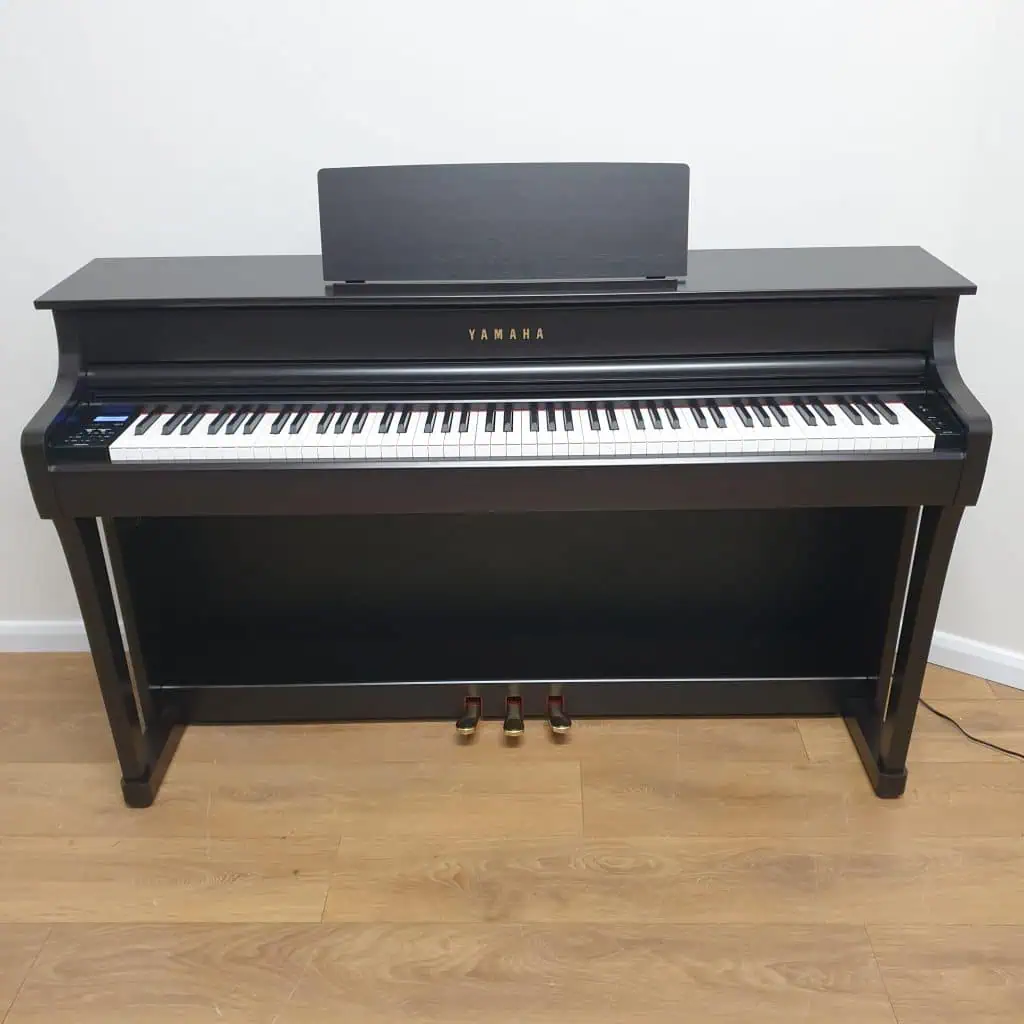
The CLP-835 is what makes the Yamaha Clavinova series truly shine. And honestly, once you hear it, you’ll see why. It comes with the same type of keys as a real grand, long and made of wood. They move and feel almost exactly like the ones on a real grand. Plus, you get to play with two of the world’s most famous piano sounds, the CFX and the Bösendorfer Imperial, which have been perfectly and very accurately recorded. What really puts the CLP-835 ahead of the game, though, is its secret sauce: it uses Virtual Resonance Modeling. This makes it sound like a real piano by showing how the inside of a piano actually works when you play two different notes at the same time. You hear the extra sounds and the way they vibrate and this is because of how the VRM works. It also does something called Grand Expression Modeling. This is where it takes into account not just how hard you hit the key, but also how you let go of it and how you move from one note to another. It may be a small difference but it makes all the difference and when you experience it, you’ll be like “wow, this is awesome, it really feels like a real piano!”
Relevant Features:
- 88 keys with GrandTouch-S action (wooden keys)
- Yamaha CFX and Bösendorfer Imperial voices
- Grand Expression Modeling + VRM
- 38 instrument voices
- 256-note polyphony
- Bluetooth MIDI + audio
- Smart Pianist app compatible
- Powerful 2-way speaker system (30W + 30W)
- 3-pedal unit with half-pedal support
If you’re a serious student, or an experienced player, or just someone who really wants to have a genuine, full piano experience without all the hassle and expense of owning a real one, then the CLP- 835 could be what you’re after. At around $3,200 to $3,500, which is a lot of cash, and it’s also pretty heavy, you won’t be moving it from room to room on your own! In my opinion, if you’re into playing the piano and are looking for something for your home that will always get you excited and make you feel like playing, then the CLP-835 is when the Clavinova really comes alive. It gives you nearly all the features of the more expensive CLP-885, but at a much more manageable price. Honestly, playing the CLP-835 makes me forget that it’s not a real, acoustic piano.
3. Yamaha CLP-885 – Best High End Console
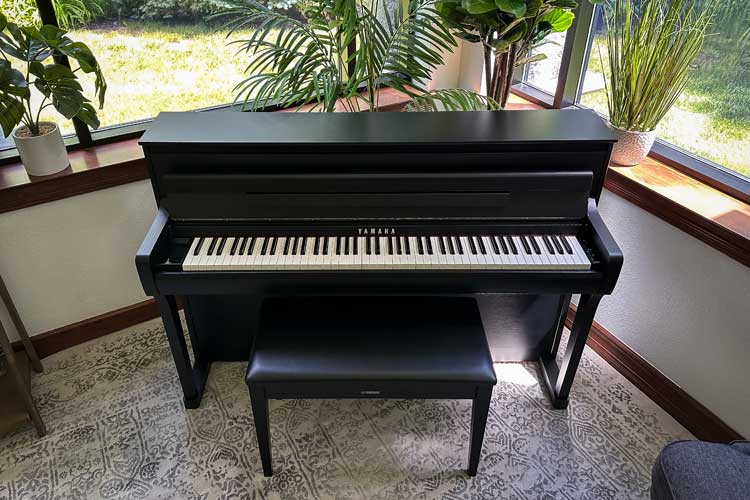
If you’ve got the money, the CLP-885 is basically the next best thing to a real piano. Let’s be honest, it’s pricey. However, if you can afford it, it’s as close to the real thing as you can get in a digital piano in 2026. The GrandTouch keyboard has the works: wooden keys with their own individual counterweights and proper escapement, just like on a proper grand. And underneath each key are three sensors that pick up on all the subtleties of how you play. It actually feels like you’re sitting at a Yamaha grand, no joke. The speaker system is seriously powerful: there are six speakers, some special diffusers, and two-way horns, and the cabinet is designed to send the sound both out in front of you and behind you. It fills the room like a real piano would. You also get a range of top-notch sounds, including the fantastic CFX and Bösendorfer Imperial, which have been recorded in 3D so they sound super realistic. There are also a bunch of other historical pianos and smaller, older-style pianos that will delight any serious classically-trained player. Oh, and I almost forgot to mention the nice touches like the soft-close piano lid and the small, pop-up screen that hides away when you don’t need it. And, of course, it’s compatible with Yamaha’s Smart Pianist app, which has all sorts of useful things like sheet music and online lessons.
Relevant Features:
- 88 keys with GrandTouch action (wooden keys, counterweights, 3 sensors)
- CFX + Bösendorfer Imperial binaural voices
- Grand Expression Modeling + VRM
- 53 voices + 480 XG voices + 14 drum kits
- 256-note polyphony
- 6-speaker system with diffusers (300W total)
- Bluetooth MIDI + audio
- GP Response Damper pedal system
- Hidden touch LCD display
- Soft-close fallboard
- Built-in lesson library (Hanon, Czerny, Burgmüller)
If you’re a serious piano player, a music teacher, or just someone who wants the ultimate in digital pianos, and you’re willing to spend top dollar, then this is the one for you. It comes with a big price tag, expect to pay over $5,000, depending on which finish you go for. It’s also very heavy, around 168 pounds, which means it’s not going anywhere once it’s set up. In my opinion, if you have the budget for it and want a digital piano that feels like the real thing, then this is your best bet. I’ve played some high-end acoustic pianos and this one is right up there with them. Yamaha is essentially saying that it’s a challenge, see if you can tell it apart from the real thing. If you really want the crème de la crème, then this is it. Otherwise, you might be better off with the CLP-835.
4. Roland FP-90X – Best Portable Premium
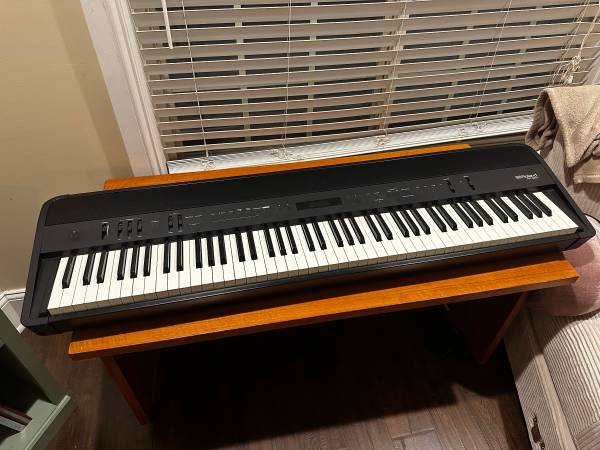
The FP-90X doesn’t cut back on anything. You get a full size, a proper key feel with Roland’s PHA-50 hybrid action which uses both real and man-made parts. It’s high-end without being too much to handle. And its sound comes from Roland’s PureAcoustic Piano Modeling. This isn’t based on recorded samples, but actually calculates what each part of the piano does when you play it. So the sound is very natural and can be played with a lot of feeling.
Relevant Features:
- 88 keys with PHA-50 hybrid action (wood + molded)
- PureAcoustic Piano Modeling sound engine
- 362 voices
- 256-note polyphony
- Bluetooth MIDI + audio
- Powerful 4-speaker system (60W total)
- Mic input with effects
- USB audio recording
- Headphone 3D ambience
If you’re a serious player, you’ll love this keyboard. It has all the features you’d expect from a high-end piano in a more compact package. It’s ideal for recording and live performances. However, it does come with a high price tag, around $2,300. Also, at about 51 pounds, it’s on the heavier side for its size. You’ll want to use a good keyboard stand because it looks out of place when just sat on an x-stand. In my opinion, if you want the best of both worlds, portability and top-notch sound and playability, then the FP-90X is your best bet. I’ve tried other portables and none of them have compared to this one. When I played it, I actually forgot I wasn’t at a full-sized piano.
How Do These Digital Piano Brands Compare To Each Other?
I get asked all the time: which brand makes the best keyboard? Honestly, I reckon every one of them is good, but in different ways. So here’s a quick run down:
Yamaha, if you’re not sure which one to choose, go for a Yamaha. They essentially make acoustic pianos and their Clavinova range is what others aim for when it comes to home digital pianos. They’ve got a great reputation and you can’t go wrong with them.
Roland, they don’t actually make acoustic pianos. What they do is use a type of computer program called modelling to make their sounds, which essentially copies how a real piano works in real time. This means they have very natural and very good action on the keys. And at more affordable prices, their keys are especially nice. Plus, their connection to other devices with Bluetooth is the best around.
Kawai, if you’re a serious pianist, this is the brand you should be looking at. They’ve been making acoustic pianos since 1927 and this experience shows in their digital versions. In their class, Kawai’s keys feel and play like a real piano. If having that authentic feel is what matters most, then Kawai might just be the one for you.
Casio, people often overlook them because of their cheap calculators, but their Privia range is where it’s at. You get a very compact and light design with good, and I mean really good, sound and feel. If you’re short on space or on a tight budget, give Casio a go.
What To Look For When Buying A Digital Piano
So here’s what you really need to pay attention to when looking at all those complicated sounding features: To start with, it all comes down to one thing: you must have a keyboard that has fully weighted, not just sorta weighted, keys. If you want to develop good playing skills and then move on to an actual acoustic piano, then this is a must. We explain more about why in our article on the difference between digital and acoustic pianos.
There are two ways to make a digital piano sound like a real one: by recording and playing back the actual sounds of a piano (this is what Yamaha and Kawai do) or by using a computer program to imitate how a piano works (Roland is the main one to do this). The best ones are a mix of both.
How many different notes can the piano play at any one time? It can’t just be 88 because things like the sustain pedal, layering and reverb use up some of those. Go for at least 128. Better still, aim for 256.
Your piano will have tiny speakers because it is a portable one, or it will have bigger and better speakers if it is a console. If you’re just going to be playing at home and you want to hear your piano sound as it should, then the latter is a big plus. If your piano is portable, then good quality headphones will help you pick up on the details that the built-in speakers can’t handle.
In terms of hooking up to other stuff, you at least need a connection to your computer. Being able to connect to music and recording programs without a wire using Bluetooth is also very handy. And being able to stream music through the piano itself is a nice extra.
Lastly, most digital pianos come with one sustain pedal, but a three-pedal unit which includes a sostenuto (or “half”) pedal is more suitable for playing classical music. Console pianos have this as standard but you usually have to buy it separately if you get a portable one.
How I Arrived To These Picks
Here’s where I’m coming from, I didn’t just copy info off the manufacturer’s sheet and paste it here. I actually went and played each of these pianos myself.
First, I check out how the keys feel. I use the same songs on every one to see how wide its range is, some jazz chords to test if it responds right, and basic scales to make sure it’s consistent. I also make sure the sound is good coming out of both speakers and through headphones. Some pianos sound fantastic with speakers but sound strange when you listen on headphones, and vice versa.
Then I look at how well made the thing is. Will it last more than 5 years or does it fall apart when you hit the keys really hard?
And finally, I think about whether it can be used in real life. Can you set it up by yourself or do you need instructions? Can you easily switch between the different sounds it has without a long and complicated menu system? Is the input for the sustain pedal solid?
Lastly, I consider whether it’s worth the price. Is there another, cheaper option that can do about the same things?
We are a participant in the Amazon Services LLC Associates Program, an affiliate advertising program designed to provide a means for us to earn fees by linking to Amazon.com and affiliated sites.