
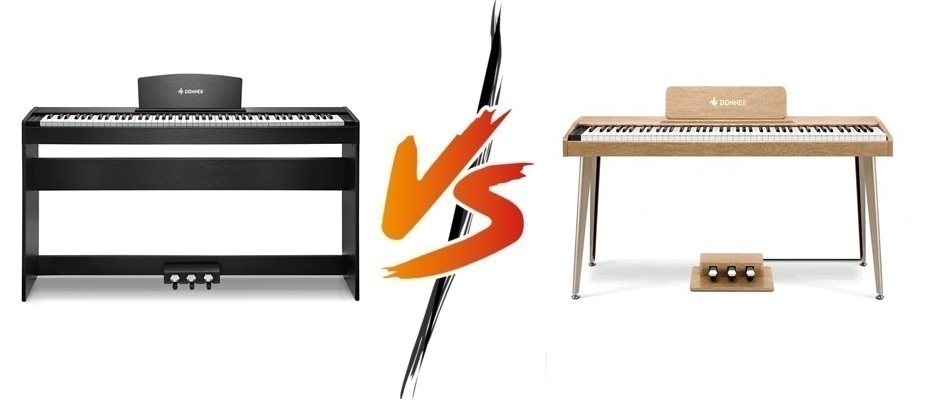
When two digital pianos come from the same manufacturer and target a similar audience, choosing between them can be surprisingly difficult. That’s exactly the situation with the Donner DDP-50 and Donner DDP-60.
At first glance, both instruments seem to occupy a similar space in Donner’s lineup. They are furniture-style digital pianos designed for home use, both feature 88 keys, integrated pedals, and an attractive cabinet that looks more like a real piano than a portable keyboard. However, once you start digging into the details, the differences become significant.
The biggest distinction is simple: the DDP-50 focuses on delivering a more authentic piano-playing experience through a fully weighted hammer-action keyboard, while the DDP-60 focuses on versatility, affordability, and beginner-friendly features through a semi-weighted action.
After spending time examining the specifications, user feedback, and overall positioning of both instruments, I believe these two pianos are aimed at slightly different buyers. One is trying to be a serious piano-learning tool, while the other is trying to be an attractive and affordable all-rounder.
This review will take a detailed look at every important category: design, keyboard action, sound quality, speakers, features, connectivity, learning potential, build quality, value for money, and long-term ownership.
Donner DDP-50 vs Donner DDP-60 Comparison Chart
If you click the links below, under the product images, you will be redirected to Amazon.com. In case you then decide to buy anything, Amazon.com will pay me a commission. This doesn’t affect the honesty of this review in any way though.
| Specification | Donner DDP-50 | Donner DDP-60 |
|---|---|---|
 |  | |
| Check the best price on Amazon | Check the best price on Amazon | |
| Piano Type | Furniture-style digital piano | Furniture-style digital piano |
| Keys | 88 keys | 88 keys |
| Key Action | Fully weighted hammer action | Semi-weighted action |
| Touch Sensitivity | Yes | Yes |
| Polyphony | 256 notes | 128 notes |
| Built-in Sounds | 375 voices | 128 voices |
| Built-in Rhythms | 100 rhythms | 83 rhythms |
| Demo Songs | Yes | 47 demo songs |
| Speaker System | Integrated stereo speaker system | 2 × 15W speakers (30W total) |
| Pedals | Triple-pedal unit (Soft, Sustain, Sostenuto) | Triple-pedal unit (Soft, Sustain, Sostenuto) |
| Recording Function | Yes | Yes |
| Metronome | Yes | Yes |
| Split Mode | Yes | Yes |
| Dual/Layer Mode | Yes | Yes |
| Duo Mode | Yes | Yes |
| Reverb Effects | Yes | Yes |
| Learning Features | Built-in learning functions and app support | Basic learning functions |
| USB Connectivity | USB-MIDI | USB-MIDI |
| Headphone Outputs | Yes | Yes |
| AUX Input | Yes | Not specified |
| AUX Output | Yes | Yes |
| MIDI Support | USB-MIDI | USB-MIDI |
| Bluetooth | No | No |
| Cabinet Style | Traditional upright-style cabinet | Modern minimalist furniture-style cabinet |
| Target User | Serious beginners, intermediate players, piano students | Beginners, hobbyists, casual home players |
| Main Strength | Realistic piano feel and long-term growth potential | Excellent value and attractive modern design |
| My individual reviews | Donner DDP-50 review | Donner DDP-60 review |
Key Differences at a Glance
| Category | Winner |
|---|---|
| Keyboard Realism | DDP-50 |
| Sound Engine | DDP-50 |
| Polyphony | DDP-50 |
| Number of Voices | DDP-50 |
| Learning Features | DDP-50 |
| Speaker Power | DDP-60 |
| Modern Design | DDP-60 |
| Ease of Use for Beginners | DDP-60 |
| Long-Term Piano Development | DDP-50 |
| Value for Casual Players | DDP-60 |
| Overall Piano Experience | DDP-50 |
Bottom Line
| If You Want… | Recommended Model |
|---|---|
| The most realistic piano-playing experience | Donner DDP-50 |
| A fully weighted keyboard | Donner DDP-50 |
| A digital piano for serious piano lessons | Donner DDP-50 |
| Better long-term value as your skills improve | Donner DDP-50 |
| The lowest price | Donner DDP-60 |
| A stylish modern furniture piano | Donner DDP-60 |
| A beginner-friendly instrument for casual playing | Donner DDP-60 |
| The best balance of affordability and features | Donner DDP-60 |
In short, the DDP-50 is the stronger choice for aspiring pianists and students, while the DDP-60 offers exceptional value for beginners and casual home users who prioritize affordability and aesthetics.
Design & Build Quality
When comparing the Donner DDP-50 and Donner DDP-60, the design and build quality of each instrument play a much bigger role than many buyers initially realize. While sound quality and keyboard action often dominate discussions about digital pianos, the way an instrument looks, feels, and integrates into a living space can have a major impact on long-term satisfaction. After all, these are furniture-style digital pianos designed to live in your home for years, not portable keyboards that spend most of their time packed away in a case.
At first glance, both models succeed in presenting a much more premium appearance than their price tags would suggest. Donner has clearly invested considerable effort into creating instruments that blend functionality with attractive furniture-inspired aesthetics. However, despite sharing the same general category, the DDP-50 and DDP-60 take noticeably different approaches to design, and those differences reveal a lot about the type of player each piano is intended for.
Donner DDP-50 Design Philosophy
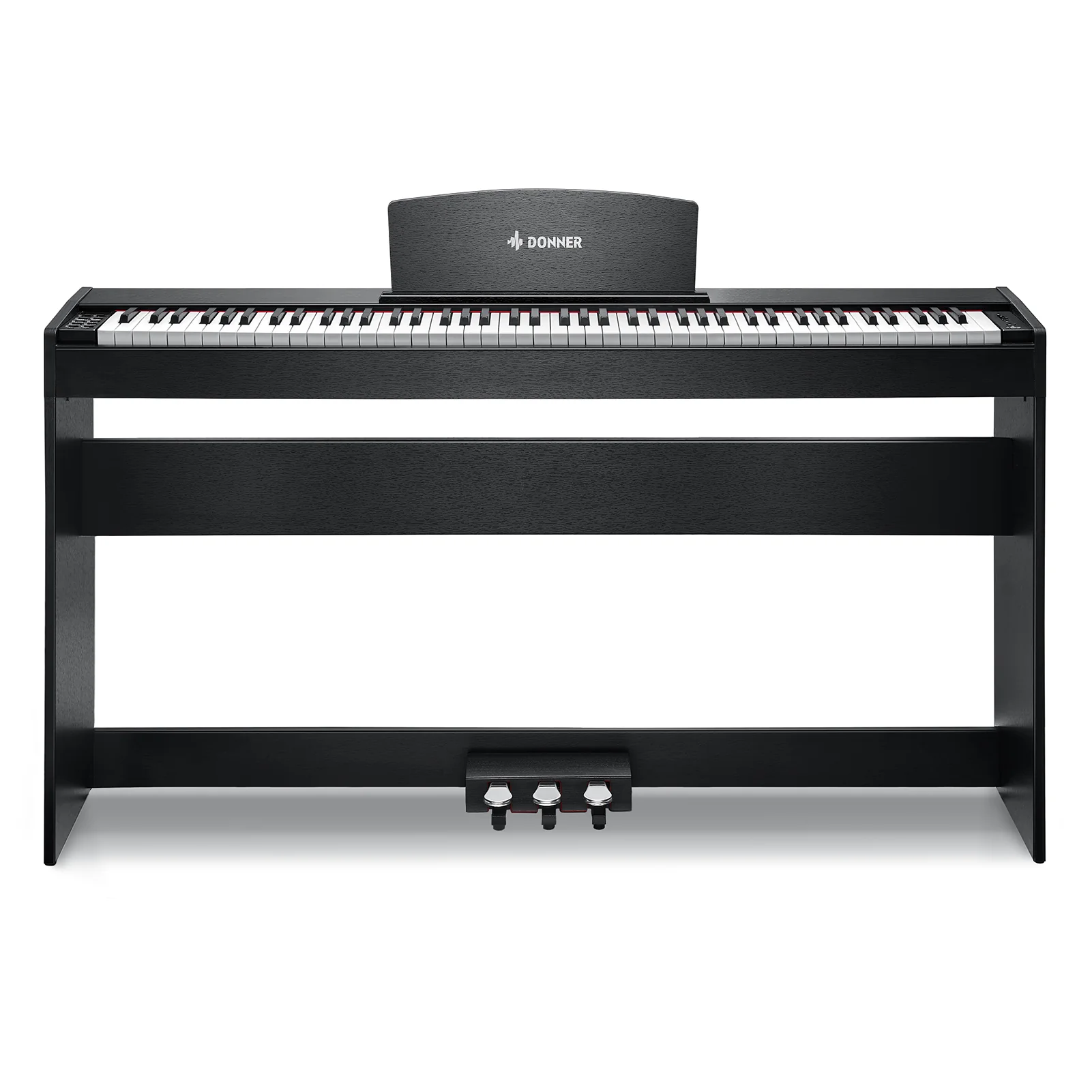
The DDP-50 embraces a more traditional digital piano design. It is built to resemble an upright piano rather than a modern piece of minimalist furniture. From the moment you see it, the instrument communicates a sense of seriousness. The cabinet is substantial, the proportions feel balanced, and the overall appearance suggests that this is a piano intended primarily for learning and performance rather than decorative purposes.
One of the DDP-50’s greatest strengths is that it avoids looking like a keyboard mounted on a stand. This may sound like a minor detail, but it has a significant effect on the ownership experience. Many budget digital pianos struggle to create a convincing furniture-piano appearance, often looking like portable keyboards that have simply been attached to wooden side panels. The DDP-50 does a much better job of presenting itself as a complete instrument.
The integrated stand and pedal assembly contribute heavily to this impression. Everything feels unified rather than modular. There are no awkward visual gaps or obvious compromises that remind you this is essentially a digital instrument. Instead, the design creates a sense of permanence, similar to what you would expect from an acoustic upright piano.
For players who grew up practicing on traditional pianos, this familiar appearance can be surprisingly important. Sitting down at an instrument that visually resembles a real piano often creates a stronger connection to the playing experience. It encourages proper posture, focused practice, and a more serious mindset during practice sessions.
Materials and Construction of the DDP-50
Although the DDP-50 is not built from the same materials as a premium acoustic piano, the overall construction feels solid for its price category. The cabinet panels are sturdy enough to avoid noticeable flex during normal use, and the piano generally inspires confidence once assembled.
Furniture-style digital pianos in this price range inevitably rely on engineered wood materials rather than solid hardwood construction. That is perfectly normal and should not be viewed as a negative. The more important question is whether the finished product feels stable, and in the case of the DDP-50, the answer is generally yes.
The piano’s weight also works in its favor. While heavier instruments can be more challenging to assemble and move, they often feel more secure during playing. The DDP-50 remains stable even during energetic performances, which contributes to the overall perception of quality.
Another positive aspect is the integration of the three-pedal unit. Some budget digital pianos treat pedals almost as an afterthought, but the DDP-50’s pedal assembly feels like a natural extension of the cabinet. This improves both appearance and usability.
Donner DDP-60 Design Philosophy
If the DDP-50 aims for traditional elegance, the DDP-60 takes a decidedly more modern route.
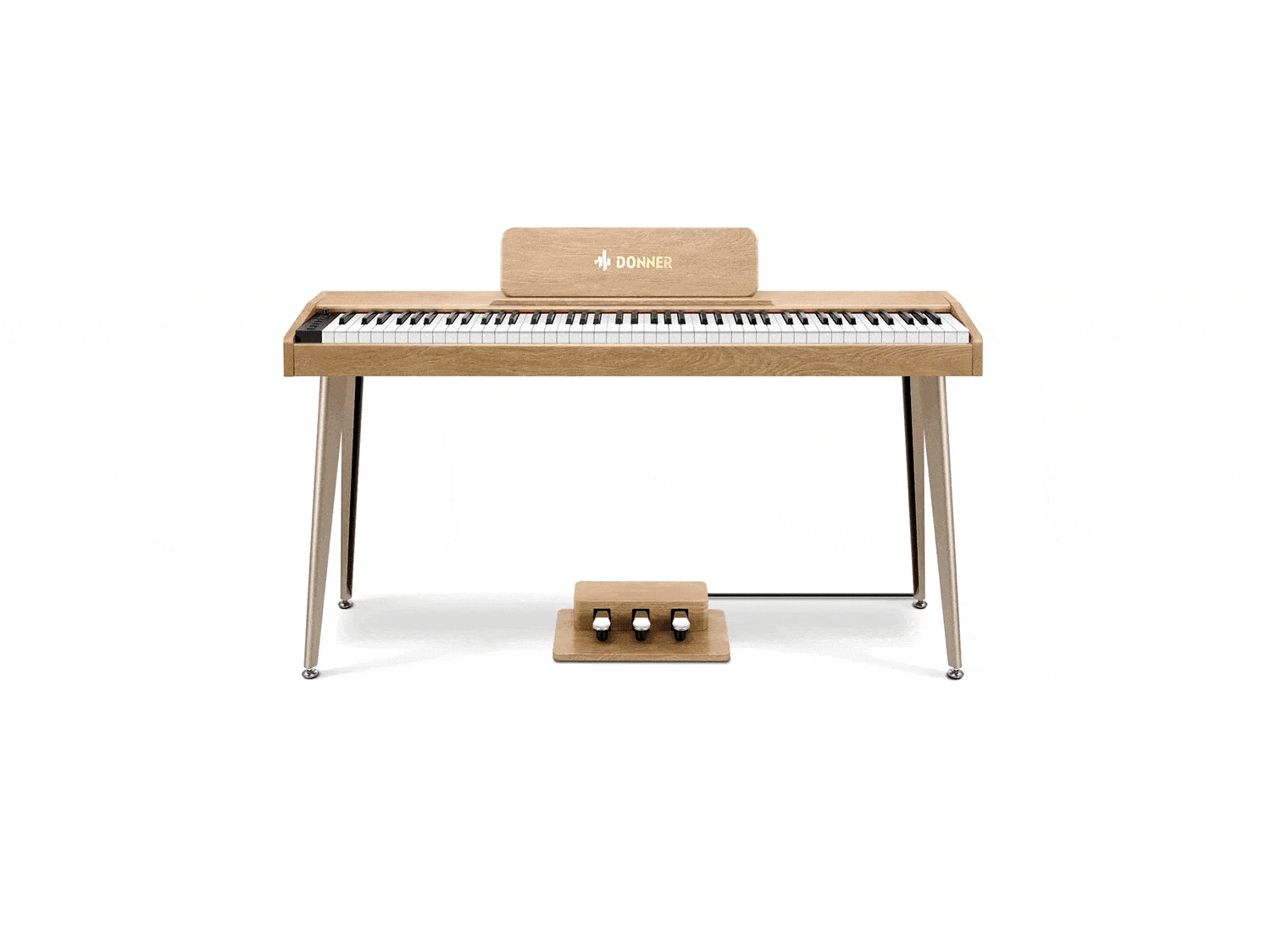
The first thing most people notice about the DDP-60 is its striking visual design. Donner clearly prioritized aesthetics when developing this model, and the result is one of the most visually distinctive instruments in its category. The clean lines, minimalist structure, and contemporary wood finish allow the piano to blend naturally into modern interiors.
Many furniture-style digital pianos attempt to imitate acoustic uprights. The DDP-60 does not. Instead, it embraces the fact that it is a modern digital instrument. This confidence gives the piano a unique identity and helps it stand out from countless competitors that follow more traditional design conventions.
The minimalist approach makes the DDP-60 particularly appealing to apartment dwellers and homeowners who are conscious of interior design. Rather than dominating a room, the instrument complements its surroundings. It can function almost as a decorative furniture piece when not being played.
This design philosophy broadens the piano’s appeal beyond dedicated musicians. Someone looking for an attractive instrument for occasional playing may find the DDP-60 far more appealing than a conventional upright-style digital piano.
Materials and Construction of the DDP-60
The DDP-60’s construction is generally impressive considering its affordability. The cabinet feels well assembled, and the overall fit and finish are better than many buyers expect from a budget-oriented digital piano.
That said, there are some differences compared to the DDP-50.
The lighter and more minimalist cabinet contributes to a somewhat less substantial feel. This is not necessarily a flaw, but it does affect perception. The DDP-50 feels like a dedicated piano first and a furniture piece second. The DDP-60 sometimes feels like a stylish furniture piece that also happens to be a piano.
In practical use, this distinction may not matter to many buyers. The DDP-60 remains stable enough for normal playing and does not feel fragile. However, when the two instruments are placed side by side, the DDP-50 projects a slightly stronger sense of robustness.
Assembly quality is generally good on both models. Most owners report straightforward assembly processes, and neither instrument appears prone to major structural issues when properly assembled. As with most furniture-style digital pianos, taking extra care during assembly pays dividends in long-term stability.
Everyday Practicality
Design is not only about appearance. It is also about how the instrument functions in everyday life.
The DDP-50’s larger, more traditional cabinet creates a stronger piano-like experience, but it also occupies more visual space. In larger rooms, this is rarely a problem. In smaller apartments, however, it can make the instrument feel more imposing.
The DDP-60’s streamlined design offers a practical advantage in this regard. Its lighter visual footprint allows it to fit comfortably into compact living spaces without overwhelming the room. For urban apartments or multipurpose rooms, this can be a significant benefit.
Cleaning and maintenance are straightforward on both models. The smooth cabinet surfaces are easy to wipe down, and neither piano includes overly complex decorative elements that collect excessive dust.
Which Design Is Better?
The answer depends entirely on what you want from your piano.
The DDP-50 is the better choice for players who value a traditional piano aesthetic. It looks and feels more like a conventional instrument, offers a slightly more substantial build, and creates a stronger sense of permanence. For serious students and dedicated pianists, these qualities are often highly desirable.
The DDP-60, meanwhile, excels in modern environments. Its sleek appearance, minimalist styling, and contemporary character make it one of the most attractive digital pianos available in its price range. It appeals not only to musicians but also to buyers who place significant importance on interior design and home aesthetics.
From a purely objective standpoint, both instruments are well designed and well built for their respective price categories. Neither feels cheaply made, and both exceed expectations in terms of visual appeal.
The real difference lies in personality. The DDP-50 feels like a piano that happens to be attractive furniture. The DDP-60 feels like beautiful furniture that happens to be a piano. Neither approach is inherently better, but understanding that distinction can make the buying decision much easier.
Keyboard and Playing Feel
If there is one category that has the greatest influence on the overall playing experience, it is the keyboard action. While sound quality, features, and connectivity are all important, the keyboard is the part of the instrument you physically interact with every time you sit down to play. It is the bridge between your musical ideas and the sounds coming out of the speakers.
For that reason, keyboard action is often considered the single most important factor when evaluating a digital piano.
This is also the area where the Donner DDP-50 and Donner DDP-60 differ most significantly. Although both instruments feature 88 keys and are designed to serve piano players, they offer fundamentally different playing experiences. The DDP-50 is built around a fully weighted hammer-action keyboard, while the DDP-60 uses a semi-weighted action. That distinction affects everything from beginner learning curves to advanced performance techniques.
For many buyers, understanding these differences may ultimately determine which piano is the better choice.
Understanding Keyboard Action
Before comparing the two instruments directly, it helps to understand what keyboard action actually means.
On an acoustic piano, pressing a key activates a complex mechanical system involving hammers, levers, and strings. The keys offer resistance, and that resistance varies depending on how forcefully you play. The interaction between your fingers and the keybed creates the expressive dynamics that make piano playing unique.
Digital pianos attempt to recreate this experience electronically.
Manufacturers use different types of actions to simulate the feel of an acoustic piano, with the most common being:
- Unweighted keys
- Semi-weighted keys
- Fully weighted hammer-action keys
Unweighted keys are typically found on entry-level keyboards and synthesizers. They are light, fast, and easy to play but provide little resemblance to a real piano.
Semi-weighted keys add some resistance through springs and light weighting mechanisms. They feel more substantial than unweighted keys but still differ noticeably from an acoustic piano.
Fully weighted hammer-action keys are designed to mimic the resistance and movement of real piano keys. These actions usually provide the most authentic playing experience and are preferred by serious students and experienced pianists.
The DDP-50 and DDP-60 sit on opposite sides of this divide.
The DDP-50’s Fully Weighted Hammer Action
The DDP-50 is equipped with a fully weighted hammer-action keyboard, and this immediately positions it as the more piano-focused instrument.
From the first few notes, the difference is apparent. The keys have noticeable resistance and require deliberate finger control. They do not feel heavy in a negative sense, but they encourage proper piano technique in a way that lighter actions simply cannot.
One of the strongest aspects of the DDP-50 is that it creates a sense of connection between the player and the instrument. When you press a key softly, you can feel the subtle movement of the action. When you play with more force, the increased energy feels natural and satisfying.
This matters because piano playing is fundamentally tied to touch sensitivity and dynamic control.
A pianist is constantly shaping phrases through variations in touch. The keyboard must respond accurately to these variations if expressive playing is to feel rewarding.
The DDP-50 generally succeeds in this regard.
Dynamic Control on the DDP-50
A fully weighted action provides greater opportunities for dynamic expression.
When practicing scales, arpeggios, or classical repertoire, players often need precise control over volume and articulation. The DDP-50 allows for more nuanced dynamic gradations than lighter keyboards.
Soft passages feel more controllable.
Loud passages feel more powerful.
Transitions between dynamic levels feel smoother.
These characteristics become increasingly important as a player’s skill level advances.
A beginner may not immediately notice the difference between semi-weighted and fully weighted keys. However, as technique develops, the ability to control tone and dynamics becomes essential. The DDP-50 provides a foundation that supports that growth.
Finger Strength Development
One often-overlooked benefit of a weighted keyboard is finger development.
Acoustic pianos require a certain amount of physical effort to play properly. Developing strength, endurance, and finger independence is part of the learning process.
The DDP-50 encourages this naturally.
Because the keys offer realistic resistance, players gradually build the muscles and coordination needed for advanced piano playing. This translates directly to acoustic instruments, making future transitions much smoother.
Students who practice on weighted keyboards typically experience fewer surprises when sitting down at a real piano.
This alone makes the DDP-50 a compelling option for anyone planning to take lessons seriously.
Long-Term Growth Potential
One of the biggest advantages of the DDP-50 is that it remains relevant as a player’s skills improve.
Many beginners purchase an inexpensive digital piano and later discover that the keyboard action has become a limiting factor. At that point, they often feel forced to upgrade.
The DDP-50 is less likely to create this problem.
While it may not match the sophisticated actions found in premium Yamaha, Roland, Kawai, or Casio instruments costing significantly more, it provides enough realism to support years of development.
A beginner can start learning on the DDP-50 and continue progressing without immediately feeling held back by the keyboard.
That gives the instrument considerable long-term value.
The DDP-60’s Semi-Weighted Action
The DDP-60 takes a different approach.
Instead of prioritizing realism above all else, Donner chose a semi-weighted keyboard that balances ease of play with affordability.
For certain buyers, this decision makes perfect sense.
Semi-weighted keys are generally lighter and require less effort to press. As a result, the keyboard feels approachable and comfortable, particularly for beginners who have never played piano before.
The action responds quickly, and many users find it enjoyable for casual playing.
The lighter touch can also be beneficial for players coming from electronic keyboards, synthesizers, or other non-piano instruments.
Rather than demanding immediate adjustments to technique, the DDP-60 offers a more forgiving experience.
Accessibility for Beginners
One area where the DDP-60 performs well is accessibility.
New players often struggle with finger strength and coordination during their first few months of practice. Fully weighted keyboards can sometimes feel intimidating.
The DDP-60 removes some of that initial resistance.
Because the keys move more easily, beginners may find it simpler to produce sound consistently and focus on learning notes, rhythms, and basic hand coordination.
This can make early practice sessions feel less physically demanding.
For casual hobbyists, that lighter touch may actually increase enjoyment.
Not everyone purchasing a digital piano intends to pursue advanced classical training. Some people simply want an attractive instrument for occasional playing, songwriting, or family entertainment.
For these users, the DDP-60’s action can be perfectly adequate.
Limitations of the Semi-Weighted Design
The strengths of a semi-weighted action also create its limitations.
As players become more experienced, they often begin seeking greater control over dynamics and articulation. This is where the DDP-60 starts to reveal its compromises.
Compared to a fully weighted keyboard, the DDP-60 provides less realistic resistance and less authentic feedback.
Fast passages may feel easy to execute, but expressive control can feel less refined.
The connection between touch and sound is not quite as convincing.
For beginners, this may not matter initially.
For intermediate players, however, it often becomes noticeable.
The more time you spend playing acoustic pianos, the more apparent the differences become.
Transitioning to Acoustic Pianos
This is perhaps the most important practical consideration.
Many students eventually encounter acoustic pianos at lessons, schools, recitals, churches, or performances.
A keyboard that closely mimics acoustic action makes these transitions easier.
The DDP-50 excels in this area.
Players moving from the DDP-50 to an acoustic piano will generally experience a familiar sense of resistance and key movement.
The DDP-60 requires a greater adjustment period.
Its lighter action can make acoustic pianos initially feel heavier and more demanding. While adaptation is certainly possible, the transition is not as seamless.
For anyone with long-term piano ambitions, this factor should not be ignored.
Comfort During Extended Practice
Comfort is another aspect worth considering.
The DDP-60’s lighter action can reduce fatigue during lengthy practice sessions. Some players genuinely prefer this feel, particularly if they play a mixture of piano, pop, and keyboard-oriented music.
The DDP-50, meanwhile, demands slightly more physical effort. However, this effort is largely beneficial because it mirrors the experience of acoustic piano playing.
Most dedicated pianists eventually adapt to weighted actions and come to appreciate the additional control they provide.
Final Verdict on Keyboard and Playing Feel
When comparing the keyboard actions of the Donner DDP-50 and Donner DDP-60, the outcome is fairly clear.
The DDP-60 offers a comfortable, beginner-friendly, and enjoyable playing experience. Its semi-weighted action makes it approachable, easy to play, and well suited for casual musicians who prioritize convenience and affordability.
However, the DDP-50 operates on a different level when it comes to authentic piano performance.
Its fully weighted hammer-action keyboard provides superior realism, stronger dynamic control, better support for proper technique, and significantly greater long-term growth potential. It feels more like a real piano, responds more naturally to expressive playing, and prepares students more effectively for acoustic instruments.
For casual home use, the DDP-60’s keyboard is perfectly serviceable.
For serious piano study, skill development, and realistic playing feel, the DDP-50 is the clear winner.
In fact, if keyboard action is your highest priority, the DDP-50 may justify its higher price on this factor alone. The keyboard is the heart of any digital piano, and in this particular comparison, the DDP-50 possesses the stronger heart.
Sound Quality
Sound quality is one of the most important factors when choosing a digital piano, and it is often the category that buyers focus on first. After all, no matter how attractive a piano looks or how many features it offers, the experience ultimately comes down to what you hear when you press a key.
That said, evaluating sound quality is not always straightforward. Unlike keyboard action, which can often be judged immediately through physical interaction, sound is highly subjective. Some players prefer bright and clear piano tones, while others gravitate toward warmer and more mellow sounds. Certain players want an instrument that closely replicates a concert grand piano, while others prioritize versatility and enjoy having access to electric pianos, strings, organs, and synthesizer voices.
The Donner DDP-50 and Donner DDP-60 approach sound from slightly different perspectives. While both are designed to satisfy home players and beginners, the DDP-50 aims for a more complete and sophisticated piano experience, whereas the DDP-60 focuses on delivering pleasant, accessible sounds at an affordable price.
Both instruments perform well within their respective price ranges, but there are meaningful differences that prospective buyers should understand before making a decision.
Understanding Digital Piano Sound
Before diving into the specifics of each instrument, it is useful to understand how digital pianos generate sound.
Most modern digital pianos rely on sampled recordings of acoustic instruments. Manufacturers record individual notes from real pianos at multiple dynamic levels and then use those recordings to recreate the experience electronically.
When done well, the result can be remarkably convincing.
However, the realism of a digital piano depends on several factors:
- Sample quality
- Number of sample layers
- Dynamic responsiveness
- Polyphony
- Sound processing
- Speaker reproduction
A piano can have excellent samples but weak speakers. Conversely, a piano may have powerful speakers but less detailed samples. The overall experience is determined by how all of these elements work together.
In the case of the DDP-50 and DDP-60, the differences become most apparent when considering realism, expressiveness, and long-term satisfaction.
The DDP-50’s Piano Sound
The DDP-50 is clearly designed with piano performance as a primary focus.
One of its major advantages is its 256-note polyphony and expanded sound engine, which provide a stronger foundation for expressive playing and complex musical passages.
From the first few notes, the piano sound feels relatively rich and full-bodied for its price category. The tone has enough depth to make practice sessions enjoyable, while remaining clear enough to support classical, pop, jazz, and contemporary music.
The sound is not attempting to compete directly with premium digital pianos from Yamaha, Roland, or Kawai that cost significantly more. However, within its own market segment, it delivers a surprisingly satisfying piano voice.
One characteristic that stands out is the instrument’s dynamic response.
Because the DDP-50 pairs its sound engine with a fully weighted hammer-action keyboard, the piano sound tends to respond more naturally to variations in touch. Soft playing produces gentler tones, while more forceful playing generates stronger and more energetic sounds.
This interaction between touch and sound contributes heavily to the instrument’s realism.
Tonal Character of the DDP-50
Describing piano tone can be challenging because much of it comes down to personal preference.
In general, the DDP-50’s primary piano voice leans toward a balanced character.
It is neither excessively bright nor overly dark.
Bright piano tones can cut through mixes effectively and provide clarity during fast passages. Darker tones often sound warmer and more intimate. The DDP-50 sits comfortably between these extremes, making it versatile across multiple musical styles.
Classical pieces generally sound convincing.
Pop ballads benefit from the instrument’s clarity.
Jazz players will appreciate the relatively smooth tonal profile.
This balanced approach may not produce the strongest emotional reaction initially, but it tends to age well over time because it works in so many different musical contexts.
Dynamic Expression and Realism
One of the areas where the DDP-50 distinguishes itself from the DDP-60 is dynamic expression.
A digital piano should not simply play notes. It should respond to the player’s intentions.
When you play a delicate phrase, the sound should feel delicate.
When you attack the keys aggressively, the sound should reflect that energy.
The DDP-50 generally performs well in this regard.
The instrument offers enough dynamic range to make expressive playing feel rewarding. While experienced pianists may notice limitations compared to more expensive instruments, beginners and intermediate players are unlikely to feel restricted.
This responsiveness becomes especially valuable when practicing technique and musical interpretation.
Students can develop better control over phrasing, dynamics, and articulation because the piano reacts more predictably to changes in touch.
Polyphony Advantage
Polyphony is often overlooked by new buyers, but it plays an important role in sound quality.
Polyphony refers to the number of notes that can sound simultaneously before the instrument begins cutting off older notes.
The DDP-50 offers 256-note polyphony, which is a substantial specification for a piano in this category.
In practical terms, this means:
- Complex classical passages remain clear.
- Heavy sustain pedal use causes fewer issues.
- Layered sounds function more smoothly.
- Fast passages retain greater detail.
Most players will never consciously think about polyphony during everyday use, but they will notice the benefits indirectly through smoother and more natural performance.
The higher polyphony contributes to the overall impression that the DDP-50 is a more mature and capable instrument.
Additional Voices on the DDP-50
Beyond its primary piano sounds, the DDP-50 includes an extensive collection of additional instrument voices.
The availability of hundreds of tones increases the instrument’s versatility considerably.
Not every voice will be used regularly, and not every sound is equally impressive. That is true of virtually every digital piano that offers large sound libraries.
However, having access to electric pianos, organs, strings, pads, and other sounds can make practice more enjoyable and encourage creative exploration.
For younger students especially, variety can help maintain motivation.
The DDP-50 succeeds in providing enough sonic diversity to keep things interesting without losing its identity as a piano-focused instrument.
The DDP-60’s Piano Sound
The DDP-60 approaches sound somewhat differently.
While still designed primarily as a digital piano, it feels more focused on delivering an enjoyable and accessible experience rather than pursuing maximum realism.
The primary piano voice is warm, pleasant, and immediately likable.
In fact, many first-time players are likely to enjoy the DDP-60’s sound right away.
It has a welcoming character that works well for casual home playing.
For simple pieces, beginner exercises, and everyday practice, the piano tone is more than capable of getting the job done.
There is nothing harsh or unpleasant about the sound.
Donner deserves credit for creating an instrument that sounds considerably better than many buyers expect at this price level.
Tonal Character of the DDP-60
Compared to the DDP-50, the DDP-60 often feels slightly less detailed and sophisticated.
This does not mean the sound is poor.
Rather, it reflects the realities of a lower-cost instrument.
The tonal complexity is somewhat reduced, and experienced players may notice fewer subtle nuances within the sound.
Sustained notes can feel slightly less alive.
Dynamic transitions may feel less gradual.
Certain passages reveal the limitations of the sampling more readily.
These observations become most noticeable during critical listening sessions or advanced performances.
For casual users, the differences may not seem dramatic.
Polyphony and Its Impact
The DDP-60 offers 128-note polyphony, which remains perfectly adequate for most situations.
For beginner and intermediate players, 128 notes are generally sufficient.
Simple classical works, pop songs, and everyday practice routines rarely push the instrument anywhere near its limits.
However, compared to the DDP-50’s 256-note polyphony, there is less headroom available for complex performances.
This difference is unlikely to affect beginners, but advanced players using extensive sustain pedal techniques may occasionally notice limitations.
Again, this is not a deal-breaker.
It simply reflects the DDP-60’s position as the more affordable option.
Additional Sounds and Versatility
The DDP-60 includes a substantial collection of additional voices, rhythms, and demo songs.
These extra sounds add value and increase the instrument’s appeal to casual users.
Many owners enjoy experimenting with electric pianos, strings, organs, and other built-in voices.
While the quality of these sounds varies, they generally perform well enough for recreational use.
The emphasis here is on variety and enjoyment rather than studio-grade realism.
For families and hobbyists, this can actually be an advantage.
Not every player needs an instrument that obsessively focuses on replicating a concert grand piano.
Sometimes having fun matters just as much.
Speaker Interaction and Perceived Sound
An important point that is often overlooked is that sound quality is influenced not only by samples but also by the speakers reproducing those samples.
Even excellent recordings can sound underwhelming through weak speakers.
Both the DDP-50 and DDP-60 provide enough volume and clarity for home use, but the way they project sound affects the overall experience.
The DDP-50’s stronger emphasis on realism pairs well with its more advanced sound engine.
The DDP-60’s speaker system helps maximize the enjoyment of its warm and approachable tones.
In both cases, using quality headphones can reveal additional detail and improve the listening experience.
Final Verdict on Sound Quality
The Donner DDP-60 delivers pleasant, enjoyable sound that exceeds expectations for its price. Its piano voice is warm, accessible, and perfectly suitable for beginners, casual players, and families looking for an attractive home instrument. For everyday practice and recreational playing, it performs admirably.
The DDP-50, however, offers the more refined sound experience overall.
Its higher polyphony, stronger dynamic responsiveness, broader sound library, and greater sense of realism make it the superior instrument from a purely sonic perspective. It feels more capable, more expressive, and better equipped to support a player’s development over time.
The difference is not so dramatic that the DDP-60 suddenly sounds inadequate. In fact, many buyers will be perfectly happy with its performance.
But when comparing the two side by side, the DDP-50 consistently demonstrates greater depth, flexibility, and musical potential.
For players who prioritize realistic piano sound and long-term satisfaction, the DDP-50 earns the advantage.
For those seeking an enjoyable and affordable digital piano with pleasing sound quality, the DDP-60 remains a strong and highly competitive option.
Speaker System
When shopping for a digital piano, the speaker system is often overlooked in favor of more obvious specifications such as keyboard action, sound samples, or built-in features. That is understandable. Most buyers naturally focus on how a piano feels under their fingers or how realistic the piano tone sounds. However, even the most impressive sound engine can be held back by a weak speaker system.
Think of it this way: the sound engine generates the piano’s voice, but the speakers are responsible for delivering that voice to your ears. If the speakers lack clarity, depth, or power, much of the instrument’s potential can be lost. Conversely, a well-designed speaker system can make even a modest sound engine feel more immersive and enjoyable.
For home players especially, speaker quality matters because most practice sessions take place without headphones. The speakers are what you hear every day. They shape your perception of the instrument, influence your playing experience, and affect how satisfying the piano feels over the long term.
When comparing the Donner DDP-50 and Donner DDP-60, both instruments provide integrated speaker systems designed for home use, but they approach sound projection in slightly different ways. Neither piano is intended to replace a professional stage amplification setup, but both are capable of delivering enough volume and clarity for practice, learning, and recreational performance.
The differences are not as dramatic as those found in the keyboard action category, but they are still worth examining in detail.
Why Speaker Quality Matters
Before comparing the two pianos directly, it is useful to understand what makes a digital piano speaker system effective.
A good speaker system should accomplish several goals simultaneously.
First, it should reproduce the piano’s sound accurately. Notes should sound clear across the entire keyboard, from the lowest bass notes to the highest treble notes.
Second, it should provide sufficient volume for the intended environment. Most home users do not need concert-level volume, but they do need enough power to fill a room comfortably without distortion.
Third, it should create a sense of depth and immersion. Acoustic pianos naturally project sound through large wooden bodies that resonate and interact with the surrounding space. Digital pianos cannot fully replicate this effect, but a well-designed speaker system can create a convincing approximation.
Finally, the speakers should remain balanced at different volume levels. Some speaker systems sound acceptable at moderate volumes but become harsh or distorted when pushed harder.
These factors collectively determine how enjoyable a digital piano sounds during everyday use.
The DDP-50 Speaker System
The Donner DDP-50 is positioned as the more piano-focused instrument in this comparison, and its speaker system reflects that goal.
While the keyboard action and sound engine receive most of the attention, the speakers play an important role in supporting the piano’s overall realism. Donner designed the DDP-50 primarily for home practice and learning, which means the speaker system prioritizes clarity and musicality rather than sheer loudness.
During normal playing, the DDP-50 produces a pleasant and balanced sound. The speakers are capable of reproducing the instrument’s piano tones with enough detail to make practice sessions enjoyable and engaging.
One of the first things many players notice is that the sound feels relatively natural throughout the keyboard range. Bass notes carry enough weight to feel convincing, while higher notes remain clear and articulate.
This balance is important because uneven speaker performance can make certain sections of the keyboard feel disconnected from others.
The DDP-50 generally avoids this issue.
Clarity and Detail
Clarity is one of the DDP-50’s strengths.
When practicing scales, chords, or classical repertoire, individual notes remain distinguishable rather than blending into a muddy mass of sound.
This becomes particularly valuable when working on technique.
Students need to hear subtle differences in articulation, timing, and dynamics. A speaker system that obscures these details can make improvement more difficult.
The DDP-50 does a respectable job of revealing the nuances within the sound engine.
While it cannot match the depth and sophistication of premium digital pianos costing two or three times as much, it provides enough clarity for meaningful musical development.
Intermediate players will likely appreciate this level of detail, especially when working on expressive pieces that require careful dynamic control.
Volume Performance
For most home environments, the DDP-50 offers more than enough volume.
Whether placed in a bedroom, office, studio, or living room, the piano can comfortably fill the space without requiring external amplification.
At moderate volume levels, the sound remains balanced and pleasant.
As the volume increases, the speakers generally maintain their composure, although there are limits to what can be expected from a digital piano in this price range.
Most users are unlikely to encounter those limits during normal practice.
In fact, many owners will spend the majority of their time playing at relatively modest volume levels, where the DDP-50 performs best.
Realism and Immersion
One area where the DDP-50 benefits from its overall design philosophy is immersion.
Because the instrument combines a weighted keyboard, realistic piano sounds, and a competent speaker system, the various components work together to create a cohesive playing experience.
When you sit down to practice, the piano feels more like a complete instrument rather than a collection of separate features.
The speakers contribute significantly to this impression.
Sound emerges naturally from the cabinet and supports the illusion of playing an acoustic instrument.
No digital piano at this price point can fully replicate the physical resonance of a real upright or grand piano, but the DDP-50 comes reasonably close within the constraints of its category.
The DDP-60 Speaker System
The DDP-60 features a dual 15-watt speaker configuration, giving it a total output of 30 watts.
On paper, this is a respectable specification for a furniture-style digital piano aimed at beginners and casual players.
In practice, the DDP-60’s speaker system performs quite well and is one of the instrument’s more appealing characteristics.
The first impression is often one of warmth.
The speakers complement the piano’s sound engine effectively, helping to create a pleasant and inviting listening experience.
For casual playing, this immediately works in the DDP-60’s favor.
Many players simply want an instrument that sounds good when they sit down and play, and the DDP-60 delivers exactly that.
Room-Filling Capability
One of the DDP-60’s strongest qualities is its ability to project sound throughout a room.
The 30-watt output provides enough power to fill most residential spaces comfortably.
Whether practicing in a small apartment or entertaining guests in a larger living room, the piano rarely feels underpowered.
This makes it particularly suitable for family environments where multiple people may be listening.
Parents can hear children practicing from across the room.
Friends and relatives can enjoy informal performances without requiring external speakers.
The instrument feels capable and confident within its intended role.
Tonal Character Through the Speakers
The DDP-60’s speakers tend to emphasize warmth and accessibility.
The piano sound feels inviting rather than analytical.
This characteristic can be especially appealing to beginners because it makes the instrument enjoyable to play immediately.
Some digital pianos pursue extreme realism at the expense of musical comfort. The DDP-60 takes a more approachable route.
The speakers help smooth out the listening experience and create a tone that remains pleasant across a wide range of musical styles.
Pop songs, contemporary pieces, and recreational playing all benefit from this character.
High Volume Performance
As volume levels increase, the DDP-60 generally maintains good composure.
There is enough headroom for most domestic situations, and the speakers rarely feel strained during ordinary use.
Like the DDP-50, the instrument eventually reaches the limits imposed by its price category. However, those limits are unlikely to concern the average buyer.
Most users will never need to push the system anywhere near its maximum output.
For practice, lessons, and casual performances, the available volume is more than sufficient.
Headphone Performance
Although this section focuses primarily on speakers, headphone usage deserves brief mention because it plays an important role in digital piano ownership.
Both the DDP-50 and DDP-60 offer headphone connectivity, allowing silent practice when necessary.
This is particularly useful for apartment living, late-night practice sessions, or shared households.
Interestingly, many of the differences between the two speaker systems become less noticeable when using headphones.
Headphones bypass many acoustic limitations and reveal more detail from the underlying sound engine.
For players who spend most of their time practicing privately, speaker quality may therefore be slightly less important.
However, for anyone planning to use the piano’s built-in speakers regularly, the quality of the speaker system remains a significant consideration.
Which Speaker System Is Better?
Comparing the speaker systems directly is not as straightforward as comparing the keyboard actions.
The DDP-50 offers a balanced and piano-focused listening experience that supports its goal of realism and musical development.
The DDP-60 provides impressive power, warmth, and room-filling capability that complement its beginner-friendly design.
The differences are relatively subtle because both systems perform competently within their intended roles.
The DDP-50’s speakers feel slightly more integrated into an overall piano-playing experience, while the DDP-60’s speakers emphasize enjoyment and accessibility.
For critical listening and serious practice, some players may prefer the DDP-50’s presentation.
For casual home use and general entertainment, many users may actually prefer the DDP-60’s fuller and more immediately satisfying sound projection.
Final Verdict on the Speaker System
The speaker systems found in both the Donner DDP-50 and Donner DDP-60 exceed what many buyers expect from digital pianos in this price range.
Neither instrument delivers the breathtaking acoustic projection of a premium upright piano, nor are they designed to compete with high-end digital pianos featuring advanced multi-speaker configurations. However, both provide enough volume, clarity, and musicality to satisfy the vast majority of home users.
The DDP-50’s speakers complement its more serious, piano-focused identity. They offer good clarity, balanced sound reproduction, and sufficient detail for skill development and focused practice.
The DDP-60’s dual 15-watt system stands out for its warmth, accessibility, and ability to fill a room comfortably. It creates an enjoyable listening experience that suits families, hobbyists, and casual musicians particularly well.
If forced to choose a winner solely in terms of speaker performance, the DDP-60 earns a slight edge due to its well-documented power output and confident room-filling sound. However, the margin is small, and both instruments deliver speaker performance that is entirely appropriate for their target audiences.
Ultimately, neither piano disappoints in this category, which is an accomplishment in itself given the competitive budget segment in which these models compete.
Functions and Features
While keyboard action and sound quality are usually the first things buyers consider when choosing a digital piano, the functions and features built into the instrument can have a surprisingly large impact on the ownership experience. Modern digital pianos are capable of much more than simply reproducing the sound of an acoustic piano. They often include learning tools, recording capabilities, rhythm accompaniments, multiple instrument voices, practice modes, and various customization options that can make practicing more productive and playing more enjoyable.
For beginners, these features can help accelerate learning and maintain motivation. For casual players, they provide variety and entertainment. Even more experienced musicians can benefit from functions that simplify recording, experimentation, or composition.
The Donner DDP-50 and Donner DDP-60 both offer a healthy selection of built-in features, but they approach functionality from different perspectives. The DDP-50 aims to provide a more comprehensive and growth-oriented experience, while the DDP-60 focuses on offering a practical set of tools that complement its beginner-friendly design.
Neither piano feels stripped down or barebones, but the depth and scope of their feature sets reveal important differences in philosophy.
The Role of Features in a Digital Piano
Before comparing the two instruments directly, it is worth considering why features matter in the first place.
In the acoustic piano world, functionality is relatively simple. You sit down, press a key, and hear a sound. The instrument either supports your playing or it does not.
Digital pianos operate in a very different environment.
Because they rely on electronic sound generation, manufacturers can add layers of functionality that extend far beyond traditional piano playing. This creates opportunities for learning, creativity, and convenience that simply do not exist on acoustic instruments.
However, more features are not automatically better.
Some digital pianos overwhelm users with hundreds of functions that are rarely used. Others focus on a smaller number of carefully chosen tools that genuinely improve the playing experience.
The ideal feature set is one that enhances the instrument without distracting from its primary purpose as a piano.
The DDP-50’s Feature Philosophy
The DDP-50 is clearly designed with long-term growth in mind.
Rather than serving solely as a beginner’s instrument, it attempts to support players throughout multiple stages of their musical development. This is reflected in the breadth of its feature set.
One of the first things that stands out is the sheer number of available sounds. The DDP-50 offers hundreds of voices, giving users access to a wide range of instruments beyond the traditional piano.
For some players, this may seem unnecessary.
After all, most people purchasing a digital piano primarily intend to play piano sounds.
However, the availability of additional voices can provide valuable variety, especially for younger students or hobbyists. Switching from a grand piano sound to an electric piano, organ, string ensemble, or synth pad can make practice sessions feel fresh and engaging.
The DDP-50 embraces this versatility without losing sight of its piano-focused identity.
Instrument Voices and Sound Selection
A large sound library is one of the DDP-50’s defining characteristics.
Having access to hundreds of voices creates opportunities for experimentation and creativity. Players can explore different genres, create layered textures, and discover sounds that inspire new musical ideas.
Of course, quantity alone does not guarantee quality.
Many digital pianos include large sound libraries filled with voices that rarely see practical use. The DDP-50 is no exception. Some sounds are undoubtedly more useful than others.
Still, the overall selection provides meaningful value.
Students can explore orchestral textures.
Songwriters can experiment with different sonic colors.
Casual players can simply enjoy the variety.
This flexibility helps the DDP-50 appeal to a broader audience than a strictly piano-only instrument.
Built-In Rhythms and Accompaniment Features
Another area where the DDP-50 offers substantial functionality is rhythm accompaniment.
The piano includes numerous rhythm patterns designed to make practice and performance more engaging.
These rhythms can serve several purposes.
They can help develop timing and rhythmic accuracy.
They can make repetitive exercises feel more musical.
They can provide a simple backing track for improvisation.
For beginners, rhythm features often make practice sessions more enjoyable. Instead of playing scales against a simple metronome click, students can work with musical accompaniment that feels more interactive.
For casual players, rhythm patterns can transform solo practice into something closer to a full musical performance.
Recording Capabilities
One of the most valuable features found on modern digital pianos is recording functionality.
The DDP-50 includes recording tools that allow players to capture their performances directly on the instrument.
This may sound like a minor convenience, but it can be an extremely effective learning tool.
Recording reveals details that are often missed during live playing.
Timing issues become easier to identify.
Dynamic inconsistencies become more obvious.
Mistakes that go unnoticed in the moment suddenly become clear.
Many piano teachers encourage students to record themselves regularly because it promotes more objective self-evaluation.
The DDP-50’s recording capability supports this process and adds genuine educational value.
Learning-Oriented Features
Perhaps the most important aspect of the DDP-50’s feature set is its emphasis on learning.
The instrument includes various educational tools designed to help students improve more efficiently.
These may include lesson-oriented functions, practice support features, and compatibility with learning applications.
In today’s digital environment, app integration has become increasingly important.
Many students supplement traditional lessons with interactive learning platforms that provide exercises, feedback, and guided instruction.
A digital piano that works well within this ecosystem gains a significant advantage.
The DDP-50 feels designed with this reality in mind.
Rather than simply offering a collection of sounds and rhythms, it attempts to function as part of a broader learning experience.
The DDP-60’s Feature Philosophy
The DDP-60 takes a somewhat different approach.
Instead of overwhelming users with extensive functionality, it focuses on providing the features that most beginners and casual players are likely to use regularly.
This creates a simpler and more approachable experience.
For many buyers, that simplicity is actually a strength.
Not everyone wants to navigate endless menus or scroll through hundreds of sounds.
Some players simply want an attractive digital piano with enough functionality to support learning and casual enjoyment.
The DDP-60 serves that audience very effectively.
Instrument Voices on the DDP-60
Although the DDP-60 offers fewer sounds than the DDP-50, the available selection remains substantial.
Most users will find more than enough variety for everyday playing.
The included voices cover the essentials:
- Acoustic pianos
- Electric pianos
- Organs
- Strings
- Additional keyboard sounds
These voices provide enough flexibility to keep practice sessions interesting without introducing unnecessary complexity.
In practical terms, many players will never use the majority of sounds available on either instrument.
The DDP-60’s more focused approach may actually feel more manageable for beginners.
Demo Songs and Practice Support
The DDP-60 includes built-in demo songs and practice-oriented features that help users become familiar with the instrument.
Demo songs serve several useful purposes.
They showcase the piano’s capabilities.
They provide listening examples.
They can inspire new players by demonstrating what is possible.
While demo songs are rarely a deciding factor in a purchase decision, they contribute to the overall user experience.
For complete beginners, they can make the instrument feel more inviting and engaging.
Duo Mode and Split Functions
One of the most practical features offered by the DDP-60 is its implementation of duo and split modes.
Duo mode allows the keyboard to be divided into two identical pitch ranges.
This feature is particularly valuable for lessons.
Teacher and student can sit side by side and play within the same register, making demonstrations easier and more effective.
Parents teaching children often appreciate this functionality as well.
Split mode offers additional flexibility by assigning different sounds or ranges to different sections of the keyboard.
While not every player will use these features regularly, they add meaningful versatility.
Metronome and Practice Tools
No discussion of digital piano features would be complete without mentioning the metronome.
The DDP-60 includes an onboard metronome that supports timing development and disciplined practice.
This may seem basic, but it is one of the most important practice tools available.
Strong rhythm forms the foundation of good musicianship.
Having a built-in metronome ensures that players always have access to a reliable timing reference.
The DDP-60 also includes reverb and other effects that allow users to adjust the character of the sound.
These features help personalize the playing experience and add variety to practice sessions.
Ease of Use
One area where the DDP-60 deserves particular praise is usability.
Feature-rich instruments sometimes become difficult to navigate.
The DDP-60 generally avoids this problem.
Its functions are organized in a way that feels approachable and beginner-friendly.
Users can access important features without feeling overwhelmed.
For many first-time piano buyers, this simplicity may be more valuable than an extensive list of advanced capabilities.
Which Piano Offers Better Features?
From a purely numerical perspective, the DDP-50 clearly offers the larger and more comprehensive feature set.
It provides more sounds, more rhythms, stronger learning support, recording functionality, and greater overall flexibility.
For players who enjoy exploring technology and maximizing the capabilities of their instrument, the DDP-50 is the stronger choice.
However, numbers do not tell the entire story.
The DDP-60 focuses on delivering practical features that many users will actually use on a regular basis.
Its streamlined approach creates a more accessible and less intimidating experience.
For casual players, that simplicity can be extremely appealing.
Final Verdict on Functions and Features
Both the Donner DDP-50 and Donner DDP-60 provide feature sets that exceed expectations for their respective price ranges.
The DDP-60 offers a thoughtful collection of practical tools, including multiple instrument voices, lesson-friendly modes, practice functions, demo songs, and effects. It succeeds in providing everything most beginners need without introducing unnecessary complexity.
The DDP-50, however, takes functionality a step further.
Its larger sound library, expanded rhythm selection, recording capabilities, educational tools, and broader learning ecosystem make it the more capable and future-proof instrument overall. It feels designed not only for today’s practice sessions but also for the player’s continued growth over the coming years.
For casual users who value simplicity, the DDP-60 remains an excellent option.
For buyers seeking maximum versatility, educational value, and long-term flexibility, the DDP-50 earns the advantage in this category. Its feature set is more ambitious, more comprehensive, and ultimately more rewarding for players who intend to explore everything a modern digital piano can offer.
Connectivity
Connectivity may not be the most exciting aspect of a digital piano, but it has become increasingly important in modern music-making. A few decades ago, a piano’s primary job was simply to produce sound. Today, digital pianos often serve as the center of a much larger ecosystem that includes computers, tablets, smartphones, recording software, educational apps, headphones, speakers, and other electronic devices.
As a result, the available connections on a digital piano can have a significant impact on how useful and versatile the instrument becomes over time.
For some buyers, connectivity is little more than a convenience. They plan to practice through the built-in speakers and may occasionally use headphones. For others, connectivity is an essential part of their workflow. Students might use piano-learning apps, content creators may record performances directly into a computer, and songwriters may use the piano as a MIDI controller for virtual instruments.
The good news is that both the Donner DDP-50 and Donner DDP-60 offer a respectable selection of modern connections. Neither instrument feels outdated or disconnected from contemporary technology. However, there are subtle differences in how the two pianos approach connectivity, and those differences may influence which model is the better fit for your needs.
Why Connectivity Matters
Before comparing the two instruments directly, it is worth understanding why connectivity has become such an important consideration.
For many years, digital pianos functioned primarily as standalone instruments. You turned them on, played them, and turned them off again.
That approach still works perfectly well for many musicians.
However, today’s players often expect more flexibility.
A student may want to connect a piano to an educational app that provides interactive lessons and instant feedback.
A songwriter may want to record MIDI performances directly into music production software.
A content creator may need to capture audio for videos or live streams.
A parent may want a child to practice silently with headphones.
All of these activities depend on connectivity.
The more effectively a piano integrates with external devices, the more value it can provide over the course of ownership.
The DDP-50’s Connectivity Philosophy
The DDP-50 is clearly designed with long-term learning and versatility in mind, and its connectivity options reflect that goal.
Rather than functioning solely as a self-contained instrument, the piano is built to interact with modern technology.
This makes sense given the DDP-50’s broader focus on education, skill development, and growth.
Many players purchasing the DDP-50 will likely use digital learning tools, recording software, or external audio equipment at some point. Donner appears to have recognized this reality and equipped the instrument accordingly.
The result is a piano that feels prepared for a variety of use cases beyond simple home practice.
USB Connectivity on the DDP-50
One of the most important connections on any modern digital piano is USB.
The DDP-50 includes USB connectivity, which opens the door to numerous possibilities.
At the most basic level, USB allows the piano to communicate with computers, tablets, and other compatible devices.
This connection transforms the instrument from a standalone piano into a powerful digital music tool.
Students can connect the piano to educational software and learning applications.
Teachers can integrate the instrument into online lesson environments.
Musicians can use the keyboard as a controller for virtual instruments and music production software.
This flexibility significantly extends the piano’s usefulness.
Even players who do not initially plan to use USB functionality may appreciate having the option available as their interests evolve.
MIDI Integration and Creative Potential
One of the greatest advantages of USB connectivity is MIDI communication.
MIDI does not transmit audio. Instead, it transmits performance information such as note data, velocity, sustain pedal movements, and timing information.
This capability unlocks a tremendous amount of creative potential.
For example, a player can use the DDP-50 to control high-end piano software running on a computer.
The physical keyboard becomes the input device, while the computer generates the sound.
This setup can provide access to studio-quality virtual instruments that far exceed the capabilities of most built-in sound engines.
Songwriters and producers often rely heavily on MIDI functionality because it allows performances to be edited, rearranged, and refined after recording.
The DDP-50’s ability to participate in these workflows increases its long-term value considerably.
Audio Connections on the DDP-50
Beyond USB functionality, the DDP-50 includes traditional audio connections that support a variety of listening and recording scenarios.
Headphone outputs are particularly important.
One of the greatest advantages of digital pianos over acoustic pianos is the ability to practice silently.
By connecting headphones, players can enjoy full-volume practice sessions without disturbing family members, roommates, or neighbors.
For apartment dwellers, this feature alone can be invaluable.
Many musicians find that they actually practice more often because headphone use removes concerns about noise.
The DDP-50’s headphone support helps maximize this benefit.
Additionally, auxiliary connections allow integration with external audio systems, speakers, and recording equipment.
This flexibility ensures that the piano can adapt to different environments and requirements.
Learning App Compatibility
A growing number of piano students rely on educational applications as part of their learning process.
Apps can provide interactive lessons, note recognition exercises, progress tracking, and guided practice routines.
The DDP-50’s connectivity options make it well suited for this modern learning environment.
Rather than existing in isolation, the piano can become part of a broader educational ecosystem.
This is particularly valuable for self-taught learners who depend on digital resources to supplement their practice.
As music education continues to embrace technology, this type of compatibility becomes increasingly important.
The DDP-60’s Connectivity Philosophy
The DDP-60 takes a slightly different approach.
Like many of its other design choices, its connectivity focuses on practicality and accessibility.
The goal is not necessarily to provide every advanced option imaginable, but rather to include the connections that most users will actually need.
This approach aligns well with the DDP-60’s target audience.
Many buyers are beginners, casual players, families, or hobbyists who simply want a reliable digital piano that integrates smoothly into everyday life.
The available connectivity options support that objective effectively.
USB-MIDI Connectivity on the DDP-60
One of the DDP-60’s strongest connectivity features is USB-MIDI support.
This ensures compatibility with computers, tablets, and music software in much the same way as the DDP-50.
For many users, USB-MIDI will be the most important connection on the instrument.
It allows the piano to function as a MIDI controller and interact with a wide range of educational and creative applications.
Students can connect to learning software.
Musicians can experiment with virtual instruments.
Producers can record MIDI performances directly into digital audio workstations.
These capabilities dramatically expand what the piano can do beyond its built-in functions.
The inclusion of USB-MIDI is especially important because it helps future-proof the instrument.
Even if a beginner does not immediately use these features, they remain available as skills and interests develop.
Headphone Connectivity
Like the DDP-50, the DDP-60 provides headphone support.
This remains one of the most practical and frequently used connectivity features on any digital piano.
Silent practice can make the difference between practicing regularly and rarely practicing at all.
For families sharing living spaces, headphone connectivity is often essential.
The ability to practice at any hour without disturbing others greatly increases the instrument’s flexibility.
Many users spend a substantial portion of their practice time using headphones, making this feature far more important than it may initially appear.
AUX Outputs and External Audio
The DDP-60 also includes audio output options that allow connection to external amplification systems.
This can be useful in several situations.
Players may want to connect larger speakers for social gatherings.
Teachers may use external amplification in lesson environments.
Musicians may wish to route the piano into recording equipment or mixers.
While most owners will rely primarily on the built-in speakers, having external audio options adds flexibility and extends the instrument’s usefulness.
What Is Missing?
No connectivity discussion would be complete without considering what is not included.
One feature some modern buyers look for is Bluetooth connectivity.
Bluetooth can simplify wireless connections to mobile devices and educational applications.
Neither of these pianos is particularly focused on wireless integration.
For some users, this will not matter at all.
For others, especially those accustomed to wireless technology in other areas of life, the absence of Bluetooth may feel like a missed opportunity.
That said, wired USB connections generally offer greater reliability and lower latency, which remain important advantages for musical applications.
Ease of Integration
An often-overlooked aspect of connectivity is ease of use.
A long list of ports means little if connecting devices becomes complicated or frustrating.
Fortunately, both the DDP-50 and DDP-60 are relatively straightforward in this regard.
Most users can establish basic connections without difficulty.
The available ports cover the needs of the vast majority of home players, students, and hobbyists.
Neither instrument feels excessively technical or intimidating.
This simplicity contributes positively to the ownership experience.
Which Piano Offers Better Connectivity?
When comparing the DDP-50 and DDP-60 purely in terms of connectivity, the differences are smaller than in categories such as keyboard action or features.
Both instruments provide the essential modern connections that most users expect.
Both support USB-based communication.
Both offer headphone connectivity.
Both can integrate with external audio equipment.
Both support educational and creative workflows.
The DDP-50 gains a slight advantage through its stronger emphasis on learning integration and broader ecosystem compatibility.
Its overall design philosophy encourages deeper interaction with software, educational tools, and recording environments.
The DDP-60 remains highly capable but feels somewhat more focused on practical everyday use.
Final Verdict on Connectivity
The connectivity options found on both the Donner DDP-50 and Donner DDP-60 are more than sufficient for the needs of most modern piano players.
The DDP-60 delivers the essentials effectively. USB-MIDI support, headphone connectivity, and external audio options provide everything most beginners and casual musicians are likely to need. It integrates smoothly with computers, learning software, and recording setups while maintaining a straightforward user experience.
The DDP-50 builds upon this foundation with a slightly more ambitious approach. Its connectivity options align closely with its educational focus and long-term growth potential. Students, content creators, and musicians who plan to make extensive use of apps, recording software, or external digital tools may find the DDP-50 marginally more appealing.
Ultimately, both instruments perform well in this category.
Connectivity is unlikely to be the deciding factor for most buyers because neither piano suffers from significant shortcomings. Instead, both provide the modern connections necessary to support learning, creativity, silent practice, and digital integration.
If a winner must be chosen, the DDP-50 earns a narrow edge due to its stronger emphasis on educational and technological flexibility. However, the margin is small, and the DDP-60 remains a thoroughly capable and well-connected digital piano in its own right.
Conclusion
After examining the Donner DDP-50 and Donner DDP-60 across every major category, it becomes clear that these two digital pianos are designed for different types of players, even though they occupy a similar space in Donner’s lineup.
The DDP-60 is an attractive, affordable, and highly approachable digital piano that focuses on delivering a pleasant overall experience. Its modern furniture-style design, capable speaker system, beginner-friendly keyboard, and practical feature set make it an excellent choice for casual players, families, hobbyists, and first-time piano owners. It offers a lot of value for the money and succeeds in making piano ownership accessible without feeling cheap or overly compromised. For someone who wants a stylish home piano for recreational playing, occasional practice, or light musical exploration, the DDP-60 is easy to recommend.
The DDP-50, however, feels like the more serious instrument. Its fully weighted hammer-action keyboard immediately separates it from the DDP-60 and gives it a much stronger foundation for long-term piano study. Add in the more advanced sound engine, higher polyphony, broader feature set, and stronger educational focus, and the DDP-50 becomes the better choice for players who are committed to learning and improving over time.
What ultimately makes this comparison interesting is that neither piano is objectively the right choice for everyone. The better option depends entirely on your goals.
If your priority is affordability, ease of use, and modern aesthetics, the DDP-60 delivers excellent value and should satisfy the needs of most casual users.
If your priority is developing proper technique, achieving a more authentic playing experience, and purchasing an instrument that can support years of musical growth, the DDP-50 is the smarter investment.
In the end, the DDP-60 is the better budget-friendly lifestyle piano, while the DDP-50 is the better piano for serious learning. Both represent strong value within their respective niches, but for most aspiring pianists looking beyond the beginner stage, the DDP-50 ultimately emerges as the stronger long-term choice.