
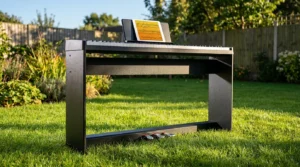
The Donner DDP-50 Weighted Digital Piano 88-Key is one of those digital pianos that immediately grabs attention for a very simple reason: it looks far more expensive than it actually is.
At first glance, it resembles the kind of minimalist furniture-style digital piano you would normally expect from Yamaha, Roland, or Kawai at a significantly higher price point. The wood-style cabinet, slim profile, and modern home-friendly design make it appealing even to people who normally dislike the look of digital pianos. But aesthetics alone don’t make a piano worth buying. The real question is whether the DDP-50 delivers where it matters most: key action, sound quality, reliability, and overall playing experience.
This is not a perfect piano. It is also not junk. The truth sits somewhere in the middle, and where you land on it depends heavily on your expectations.
If you click the button above you will be redirected to Amazon.com. In case you then decide to buy anything, Amazon.com will pay me a commission. This doesn’t affect the honesty of this review in any way though.
Design & Build Quality
One of the biggest reasons people become interested in the Donner DDP-50 in the first place has very little to do with sound engines, polyphony counts, or MIDI functionality. It’s the design.
The DDP-50 immediately stands out in a market filled with black plastic keyboards that often look more like office equipment than musical instruments. Donner clearly understood that many modern buyers want a digital piano that feels like part of the home rather than a temporary practice tool shoved into a corner. The result is an instrument that places a strong emphasis on visual appeal and furniture-style presentation.
And honestly, that strategy works remarkably well.
At first glance, the DDP-50 looks more expensive than it actually is. The slim cabinet, clean lines, wood-style finish, and minimalist layout give it a distinctly modern aesthetic. Depending on the finish option, it can fit surprisingly naturally into contemporary apartments, bedrooms, studios, or living rooms. Instead of dominating a room the way traditional upright pianos often do, the DDP-50 feels lighter and more integrated into the environment.
That may sound superficial, but it matters more than many people realize.
Digital pianos are long-term objects. Unlike a guitar that can be stored in a case, a home piano becomes part of the room itself. People see it every day. Guests notice it. Family members interact with it visually even when nobody is playing. An unattractive instrument often becomes something owners mentally hide away, while an attractive instrument tends to invite use.
The DDP-50 understands this psychology very well.
The overall footprint is relatively compact compared to many furniture-style digital pianos. It offers enough presence to feel like a proper instrument without becoming oversized or cumbersome. For apartment users especially, this balance is important. Many buyers simply do not have space for a full acoustic upright or large console digital piano. The DDP-50 manages to create the visual impression of a more substantial instrument while still remaining practical for smaller spaces.
The minimalist design philosophy extends to the control layout too.
Unlike some beginner digital pianos that overload the front panel with buttons, flashing LEDs, and dozens of labeled functions, the DDP-50 keeps things visually restrained. From a distance, it almost resembles a traditional upright more than a tech-heavy digital instrument. That clean appearance contributes heavily to its premium-looking aesthetic.
However, this design choice creates both advantages and disadvantages.
The obvious advantage is visual simplicity. The piano looks elegant and uncluttered. It avoids the “cheap electronic keyboard” appearance that plagues many budget instruments.
The downside is usability.
Because there are fewer dedicated controls on the surface, certain functions require combinations of buttons or menu navigation that may not feel immediately intuitive. More experienced users who frequently switch sounds, adjust settings, or access advanced features may occasionally find the interface slightly cumbersome. This is one of those situations where aesthetic minimalism partially comes at the expense of operational convenience.
Still, for the target audience of beginners and casual home players, the tradeoff probably makes sense.
The bench and integrated stand system also deserve mention. Unlike portable keyboards paired with X-stands, the DDP-50 feels more stable and intentional as a piece of furniture. That creates a better overall playing experience psychologically and physically. There is something satisfying about sitting at an instrument that feels planted and complete rather than temporary.
The integrated triple-pedal unit further reinforces this impression.
Many entry-level digital pianos cut costs by including only a basic sustain pedal, often made of lightweight plastic that slides around the floor during use. The DDP-50 instead includes a built-in three-pedal assembly that visually and functionally resembles an acoustic piano setup. This significantly improves the perceived quality of the instrument.
From a distance, the piano genuinely looks refined.
Up close, though, some budget realities begin to appear.
The materials used throughout the cabinet are decent for the price but not luxurious. Certain surfaces reveal their MDF and laminate construction under closer inspection. The texture and finish lack the richness and density you would find on higher-end digital pianos from Yamaha, Roland, or Kawai. None of this is shocking given the price category, but it is important to maintain realistic expectations.
The key surfaces themselves are reasonably comfortable, though they do not feel especially premium. They lack the ivory-textured finishes found on more expensive models, and the plastic construction becomes more apparent during extended sessions. Still, they avoid feeling excessively cheap or toy-like, which is arguably more important in this category.
Structural stability is generally solid once assembled.
The piano does not wobble excessively during normal playing, and the cabinet feels secure enough for everyday home use. This is important because some budget furniture-style digital pianos suffer from concerning instability or weak assembly points. The DDP-50 performs reasonably well here.
Assembly itself appears fairly straightforward based on owner impressions. Most users should be able to put it together without professional help. The instructions are reportedly clear enough, and the process resembles standard flat-pack furniture assembly more than complicated instrument setup.
That said, build consistency remains one of the larger concerns surrounding Donner products as a whole.
This is where the conversation becomes more nuanced.
The DDP-50 often creates an excellent first impression. Many owners are initially surprised by how attractive and substantial the instrument feels for the price. The concern is less about immediate appearance and more about long-term durability and quality control.
Established brands like Yamaha and Roland have decades-long reputations for consistency. Buyers generally trust that their instruments will remain reliable for years with minimal issues. Donner, by comparison, is still building that reputation.
Some users report excellent experiences with Donner products, while others mention issues involving inconsistent assembly quality, electronic faults, or customer support frustrations. This does not necessarily mean the DDP-50 is unreliable, but it does introduce an element of uncertainty that buyers should acknowledge.
This becomes especially relevant for parents purchasing a first piano for children.
A beginner instrument often experiences years of heavy daily use, accidental bumps, repetitive key strikes, and occasional rough treatment. Long-term durability matters enormously in those situations. While the DDP-50 appears sufficiently sturdy for normal home environments, it does not yet carry the same confidence-inspiring reputation as more established competitors.
Another area worth mentioning is portability.
Technically, the DDP-50 is lighter and more compact than many console-style digital pianos, but it is still fundamentally designed as a stationary home instrument. Once assembled, most owners probably will not want to move it frequently. This is not a portable stage piano intended for gigging musicians. Its design priorities lean heavily toward home integration and aesthetics rather than mobility.
Cable management is reasonably discreet as well. Donner does a decent job hiding some of the visual clutter that often accompanies digital instruments. This helps preserve the piano’s clean appearance, especially in minimalist interiors.
Overall, the design and build quality of the Donner DDP-50 represent one of the instrument’s strongest selling points.
It looks modern, elegant, and far more premium than many people would expect at its price. The furniture-style presentation gives it a maturity that many entry-level digital pianos completely lack. While the materials and long-term reliability may not fully match higher-end competitors, the piano succeeds at creating an inviting and visually attractive playing experience.
And in many homes, that alone may be enough to make people sit down and play more often.
Keyboard and Key Action
If there is one area that determines whether a digital piano feels satisfying or frustrating to play, it’s the keyboard action. Everything else is secondary. A piano can have excellent speakers, hundreds of sounds, and beautiful furniture styling, but if the keys feel unrealistic or unpleasant under the fingers, the entire experience suffers.
This is especially important for beginners.
The keyboard is the physical connection between the player and the instrument. It directly affects technique development, finger strength, dynamic control, timing, and overall musical expression. Poor key action can create bad habits that become difficult to unlearn later. Good key action, even on a budget instrument, encourages proper playing technique from the beginning.
The Donner DDP-50 enters this area with fairly ambitious claims for its price category. Donner markets the piano as featuring a fully weighted 88-key graded hammer-action keyboard designed to simulate the feel of an acoustic piano. On paper, that already places it above the countless inexpensive keyboards that use semi-weighted or synth-style actions.
And to Donner’s credit, the DDP-50 does make a legitimate effort to provide a more realistic piano-playing experience.
The first thing most players notice when sitting down at the instrument is that the keys actually have resistance. This may sound obvious, but many entry-level keyboards feel extremely light and springy, almost like typing on oversized computer keys. The DDP-50 avoids that problem. The keys push back against the fingers with enough weight to create a more substantial and piano-like feel.
For complete beginners, this is a major improvement over cheaper alternatives.
Weighted keys matter because acoustic pianos are naturally heavy compared to electronic keyboards. Developing proper finger strength and control requires resistance. Without it, players often struggle when transitioning to real pianos later. In that sense, the DDP-50 provides a much more legitimate foundation for learning proper technique than low-cost unweighted keyboards.
The grading of the keyboard is another important detail.
On acoustic pianos, lower notes feel slightly heavier while higher notes feel lighter due to the physical mechanics of the hammer system. The DDP-50 attempts to recreate this behavior through graded hammer action, and while it isn’t perfect, the effect is noticeable enough to improve realism.
Lower-register playing feels appropriately weightier, while upper-register passages become somewhat lighter and quicker under the fingers. This contributes to a more natural playing experience overall.
However, the quality of a keyboard action is not just about weight. It’s also about responsiveness, repetition speed, consistency, and subtlety.
This is where the DDP-50 begins to reveal some of its limitations.
The action itself leans toward the heavier side compared to many competing entry-level digital pianos. Some players may actually enjoy this. A slightly heavier action can create the impression of solidity and control, especially for beginners who associate weight with realism. Slower practice pieces and chord-heavy playing feel reasonably satisfying because the keys offer enough resistance to avoid feeling flimsy.
But heavier does not always mean better.
More experienced pianists will likely notice that the action lacks some refinement and agility. Fast passages, repeated notes, and highly dynamic playing expose the mechanical limitations more clearly. The rebound speed is decent but not particularly quick, meaning rapid repetition can feel slightly sluggish compared to more advanced digital pianos from Roland or Yamaha.
This becomes especially noticeable in technically demanding classical repertoire.
Pieces requiring fast trills, repeated-note patterns, or highly nuanced articulation may feel less fluid on the DDP-50. The action is perfectly serviceable for beginner and intermediate material, but advanced pianists may find themselves fighting against the keyboard rather than forgetting it exists.
That distinction matters.
The best piano actions disappear beneath the fingers. They respond naturally enough that the player focuses entirely on music rather than mechanics. The DDP-50 does not quite achieve that level of transparency.
Still, context is important here.
At this price point, compromises are inevitable. The real question is whether the DDP-50’s action performs well enough for its intended audience. For beginners and casual players, the answer is probably yes.
The key surfaces themselves are fairly standard plastic without the textured ivory-like coatings found on more expensive instruments. They feel smooth and functional but not luxurious. During longer practice sessions, the lack of texture becomes more noticeable, especially for players accustomed to premium digital pianos or acoustic instruments.
That said, the keys do not feel excessively cheap either.
There is enough structural stability to avoid the hollow, rattling sensation common in very low-budget keyboards. Key wobble is reasonably controlled, and the overall construction feels solid enough for normal home use.
Another positive aspect is the inclusion of adjustable touch sensitivity settings.
This feature allows players to alter how the piano responds to velocity and dynamics. In practical terms, it changes how much force is required to produce louder or softer notes. Beginners may appreciate lighter sensitivity settings while developing finger control, while more advanced players can choose settings that better suit expressive playing.
Having this level of customization adds flexibility and makes the instrument more adaptable to different playing styles.
Dynamic response is respectable overall, though not especially nuanced.
The DDP-50 can distinguish between soft, medium, and loud playing with reasonable accuracy, allowing players to shape musical phrases and practice expressive control. However, compared to higher-end digital pianos, the transitions between dynamic layers feel less sophisticated.
This is one of the subtle differences between budget and premium instruments.
On expensive digital pianos, dynamic changes often feel smooth and continuous. On more affordable instruments like the DDP-50, players may occasionally sense the underlying sample layers switching beneath their fingers. The expressive range exists, but it feels somewhat less organic.
For many beginners, this limitation may never become a problem.
In fact, most entry-level players will probably find the keyboard highly enjoyable because it already feels dramatically more realistic than non-weighted keyboards. Expectations matter enormously here. Someone upgrading from a basic electronic keyboard may be genuinely impressed by the DDP-50’s action.
Experienced pianists, however, will likely recognize the compromises immediately.
One area where opinions may vary significantly is the perceived heaviness of the action. Some users prefer heavier actions because they encourage finger strength and create a more “serious” feel. Others may find the DDP-50 slightly fatiguing during extended sessions.
This is highly subjective.
Players coming from acoustic uprights may adapt comfortably, while those accustomed to lighter digital actions could initially struggle with the resistance. Ideally, prospective buyers would test the keyboard in person before purchasing, though that is not always practical with online-focused brands like Donner.
Noise levels during key movement are fairly typical for this category.
The action produces some mechanical sound during playing, especially when practicing quietly without headphones or speakers at higher volumes. This is normal for many digital pianos, but the DDP-50 is not among the quietest actions available. In a silent room, the physical key noise becomes noticeable during repetitive exercises or fast passages.
Again, this is not a dealbreaker at the price point, but it contributes to the overall sense that the instrument prioritizes affordability over refinement.
One interesting aspect of the DDP-50 is that its keyboard becomes significantly more valuable when paired with external piano software.
Because the instrument supports USB-MIDI connectivity, users can connect it to virtual piano libraries on a computer or tablet. This allows the keyboard action to control far more sophisticated piano sounds than the onboard engine provides.
In practice, this means the DDP-50 can function as a reasonably capable MIDI controller for home practice and music production. While the action may not rival premium stage pianos, it becomes surprisingly usable when combined with high-quality virtual instruments.
This flexibility adds considerable long-term value to the instrument.
Overall, the keyboard and key action of the Donner DDP-50 occupy an interesting middle ground.
They are clearly better than ultra-budget beginner keyboards pretending to be pianos. The fully weighted graded action provides a legitimate foundation for learning and allows for reasonably expressive playing. For beginners and casual hobbyists, the keyboard may feel entirely satisfying for years.
At the same time, the action lacks the refinement, speed, and realism found in more established competitors from Yamaha, Roland, or Kawai. Advanced players will likely notice limitations in responsiveness and nuance fairly quickly.
But within the context of its price range, the DDP-50 performs respectably.
It may not perfectly recreate the feel of an acoustic piano, but it gets close enough to support real practice, real technique development, and genuine musical enjoyment. And for many buyers shopping in this category, that is ultimately what matters most.
Sound Quality
Sound quality is where digital pianos often separate themselves most clearly from one another. Even people with little musical experience can usually tell the difference between a piano that sounds rich and convincing and one that sounds artificial or flat. The challenge for affordable digital pianos is that recreating the complexity of an acoustic piano is extremely difficult. Real pianos produce layers of harmonics, sympathetic resonance, mechanical noise, and dynamic variation that are hard to capture digitally without expensive hardware and sophisticated sound engines.
The Donner DDP-50 attempts to deliver a convincing piano experience while staying within a budget-oriented price range. In practice, the results are mixed but generally respectable for what the instrument is trying to achieve.
The first thing to understand is that the DDP-50 is primarily designed for beginners, casual hobbyists, and home users rather than professional pianists or recording musicians. That target audience shapes many aspects of the sound design. Donner seems to prioritize accessibility and versatility over deep realism. As a result, the piano offers a sound that is pleasant, usable, and enjoyable in everyday situations, even if it does not fully replicate the depth and complexity of a true acoustic instrument.
The main acoustic piano tone is the centerpiece of the entire experience.
Fortunately, it is reasonably good.
At default settings, the piano produces a warm, clean, and fairly balanced sound that works well for general practice, beginner lessons, pop music, and casual playing. It avoids the harsh, brittle character that often plagues very cheap digital pianos. The tone has enough body to feel musical rather than toy-like, which is an important distinction in this category.
The lower register carries decent warmth without becoming excessively muddy, while the midrange remains clear enough for chord work and melodic playing. Higher notes have enough brightness to cut through without sounding painfully sharp or metallic.
For beginner and intermediate players, this tonal balance is actually one of the DDP-50’s strengths.
Many inexpensive digital pianos overcompensate by making their sound unnaturally bright in an attempt to appear more detailed. The DDP-50 instead leans slightly toward a softer and more approachable tone, which makes long practice sessions less fatiguing.
The instrument also responds reasonably well to changes in playing dynamics.
Soft playing produces gentler tones with reduced attack, while harder playing introduces more brightness and intensity. This dynamic responsiveness is critical because expressive control is one of the defining qualities of piano playing. A piano that sounds identical regardless of touch quickly becomes uninspiring.
The DDP-50 avoids that trap to a certain extent.
However, this is also where the limitations of the sound engine begin to emerge.
Compared to higher-end digital pianos, the transitions between dynamic layers can feel somewhat artificial. On premium instruments, changes in tone often feel smooth and continuous. On the DDP-50, players may occasionally sense the underlying sample layers switching as velocity increases. It is not necessarily distracting for beginners, but experienced pianists will likely notice it.
This points to one of the broader realities of budget digital piano design: sampling quality matters enormously.
Most affordable digital pianos rely on recorded samples of acoustic pianos rather than advanced physical modeling systems. The quality of those samples, and how naturally they transition between dynamic levels, determines much of the instrument’s realism.
The DDP-50’s samples are decent but not especially sophisticated.
There is enough detail for practice and casual enjoyment, but the sound lacks the deep harmonic richness and organic complexity found in more expensive instruments from Roland, Yamaha, or Kawai. Sustained notes reveal this limitation most clearly. The decay characteristics can feel somewhat static and predictable rather than naturally evolving the way an acoustic piano does.
Another noticeable limitation involves resonance behavior.
Acoustic pianos generate complex sympathetic resonances whenever notes interact. Strings vibrate together, harmonics build upon one another, and the entire instrument contributes to the final sound. Premium digital pianos attempt to recreate this through sophisticated resonance modeling systems.
The DDP-50 includes some degree of simulated resonance, but it remains fairly basic.
Chords sound full enough for casual use, but they lack the immersive bloom and interaction found on higher-end digital pianos. Sustained pedal passages especially reveal the simplified nature of the sound engine. The instrument handles these situations adequately, but not convincingly enough to fully imitate a real piano.
This becomes more noticeable in classical repertoire.
Pieces relying heavily on sustain, pedal blending, and dynamic subtlety expose the limitations of the DDP-50 more clearly than simpler pop or contemporary music. Debussy, Chopin, and expressive romantic-era works demand a level of tonal nuance that budget digital pianos often struggle to provide.
That does not mean such music becomes unplayable. It simply means the emotional and tonal depth may feel somewhat reduced.
On the other hand, for pop music, worship playing, singer-songwriter accompaniment, and casual improvisation, the DDP-50 performs quite comfortably. In these contexts, absolute acoustic realism is often less important than having a pleasant and responsive sound.
One area where Donner tries to add value is through the inclusion of a large number of additional instrument voices.
Beyond the main acoustic piano tone, the DDP-50 includes electric pianos, organs, strings, synths, basses, and various other sounds. The sheer quantity is impressive on paper, especially for the price.
In reality, the quality varies considerably.
Some of the electric piano sounds are genuinely enjoyable. Certain Rhodes-style and soft electric patches work nicely for jazz, lo-fi practice, or relaxed chord playing. A few layered string combinations also create atmospheric textures that beginners may find inspiring.
However, many of the additional voices feel more like bonus features than deeply crafted instruments.
This is common in budget digital pianos. Manufacturers often advertise hundreds of sounds, but most users ultimately rely on only a handful regularly. The DDP-50 follows that pattern. The core acoustic piano matters most, and thankfully it is among the better sounds in the instrument.
Still, the extra tones do add versatility.
Beginners especially may enjoy experimenting with different instrument sounds while learning. This variety can make practice sessions feel more engaging and less repetitive. For younger students, having multiple voices available sometimes increases motivation to play.
Another important factor influencing perceived sound quality is the speaker system.
The DDP-50’s onboard speakers are capable enough for normal home use, but they do place limits on how impressive the piano can sound. Through the built-in speakers, the instrument occasionally lacks depth and low-end richness. The sound remains clear at moderate volumes, but it does not fully fill a room with the same authority as higher-end digital pianos.
Interestingly, the piano often sounds noticeably better through headphones.
This is actually common with budget digital pianos. Headphones bypass some of the limitations of the onboard speaker system and allow the underlying samples to come through with greater clarity. The stereo image feels wider, subtle details become easier to hear, and the overall playing experience improves significantly.
For apartment users or late-night practice sessions, this is excellent news.
Using quality headphones can elevate the DDP-50 from merely decent to genuinely enjoyable. Players who intend to practice primarily with headphones will likely have a more positive impression of the instrument’s sound quality overall.
The piano’s USB-MIDI capability also expands its sonic potential considerably.
This may actually be one of the smartest ways to use the DDP-50 long-term.
By connecting the piano to a computer or tablet, users can access high-quality virtual piano software such as Pianoteq, Garritan CFX, Keyscape, or Native Instruments libraries. These software instruments often sound dramatically better than built-in digital piano engines, even on instruments costing far more than the DDP-50.
In this setup, the DDP-50 essentially becomes a weighted MIDI controller with furniture styling. The onboard sounds become less important because the external software handles audio generation.
This dramatically increases the piano’s long-term usefulness.
For beginners, the internal sounds are perfectly adequate to start learning and practicing immediately. For more advanced users, MIDI connectivity creates a path toward much better sound quality later without replacing the entire instrument.
Another aspect worth mentioning is sound consistency across the keyboard range.
Some budget digital pianos suffer from obvious tonal jumps between sampled regions, where different sections of the keyboard sound disconnected from one another. The DDP-50 handles this reasonably well. While experienced ears may still detect some transitions, the overall tonal balance across the keyboard remains fairly smooth.
That helps preserve immersion during normal playing.
Overall, the sound quality of the Donner DDP-50 is best described as competent and enjoyable rather than truly exceptional.
It delivers a pleasant core piano tone with enough dynamic responsiveness to support real musical expression. The sound engine avoids the thin, toy-like character of extremely cheap keyboards, and the included variety of voices adds versatility for casual users.
At the same time, the piano lacks the realism, harmonic complexity, and nuanced resonance modeling found in more advanced digital pianos. Experienced players will likely recognize the limitations fairly quickly, especially during expressive classical playing.
But within its intended role as an affordable home digital piano, the DDP-50 performs reasonably well.
It may not completely fool anyone into believing they are playing a concert grand, but it succeeds at something arguably more important for its audience: it provides a sound that is pleasant enough to encourage regular practice and enjoyable enough to keep players coming back to the instrument.
Speakers and Audio Projection
The speaker system of a digital piano is one of those features that people often underestimate until they actually sit down and play the instrument in a real room. Many buyers focus heavily on the keyboard action or the sound engine itself, which makes sense because those are core parts of the playing experience. But even a good piano sound can feel disappointing if the speakers are weak, poorly tuned, or unable to project the sound properly.
This is especially true for home digital pianos like the Donner DDP-50.
Unlike portable keyboards that are often expected to connect to external amplification, furniture-style digital pianos are usually intended to function as complete self-contained instruments. Most buyers expect to assemble the piano, plug it in, and immediately enjoy a satisfying listening experience without needing studio monitors or external speakers.
The DDP-50 mostly delivers on that expectation, though with some clear limitations that reflect its price category.
At a basic level, the onboard speaker system is perfectly functional for everyday home practice. The speakers provide enough volume for solo playing in small and medium-sized rooms, and the overall sound remains reasonably clear at moderate listening levels. Beginners practicing scales, chords, exercises, or simple songs will likely find the built-in audio more than adequate.
In fact, many casual users may never feel the need for external amplification at all.
The piano creates a pleasant enough sound field for personal practice, especially in apartments, bedrooms, studios, or smaller living rooms. The stereo effect also helps the instrument feel more immersive than ultra-cheap keyboards that rely on tiny downward-facing speakers with almost no spatial presence.
That stereo imaging matters more than people sometimes realize.
A piano is naturally a wide instrument. Lower notes resonate from one side while higher notes emerge from another, and the interaction between these frequencies contributes significantly to the realism of the playing experience. The DDP-50 does a decent job preserving at least some sense of width and separation, helping the instrument feel more alive during practice.
Still, it is important to set realistic expectations.
The DDP-50 does not have a particularly powerful or sophisticated speaker system compared to premium digital pianos. This becomes obvious fairly quickly when playing more demanding music or increasing the volume significantly.
The most noticeable limitation is depth.
The speakers produce enough low-end presence for casual use, but they lack the richness and physical resonance associated with larger, more expensive digital pianos. Bass notes are audible and reasonably balanced, but they do not fully bloom into the room with the authority of an acoustic upright or high-end console piano.
As a result, lower-register passages can occasionally feel somewhat restrained.
This is particularly noticeable in classical music and cinematic pieces where the left hand carries substantial harmonic weight. Chord-heavy arrangements reveal the limitations of the speaker cabinet and amplification system more clearly because the sound lacks the deep resonance that gives acoustic pianos their physical presence.
The midrange performs more convincingly.
Most melodies, chord voicings, and general practice material sound clean and intelligible through the onboard speakers. The piano avoids the boxy or muffled sound character that often affects very low-budget instruments. Notes remain reasonably separated from one another, and the tonal balance is pleasant enough for extended playing sessions.
The higher frequencies are handled competently as well, though there are moments where brightness can become slightly artificial at louder volumes.
This points toward one of the broader challenges of affordable digital piano speakers: balancing clarity against harshness.
Manufacturers often tune inexpensive speakers to emphasize treble frequencies because brighter sounds initially appear more detailed and impressive during short demonstrations. The DDP-50 generally avoids becoming painfully sharp, but aggressive playing at high volume can occasionally expose some brittleness in the upper range.
Again, context matters here.
For beginners and casual players, these issues may barely register. Someone learning chords, practicing beginner exercises, or playing pop arrangements at moderate volume will probably find the speaker performance entirely acceptable.
More experienced pianists, however, tend to notice these subtleties much more quickly.
One area where the speaker system struggles somewhat is dynamic realism.
Acoustic pianos naturally respond to changes in playing intensity with enormous tonal variation. Soft passages feel intimate and delicate, while powerful fortissimo sections can fill an entire room with energy and resonance. Replicating this convincingly requires not only a sophisticated sound engine but also a capable amplification system.
The DDP-50’s speakers can reproduce dynamic changes, but they compress somewhat under heavier playing.
As volume increases, the sound becomes less open and spacious. Complex chord clusters and forceful passages can start to feel slightly congested, especially when sustain pedal is heavily used. The instrument never becomes unusable, but the illusion of acoustic realism weakens under more demanding conditions.
This is one of the clearest distinctions between budget and premium digital pianos.
Higher-end instruments from Roland, Yamaha, or Kawai often include multi-speaker systems specifically designed to emulate the directional projection of acoustic pianos. Some models place speakers in multiple positions around the cabinet to recreate the sense of sound moving through a wooden body.
The DDP-50 does not attempt anything that ambitious.
Its speaker system is more straightforward and practical, designed primarily to deliver competent home audio rather than immersive acoustic simulation.
That said, there are advantages to this simpler setup too.
Because the speakers are not excessively bass-heavy or aggressively amplified, the piano remains very apartment-friendly. It produces enough volume for satisfying practice without easily overwhelming neighboring rooms. For many buyers, especially those living in shared spaces, this balance may actually be preferable.
The speaker tuning also works reasonably well for long practice sessions.
Some inexpensive digital pianos become fatiguing after extended use because the speakers emphasize harsh frequencies or distort at moderate volumes. The DDP-50 generally maintains a softer and more approachable sound profile. Even though it lacks premium richness, it remains comfortable to listen to for extended periods.
Another important aspect of the listening experience involves cabinet resonance.
On acoustic pianos, much of the instrument’s character comes from the interaction between the strings and the wooden body itself. Furniture-style digital pianos attempt to recreate at least some of this effect through cabinet design and speaker placement.
The DDP-50 provides a small hint of this resonance, but not enough to fully mimic an acoustic instrument. The cabinet contributes modestly to the overall warmth of the sound, yet it still feels fundamentally like amplified digital audio rather than naturally resonating wood.
This is not surprising at the price point, but it reinforces the idea that the DDP-50 aims for practicality and affordability rather than total realism.
Where the instrument performs much better is headphone use.
In many ways, headphones unlock the best version of the DDP-50.
Through good headphones, several limitations of the onboard speakers become far less noticeable. The stereo image widens considerably, subtle details emerge more clearly, and the overall sound gains greater depth and clarity. Bass response feels tighter, higher frequencies smooth out somewhat, and the piano becomes much more immersive.
For apartment users, students, and late-night practice sessions, this is extremely important.
Many digital piano owners actually spend most of their time practicing with headphones. In that context, the quality of the onboard speakers becomes slightly less critical. The DDP-50’s internal sound engine sounds noticeably more refined through headphones than through its built-in speaker system alone.
This also means buyers who already own good studio headphones may have a significantly more positive experience with the instrument overall.
External speaker connectivity further improves flexibility.
The DDP-50 includes audio output options that allow users to connect external monitors, amplifiers, or powered speakers. This dramatically expands the instrument’s potential because external speakers can compensate for many of the onboard system’s limitations.
Even relatively affordable studio monitors can provide:
- Better bass response
- Greater clarity
- Wider stereo imaging
- Improved dynamic range
- More room-filling sound
In practice, connecting the DDP-50 to quality external speakers can noticeably elevate the entire playing experience.
This makes the piano more future-proof than some buyers might initially expect. Beginners can comfortably use the onboard speakers at first, then gradually upgrade their setup later if they desire better audio performance.
Another subtle but important factor is speaker placement.
The DDP-50’s speaker positioning works reasonably well for seated players. The sound projects toward the performer effectively enough that the piano does not feel disconnected or distant while playing. Some cheaper keyboards suffer from downward-facing speakers that make the sound seem detached from the instrument itself. The DDP-50 avoids that problem reasonably well.
Overall, the speaker system of the Donner DDP-50 is best viewed as functional and competent rather than exceptional.
It provides enough clarity, volume, and stereo presence for enjoyable home practice while remaining pleasant and approachable during long sessions. The speakers support the instrument’s role as a beginner-friendly home piano without introducing major flaws or obvious weaknesses.
At the same time, they lack the depth, projection, and dynamic realism found in more advanced digital pianos. Serious pianists and demanding listeners will likely notice limitations in bass richness, openness, and overall immersion fairly quickly.
But for the piano’s intended audience, the speaker system largely accomplishes its job.
It delivers a comfortable, practical listening experience that supports daily practice, casual playing, and home enjoyment without significantly inflating the instrument’s price. And for many buyers in this category, that balance will feel entirely reasonable.
Functions and Features
One of the most interesting things about the Donner DDP-50 is how aggressively it tries to compete on features. While some digital pianos focus almost entirely on delivering the best possible keyboard action and piano sound within a certain price range, Donner takes a broader approach. The DDP-50 is designed not only as a piano, but also as a beginner learning tool, a casual entertainment instrument, and a modern home music device.
That distinction matters because it shapes the entire user experience.
Instead of offering a stripped-down “just the basics” approach, Donner packs the DDP-50 with a surprisingly large number of functions aimed at making the instrument feel versatile and approachable. Some of these features are genuinely useful. Others feel more like bonus additions intended to make the specification sheet look impressive. But overall, the feature set is one of the piano’s strongest selling points, especially for beginners and casual home users.
The core functionality starts with the basics you would expect from a modern digital piano.
The DDP-50 includes adjustable touch sensitivity settings, built-in metronome functionality, recording capabilities, multiple instrument voices, demo songs, dual mode, split mode, and rhythm accompaniments. On top of that, it offers USB-MIDI support and compatibility with learning apps and external software.
For a budget-oriented furniture-style digital piano, that is actually a fairly generous package.
The metronome deserves attention first because it is one of the most practical and important learning tools included.
Many beginners underestimate how critical timing development is during piano practice. Students often focus heavily on hitting the correct notes while neglecting rhythm and tempo consistency. A built-in metronome encourages disciplined practice habits from the beginning.
The DDP-50’s metronome is straightforward and easy to use. It allows players to adjust tempo according to practice needs, making it useful for scales, exercises, technical drills, and repertoire practice. It may not be a flashy feature, but it is one of the most genuinely valuable functions included on the instrument.
The recording function is another highly useful addition.
Being able to record your own playing is incredibly important for improvement because it exposes details that are easy to miss while actively performing. Timing inconsistencies, uneven dynamics, hesitations, and articulation issues become much more obvious during playback.
For beginners especially, this can accelerate learning dramatically.
The DDP-50’s recording capabilities are relatively basic compared to professional workstation keyboards or advanced digital pianos, but they are more than sufficient for practice evaluation and simple idea capture. Casual players may also enjoy recording their performances simply for fun or sharing progress with family and friends.
Another practical feature is dual mode, sometimes referred to as layer mode.
This allows two sounds to be combined simultaneously, such as piano and strings together. Layered sounds can create a fuller and more cinematic texture, which many casual players enjoy. Soft string layers underneath piano tones are especially popular because they create an emotional, ambient sound that feels rewarding even for simple chord progressions.
This feature may not matter much to purist classical pianists, but for hobbyists and modern players, it adds a lot of enjoyment.
Split mode is equally useful, though in a different way.
This function divides the keyboard into separate sections with different sounds assigned to each side. For example, a player could use bass sounds in the left hand and piano or electric piano sounds in the right.
While advanced musicians may use split mode creatively for performance or arranging, it is also extremely practical for teaching.
Many digital pianos now include a variation of “lesson mode” where the keyboard splits into two equal pitch ranges, allowing teacher and student to sit side-by-side and play identical notes simultaneously. The DDP-50 supports this type of educational functionality, which is especially helpful for beginners taking lessons at home.
For families purchasing a first piano for children, this feature adds genuine long-term value.
The rhythm accompaniment functions are more divisive.
The DDP-50 includes various built-in rhythms and backing patterns intended to make practice sessions feel more interactive. Some users may enjoy jamming along with simple drum grooves or accompaniment styles, especially when learning pop songs or improvisation.
However, these features can also feel somewhat gimmicky depending on the player.
Serious pianists focused primarily on traditional piano repertoire may rarely touch them after the first week of ownership. This is common across many beginner-oriented digital pianos. Manufacturers often include large numbers of features that sound impressive in marketing materials but become secondary in everyday use.
Still, for casual players and younger beginners, these additions can genuinely increase engagement.
The same applies to the included demo songs and additional instrument voices.
The DDP-50 offers hundreds of tones beyond its primary acoustic piano sound, including:
- Electric pianos
- Organs
- Strings
- Synths
- Choirs
- Basses
- Drum kits
As with many affordable digital pianos, the quality varies considerably. Some sounds are surprisingly enjoyable, while others feel more like novelty additions.
The electric piano tones are probably among the strongest alternatives. Several patches work nicely for jazz, lo-fi playing, or contemporary music. String layers can also sound pleasant when blended softly with piano.
The organ and synth sounds are more mixed. They are usable for experimentation and casual entertainment, but they are not likely to satisfy experienced keyboard players seeking authentic recreations.
Still, variety has value.
For beginners especially, exploring different sounds can make practice more exciting and creative. A child practicing scales with a synth lead or string patch may remain engaged longer than they would using only a standard piano tone.
This is one of the broader strengths of feature-rich beginner instruments: they encourage experimentation.
The user interface itself is where opinions may become more divided.
Visually, the DDP-50 maintains a clean and minimalist appearance by limiting the number of visible controls. While this helps the instrument look elegant and furniture-like, it also means deeper functions often require button combinations or menu navigation.
In practice, this creates a small learning curve.
Basic operations are simple enough, but accessing advanced settings or switching through larger sound libraries may occasionally feel less intuitive than on more control-heavy instruments. Some users will appreciate the uncluttered design, while others may wish for more direct-access buttons.
This becomes a classic design tradeoff:
- Cleaner appearance
- Slightly reduced operational convenience
For the DDP-50’s target audience, the balance is probably acceptable.
Another major feature category involves app integration and external learning support.
Modern digital pianos increasingly function as part of broader learning ecosystems rather than standalone instruments. Donner attempts to follow this trend by supporting compatibility with apps such as Melodics and Donner’s own learning platforms.
This is particularly valuable for self-taught beginners.
Interactive learning apps can provide guided lessons, rhythm exercises, note-reading practice, and immediate feedback in ways that feel more engaging than traditional method books alone. The DDP-50’s USB-MIDI support allows the instrument to communicate directly with computers and tablets, enabling these educational features.
For younger players raised in highly digital environments, this connectivity can make piano learning feel significantly more approachable.
USB-MIDI functionality also dramatically increases the instrument’s usefulness beyond beginner lessons.
Once connected to a computer, the DDP-50 can function as a MIDI controller for:
- Music production software
- Virtual piano libraries
- DAWs like Ableton or Logic
- Composition tools
- Notation software
This flexibility extends the lifespan of the instrument considerably.
Even if a player eventually outgrows the onboard sounds, the weighted keyboard can still serve as a capable controller for much more advanced external software instruments. In many ways, this feature alone adds substantial long-term value to the piano.
Another practical feature worth mentioning is headphone support.
Silent practice is one of the greatest advantages of digital pianos in general, and the DDP-50 handles this well. Players can practice late at night without disturbing neighbors or family members, making the instrument especially suitable for apartment living.
For many adults balancing work schedules, shared living spaces, or young children, this feature becomes essential rather than optional.
The inclusion of a triple-pedal system also enhances the feature set significantly.
Unlike cheaper beginner keyboards that include only sustain pedals, the DDP-50 provides soft, sostenuto, and sustain pedals integrated into the cabinet. This creates a more authentic piano-playing experience and allows students to develop proper pedal technique from the beginning.
Pedal realism itself is not at the level of premium continuous-pedal systems, but the functionality is more than adequate for beginner and intermediate playing.
One area where the DDP-50 could improve is interface refinement and software polish.
Larger brands often provide smoother menu systems, better app integration, clearer display layouts, and more intuitive navigation overall. Donner’s software ecosystem still feels somewhat less mature by comparison.
This is not unusual for newer or budget-focused brands, but it does affect the overall user experience slightly.
Overall, the functions and features of the Donner DDP-50 represent one of its strongest advantages in the entry-level digital piano market.
The piano offers a surprisingly broad collection of tools aimed at beginners, hobbyists, and modern home users. From recording functions and learning modes to MIDI connectivity and layered sounds, the DDP-50 provides far more versatility than many buyers may expect at its price.
Not every feature feels equally polished or essential, and some functions clearly exist more for marketing appeal than daily practicality. But taken as a whole, the piano succeeds at creating a flexible and approachable experience that goes beyond simple piano practice.
For beginners especially, that versatility can make the instrument feel less intimidating, more engaging, and ultimately more enjoyable to use regularly.
Connectivity
Connectivity is one of the areas where modern digital pianos have evolved the most over the past decade. A digital piano is no longer just a self-contained instrument for practicing scales or playing simple songs at home. Increasingly, these instruments function as part of larger digital ecosystems involving computers, tablets, recording software, online lessons, virtual instruments, and music production setups.
The Donner DDP-50 clearly tries to embrace this modern approach.
While it is positioned primarily as an affordable home digital piano for beginners and casual players, Donner includes enough connectivity features to make the instrument surprisingly flexible beyond basic practice. For many buyers, these features may end up becoming more valuable over time than they initially expect.
At its core, the DDP-50 offers the essential connections most players need:
- USB-MIDI support
- Headphone outputs
- Audio output options
- Pedal connectivity
- Compatibility with external apps and software
This may not sound especially exciting at first glance, but these features significantly expand what the instrument can actually do.
The most important connection on the piano is easily the USB-MIDI functionality.
This is arguably one of the DDP-50’s biggest strengths overall.
USB-MIDI allows the piano to communicate directly with computers, tablets, smartphones, and music software. Instead of functioning only as a standalone instrument, the DDP-50 essentially becomes a digital controller capable of interacting with an enormous range of modern music tools.
And honestly, this changes the long-term value proposition of the instrument quite dramatically.
Without MIDI support, a budget digital piano is limited by its internal sound engine forever. Once players outgrow the built-in sounds or features, the instrument becomes much less useful. With USB-MIDI, however, the keyboard itself remains valuable because it can control external software instruments that are vastly more sophisticated than the onboard sounds.
This is especially important because software piano libraries have become incredibly advanced.
Programs like:
- Pianoteq
- Keyscape
- Garritan CFX
- Native Instruments Noire
- Addictive Keys
- Vienna Synchron Pianos
can produce sound quality that rivals or even surpasses many expensive hardware digital pianos.
The DDP-50’s weighted keyboard can connect directly to these programs through USB-MIDI, allowing users to access dramatically improved piano sounds without replacing the instrument itself.
For beginners, this may not matter immediately.
But for intermediate players, hobbyist producers, or musicians interested in long-term flexibility, it is a huge advantage.
In many ways, the DDP-50 becomes more future-proof because of this capability.
The setup process for USB-MIDI is generally straightforward as well. Most modern operating systems recognize class-compliant MIDI devices automatically, meaning users can often plug the piano directly into a computer or tablet without complicated driver installation.
This simplicity matters because the DDP-50 is aimed largely at non-technical users.
A beginner trying to use piano-learning software should not have to navigate complicated setup procedures just to start practicing. Fortunately, the DDP-50 appears reasonably accessible in this regard.
The educational applications of MIDI connectivity are particularly valuable.
Modern piano learning increasingly relies on interactive software platforms that provide:
- Real-time feedback
- Guided lessons
- Rhythm exercises
- Note recognition
- Progress tracking
- Gamified learning systems
The DDP-50’s MIDI functionality allows it to integrate with these tools effectively. Apps like Melodics and various piano-learning platforms can detect note input directly from the keyboard, making lessons far more interactive than traditional books alone.
For self-taught beginners, this can significantly improve motivation and consistency.
Younger students especially may find app-based learning more engaging than conventional methods. The DDP-50’s connectivity helps position it as part of that modern learning environment rather than just a standalone instrument.
Beyond education, MIDI support also opens the door to music production.
This is where the piano becomes surprisingly versatile.
Even though the DDP-50 is not marketed as a professional studio controller, its fully weighted 88-key keyboard can still function effectively inside digital audio workstations such as:
- Ableton Live
- Logic Pro
- FL Studio
- Cubase
- Reaper
- Studio One
Musicians can record MIDI performances directly into their DAWs, edit mistakes afterward, trigger orchestral libraries, compose arrangements, or control synthesizers.
For beginner producers who want both a practice piano and a production controller, the DDP-50 actually becomes a fairly attractive option.
The weighted action is especially beneficial here because many budget MIDI controllers use lightweight synth-style keys that feel unrealistic for piano playing. The DDP-50 provides a more authentic playing experience while still functioning within digital production environments.
Another practical connection feature involves the headphone outputs.
This is one of the most essential aspects of any home digital piano.
Silent practice is a massive advantage of digital instruments, especially for:
- Apartment dwellers
- Families with children
- Students
- Late-night practice sessions
- Shared living environments
The DDP-50 supports headphone connectivity well enough for these situations. In fact, many users may spend the majority of their playing time using headphones rather than the onboard speakers.
And honestly, the piano often sounds noticeably better through headphones anyway.
Headphones bypass many limitations of the internal speaker system and reveal greater detail in the sound engine. The stereo image feels wider, subtle dynamics become easier to hear, and the overall experience becomes more immersive.
This means the headphone connection is not merely a convenience feature. For many owners, it becomes central to the instrument’s everyday usability.
The placement of headphone jacks, however, may not be perfect depending on the exact cabinet layout.
Some Donner products have been criticized for awkwardly positioned ports located toward the rear or underside of the instrument. While this preserves the piano’s clean visual appearance, it can occasionally become inconvenient during regular use.
This reflects one of the recurring design philosophies of the DDP-50:
- prioritizing aesthetics first
- operational convenience second
For some users, this tradeoff will feel worthwhile. Others may occasionally find it mildly frustrating.
Audio output connectivity is another valuable inclusion.
The ability to connect external speakers, monitors, or amplification systems dramatically increases the piano’s flexibility. While the onboard speakers are perfectly adequate for home practice, external audio systems can significantly improve:
- Bass response
- Stereo imaging
- Dynamic range
- Overall clarity
- Room-filling projection
This becomes particularly useful for:
- Home studios
- Small performances
- Church use
- Group lessons
- Larger practice spaces
Even affordable studio monitors can elevate the DDP-50’s sound quality considerably.
This external output capability also extends the piano’s lifespan because users can upgrade their audio experience gradually over time without replacing the instrument itself.
Pedal connectivity is handled competently as well.
The integrated triple-pedal system connects cleanly within the cabinet design and supports standard piano functionality including:
- Sustain pedal
- Soft pedal
- Sostenuto pedal
For beginners, having all three pedals included from the start is a meaningful advantage because it allows proper pedal technique development immediately rather than requiring additional accessories later.
The pedal response itself may not reach the nuanced realism of premium continuous-pedal systems found on high-end digital pianos, but it is more than sufficient for normal learning and recreational playing.
One subtle but important aspect of connectivity is compatibility stability.
This is where larger brands sometimes maintain an advantage.
Yamaha, Roland, and Kawai generally have long-established reputations for reliable driver support, software updates, and broad compatibility across devices and operating systems. Donner’s ecosystem is newer and somewhat less proven.
Most users likely will not encounter major problems, but long-term software support always carries a bit more uncertainty with smaller or budget-focused manufacturers.
This becomes more relevant for users heavily dependent on external software integration.
Another limitation worth mentioning is the apparent lack of advanced wireless functionality.
Some modern digital pianos now include Bluetooth MIDI or Bluetooth audio capabilities, allowing wireless integration with tablets and smartphones. The DDP-50 appears more traditional in its approach, relying primarily on physical wired connections.
For some buyers, this will not matter at all.
In fact, wired connections are often more stable and reliable than Bluetooth for music applications. But users seeking maximum wireless convenience may find the piano slightly less modern compared to newer competitors offering integrated Bluetooth ecosystems.
Still, considering the price category, the connectivity package remains genuinely impressive overall.
Many beginner-oriented digital pianos focus almost exclusively on basic standalone functionality. The DDP-50 instead offers enough external integration to remain useful even as players progress beyond beginner stages.
This flexibility is one of the piano’s most underrated strengths.
A beginner can start by simply practicing with onboard sounds and speakers. Later, they can:
- Add learning apps
- Connect headphones
- Use virtual piano software
- Integrate DAWs
- Upgrade external speakers
- Explore music production
The piano grows alongside the user to a certain extent.
Overall, the connectivity features of the Donner DDP-50 contribute enormously to its value proposition.
The instrument successfully bridges the gap between traditional home piano practice and modern digital music workflows. USB-MIDI support alone dramatically increases the piano’s versatility and long-term usefulness, while headphone outputs and audio connectivity make the instrument adaptable to a wide range of living situations and playing environments.
Although the connectivity experience lacks some of the polish, wireless convenience, and ecosystem maturity found in premium brands, the DDP-50 still delivers far more flexibility than many buyers would expect at its price point.
For beginners especially, that adaptability makes the piano feel less like a temporary starter instrument and more like a platform they can continue using as their musical interests evolve.
Conclusion
The Donner DDP-50 is a digital piano that understands its audience surprisingly well. It is not trying to compete directly with high-end instruments from Yamaha, Roland, or Kawai in terms of realism, refinement, or professional-level performance. Instead, it focuses on offering an approachable, visually attractive, and feature-rich piano experience at a price that feels accessible to beginners and casual players.
And in many ways, it succeeds.
The strongest aspect of the DDP-50 is how balanced the overall package feels for the money. The fully weighted 88-key keyboard gives beginners a legitimate foundation for learning proper technique, the furniture-style cabinet looks far more premium than many competing instruments, and the generous collection of features adds versatility that many users will genuinely appreciate over time.
The piano also benefits greatly from its modern connectivity options. USB-MIDI support, app compatibility, and headphone functionality help the DDP-50 fit naturally into contemporary learning and home practice environments. For players interested in virtual instruments or music production, the piano becomes far more flexible than its price might initially suggest.
At the same time, the DDP-50 is not without compromises.
The piano sound, while pleasant, lacks the depth and realism of more established competitors. The speaker system is functional rather than immersive, and the keyboard action, although respectable, still falls short of the refinement found on premium digital pianos. Long-term reliability and quality control also remain question marks compared to larger, more proven brands.
Still, context matters.
For beginners, hobbyists, apartment users, and budget-conscious buyers who care about aesthetics as much as functionality, the DDP-50 offers a lot of value. It feels more serious and inviting than many entry-level keyboards while remaining affordable enough for first-time piano owners.
Ultimately, the Donner DDP-50 is best viewed as a well-designed entry point into piano playing rather than a lifelong endgame instrument. For the right buyer, that may be exactly what makes it such an appealing option.