
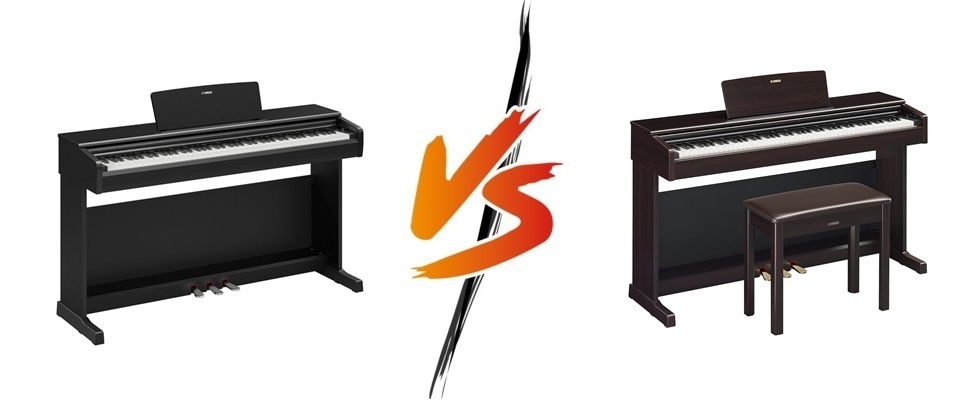
Looking at the Yamaha YDP-146 and YDP-145, you’re probably after something more serious than a basic portable keyboard. Both are full-size 88-key digital pianos in Yamaha’s ARIUS furniture-style range, meant to be a permanent room fixture, provide a reasonably convincing piano experience. And provides enough features for a beginner or intermediate player to use for years.
At first glance, they seem very similar. They both have 88 weighted keys, three pedals, Yamaha’s CFX concert-grand piano sound, 192-note polyphony, 10 voices, 353 built-in songs, USB connectivity, and the same cabinet dimensions. So, the YDP-145 isn’t dramatically outclassed by the YDP-146.
But there’s a catch: the YDP-146 currently sold by Yamaha is a newer-generation model than the YDP-145, and Yamaha’s specs give the 146 some important updates, most Bluetooth connectivity, USB audio functionality and redesigned speaker grilles. Yamaha’s current European/US documentation lists the YDP-146 with Bluetooth Audio/MIDI, a 44.1 kHz/24-bit stereo USB audio interface and 12 cm speakers with diffusers.
That makes this comparison more interesting than the model numbers suggest.
The YDP-145 is still a very capable digital piano. It has the same GHS keyboard, CFX-based piano sound, VRM Lite resonance modelling, three-pedal setup, and 192-note polyphony. Yamaha also gives it some useful practice features, like Duo mode, Dual mode, recording, and compatibility with the Smart Pianist app.
Which one should you buy?
That short version is: the YDP-146 is more complete and future-proof, while the YDP-145 becomes particularly attractive when you can buy it substantially cheaper. If the price difference is small, I’d choose the YDP-146. If you find a heavily discounted YDP-145, however, it can represent excellent value because the fundamental piano-playing experience is much closer between the two than the model numbers might suggest.
Now, let’s get into the details.
Yamaha YDP-146 vs Yamaha YDP-145 Comparison Table
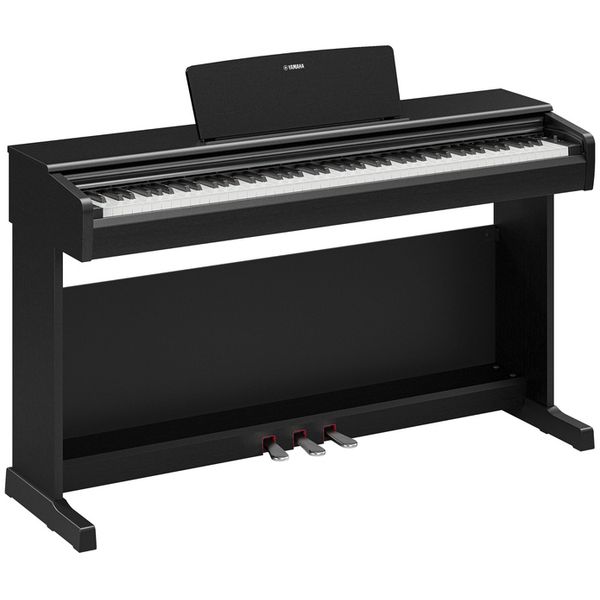
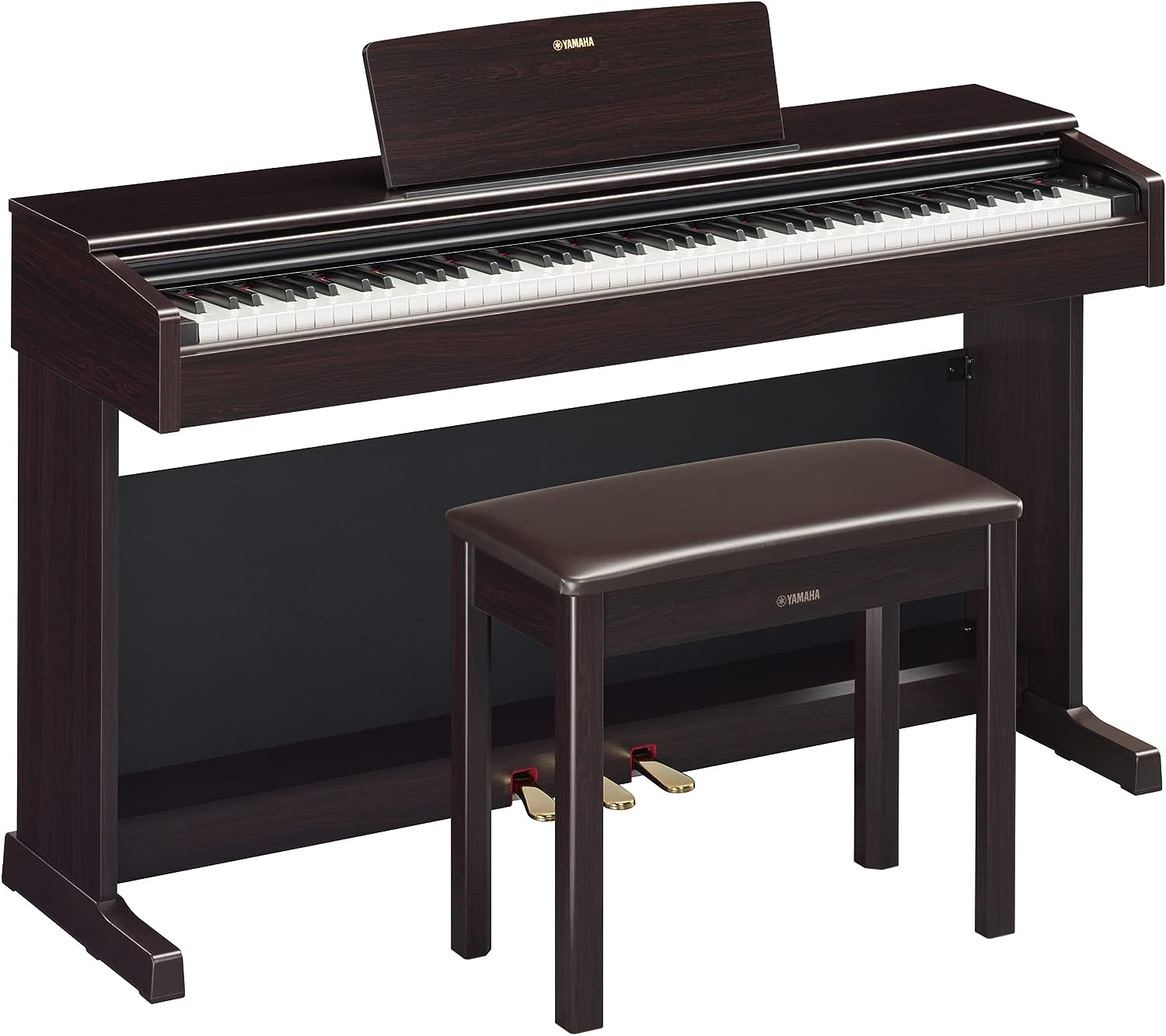
The Yamaha YDP-146 and YDP-145 share many of the same core specifications, including the 88-key GHS keyboard, Yamaha CFX piano sound, 192-note polyphony, 10 voices, and 353 built-in songs. The main differences are in the speaker design and connectivity, with the YDP-146 adding diffuser-equipped speakers, Bluetooth Audio/MIDI, and USB audio functionality.
If you click the links below, under the product images, you will be redirected to Amazon.com. In case you then decide to buy anything, Amazon.com will pay me a commission. This doesn’t affect the honesty of this review in any way though.
| Specification | Yamaha YDP-146 | Yamaha YDP-145 |
|---|---|---|
 |  | |
| Check the best price on Amazon | Check the best price on Amazon | |
| Product type | ARIUS digital piano | ARIUS digital piano |
| Number of keys | 88 | 88 |
| Keyboard action | GHS (Graded Hammer Standard) | GHS (Graded Hammer Standard) |
| Keytops | Matte black | Matte black |
| Touch sensitivity | Hard / Medium / Soft / Fixed | Hard / Medium / Soft / Fixed |
| Piano sound | Yamaha CFX | Yamaha CFX |
| Virtual Resonance Modeling | VRM Lite | VRM Lite |
| Maximum polyphony | 192 notes | 192 notes |
| Number of voices | 10 | 10 |
| Reverb | 4 types | 4 types |
| Intelligent Acoustic Control | Yes | Yes |
| Stereophonic Optimizer | Yes | Yes |
| Dual/Layer mode | Yes | Yes |
| Duo mode | Yes | Yes |
| Preset songs | 353 | 353 |
| Voice demo songs | 10 | 10 |
| Classical songs | 50 | 50 |
| Lesson songs | 303 | 303 |
| Built-in recording | 1 song | 1 song |
| Recording tracks | 2 | 2 |
| Metronome | Yes | Yes |
| Tempo range | 5–280 BPM | 5–280 BPM |
| Transpose | −6 to 0 to +6 | −6 to 0 to +6 |
| Tuning | 414.8–440.0–466.8 Hz | 414.8–440.0–466.8 Hz |
| Pedals | 3 | 3 |
| Damper pedal | Half-pedal capable | Half-pedal capable |
| Sostenuto pedal | Yes | Yes |
| Soft pedal | Yes | Yes |
| Speakers | 2 × 12 cm with diffuser | 2 × 12 cm |
| Amplification | 2 × 8 W | 2 × 8 W |
| Bluetooth | Audio + MIDI* | No |
| USB audio interface | 44.1 kHz / 24-bit stereo | No |
| USB to Host | Yes, Type B | Yes |
| Headphone outputs | 2 | 2 |
| Smart Pianist compatibility | Yes | Yes |
| Width | 1,357 mm | 1,357 mm |
| Height | 815 mm | 815 mm |
| Depth | 422 mm | 422 mm |
| Weight | 38 kg | 38 kg |
| Key cover | Sliding | Sliding |
| Music rest | Yes | Yes |
| Auto power-off | Yes | Yes |
| My individual reviews | Yamaha YDP-146 review | Yamaha YDP-145 review |
Key differences at a glance
| Area | YDP-146 | YDP-145 |
|---|---|---|
| Keyboard feel | Essentially the same GHS action | Essentially the same GHS action |
| Piano sound | CFX + VRM Lite | CFX + VRM Lite |
| Speaker presentation | 12 cm speakers with diffuser | 12 cm speakers |
| Wireless connectivity | Bluetooth Audio/MIDI* | No Bluetooth listed |
| USB audio | Yes, 44.1 kHz/24-bit stereo | No |
| Core piano features | Very similar | Very similar |
| Physical size | Same | Same |
| Weight | Same | Same |
The important takeaway is that the YDP-146 is not a major upgrade in keyboard action or core piano sound. Both use the same GHS action, CFX piano voice, VRM Lite, 192-note polyphony and 10-voice sound set. The newer YDP-146’s most significant advantages are its diffuser-equipped speakers and expanded connectivity.
This makes the comparison quite straightforward: the YDP-145 offers most of the fundamental piano experience of the YDP-146, while the YDP-146 adds modern connectivity and some audio refinements.
Design & Build Quality
The Yamaha YDP-145 and YDP-146 appear very similar at first, which isn’t bad. They both follow Yamaha’s ARIUS design: the look is restrained, they fit in a living room. And the focus is on the piano, not lots of buttons, screens, and lights. As furniture-style digital pianos, they’re meant to stay in one place, becoming part of the room, rather than being packed up after each practice session.
The YDP-145 and YDP-146 are distinct from portable digital pianos. They don’t have a detachable stand or a lightweight body. What you get is an upright-style cabinet with a music rest, key cover, and three-pedal assembly all in one. This setup feels like a conventional piano, both for looks. And physical feel.
They’re almost identical for basic physical dimensions, with Yamaha listing both at about 135.7 cm wide, 81.5 cm high, and 42.2 cm deep, and a weight of around 38 kg. This makes them fairly compact for furniture-style digital pianos, and they don’t dominate a room like a full acoustic upright can. They’re not portable, but that’s not what they’re designed for; they’re meant to be a compact, furniture-style option.
It has a deliberately understated appearance
The restrained design is a key strength of both pianos, and it’s what really sets them apart.
Yamaha made a conscious decision not to give these instruments a futuristic appearance. You won’t find a big LCD screen above the keyboard, or a complex control panel with synthesizer knobs and sliders. The controls are actually pretty understated. From a distance, the piano looks more like a furniture piece than a consumer electronics device.
It matters when the piano is going in a living room or another shared space. Inexpensive digital keyboards often have a look that screams “electronic keyboard on a stand”. That’s not inherently bad, but it can give off a temporary vibe.
The YDP-145 and YDP-146 don’t have that problem.
The instrument looks like an upright piano when the keyboard cover is closed. It’s a different story when you open the cover and sit down, it’s now a musical instrument, not just something in the room.
Its design won’t go out of style soon. No fashionable curves or decorative details that might look old after a few years here.
Yamaha opted for a classic cabinet look, which is sensible for a piano, something you’ll likely keep for a long time.
Cabinet construction
Cabinets on these models are substantial enough for what they’re made for.
Weighing 38 kg, these instruments feel stable, largely due to their physical mass. Playing normally, the piano doesn’t seem precarious on its stand. It’s the integrated construction that gives the keyboard and pedal assembly a solid, more permanent feel.
This becomes noticeable when the pedals are used.
Pressing a sustain pedal on a portable keyboard is a reminder that you’re using a lightweight electronic instrument. It can make the pedal slide around and the stand move slightly, which makes the setup feel disconnected.
The pedal assembly on the YDP-145 and YDP-146 is integrated into the cabinet. This means that once the piano is in place, the pedals stay put.
This detail may be small, and it matters because it contributes to the overall quality impression.
It’s not about comparing these to top-of-the-range digital pianos from Yamaha, as that’s a different category altogether. You won’t find luxurious materials or detailed woodworking like those on expensive acoustic instruments or high-end digital grands. Functionality is the focus of the construction, rather than extravagance.
The price category makes this suitable.
I would much rather Yamaha allocate its budget to the keyboard mechanism, sound system, and electronics instead of using it for decorative woodwork on an entry-level digital piano.
Room placement and size
That dimensions are another strength.
They’re relatively compact, at roughly 1.36 metres wide. A dedicated location is still needed for both pianos, but they don’t require as much space as a traditional upright piano.
What’s also useful is the depth, about 42 cm, which means the piano doesn’t project very far into a room.
Against a wall, one can be placed without using a lot of floor space.
This matters in smaller apartments or bedrooms.
It’s relatively modest in height. The piano stands at just over 81 cm to the top of the main cabinet, giving it a lower profile than a typical upright. This makes it easier to blend into modern spaces, and it doesn’t feel like a large wooden object is dominating the room.
Obviously, the big trade-off is portability.
Moving a YDP-145 or YDP-146 isn’t something you’ll want to do often, it’s a big job. Weighing about 38 kg, it’s heavy, and you’ll probably need someone to help you if you’ve to carry it up stairs or move it to another room.
Choosing a furniture-style piano means it’s going to be heavy, that’s all.
If portability is important, neither model is the right type of instrument. If you’re looking for something to live permanently in one room, the weight becomes an advantage.
Keyboard cover
The sliding key cover is one of those features that’s easy to overlook when reading specifications but becomes useful in everyday life.
You can close the cover over the keys when the piano isn’t being used. This keeps dust and debris away, and it makes the instrument look tidier.
It’s a genuine advantage for households with a piano in the living room.
Digital pianos can accumulate a lot of dust around the keys if they’re left uncovered for months. Keeping the keyboard protected when it isn’t being played reduces that problem.
It also has a psychological benefit. With the keys hidden, it looks like a finished piece of furniture, not an electronic device waiting to be used.
It’s a subtle but good design choice.
Music rest
Both models have a simple, integrated music rest.
You can put sheet music or other materials in front of you without needing a separate stand.
That’s exactly what you want for traditional sheet-music practice.
It’s also useful for following lessons on a tablet or using digital scores. The music rest is part of the cabinet, so it doesn’t take up extra floor or desk space.
An integrated music rest isn’t as flexible as a large, adjustable professional music stand. You’ll notice the difference if you’re using a large book, multiple scores, or several devices at once.
It’s more than adequate for ordinary piano practice.
Pedal assembly and physical stability
That three-pedal unit is another important part of the design.
Both instruments have the conventional
Damper pedal
Sostenuto pedal
Soft pedal
The pedals are mounted in the cabinet, not hanging from a portable keyboard stand.
This makes the playing position feel more natural.
The physical arrangement also means you can sit down, put your feet in about the same position you’d expect on an acoustic piano and start playing. You don’t need to position a separate sustain pedal each time.
The damper pedal supports half-pedaling, which is important because the pedals aren’t just decorative. They’re intended to provide a more expressive playing experience.
This integrated approach makes the piano feel like a single instrument, not separate components.
Speaker integration
The speakers are built into the cabinet, and Yamaha considered how sound escapes.
The YDP-145 has a two-speaker system with 12 cm units and 8 W + 8 W amplification. Yamaha’s design incorporates sound-escaping construction to project sound naturally into the room.
The YDP-146 has the same amplification arrangement but adds speaker diffusers. These diffusers help disperse sound and improve clarity, especially in higher frequencies.
This change gives the YDP-146 a meaningful advantage over the YDP-145.
It’s not a dramatic redesign, and the 146 won’t be twice as loud. That amplifier is still 8 W per side.
The emphasis is on how sound reaches the listener.
This is a sensible decision for a home digital piano. Increasing power isn’t the best way to improve the listening experience. Better dispersion can make the piano sound more balanced around the room without simply making it louder.
YDP-145 vs YDP-146: is the newer model better built?
The YDP-146 isn’t dramatically better built than the YDP-145, in my opinion.
Physically, they’re very similar. And neither is a radical redesign.
A more accurate description is that the YDP-146 refines the same basic design.
Yamaha has kept the furniture cabinet, dimensions, weight and overall philosophy while updating some of the internal and acoustic technology.
This is reassuring if you’re considering the YDP-145.
The YDP-145 doesn’t feel obsolete or flawed. The YDP-146 is more of an evolution.
Finishes and visual appeal
Depending on the market, Yamaha offers these pianos in different finishes, so availability should be checked with the particular retailer. Black and white versions are commonly associated with the range, while finish availability can vary by country.
The choice is mostly aesthetic.
A black cabinet tends to give the piano a more traditional appearance, while a white finish can make the instrument feel somewhat lighter visually and work well in modern interiors.
Either way, the design is understated.
And that’s precisely why I think it ages well.
If you’re spending a significant amount on a piece of furniture that’s likely to stay in your home for five, ten or more years, understated is generally preferable to trendy.
This overall impression
After considering the pianos as physical objects, I think Yamaha made a sensible trade-off.
Neither piano pretends to be a handcrafted acoustic upright. They’re digital pianos. Yamaha gave them a physical presence and stability like a home piano.
The cabinets are compact enough for normal domestic spaces, the integrated pedal system feels much better than a loose external pedal, the key cover is practical, the music rest is convenient and the overall appearance is restrained enough to fit into most rooms.
The YDP-146 has a modest advantage with its updated speaker design and contemporary technology.
But there’s no compelling reason to choose the YDP-146 purely because you think its cabinet is dramatically superior.
It isn’t.
Design & Build Quality verdict
If I were judging only the physical design, I’d call this a very close contest.
The YDP-145 gets the basics right: solid cabinet, sensible dimensions, integrated pedals, key cover, music rest, and it doesn’t look cheap.
The YDP-146 takes essentially the same successful formula and refines it. The speaker diffusers are an improvement, and the construction is familiar.
That bigger question isn’t whether the YDP-146 is better built. It’s whether the extra features justify the price premium.
If the two models are sitting next to each other with only a small price difference, I’d lean toward the YDP-146 because you’re getting the newer implementation and more modern overall package.
If the YDP-145 is much cheaper, I’d buy it without hesitation. You’re not sacrificing cabinet quality or usability. You’re getting the same concept, but without some newer features.
In other words, the YDP-146 is the more refined design, but the YDP-145 isn’t a physically inferior instrument. The difference is about modernization, not construction quality.
For a home digital piano, that’s a good result for both models.
Keyboard and Playing Feel
If you’re buying a digital piano primarily to learn, practice or simply enjoy playing piano, the keyboard is arguably the single most important part of the instrument. Speakers can be upgraded, sounds can be changed and connectivity can be added with external equipment but the keys are where you physically interact with the piano every time you play.
That comparison between the Yamaha YDP-145 and YDP-146 is interesting, as the newer model doesn’t drastically change the keyboard action. Both pianos use Yamaha’s GHS action, which features 88 full-size keys and matte-finished black keys. Yamaha didn’t use the YDP-146 to introduce a new class of keyboard mechanism.
This is good news for buyers. The YDP-145 has a weighted piano action, and the YDP-146 builds on that. If you’re choosing between the two, the decision should therefore be based much more on price, connectivity and other refinements than on an expectation that the YDP-146 will feel radically different under your fingers.
The keyboard matters
Even with great samples and speakers, a digital piano can be frustrating if the keyboard doesn’t respond naturally.
The opposite is also true. A good keyboard can make a relatively modest digital piano enjoyable because your fingers receive predictable feedback and the instrument responds to variations in your playing.
This is especially important when learning.
When you press a key on an acoustic piano, it doesn’t just produce a set sound. How you press the key affects the hammer’s behavior, which in turn affects the note’s volume and character. Digital pianos reproduce this relationship electronically.
The YDP-145 and YDP-146 achieve this with their weighted GHS actions and velocity-sensitive sound.
Neither is intended to compete directly with Yamaha’s most sophisticated digital piano actions, but both are designed to give you the basic physical experience of playing an acoustic piano rather than that of playing a lightweight electronic keyboard.
The proper piano layout has 88 keys
Both pianos have the full 88-key range of a conventional piano.
This is worth noting for beginners.
Keyboards with 61 or 76 keys are useful for certain types of music. For learning traditional piano repertoire, an 88-key instrument makes more sense.
With 88 keys, you won’t need to adjust your hand position, and you can practice pieces as written.
The YDP-145 and YDP-146 offer the right physical range for beginner exercises to classical repertoire.
You probably won’t use the extreme ends of the keyboard very often as a beginner, but having them available means the instrument won’t become restrictive as you progress.
What’s GHS?
GHS honestly means Graded Hammer Standard.
There are two important ideas contained in that name.
First, the keys are weighted to simulate an acoustic piano’s action.
Second, the weighting is graded across the keyboard.
Lower keys are heavier, and higher keys are lighter.
This is based on an acoustic piano’s behavior, where the bass section has larger, heavier components than the treble section.
A uniform keyboard can feel artificial to a pianist used to an acoustic piano. This graded weighting on the YDP models provides a more familiar response.
You notice this when moving quickly from the bottom to the top of the keyboard. The bass and treble don’t feel the same.
This technology is relatively simple, but it makes a big difference compared to an unweighted keyboard.
GHS is a good action,
Yes, particularly at this price level.
However, there’s an important qualification: GHS is Yamaha’s entry-level weighted action, not its premium action.
Buyers should understand this before spending their money.
More expensive instruments have Yamaha’s more advanced mechanisms, like GH3 and GrandTouch actions. Those mechanisms can provide greater refinement in areas such as repetition, control and subtle dynamic response.
The YDP-145 and YDP-146 don’t compete with those higher-end keyboards.
That’s okay.
GHS provides enough resistance for beginners to develop proper finger technique and enough dynamic response for expressive playing.
It’s also usable for intermediate players.
However, advanced pianists used to high-end acoustic grands will notice the limitations more easily.
That keys lack the sophistication and nuanced mechanical response of Yamaha’s more expensive actions.
The YDP-145 feels
The YDP-145 has a reasonably firm, controlled, and clearly weighted feel, typical of Yamaha’s GHS.
It’s noticeably different from a cheap synth-style keyboard. You feel resistance when you press a key, rather than just pushing down a lightweight plastic lever.
This resistance is important for piano technique practice.
You can practice finger strength, articulation, scales, arpeggios, and chord voicing without feeling completely disconnected from an acoustic piano’s mechanics.
This weighting is also graded; the lower register has more resistance than the upper register.
This is one of the YDP-145’s strongest selling points for beginners.
You aren’t buying an electronic keyboard that happens to have 88 keys. You’re buying an instrument that encourages piano technique.
The YDP-146 feels
It’s very similar.
The keyboard is still GHS, so the physical response isn’t dramatically different.
That’s important because it’s easy to assume a higher model number means a substantially better keyboard.
It doesn’t mean that.
Don’t expect the 146 to feel like a professional Yamaha grand just because it’s beside the 145.
The two are much closer than that.
The YDP-146’s advantages are elsewhere, like its connectivity and updated speaker system.
If key feel is your main concern, the YDP-146 might not be worth the premium.
If the keyboard is your primary concern, the money might be better spent moving to a digital piano with a genuinely more advanced action.
Touch sensitivity is
You can adjust the touch response on both pianos.
Yamaha offers four settings:
Soft touch
Medium touch
Hard touch
Fixed touch
This is useful since there’s no one correct keyboard response.
A beginner with a relatively light touch may find the default setting comfortable.
A stronger player might prefer a harder response, which requires more physical input for higher volume.
The soft setting can make it easier to produce louder sounds without striking the keys particularly hard.
The fixed setting is different; it removes normal velocity sensitivity. It’s not generally the setting you’d want for conventional piano playing, but it can be useful for particular applications.
You’ve options, which is important.
Why touch settings matter
Two players sit at the same piano.
One plays very lightly.
The other is more aggressive.
One of them would find it uncomfortable if the keyboard responded the same way to both.
You can adjust how physical effort affects digital velocity with touch-response settings.
For beginners, I would recommend starting with the normal/medium setting rather than immediately changing things.
That default setting provides a baseline for developing technique.
As you become more experienced, experimenting with the other settings can help you determine what feels most natural.
That keys are matte black
Both have matte black keys.
This may sound like a minor cosmetic detail, but the texture can affect playing comfort.
Glossy plastic can become slippery, particularly during longer practice sessions or if your hands become warm.
That matte finish gives a better grip. And makes the keys feel less toy-like.
It looks like a serious piano’s surface treatment.
It’s a nice detail. But it won’t transform your playing.
Dynamic control
One of the most important tests of a digital piano action is whether you can play quietly as well as loudly.
Inexpensive digital pianos can produce loud notes when you hit the key hard.
The more difficult challenge is getting convincing control at the lower end of the dynamic range.
The YDP-145 and YDP-146 are respectable, not revolutionary.
The GHS actions and CFX sound engine give you enough control for expressive playing.
You can play softly or forcefully.
You can shape your phrases.
You can emphasize the melody over the accompaniment.
You can practice changing dynamics gradually.
An experienced pianist may notice the response isn’t as nuanced as a high-end acoustic or digital mechanism.
That’s a compromise to keep the YDP range affordable.
Repetition and fast playing
Advanced pianists may notice GHS limitations in rapid repetition.
Professional piano actions allow fast repeated notes with precise control.
The YDP-145 and YDP-146 can play fast, but they’re not substitutes for high-end concert-piano actions.
For ordinary repertoire, this isn’t likely to cause a problem.
Beginners working through scales and simple pieces have enough capability.
As your technique becomes highly advanced, however, you may start noticing differences in the speed and physical behavior of the action.
That’s a reflection of the price category, not a flaw.
Key noise honestly matters
Digital pianos have mechanical noise.
Weighted keys inevitably make some physical sound when they’re pressed.
The YDP models are reasonably quiet, but not silent.
The speaker sound dominates at normal volume.
When you’re using headphones late at night, however, the physical noise of the keys can become more noticeable.
That’s true of weighted digital pianos generally.
It’s worth remembering that “silent practice” means silent to the people in the next room; it doesn’t mean the keys themselves produce absolutely no physical sound.
Pedal response and feel natives to the keyboard
The keyboard and pedals are connected.
A good piano action combined with an inadequate pedal system would still be limiting.
Both YDP models have three pedals and support half-pedaling.
It’s useful for classical music.
A sustain pedal is either on or off.
Half-pedaling gives more control.
You can lift the dampers partway and sustain some sound.
It may not seem important to beginners.
It becomes valuable as you play more.
Duo mode
Both models have Duo mode, dividing the keyboard into two identical ranges.
It’s mainly a teaching feature.
A teacher and student can sit beside one another and play the same notes without having to occupy opposite ends of the keyboard.
It’s a clever use of the 88-key layout and another example of Yamaha designing these instruments primarily around actual piano playing rather than trying to turn them into general-purpose keyboards.
For a child learning with a teacher or parent, this can be particularly useful.
Playing position
The construction affects playing feel.
Because the keyboard is integrated into a fixed cabinet, the instrument doesn’t move around as you play.
Stability makes a difference, even if it’s obvious.
A portable keyboard on a lightweight stand can shift when playing or using pedals.
The YDP-145 and YDP-146 feel like fixed instruments.
You can sit down, put your feet on the pedals, and play consistently.
Consistency helps with learning.
The YDP-145 vs YDP-146: which one comes out on top?
When it comes specifically to the keyboard and playing feel, this is probably the easiest section of the comparison to call.
No clear winner emerges.
They both use GHS.
Both have 88 keys, too.
And they both use graded weighting.
This keytops are matte black on both.
They both offer adjustable touch sensitivity.
Both also have three pedals with half-pedaling.
The YDP-146 isn’t a huge leap forward in keyboard tech.
It’s worth noting that marketing language can create unrealistic expectations.
If you own a YDP-145, don’t expect a much better action from the YDP-146; it’s not worth the upgrade.
You would be spending money for a relatively small change in the actual playing mechanism.
But for a first piano, both are good options.
Beginners will notice
A beginner will probably notice three things immediately.
The keys are heavier than on a normal electronic keyboard.
The bass and treble feel different due to graded weighting.
And the instrument responds differently to pressure.
Those are the characteristics you want for learning piano.
That action provides enough resistance without being too heavy.
Individual preferences vary, of course. Some prefer lighter actions; others like more resistance.
That’s why, if possible, I would always recommend physically trying a weighted piano before buying it.
Specifications can tell you that an instrument uses GHS.
But they can’t tell you if you’ll like the feel.
Intermediate players will notice
Intermediate players are more likely to appreciate the consistency of the action.
At this stage, you’re probably playing more dynamically and using the pedals more deliberately.
The GHS action is capable of handling that.
You can work on articulation, phrasing, chord balance, and dynamic contrast.
You may notice its limits.
It won’t provide the same subtle feedback as a more expensive Yamaha.
But it’s capable enough not to hold you back.
Advanced pianists will notice
An advanced pianist will probably be more critical.
If you’ve spent years playing acoustic grands or high-end digital pianos, the GHS action can feel comparatively basic.
You may notice differences in
repetition speed, for one
key return, too
fine velocity control, also
subtle dynamic response, as well
and overall mechanical refinement.
This doesn’t mean the YDP-145 or YDP-146 is unsuitable for advanced players.
You just need realistic expectations.
An occasional advanced player may be happy with either.
A conservatory student may prefer a more sophisticated action, given their practice schedule.
The key takeaway for buyers
The most important thing I take from the keyboard comparison is that Yamaha has resisted the temptation to make the YDP-146 dramatically more complicated.
The company has kept the same fundamental GHS action because it remains appropriate for this class of instrument.
That makes the YDP-145 more competitive than its age might suggest.
This older model isn’t inferior.
The YDP-146 is more modern in other ways, but the action is essentially the same.
Final verdict on the keyboard
It’s a draw if keyboard feel is the deciding factor.
The YDP-145 has a solid, weighted 88-key action suitable for beginners, intermediate players, and experienced pianists who don’t need premium.
The YDP-146 provides the same foundation.
This isn’t a criticism of the 146, though. In fact, it’s one of the reasons I think both instruments make sense. Yamaha improved the newer model in areas like connectivity and audio, not just the GHS action.
Neither piano has a premium keyboard. If the most realistic possible piano action is your number-one priority, I’d look beyond both models toward a Yamaha equipped with a more advanced action, even if that honestly means buying a different model altogether.
For others, GHS is a sensible compromise.
It’s weighted, graded, and expressive enough for serious practice. The three-pedal setup and half-pedaling support complete it nicely.
Don’t expect the YDP-146 to feel like a high-end Yamaha grand. It doesn’t.
Instead, choose based on the overall package and, most, the price difference. If the YDP-145 is discounted, its keyboard is a strong reason to consider it. You’re getting essentially the same fundamental playing experience as the newer YDP-146 while potentially spending considerably less.
If they’re similarly priced, the YDP-146 makes more sense.
Either way, the good news is that you’re starting with the part of a digital piano that matters most: a full-size, properly weighted Yamaha keyboard that gives you a credible foundation for learning and enjoying the instrument for years.
Sound
The Yamaha YDP-145 and YDP-146 are hard to tell apart on paper, especially when it comes to sound. Both are built around Yamaha’s CFX concert-grand piano sound, both use Virtual Resonance Modeling Lite (VRM Lite). And both offer 192-note polyphony. So they share the same philosophy: focusing on a convincing piano voice instead of hundreds of sounds.
That’s the right priority.
You’ll likely spend most of your time playing piano sound on an ARIUS piano. You might occasionally switch to electric piano, strings or organ, but the quality of the main piano voice is what you’ll hear for hundreds of hours. A digital piano can have fantastic connectivity and a beautiful cabinet, but if the piano sound is uninspiring, you’ll eventually notice.
The good news is that neither the YDP-145 nor YDP-146 has that problem. They both produce a convincing piano sound with varying dynamics and resonance, making playing feel more natural than on a basic keyboard.
This differences are relatively subtle. The YDP-146’s speaker system gives it an advantage in how that sound is presented in a room, but the underlying character of the piano sound is much closer between the two models than the model numbers might suggest.
Yamaha’s CFX concert-grand sound
The CFX piano voice is the centerpiece of both instruments.
Yamaha’s CFX is a distinctive instrument. The CFX sound has clear highs, powerful bass, and a broad range.
That’s a fair description.
The resulting digital piano voice has a character that I would describe as clear and energetic rather than excessively dark or soft. The upper register is defined, and the lower register has enough weight to prevent thinness.
Tonal balance is important for versatility.
A very bright piano can work beautifully for some classical pieces but become tiring during extended practice.
A very mellow piano can sound beautiful in slow music but lose definition during fast passages or dense chords.
The CFX sound is in the middle. It has enough brightness to articulate individual notes while retaining sufficient body for chords and lower-register passages.
The CFX sample matters
That phrase “sampled from a concert grand” can sound like marketing language, but there is a practical reason it matters.
A concert grand has a huge tonal palette.
A single note isn’t simply “piano.”
The character changes depending on playing style, keyboard position, string resonance, and sustain pedal use.
A good digital piano captures those characteristics so you don’t feel like you’re playing an electronic instrument.
The YDP-145 and YDP-146 can’t replicate every aspect of a real CFX grand. But they offer a more sophisticated starting point than generic samples on cheap keyboards.
For a learner, it matters because you’re not just practicing notes. You’re learning sound shaping.
Dynamic response is one of their strengths
They’ve great dynamic response.
Softly played notes are softer.
Harder key strikes are louder and more forceful.
The transition quality is what separates a convincing digital piano from a basic keyboard.
You want to play quiet melodies over loud accompaniments.
You want chords to grow gradually, not suddenly.
You want strong accents to sound intentional, not just louder.
The YDP-145 and YDP-146 have enough velocity sensitivity for this.
They’re not at the level of Yamaha’s most sophisticated digital instruments, where the dynamic behavior can become exceptionally nuanced, but they’re certainly capable of expressive playing.
For a beginner or intermediate pianist, there’s plenty of room to develop.
VRM Lite and resonance
Yamaha’s VRM Lite technology is the next key part of the sound equation.
VRM means Virtual Resonance Modeling.
An acoustic piano produces a lot more sound than just the note for the key you press.
When you press a key on an acoustic piano, the strings vibrate. Other strings can respond sympathetically. And the soundboard vibrates too. The position of the dampers changes. Pedal use alters the way the instrument resonates.
VRM Lite attempts to simulate some of those interactions digitally.
That’s why the piano doesn’t sound as static as a basic sample playback system.
For example, when you play a chord and use the sustain pedal, you get a more complex sonic environment than you would from a basic keyboard simply holding every note at the same volume.
You notice this extra complexity especially when playing slowly or using the sustain pedal a lot.
What VRM Lite doesn’t do
But it’s also important not to overstate what the technology can do.
VRM Lite doesn’t make the YDP-145 or YDP-146 a digital equivalent of an acoustic grand.
There are differences still.
An acoustic piano has thousands of mechanical and acoustic components that interact. Its sound changes continuously depending on the physical condition of the instrument, the room and the precise behavior of the pianist.
Digital modeling is just an approximation.
It’s a good one in this case, but an approximation nonetheless.
For the price, VRM Lite adds realism without needing a lot of processing power or complexity like more expensive instruments do.
Bass response
This bass register is important when judging a digital piano.
A weak bass can make the entire instrument feel small.
The YDP models have enough low-end weight to give the piano a good foundation.
The 12 cm speakers aren’t huge, so don’t expect the impact of a large acoustic grand. But the bass notes have enough presence for playing at home.
This is useful especially when playing left-hand octaves or big chords.
The lower register feels connected to the rest of the instrument, not like a separate speaker system.
The YDP-146’s speaker refinements may give it a slight advantage in overall presentation, but the difference isn’t night and day.
Treble response
Then there’s the treble.
The upper register needs to be clear, not painfully bright.
The CFX voice handles this well enough.
You can easily distinguish individual notes, which helps when playing fast passages.
Yamaha’s redesigned speaker diffusers on the YDP-146 are intended to improve high-frequency dispersion, allowing the treble to remain clearer when you’re not sitting directly in front of the speakers.
That’s a useful change.
The thing is, the YDP-146 doesn’t have a completely different treble voice. Rather, it can present the existing sound more effectively around the room.
YDP-145 sound through headphones
The headphone experience is arguably one of the most important parts of owning a digital piano.
If you’re practicing in an apartment, sharing a house or playing late at night, you may spend a lot of time wearing headphones.
Both instruments are designed with this in mind.
Yamaha’s Stereophonic Optimizer makes headphone playback feel more natural by changing the sound’s position. The sound has a greater sense of spatial separation, rather than feeling like it’s being played right into your head.
This may sound like a small detail.
But it’s not.
Poor headphone piano can become tiring surprisingly quickly.
A piano is a large acoustic instrument, and listening to a completely dry stereo recording through headphones can feel unnatural.
The YDP’s processing makes practicing with headphones more comfortable.
Sound quality is good through headphones on the YDP-146.
The YDP-146 uses a headphone-oriented approach.
This difference between the two models becomes smaller if you’re mainly using headphones, which makes this comparison worth considering.
Speaker improvements on the YDP-146 are of little consequence when the speakers aren’t in use.
That situation brings you much closer to the same underlying piano sound experience.
For apartment dwellers who practice almost exclusively through headphones, the premium for the YDP-146’s speaker system may not be worth it.
Connectivity features are a strong point. And they might be enough to justify this. But the acoustic advantage doesn’t carry as much weight.
Additional voices exist
Piano takes center stage, but both models come with 10 instrument voices.
More sounds are also included, such as piano and electric-piano sounds, organs, strings, and other voices.
Variety is what they’re useful for.
Using an electric piano sound is a lot of fun for playing pop or jazz.
Layering strings with piano creates a larger cinematic texture.
An organ voice is another option to try out for different tones.
I’d advise prospective buyers not to overestimate their importance.
The YDP models can seem almost primitive when compared to a synthesizer that offers hundreds of sounds.
They’re not trying to be synthesizers.
Yamaha’s central philosophy is clear: a piano should be a piano first, and the small selection reflects this approach.
Dual voice mode and sound layering
You can combine two voices using dual mode.
Piano plus strings is probably the obvious example.
Playing ballads or slower pieces is particularly enjoyable with this, as it produces a fuller, more atmospheric sound.
It offers creative flexibility too, and you don’t need a computer or synthesizer outside of it.
It’s more of a bonus than a core feature, still.
Owners will likely use one of the piano voices for most of their playing time.
Reverb
Four reverb types are offered by both instruments.
A completely dry piano sounds strangely close and clinical, which is why reverb matters.
An acoustic piano exists in a room naturally. Sound bounces off the floor, walls, and ceiling, creating space.
Digital reverb lets you simulate some environment.
Adding a subtle sense of room ambience is an option, or you can create a larger impression, similar to a concert hall.
This important thing is restraint.
Reverb can make a piano sound impressive, but only for a short time, and then it becomes clear that every chord has the same artificial echo, which gets old quickly.
I’d generally favor a relatively modest setting for everyday playing.
192-note polyphony
The YDP-145 and YDP-146 have 192-note polyphony.
That number is substantial for a digital piano.
Polyphony is about how many notes an instrument can play at the same time before it may have to stop playing some of the older ones.
Heavy sustain-pedal use and complex playing on a basic digital piano with low polyphony can cause notes to cut out early.
Having 192-note polyphony makes that concern pretty minor.
Playing large chords is straightforward, and you can also use the sustain pedal and layer voices, all without worrying that you’ll run out of notes.
192 notes is plenty for normal solo piano playing.
Practically, the polyphony specification is the same for both, so I don’t think it’s a key factor in deciding between them.
The sound quality of the YDP-145 is what it’s all about and it’s actually very
After playing the YDP-145 for a bit, its sound becomes convincing and it doesn’t feel like a compromise anymore.
The CFX voice delivers enough detail and dynamic variation at moderate volume to encourage expressive playing.
It’s versatile enough to fit different styles.
Clarity benefits classical pieces.
Directness benefits pop and contemporary songs.
Slow pieces sound quite warm with the right dynamics and moderate reverb.
Limitations are more about the physical than the electronic side.
These are essentially 12 cm speakers in a compact digital-piano cabinet that you’re listening to.
A real concert grand moves a tremendous amount of air.
The YDP-145 can’t reproduce that physical scale.
No clever sampling can overcome that limitation completely.
The sound quality of the YDP-146 is what matters. So how does it sound?
The YDP-146 has the same basic sound, but its speaker presentation is better.
A diffuser-equipped speaker design is used to spread sound more naturally.
That’s a big deal when you’re several feet away, or if you’re sitting off to the side or in a bigger room.
It doesn’t necessarily change the piano tone completely. The tone feels more evenly distributed, that’s the main difference.
The distinction is important.
The difference is considerably less obvious when comparing the two through headphones.
The 146 has a stronger case when compared using their built-in speakers in the same room.
Can digital pianos replace an acoustic piano?
Absolutely, for practice.
Emotional and physical realism, not entirely.
The immediacy of an acoustic piano is hard to match.
Sound resonates from the soundboard vibrating through the cabinet. Mechanical movement of the action happens, and strings interact with the room. The tiny variations from one note to the next also matter, and they all contribute.
The physical experience is different, despite the YDP models providing a very good approximation of the musical result.
For many home players, the distinction between digital and acoustic pianos matters less now that digital piano technology has advanced.
A badly maintained or severely out of tune inexpensive acoustic upright may not be the best choice, and in this case, a YDP-145 or YDP-146 could provide a more consistent sound, and you’ll probably enjoy playing it more.
YDP-145 and YDP-146 sound comparison
I’d summarize the difference like this:
The core piano sound is where the YDP-145 gets it right.
The YDP-146 delivers sound more effectively due to its updated speaker system.
The technology used in both instruments, CFX foundation and VRM Lite, shares many similarities.
There isn’t a compelling reason to upgrade from a YDP-145 to a YDP-146 just for a dramatically better piano sample.
It’s not that black and white, the difference is actually pretty subtle.
The 146 offers better sound due to its improved speaker dispersion and updated audio architecture, making it a more polished package, especially when listening through its built-in speakers.
The YDP-145 maintains the sound quality of a proper Yamaha digital piano, and it doesn’t come across as an outdated electronic keyboard.
One major issue with these two models is their biggest limitation
One criticism of both is that the speaker system limits the piano’s sound in a larger room.
For home practice, the 8 W + 8 W amplification is perfectly adequate; however, these instruments aren’t designed to project sound in a large space like an acoustic grand does.
Not a problem necessarily.
Buyers typically don’t buy an ARIUS digital piano for performing in concert halls.
This output is sufficient for a bedroom, study, or living room, as well as a small teaching environment.
It’s worth considering if regular performances are a goal for using the instrument.
Eventually, external amplification may be necessary in that case.
That’s the final verdict on sound
When it comes to the main piano sound, which is the most crucial aspect, the YDP-145 and YDP-146 deliver solid performance.
Yamaha’s CFX voice is what sets them apart, giving a distinctive tonal character that’s pretty convincing. With VRM Lite, the sound gets resonance and interaction, making it feel less like it’s just sitting there. It’s the 192-note polyphony that really pretty helps, too, it means you’ve got plenty of room for sustained chords and playing with a lot of pedal.
The YDP-146 has an edge, it’s more of a refinement than a complete overhaul, though.
This sound is better dispersed thanks to its diffuser-equipped speakers. Modern use is also more flexible with the newer instrument’s connectivity and audio functionality. I’d choose the 146 if you want the most polished version of this Yamaha design and you’re playing through the built-in speakers.
However, the YDP-145 remains extremely competitive if it’s substantially cheaper.
The CFX piano experience remains largely intact, and the price difference often outweighs the sound difference. It’s the underlying piano character that matters, and this one stays close to the original.
So my assessment would be:
The YDP-145 has an excellent core piano sound for its price, offering sufficient resonance and dynamic range to support serious home practice.
The YDP-146 has a similarly strong piano sound and it’s also got better speaker dispersion, giving a more refined overall presentation.
For heavy headphone users, the difference in sound isn’t that significant.
The YDP-146 earns its advantage if it’s mostly used with the built-in speakers.
Buying for piano voice quality rather than extra features, a discounted YDP-145 is fine. It has the CFX sound and VRM Lite system, which are the key sonic elements.
Speakers
The speaker system is one of the areas where the Yamaha YDP-145 and YDP-146 show a little more difference than their shared piano specifications might suggest. Neither model is designed to compete with a large acoustic piano for sheer volume or physical resonance but both are equipped well enough for everyday home practice. The YDP-146 has some refinements that make its speakers more effective, especially when listening from different spots.
Yamaha YDP-145 speaker system
The YDP-145 uses a straightforward two-speaker setup with two 12 cm speakers powered by 8-watt amplifiers. Those specs may not sound impressive but they’re reasonable for a compact digital piano meant for home use.
The YDP-145 isn’t meant to produce concert-hall volume. The speakers give you a reasonably full piano sound at normal playing levels. For practicing scales, learning songs, working through classical pieces, or simply playing for family members, there’s generally enough volume available without needing an external amplifier.
The 12 cm speaker size also gives the piano a little more body than you might expect from a small desktop digital piano. Lower notes have some weight, and the middle register is clear enough for melodies and accompaniment. At moderate volume, the sound can be quite pleasant.
But there are limitations. A pair of small speakers can’t match the physical impact of a real acoustic piano. You won’t get the same sensation of air moving around the room, nor the deep, resonant bass that comes from a large acoustic soundboard and piano cabinet. This is noticeable in larger rooms or when trying to recreate the experience of sitting far from a grand piano.
The YDP-145 is therefore best thought of as having speakers designed for personal and family listening rather than performance-level amplification.
Yamaha YDP-146 speaker improvements
The YDP-146 has a similar speaker setup, but with diffusers added. This is a relatively small specification change, yet it can make a noticeable difference to how the piano sounds around the room.
This diffusers help spread the high-frequency sound more effectively. Treble frequencies are more directional than bass frequencies, so this matters. Without good dispersion, the sound can change considerably depending on where you are sitting.
The YDP-146 gives you a more evenly distributed sound. You don’t necessarily get dramatically more power, but the piano can sound more open and consistent when you aren’t sitting directly in the ideal listening position.
That’s useful in a living room. Perhaps someone is sitting on a sofa while you are playing, or you are standing beside the piano listening to a recording. The YDP-146’s design helps keep the piano sound clear in those situations.
Is the YDP-146 louder?
Not necessarily in the way you might expect.
Because both models use two 12 cm speakers with 8-watt amplification, the YDP-146 should not be considered a major upgrade in raw volume. If you’re buying it because you expect more power, you may be disappointed.
The improvement is in how the sound is distributed. The YDP-146 can give the impression of a more spacious and balanced presentation without simply turning up the volume.
This distinction is important when comparing them. The YDP-145 isn’t weak just because it lacks the newer refinements. For normal home practice, its amplification is perfectly usable. The YDP-146 is a bit more sophisticated in how it delivers the sound.
The bass, mid, and treble ranges
Both instruments use Yamaha’s CFX concert-grand piano sample and VRM Lite processing; this means they produce a fairly detailed digital piano sound, not a basic electronic tone.
The bass register is clear enough for normal playing, but it lacks the physical rumble of a larger system. And that’s not necessarily bad for a home piano. Excessive bass can make a small room sound muddy, particularly when the instrument is placed close to a wall.
The middle register is arguably the most important part of the speaker system because that’s where much of the musical information sits. Both pianos offer enough clarity for practicing melodies and accompaniments.
The YDP-146’s improved dispersion is more noticeable in the upper register. Treble notes can sound clearer and more naturally spread around the room, rather than feeling as though the sound is coming from two small points near the keyboard.
Using headphones
Built-in speakers are only part of the story, though. Both models provide two headphone connections, which can be particularly useful for late-night practice.
With headphones, the speaker system differences mostly disappear. The YDP-146’s diffuser advantage doesn’t matter because you’re not using the built-in amplifiers or speakers.
This makes the YDP-145 interesting for players who use headphones a lot. If you practice through headphones most of the time, the YDP-146’s improved speaker presentation may not be worth the extra cost.
How do the speaker systems compare?
The YDP-146 has the more refined built-in speaker system, but the difference should be kept in perspective. It’s an improvement in sound distribution and presentation rather than a transformation in volume or bass power.
The YDP-145 is still capable for everyday home playing, especially in smaller rooms. Its speakers are clear and loud enough for practice without needing extra equipment.
The YDP-146 is a better choice if you play through speakers often, have a room with different listening spots, or want the newer model’s more polished sound.
Neither piano should be purchased primarily for its speaker power. What really matters is the combination of Yamaha’s piano sound, GHS keyboard action, and furniture-style cabinet. In that context, the YDP-145’s speakers work well, and the YDP-146 adds a useful refinement. If the price difference is small, the YDP-146’s improved speaker dispersion is a good extra feature. But if the YDP-145 is heavily discounted, its speaker system isn’t a compelling reason to avoid it.
Features & Functions
The Yamaha YDP-145 and YDP-146 are digital pianos, not all-purpose keyboards. And their feature sets show it. They don’t have hundreds of sounds, rhythms, or complicated menus. Yamaha focused on functions that are useful for playing piano.
That simplicity is both a strength and a limitation. You can just sit down and play without navigating a big menu system, which makes sense for these models. But if you want arranger-keyboard features or sound design, these pianos aren’t it.
The YDP-146 does add some useful modern connectivity features, which gives it an advantage over the older YDP-145.
Piano sounds and instrument voices
They both have 10 built-in voices. The main attraction is the Yamaha CFX piano voice, and there are other sounds too.
You get piano variations, electric piano, organ, strings, and more. Ten sounds may seem limited compared with a typical portable keyboard, but that’s intentional. These instruments are aimed at people who primarily want to play piano.
For home use, the selection is interesting enough. You can switch to electric piano, add strings, or try organ sounds. But there aren’t a lot of sounds to explore.
This is worth considering before buying. If you see these as digital pianos, the limited voices make sense. If you want an instrument that doubles as a synthesizer or arranger, the feature set will feel restrictive.
Dual and Duo modes
They both have Dual mode, which layers two voices. A common example is combining piano and strings, creating a fuller sound for certain types of music.
This is a simple feature, but it can be surprisingly useful. Piano and strings can make a basic arrangement sound more cinematic, and different electric piano or organ sounds can create interesting textures.
There’s also Duo mode, which divides the keyboard into two identical ranges. This is particularly useful for lessons because a teacher and student can sit side by side and play the same notes in the same register.
For a digital piano aimed at home users, Duo mode is one of those features that may not matter to everyone, but it can be genuinely valuable if the instrument is being used for teaching.
Recording functions
They both have built-in recording, so you can record and listen back.
This is particularly useful for practice. Recording yourself can reveal timing problems or mistakes. It can also be useful when developing a piece because you can listen to your interpretation from the perspective of a listener rather than a player.
However, the recording system should not be confused with a full digital audio workstation. These pianos aren’t designed to replace dedicated recording software.
The recording functionality is best viewed as a practice tool rather than a professional production feature. For editing, multiple tracks, effects, or mixing, you’ll need external software.
Built-in songs and learning potential
The YDP-145 and YDP-146 include 353 built-in songs. This gives the instruments considerably more content than the relatively small number of built-in voices might suggest.
This song library is useful for practice and exploration, particularly for beginners who want something to play along with. Having built-in material also kind of means you do not always need a phone or computer nearby to get started.
However, the built-in songs shouldn’t be mistaken for a complete interactive learning system. They lack a visual lesson interface like some modern keyboards and apps.
Instead, they take a simpler approach: offer a large music collection that players can work through using the piano or compatible software.
Metronome and practice functions
A metronome is an essential feature on any serious digital piano, and both models include one.
It may seem basic, but you’ll likely use it often. Using a metronome helps you develop consistent timing and makes it easier to increase the tempo of tough passages.
Touch sensitivity settings are also crucial for practice. You can choose different response levels, so the keyboard responds more or less strongly to playing pressure.
This is particularly useful for beginners because it allows the keyboard to feel more comfortable while developing finger control. Experienced players can use these settings to adjust how playing force affects volume.
Pedal functions
Both models have a three-pedal unit, not just a single sustain pedal like many portable keyboards.
The pedals have sustain, sostenuto, and soft functions, and the sustain pedal allows half-pedaling. This is important for players who want to develop more realistic classical piano technique.
Half-pedaling lets you control sustain, rather than just switching it on or off. That makes pedaling more expressive and gives experienced players greater control over transitions between harmonies.
Again, this is an area where both pianos are much more focused on traditional piano playing than on keyboard-style experimentation.
Smart Pianist compatibility
Both the YDP-145 and YDP-146 can work with Yamaha’s Smart Pianist app. And expands the instrument’s functionality through a compatible smart device.
This is one of the most useful features for modern players since the piano has a minimalist control system. Rather than putting a large display. And many buttons on the cabinet, Yamaha lets compatible devices provide a more visual interface.
The app can make it easier to access settings, work with songs and manage various functions. For beginners, this can make the piano feel more approachable, and experienced players may appreciate the extra control without clutter.
The downside is that you are relying on an external device for some of the more advanced interaction. Players who prefer completely self-contained instruments may find this less convenient.
Connectivity
The YDP-146 moves ahead in connectivity.
The YDP-145 has USB to Host connectivity, letting it communicate with compatible computers and devices. This makes it possible to use the piano with music applications, recording software and other MIDI-compatible tools.
The YDP-146 retains USB connectivity and adds Bluetooth Audio and Bluetooth MIDI in some markets.
Bluetooth Audio is useful for playing music from a phone or tablet through the piano’s speakers. You can turn the piano’s speaker system into a convenient listening setup.
Bluetooth MIDI is potentially more useful for musicians, as it lets compatible devices and applications communicate with the piano wirelessly.
It reduces cable clutter and makes the YDP-146 more flexible in a home setup.
Buyers should check the specifications for their regional version, as Bluetooth availability can vary.
Polyphony and processing
Both models offer 192-note polyphony. For normal piano playing, this is more than enough.
High polyphony is useful when you use the sustain pedal extensively, layer voices, play dense chords, or work with complex arrangements. With 192 notes available, you are unlikely to run into obvious note cutoffs during ordinary playing.
The practical difference between the two instruments doesn’t come from one having more processing power or polyphony. Their digital piano architecture is similar.
Is it worth paying for the extra features?
The feature comparison is interesting, as the YDP-146 doesn’t reinvent the YDP-145. Instead, it takes a familiar digital piano formula and adds some useful modern conveniences.
The core functions are similar: they both offer 10 voices, 353 built-in songs, 192-note polyphony, recording, Dual and Duo modes, three pedals, half-pedaling, touch sensitivity settings, and Smart Pianist compatibility.
The YDP-146’s biggest advantage is connectivity, particularly Bluetooth where available. That makes it more convenient for people who regularly use smartphones, tablets, apps or wireless audio.
The YDP-145, meanwhile, remains appealing precisely because it provides most of the important piano-focused features without trying to do too much.
Verdict on features
Neither model is a feature-packed workstation, which is probably good for their audience. Yamaha has concentrated on piano-specific functions rather than filling the instruments with features that many players would rarely use.
The YDP-145 provides the essentials for learning, practicing, and performing at home. Its recording, song library, Duo mode, pedal functions and Smart Pianist compatibility give it considerably more flexibility than its minimalist appearance suggests.
The YDP-146 builds on that with improved connectivity and a more modern feature package. Bluetooth Audio and MIDI can be particularly convenient if you regularly use mobile devices.
The takeaway is that the YDP-146 isn’t dramatically more capable as a piano. Its advantage is mainly in convenience and connectivity. If convenience and connectivity matter, the newer model has an advantage. The YDP-145 covers the fundamentals well if you just want a solid digital piano for practicing and playing.
Connectivity
People usually don’t think about connectivity when buying a digital piano. The keyboard action, sound, pedals and speaker system get most of the attention. However, once you start using a digital piano regularly, the ability to connect it to phones, tablets, computers and headphones can become surprisingly important.
This sort of matters when comparing the Yamaha YDP-145 and YDP-146. At first glance, both look like traditional digital pianos with simple physical controls. But they offer useful connections to modern devices. The YDP-146 goes further with wireless connectivity.
USB connectivity
Both pianos have USB connectivity for compatible computers and smart devices.
For most users, this connection is mainly for MIDI communication. MIDI lets the piano send information about what you play to another device. When you press a key, for example, the connected software can receive information about the note, its timing and how strongly it was played.
This opens up many possibilities.
You can connect the piano to music software, notation programs, virtual instruments, and educational apps. Instead of using only the piano’s sounds, you can use it as a MIDI controller for computer software.
That can be particularly useful as your musical interests develop. A beginner might use the USB connection to access a learning app, while a more experienced player could use it to record MIDI performances or try software instruments.
The important thing is that the USB connection makes both pianos more flexible than their traditional appearance might suggest.
Yamaha Smart Pianist
One of the most useful connectivity options for both models is compatibility with Yamaha’s Smart Pianist application.
Smart Pianist is straightforward: it uses a smart device for a more visual interface instead of a screen on the piano.
This fits the YDP range’s design philosophy well. The control panel stays simple, keeping the traditional piano look while giving access to more settings through an external device.
For beginners, this can make certain functions easier to understand. Instead of remembering button combos or checking the manual, you can use a graphical interface to access settings and content.
But there’s a trade-off. You need a compatible phone or tablet to use all the app’s features. The piano still works without a smart device, but some modern features need one.
Bluetooth on the YDP-146
The YDP-146 has a big connectivity advantage here.
The YDP-146 has Bluetooth Audio and MIDI, depending on the market and version. These two functions are different.
Bluetooth Audio sends audio wirelessly from a device to the piano. You can listen to the audio through the piano’s speakers.
This can be useful when practicing along with recordings or lessons. Instead of playing the piano while simultaneously using the small speakers on your phone or tablet, the external audio can come through the piano’s speaker system.
It also makes the YDP-146 a good casual home audio system. You could play music from your phone through the piano without needing to connect a separate speaker.
Bluetooth MIDI is another thing. It exchanges MIDI info wirelessly between devices.
That can be useful with music and learning applications. For example, you can use an app to communicate with the piano without a cable.
This is a big improvement over the YDP-145 for people who like a clean setup.
The YDP-145 has a wired approach
The YDP-145 does not have the same built-in Bluetooth functionality listed in its specifications, and its approach to device connectivity is more traditional.
USB connectivity still provides plenty of functionality, but you generally need a physical connection when communicating with another device.
This is not necessarily a serious disadvantage. Wired connections can be reliable, straightforward and free from the occasional pairing issues that can affect wireless devices.
In fact, for someone who mainly connects the piano to a computer in a fixed home setup, a USB cable may be perfectly adequate.
But the difference is noticeable if you often use a tablet or smartphone. In that situation, wireless connectivity on the YDP-146 can simply be more convenient.
Bluetooth Audio is useful for practice
Bluetooth Audio deserves particular attention because it can change how you use the piano on a day-to-day basis.
If you’re learning a song from an online lesson. With the YDP-146, you can potentially send the audio from your smart device to the piano’s speakers while playing along.
So the piano and backing audio come from the same source, making it more natural.
It can also be useful for playing along with backing tracks, listening to reference recordings or simply using the piano’s speakers for music.
But Bluetooth Audio doesn’t make the YDP-146 a professional wireless audio system. The quality is still ultimately limited by the piano’s internal speakers and amplifier. It’s primarily a convenience feature.
Headphone connections
Both models have two headphone connections, which is important for connectivity.
Two headphone outputs are especially useful for lessons. A teacher and student can both listen privately while playing, without disturbing others.
It is also useful for households where the piano may be played at night.
Headphones remove much of the environmental noise problem. You can play quietly and still hear the piano clearly.
Yamaha provides features to make headphone listening more natural. The experience can be more convincing than simply listening to a pair of speakers placed close to your ears, although the exact result will depend heavily on the headphones you use.
USB audio and the YDP-146
The YDP-146 also supports USB audio, in addition to MIDI connectivity.
This sort of means the newer model is more flexible for recording and music production on a computer or compatible device.
Casual players may not care about this feature. If you’ve no interest in recording or producing music, you may never use the feature.
For musicians who want to record their playing digitally, however, it can reduce the need for more hardware and simplify the connection between the piano and a computer.
This is one of those features that may have little value to one buyer and considerable value to another.
Wireless convenience versus simplicity
This difference in connectivity between the two pianos is about convenience, not basic functionality.
The YDP-145 can still connect to modern devices, use Yamaha’s app ecosystem and communicate with music software. It’s not an isolated instrument.
The YDP-146 gives you more options, especially if you want to avoid cables.
Wireless connectivity is convenient, but not always better. A wired USB connection can be more predictable for certain computer-based setups, particularly when latency and stable communication are important.
So Bluetooth is an extra convenience, not a replacement for wired connections.
Which model makes more sense for connectivity?
If you rarely connect your piano to anything but headphones, the connectivity differences won’t affect you much.
But if you use a tablet, smartphone, computer, or music software regularly, the comparison gets more interesting.
The YDP-145 has the essential wired connections for a modern setup. It’s therefore still quite capable for its age.
The YDP-146 has a more versatile connectivity package, thanks to Bluetooth Audio, Bluetooth MIDI, and extra USB audio capabilities. These features make it better for people who want to use their piano with more modern devices.
Connectivity verdict
The YDP-146 clearly improves on the YDP-145 for connectivity. That difference doesn’t affect playability, but it can affect convenience.
The YDP-145 is still functional if you have simple needs. USB connectivity, headphone outputs and Smart Pianist compatibility cover the essentials for many home players.
The YDP-146 is more future-friendly, Bluetooth Audio makes playing along with music easier, Bluetooth MIDI reduces clutter, and USB audio adds recording potential.
But that doesn’t mean the YDP-146 is right for everyone. If you simply want to sit down and practice piano, the YDP-145 already offers the necessary connectivity. But if you’ll use apps, devices, or software regularly, the YDP-146’s modern connections are a real advantage.
Conclusion
The Yamaha YDP-145 and YDP-146 are similar digital pianos, making this comparison more interesting than just “newer is better.” Both pianos offer the core features most home pianists need, including an 88-key GHS keyboard, Yamaha’s CFX piano sound, VRM Lite, 192-note polyphony, three-pedal functionality. And useful practice features, plus compatibility with Smart Pianist.
The YDP-145 is still a capable instrument. The YDP-145’s keyboard action and core piano sound are similar to the YDP-146’s, and its speaker system is adequate for home practice. If you find one at a discount, it’s not a bad choice just because it’s older.
The YDP-146 offers some refinements and modern conveniences. The YDP-146’s speakers provide more even sound, and it has Bluetooth Audio, Bluetooth MIDI, and USB audio capabilities for use with phones, tablets, and computers. These improvements don’t really change the playing experience, but they can make the instrument more convenient to live with.
Price is the biggest factor. If the YDP-146 costs only modestly more, its newer connectivity and audio refinements make a strong case for choosing it. If the YDP-145 is cheaper, the savings can be more meaningful than the relatively small differences between the two instruments.
Neither model is a major upgrade for piano performance. The YDP-145 is good for home playing and practice, and the YDP-146 is more modern and versatile. Your choice should come down primarily to price, connectivity requirements and how much you value the newer speaker and wireless features.