
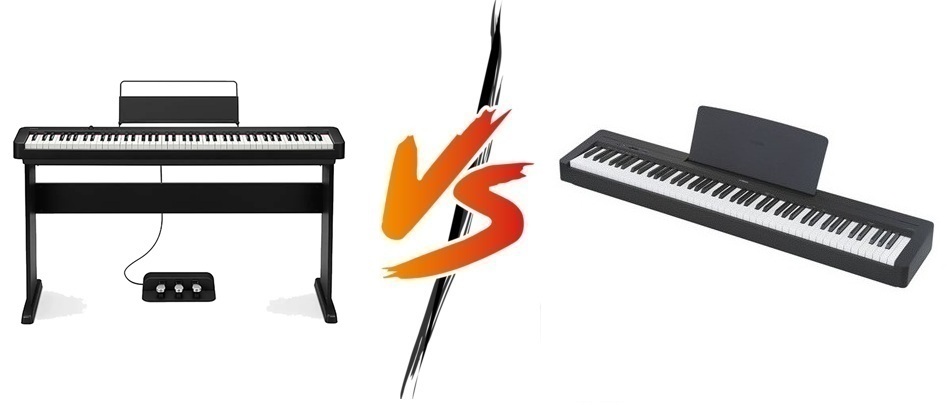
If you’re shopping for an affordable digital piano in 2026, chances are you’ve narrowed your search down to two models: the Casio CDP-S160 and the Yamaha P-145.
That’s hardly surprising.
Both are compact 88-key digital pianos aimed at beginners, hobbyists, returning pianists, and anyone looking for a realistic piano experience without spending well over $1,000. They come from two of the most respected manufacturers in the industry, both promise fully weighted hammer-action keyboards, and both occupy almost exactly the same price bracket.
On paper, they seem remarkably similar.
But once you spend some time playing them, the differences become much more obvious.
I’ve spent years playing acoustic pianos and reviewing entry-level digital pianos, and these two models represent two very different philosophies. Yamaha focuses on recreating the feel and sound of a traditional acoustic piano with as few distractions as possible. Casio, on the other hand, tries to provide a more flexible instrument with extra features, better connectivity, and a slimmer design.
Neither approach is objectively better.
It simply depends on what kind of player you are.
In this review, I’ll compare every important aspect of the Casio CDP-S160 and Yamaha P-145.
Casio CDP-S160 vs Yamaha P-145 Comparison Chart
If you click the links below, under the product images, you will be redirected to Amazon.com. In case you then decide to buy anything, Amazon.com will pay me a commission. This doesn’t affect the honesty of this review in any way though.
| Specification | Casio CDP-S160 | Yamaha P-145 |
|---|---|---|
 |  | |
| Check the best price on Amazon | Check the best price on Amazon | |
| Keyboard | 88-key Scaled Hammer Action Keyboard II | 88-key GHC (Graded Hammer Compact) keyboard |
| Touch Sensitivity | 3 levels + Off | Hard, Medium, Soft, Fixed |
| Key Surface | Textured keys | Matte black keys |
| Sound Engine | AiR (Acoustic and Intelligent Resonator) | CFIIIS Concert Grand Piano sampling |
| Polyphony | 64 notes | 64 notes |
| Number of Voices | 10 | 10 |
| Built-in Songs | 2 demo songs | 10 voice demo songs + 10 piano preset songs |
| Speaker System | 2 × 8W | 2 × 8W |
| Speaker Size | 12 cm × 6 cm (oval) × 2 | 12 cm × 8 cm × 2 |
| Headphone Outputs | 1 (stereo mini jack) | 1 (stereo mini jack) |
| USB Connectivity | USB Type-B (MIDI) | USB to Host (MIDI/Audio) |
| Bluetooth | Optional via Casio WU-BT10 adapter | Not supported |
| Audio Outputs | Yes (dedicated Line Out) | No dedicated Line Out |
| Sustain Pedal Included | Yes (SP-3) | Yes (Footswitch) |
| Compatible Triple Pedal Unit | No | No |
| Metronome | Yes | Yes |
| Transpose | ±12 semitones | ±6 semitones |
| Fine Tuning | Yes | Yes |
| Layer Mode | Yes | Yes |
| Duet Mode | Yes | Yes |
| Recording Function | No | No |
| Companion App | Casio Music Space | Yamaha Smart Pianist (limited functionality) |
| Power Supply | AC adapter or 6 AA batteries | AC adapter only |
| Dimensions (W × D × H) | 1,322 × 232 × 99 mm | 1,326 × 268 × 129 mm |
| Weight | 10.5 kg (23.1 lbs) | 11.1 kg (24.5 lbs) |
| Optional Furniture Stand | CS-46P | L-100 |
| Matching Pedal Unit | SP-34 (with CS-46P stand) | LP-5A (with L-100 stand) |
| Available Colors | Black, White, Red | Black |
| My individual reviews | Casio CDP-S160 review | Yamaha P-145 review |
At a Glance
| Category | Winner |
|---|---|
| Keyboard Action | Yamaha P-145 |
| Piano Sound | Yamaha P-145 |
| Speaker Quality | Yamaha P-145 |
| Design & Portability | Casio CDP-S160 |
| Features | Casio CDP-S160 |
| Connectivity | Casio CDP-S160 |
| Learning Features | Casio CDP-S160 |
| Value for Money | Casio CDP-S160 (slightly) |
| Overall Piano Playing Experience | Yamaha P-145 |
| Best Overall for Most Pianists | Yamaha P-145 |
In short, the Yamaha P-145 offers the stronger keyboard action, more natural piano sound, and more refined playing experience, making it the better choice for players whose priority is authentic piano performance. The Casio CDP-S160, meanwhile, stands out with its slimmer design, battery operation, better connectivity, and broader feature set, making it an excellent option for those who value portability and versatility.
Design & Build Quality
When comparing beginner digital pianos, it’s easy to focus almost exclusively on keyboard action and sound quality. Those are undoubtedly the most important aspects of any instrument, but design and build quality shouldn’t be overlooked. After all, this is a piano you’ll likely have in your home for years. You’ll move it, clean it, transport it to lessons or rehearsals, and interact with it every time you sit down to practice.
A well-designed digital piano makes ownership more enjoyable. It fits naturally into your living space, feels sturdy under your hands, and doesn’t become a nuisance every time you need to move it. On the other hand, a poorly designed instrument can quickly become frustrating, even if it sounds good.
Both the Casio CDP-S160 and the Yamaha P-145 are designed to appeal to beginners and intermediate players looking for an affordable, compact digital piano. They share many similarities in terms of size and weight, but each company has taken a noticeably different approach to the overall design. Casio prioritizes portability and modern practicality, while Yamaha leans toward a more traditional and understated aesthetic.
Let’s take a closer look at how they compare.
Casio CDP-S160 Design
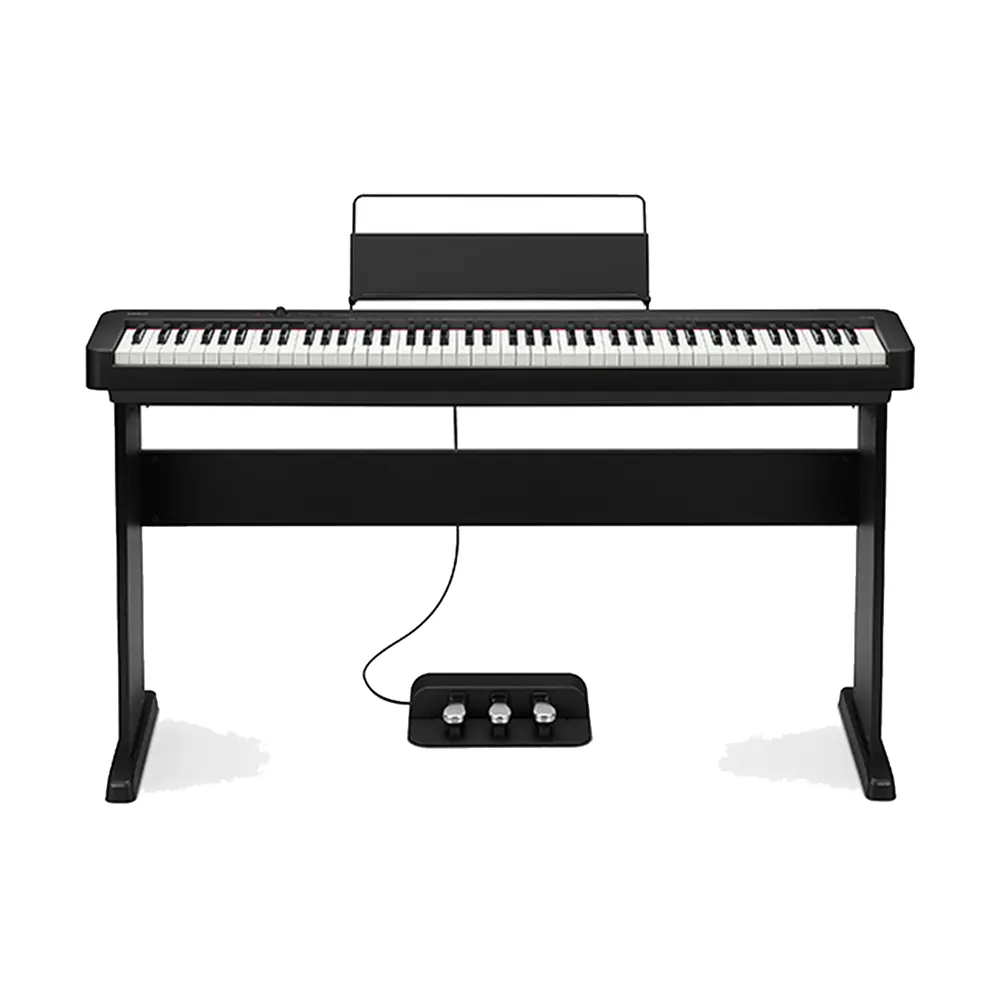
The first thing you’ll notice about the Casio CDP-S160 is just how slim it is. In fact, it’s one of the slimmest fully weighted digital pianos currently available.
This isn’t simply a marketing claim. The compact profile is immediately apparent the moment you place it next to competing models. Casio has done an impressive job of reducing the depth of the instrument without making it feel cramped or uncomfortable to play.
For many people, this is a much bigger advantage than it might initially seem.
Not everyone has the luxury of dedicating an entire room to a piano. Plenty of buyers live in apartments, student accommodation, or smaller homes where every bit of floor space matters. The CDP-S160 fits comfortably against a wall, on a desk, or on a compact keyboard stand without dominating the room. When you’re finished practicing, it simply occupies less visual and physical space than many competing digital pianos.
Its slim dimensions also make it surprisingly easy to transport. Weighing just over 10 kilograms (around 23 pounds), it’s light enough for one person to carry without much effort. If you regularly take your piano to lessons, rehearsals, church services, or small performances, this portability quickly becomes one of its biggest selling points.
Despite the lightweight construction, the piano doesn’t feel flimsy.
Casio has clearly paid attention to the structural rigidity of the chassis. The body remains stable during normal playing, and there’s very little flex when lifting or moving the instrument. The plastic housing is solid, with no obvious weak points or creaking panels.
Of course, this is still an entry-level digital piano, so you won’t find premium materials like metal panels or wooden side cheeks. Most of the exterior is molded plastic. Fortunately, it feels like good-quality plastic rather than the thin, hollow material sometimes found on cheaper keyboards.
The finish is clean and modern, with subtle curves that help soften the overall appearance. It doesn’t try to imitate a traditional upright piano, nor does it look overly futuristic. Instead, it strikes a nice balance that allows it to fit comfortably into most living rooms, bedrooms, or practice spaces.
The control panel follows the same minimalist philosophy.
Rather than filling the top panel with dozens of buttons and a large display, Casio has kept everything remarkably clean. Most functions are accessed through a small collection of clearly labeled buttons combined with key shortcuts.
From a visual standpoint, this works very well. The piano looks uncluttered and modern, allowing the keyboard itself to remain the focal point.
However, there is a trade-off.
Since there isn’t a dedicated screen, some features require referring to the manual, especially during the first few weeks of ownership. Changing certain settings involves holding function buttons while pressing specific keys on the keyboard. Once you become familiar with the layout, it’s fairly straightforward, but it isn’t as intuitive as having dedicated controls for every function.
This is a common compromise among compact digital pianos, and Casio isn’t alone in adopting this approach.
Another practical advantage of the CDP-S160 is its compatibility with both portable keyboard stands and Casio’s optional furniture stand. This gives buyers flexibility depending on how they plan to use the instrument. If portability is the priority, a lightweight X-stand works perfectly. If the piano will remain permanently in one location, adding the furniture stand creates a much more polished, home-friendly appearance.
Overall, Casio deserves a lot of credit for producing an instrument that feels surprisingly refined considering its compact size and affordable price.
Yamaha P-145 Design
The Yamaha P-145 takes a noticeably different approach.
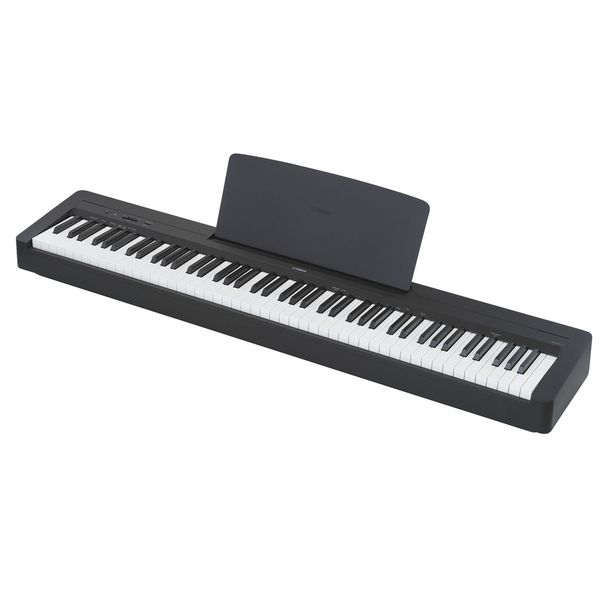
Rather than emphasizing ultra-slim dimensions, Yamaha focuses on creating an instrument that resembles a traditional piano as closely as possible while remaining portable.
The design is understated in the best possible way.
There are no flashy accents, unusual shapes, or decorative elements competing for attention. Instead, the piano features clean lines, gently rounded edges, and an understated matte finish that gives it a quietly professional appearance.
If the Casio feels modern and space-efficient, the Yamaha feels timeless.
This is very much in line with Yamaha’s overall design philosophy across its digital piano range. Whether you’re looking at an entry-level model or one of the company’s premium Clavinova instruments, there’s a consistent emphasis on simplicity and elegance.
The P-145 weighs only slightly more than the Casio, coming in at approximately 11 kilograms (24 pounds). In practical terms, there’s almost no difference between the two. Both are easy enough for one person to move around the house, carry to lessons, or load into the back of a car.
Where the Yamaha feels different is in its overall solidity.
The chassis feels exceptionally well assembled. Every panel fits together neatly, the buttons have a reassuring firmness, and the keyboard itself feels securely integrated into the body. Nothing rattles or shifts during energetic playing.
It’s one of those instruments that inspires confidence from the moment you take it out of the box.
Like the Casio, the Yamaha uses a predominantly plastic exterior, which is entirely expected at this price point. However, the quality of the finish is excellent. The surfaces resist fingerprints reasonably well, and the overall presentation feels slightly more premium than many competing entry-level models.
The control panel is even simpler than the Casio’s.
Yamaha intentionally limits the number of visible controls, creating an appearance that’s remarkably close to an acoustic piano. This clean layout is aesthetically pleasing and helps beginners focus on playing rather than constantly adjusting settings.
The downside is similar to the Casio.
Without a display, certain functions rely on button combinations and keyboard shortcuts. Fortunately, the P-145 offers fewer features overall, so navigating its functions tends to be slightly less complicated.
Another strength of the Yamaha’s design is its compatibility with an optional matching furniture stand. Once installed, the instrument looks much more like a compact home piano than a portable keyboard, making it an attractive addition to a living room or dedicated music space.
Everyday Practicality
Looking beyond appearances, both instruments perform well in day-to-day use.
Their compact footprints make them suitable for smaller homes, and neither requires a dedicated music room to fit comfortably into your living space. Both can be placed on portable stands for maximum flexibility or paired with furniture stands for a more permanent setup.
Cleaning is straightforward thanks to their smooth matte finishes, and both pianos feel durable enough to withstand years of regular practice.
Neither model feels cheaply made, which is reassuring given their position in the entry-level market.
That said, the Casio’s slimmer profile gives it a slight edge if portability is one of your main priorities. It simply feels easier to carry, easier to store, and easier to fit into tighter spaces.
The Yamaha, meanwhile, edges ahead in terms of overall refinement. While the difference isn’t dramatic, its construction feels a touch more substantial, and its understated design has a timeless quality that many players will appreciate.
Verdict
Both manufacturers have done an excellent job with the design and construction of these digital pianos, and it’s difficult to criticize either one in any significant way. They’re well-built, thoughtfully designed, and perfectly suited to the needs of beginner and intermediate players.
If your priority is maximum portability and making the most of limited space, the Casio CDP-S160 stands out. Its exceptionally slim body is one of its defining strengths and helps distinguish it from nearly every other digital piano in its class.
If, however, you prefer a more traditional appearance and slightly more refined overall construction, the Yamaha P-145 has the edge. It feels every bit like a Yamaha instrument: understated, solid, and built with long-term reliability in mind.
Ultimately, this category ends up being surprisingly close. The Casio wins for portability and innovative use of space, while the Yamaha earns points for its premium feel and classic styling. Which design you prefer will largely come down to your living space, your aesthetic preferences, and whether you expect to move the piano frequently.
Keyboard Action
If there’s one area that deserves the closest attention when buying a digital piano, it’s the keyboard action. You can always connect better speakers, use headphones, or even access higher-quality piano sounds through software instruments later on. But the feel of the keys is something you’re going to experience every single time you play, and it’s not something you can upgrade.
A good keyboard action encourages proper technique, allows for expressive playing, and makes the transition to an acoustic piano much easier. A poor one, on the other hand, can make even a great-sounding instrument feel lifeless or difficult to control.
This is where the Casio CDP-S160 and Yamaha P-145 take noticeably different approaches. Both feature fully weighted 88-key keyboards designed to mimic the feel of an acoustic piano, but the similarities largely end there. Their actions have distinct personalities, and after spending time with both instruments, it’s clear that each one has its own strengths and compromises.
Casio CDP-S160 Keyboard Action
The Casio CDP-S160 uses the company’s Scaled Hammer Action Keyboard II mechanism. This is an evolution of the action found in earlier CDP models and represents a meaningful improvement over previous generations.
The first thing you’ll notice is that the keys feel reassuringly weighted. They don’t have the springy, lightweight feel that often characterizes cheaper keyboards, and they provide enough resistance to encourage proper finger technique.
The grading across the keyboard is also handled well. Like an acoustic piano, the lower notes feel heavier while the higher notes become progressively lighter. It’s not the most dramatic difference in the world, but it’s noticeable enough to make the instrument feel more authentic.
For beginners, this is excellent news.
One of the biggest mistakes new players can make is learning on an unweighted keyboard. Transitioning from those light keys to an acoustic piano later can be surprisingly difficult. The CDP-S160 provides enough realism that students can develop proper finger strength and playing habits from the very beginning.
The action itself leans slightly toward the firmer side. There’s a bit more resistance than you’ll find on some competing entry-level digital pianos, and some players may actually prefer this. It gives the keyboard a solid, deliberate feel that works particularly well for slower classical pieces and careful practice.
Dynamic control is another area where the Casio performs well.
The keyboard responds predictably to changes in playing velocity. Soft touches produce gentle, delicate notes, while harder playing generates noticeably more volume and brightness. This allows beginners to start developing musical expression instead of simply playing every note at the same volume.
That said, the CDP-S160 isn’t without its limitations.
The most commonly discussed characteristic of Casio’s compact action is its relatively short pivot length.
Without getting overly technical, the pivot is the point around which each key rotates. On an acoustic piano, this pivot is located much farther back because the keys themselves are significantly longer than what you see from the front.
Compact digital pianos simply don’t have the internal space for keys of that length.
As a result, when you press the keys closer to their backs, particularly when playing black keys or certain complex chords, they require noticeably more force than when pressed near the front.
It’s not a problem during casual playing.
Many beginners may never even notice it.
However, intermediate and advanced pianists who play technically demanding repertoire may occasionally find the action less forgiving than that of larger digital pianos.
Fast repeated notes also reveal some of the action’s limitations. While perfectly capable for everyday practice, it doesn’t quite match the fluidity of more expensive keyboard mechanisms. Rapid passages require slightly more effort, and the keys don’t reset quite as naturally as premium actions.
Still, it’s important to keep the price of the instrument in perspective.
The CDP-S160 sits firmly in the entry-level category, and within that context, its keyboard performs remarkably well. In fact, it’s considerably better than many digital pianos that were available in this price range just a few years ago.
Another nice touch is the textured key surfaces.
Casio has given both the white and black keys a subtle texture that improves grip without feeling rough. During longer practice sessions, especially in warmer environments where your hands may become slightly sweaty, this texture provides a little extra confidence.
It’s a small detail, but one that contributes positively to the overall playing experience.
Yamaha P-145 Keyboard Action
The Yamaha P-145 introduces the company’s newer GHC (Graded Hammer Compact) keyboard action.
This is significant because it replaces the long-running GHS (Graded Hammer Standard) action that Yamaha used for many years across numerous entry-level models.
Rather than simply shrinking the older mechanism, Yamaha redesigned the action to be both more compact and more refined.
The result is impressive.
From the first few minutes of playing, the keyboard feels smooth, balanced, and highly predictable.
Like the Casio, the Yamaha features graded hammer weighting, with heavier bass keys gradually transitioning to lighter treble keys. However, the transition feels slightly more seamless.
The keys themselves move with a smoothness that’s immediately noticeable. There’s less mechanical resistance, and each keystroke feels fluid from beginning to end.
This doesn’t necessarily mean the action is lighter.
Instead, it feels more natural.
The resistance builds and releases in a way that more closely resembles an acoustic piano, making expressive playing feel easier and more intuitive.
One area where the Yamaha really shines is consistency.
Whether you’re playing simple scales, repeated chords, or more intricate passages, the action behaves predictably. That consistency helps build confidence, particularly for students who are still developing finger independence and control.
Repeated notes are also handled slightly better than on the Casio.
The keys recover quickly after each press, making faster passages feel more effortless. While this isn’t a substitute for the sophisticated actions found in premium digital pianos costing several times as much, it’s an impressive performance for an instrument in this price bracket.
Dynamic control is another strength.
The GHC action makes it relatively easy to produce subtle changes in volume simply by varying finger pressure. Quiet passages feel delicate, while louder sections retain plenty of control without becoming harsh.
This responsiveness becomes especially rewarding when playing expressive classical works or lyrical film music, where small differences in touch contribute significantly to the overall performance.
Like every entry-level keyboard, however, the GHC action has its limits.
It still lacks the escapement simulation, wooden keys, and extended pivot lengths found on more expensive instruments. Experienced pianists accustomed to grand pianos will immediately recognize that they’re playing an entry-level digital piano.
Fortunately, Yamaha has done an excellent job minimizing those compromises.
Rather than feeling like a cut-down version of a premium action, the GHC feels like a thoughtfully engineered mechanism designed specifically for affordable digital pianos.
Side-by-Side Comparison
Playing these two instruments back-to-back highlights their differences more clearly than reading any specification sheet ever could.
The Casio feels a little firmer and more deliberate.
The Yamaha feels smoother and slightly more refined.
Neither approach is inherently right or wrong.
Some players actually enjoy the Casio’s slightly heavier feel because it encourages stronger finger technique and creates the impression of playing a substantial instrument.
Others will immediately prefer the Yamaha because of its fluidity and ease of control.
The difference becomes more noticeable as your playing becomes more advanced.
Simple beginner pieces don’t reveal many weaknesses in either action.
As you move into faster scales, repeated-note passages, expressive dynamics, and technically demanding repertoire, the Yamaha gradually begins to pull ahead.
Its smoother repetition and more natural key movement simply make difficult music feel easier to manage.
Another point worth mentioning is fatigue.
During longer practice sessions lasting an hour or more, I found the Yamaha slightly more comfortable to play. The Casio’s firmer action isn’t uncomfortable by any means, but it requires just a little more effort over extended periods.
For beginners practicing twenty or thirty minutes a day, this probably won’t matter.
For more serious students spending several hours each week at the keyboard, it’s something worth considering.
Which Action Is Better for Different Players?
The answer depends largely on your experience level.
If you’re buying your very first piano, both actions are excellent starting points. Either instrument will allow you to develop proper technique and prepare you well for eventual acoustic piano playing.
If you’re returning to piano after several years away, the Yamaha’s smoother action may feel a little more welcoming, especially if you’ve previously played acoustic instruments.
Intermediate players will likely appreciate the Yamaha’s greater refinement during more demanding repertoire.
Advanced pianists looking for a practice instrument will probably gravitate toward the Yamaha as well, although both keyboards remain firmly within the entry-level category and neither fully replicates the feel of a high-end acoustic grand.
Verdict
This is one of the most important categories in the entire comparison, and it’s also one of the clearest.
The Casio CDP-S160 offers a very capable keyboard that performs well above what many people would expect at this price. Its Scaled Hammer Action Keyboard II provides realistic weighting, solid dynamic control, and enough authenticity for beginners and many intermediate players. The textured keys and generally firm feel make it a satisfying instrument to practice on, even if its compact design introduces some inevitable compromises.
The Yamaha P-145, however, takes a small but meaningful step forward. Its GHC action feels smoother, more consistent, and more refined throughout the entire keyboard. The improved repetition, natural resistance, and overall responsiveness create a playing experience that remains enjoyable as your skills develop.
The difference isn’t dramatic enough to make the Casio feel inferior, but it is noticeable enough that most players who spend time with both instruments will likely prefer the Yamaha.
For anyone whose primary goal is to develop strong piano technique and enjoy the most authentic playing experience possible in this price range, the Yamaha P-145 earns a well-deserved victory in the keyboard action category.
Piano Sound
Alongside keyboard action, the piano sound is arguably the most important factor when choosing a digital piano. You can have the most realistic key action in the world, but if the instrument sounds uninspiring, you’ll probably find yourself playing less over time. On the other hand, a rich, expressive piano tone can make even simple practice sessions much more enjoyable.
This is one of those areas where personal preference plays a huge role.
Unlike keyboard action, which can often be evaluated using fairly objective criteria, sound is inherently subjective. Some players prefer a bright, crisp piano that cuts through a mix, while others gravitate toward a warmer, mellower tone that’s better suited to solo playing. Neither approach is necessarily better, but understanding the differences can help you choose the instrument that best matches your musical tastes.
The Casio CDP-S160 and Yamaha P-145 have distinctly different sonic personalities. Both produce high-quality piano sounds for their price range, but they do so in very different ways. Casio aims for clarity and versatility, while Yamaha focuses on recreating the character of one of its renowned acoustic grand pianos.
After spending time with both instruments, these differences become increasingly apparent.
Casio CDP-S160 Piano Sound
The Casio CDP-S160 is powered by the company’s AiR (Acoustic and Intelligent Resonator) sound engine, which has been a core part of Casio’s digital piano lineup for several years.
The AiR engine has matured considerably over time, and the version found in the CDP-S160 delivers a surprisingly polished piano sound considering the instrument’s entry-level price.
The first thing you’ll notice is its brightness.
The main concert piano voice has a clean, clear tone that immediately projects well through both the built-in speakers and headphones. Individual notes are well defined, and chords remain articulate even when playing more complex harmonies.
This bright character works particularly well for contemporary music.
Whether you’re playing pop, worship music, jazz standards, or modern film scores, the Casio’s piano sound has enough presence to remain expressive without becoming muddy.
The midrange is especially pleasing.
Melodies stand out clearly, making it easy to shape musical phrases, while accompaniment patterns remain distinct without overpowering the main line.
The bass register is respectable as well.
Although it doesn’t have the deep resonance of more expensive digital pianos, lower notes still carry enough weight to provide a satisfying foundation for most pieces.
The upper register is where opinions may begin to differ.
Some players appreciate its sparkling clarity, particularly for brighter musical styles.
Others may find it slightly too crisp, especially when playing classical repertoire that benefits from a warmer tonal character.
This doesn’t mean the sound is harsh.
Rather, it leans toward a modern, polished presentation instead of trying to replicate every subtle imperfection found in an acoustic grand.
Dynamic response is another area where the CDP-S160 performs well.
The AiR engine responds convincingly to changes in playing velocity. Soft touches produce gentle, rounded notes, while more forceful playing introduces additional brightness and attack.
This responsiveness allows players to shape musical phrases naturally instead of feeling locked into a single volume level.
The transition between dynamic layers is also relatively smooth.
On some lower-end digital pianos, changing from soft to loud playing can reveal abrupt sample changes that make the instrument sound artificial.
Casio has done a good job minimizing this effect, resulting in a more cohesive and enjoyable playing experience.
Sustain is handled competently as well.
Notes decay naturally enough for everyday practice, and sustained chords blend together pleasantly without sounding overly synthetic.
Of course, there are limits.
Compared to higher-end digital pianos, the sustain lacks some of the complex harmonic development you’d hear from premium sampling engines or physical modeling technology.
However, expecting that level of realism from an entry-level instrument wouldn’t be entirely fair.
One characteristic that deserves mention is consistency.
No matter what style of music you play, the Casio tends to maintain a balanced, predictable sound. It’s forgiving, easy to work with, and generally flattering to players of all skill levels.
That makes it an excellent choice for beginners who simply want an enjoyable instrument without worrying too much about tonal nuances.
Yamaha P-145 Piano Sound
The Yamaha P-145 takes a different approach.
Rather than emphasizing versatility, Yamaha places its focus squarely on authenticity.
The primary piano voice is sampled from the Yamaha CFIIIS concert grand, a highly respected instrument that has appeared in concert halls around the world.
While this entry-level digital piano obviously doesn’t capture every subtle characteristic of the original grand piano, it successfully conveys much of its overall tonal personality.
The first impression is warmth.
Compared to the Casio, the Yamaha immediately sounds fuller and more organic.
There’s a natural roundness to the notes that makes the instrument feel less digital, particularly when listening through quality headphones.
The bass register is one of the strongest aspects of the P-145.
Lower notes have impressive depth without becoming boomy or overwhelming. Left-hand accompaniment patterns feel substantial, providing a satisfying sense of weight beneath the melody.
The middle register is equally convincing.
This is where much of the piano repertoire lives, and Yamaha has done an excellent job capturing the richness and complexity of this range. Chords sound cohesive, melodies sing beautifully, and the instrument encourages expressive phrasing.
The treble register remains clear but avoids excessive brightness.
Even when playing loudly, higher notes retain a smooth quality that many players associate with acoustic grand pianos.
For classical music, this tonal balance is particularly rewarding.
Pieces by composers such as Chopin, Debussy, Beethoven, or Schubert benefit from the Yamaha’s warmer presentation, allowing lyrical passages to breathe naturally.
The dynamic response also deserves praise.
One of the pleasures of playing the P-145 is how naturally the sound evolves with changes in touch. Gentle playing produces soft, intimate tones, while increased velocity gradually introduces greater brilliance and power.
The transitions feel fluid.
Instead of sounding like separate recordings stitched together, the instrument responds more like a single acoustic piano reacting to your touch.
This contributes significantly to the overall realism.
The decay of sustained notes is another highlight.
Individual notes fade gradually, and held chords develop with a convincing sense of resonance. While it’s still obvious that you’re playing a digital piano, the overall impression is remarkably satisfying given the instrument’s price.
Sound Through Speakers vs Headphones
One interesting observation is how these two instruments change depending on how you listen to them.
Through the built-in speakers, the Yamaha generally sounds larger and more room-filling. Its warmer tonal balance complements the speaker system well, creating an impression of greater depth.
The Casio, meanwhile, emphasizes clarity.
Its brighter sound projects very effectively through the speakers, making individual notes easy to distinguish even at lower listening volumes.
When using headphones, the gap narrows somewhat.
Both instruments reveal considerably more detail than their internal speakers can reproduce.
The Casio gains additional warmth and subtlety through good headphones, while the Yamaha becomes even more immersive and expressive.
If you plan to practice primarily with headphones, either piano will provide a satisfying experience.
Other Instrument Voices
Although this comparison focuses mainly on piano sound, it’s worth briefly mentioning the additional voices included with each instrument.
The Casio offers a selection of electric pianos, strings, organs, harpsichord, bass, and several other sounds.
Most of these are surprisingly usable.
The electric pianos, in particular, are enjoyable for pop and jazz playing, while the string voices layer nicely with the acoustic piano to create fuller textures.
Yamaha also includes additional instrument sounds, but the emphasis is clearly on quality rather than quantity.
The electric pianos are excellent, and the strings have a pleasant warmth, but the overall selection is more conservative.
Realistically, most buyers in this category will spend the overwhelming majority of their time using the main acoustic piano voice.
For that reason, the quality of the primary piano sound remains far more important than the total number of available voices.
Which Sound Is Better?
This is where personal taste becomes the deciding factor.
If you enjoy brighter, cleaner piano tones with excellent note definition, the Casio will likely appeal to you.
Its sound works beautifully for contemporary worship, pop music, jazz, and situations where clarity is more important than tonal richness.
If your preferences lean toward classical repertoire or traditional solo piano playing, the Yamaha is likely to feel more satisfying.
Its warmer character, smoother dynamic response, and richer harmonic balance create a playing experience that many people will describe as more “musical.”
Neither instrument sounds cheap.
Both represent a significant improvement over entry-level digital pianos from just a decade ago.
The differences are less about quality and more about personality.
The Casio feels modern and articulate.
The Yamaha feels mature and expressive.
Verdict
Both the Casio CDP-S160 and Yamaha P-145 deliver impressive piano sounds considering their modest price tags, and either instrument is capable of supporting years of enjoyable practice.
The Casio’s AiR sound engine produces a bright, clean, and highly versatile piano tone that performs particularly well across a wide range of contemporary musical styles. Its clarity, consistent dynamic response, and polished presentation make it approachable for beginners and enjoyable for casual players who appreciate a modern sound.
The Yamaha P-145, however, offers a more emotionally engaging experience. Its CFIIIS concert grand samples provide greater warmth, richer tonal complexity, and a more natural sense of expression that becomes increasingly rewarding as your playing develops. Combined with smooth dynamic transitions and convincing sustain, the instrument encourages expressive phrasing in a way that feels remarkably close to an acoustic piano for this price range.
The margin isn’t enormous, and many players will genuinely prefer the Casio’s brighter character. But when judging the realism, depth, and overall musicality of the main piano voice alone, the Yamaha P-145 comes out ahead.
For players who intend to spend most of their time practicing solo piano music, it’s simply the more inspiring instrument to listen to, and that’s a quality that continues to matter long after you’ve memorized your first few pieces.
Speakers
When people compare digital pianos, the built-in speaker system is often one of the most overlooked aspects of the instrument. That’s understandable to a point. Keyboard action and piano sound naturally receive most of the attention because they’re the defining characteristics of any piano. However, even the best sound engine can only perform as well as the speakers reproducing it.
Think of it this way. You could have beautifully sampled concert grand piano sounds, but if they’re played through weak, tinny speakers, much of that realism disappears. Likewise, a good speaker system can make an entry-level digital piano sound richer, fuller, and more enjoyable than its specifications alone would suggest.
This is particularly important because many buyers in this price range will spend most of their time using the built-in speakers rather than external monitors or headphones. Beginners practicing at home, students taking lessons, and hobbyists playing for their own enjoyment often simply switch the piano on and start playing. In those situations, the speaker system becomes a major part of the overall playing experience.
The Casio CDP-S160 and Yamaha P-145 both feature relatively modest onboard amplification, as you would expect from affordable digital pianos. Neither is designed to fill a concert hall, and neither aims to replace a professional sound system. Instead, they’re built to provide enough volume and clarity for everyday home practice.
While their specifications appear very similar on paper, they don’t sound identical in practice.
Casio CDP-S160 Speaker System
The Casio CDP-S160 is equipped with a pair of 8-watt speakers, giving it a total output of 16 watts.
Looking purely at the numbers, this is perfectly respectable for an entry-level digital piano. In fact, many competing instruments in this price range offer similar amplification, so there isn’t anything obviously lacking here.
Once you begin playing, the first thing you’ll notice is the clarity.
The CDP-S160 projects individual notes very cleanly. Even when playing dense chords or quick passages, the notes remain well separated, making it easy to hear exactly what’s happening.
This characteristic complements Casio’s brighter piano sound particularly well.
The speakers reproduce the upper frequencies with plenty of detail, giving melodies a crisp, articulate quality that suits contemporary music nicely. Pop songs, worship music, jazz, and modern arrangements all benefit from this presentation.
The stereo image is surprisingly good considering the compact dimensions of the instrument.
Sitting directly in front of the piano, you can clearly perceive the separation between lower and higher registers, creating a more immersive experience than you might expect from such a slim cabinet.
One of Casio’s biggest engineering achievements is fitting a capable speaker system into an incredibly shallow chassis.
There’s simply less internal space available for acoustic resonance compared to thicker digital pianos.
That inevitably creates certain limitations.
Most noticeably, the bass response isn’t particularly deep.
Lower notes remain perfectly audible, but they don’t produce the physical fullness you experience with larger cabinets. Instead of feeling the bass resonate through the instrument, you primarily hear it.
For beginners, this probably won’t matter very much.
For more experienced pianists who enjoy rich left-hand accompaniment or powerful romantic repertoire, the lack of low-end presence becomes more noticeable.
Fortunately, the midrange is well balanced.
This is where the majority of piano music lives, and the CDP-S160 reproduces it cleanly and consistently. Chords sound focused, melodies are easy to shape, and nothing feels overly compressed.
Volume is another pleasant surprise.
For home practice, the Casio has more than enough power.
Even at around 50 to 60 percent volume, it’s capable of comfortably filling a medium-sized room without any difficulty.
Most players are unlikely to push the volume much higher during everyday practice.
As you approach maximum volume, however, some compromises begin to appear.
The sound starts to lose a little refinement.
Higher frequencies become slightly more aggressive, and the overall presentation feels less balanced than it does at moderate listening levels.
This isn’t unusual.
Nearly every entry-level digital piano struggles somewhat when operated at its absolute maximum volume.
The Casio remains perfectly usable, but it clearly sounds its best somewhere below the highest settings.
One area where the CDP-S160 performs particularly well is consistency across different instrument voices.
Whether you’re using the acoustic piano, electric piano, strings, or organ sounds, the speakers maintain a balanced presentation without noticeably favoring one sound over another.
That’s especially useful for players who enjoy exploring the piano’s additional voices.
Yamaha P-145 Speaker System
Like the Casio, the Yamaha P-145 also features dual 8-watt speakers.
Once again, the specifications appear almost identical.
If you were judging purely by the numbers, you’d probably expect the two instruments to sound virtually the same.
That’s not what happens.
Despite matching amplifier power, the Yamaha produces a noticeably fuller sound.
This is a good reminder that speaker quality depends on much more than wattage alone.
Cabinet design, speaker placement, acoustic tuning, and digital signal processing all contribute significantly to the final result.
The first impression when playing the P-145 is one of warmth.
The speakers complement Yamaha’s piano samples beautifully, producing a sound that feels slightly larger than the instrument itself.
The bass has greater presence than the Casio.
Again, we’re not talking about earth-shaking low frequencies.
This remains a compact home digital piano.
However, lower notes carry more weight and resonance, making accompaniment patterns feel more satisfying.
The middle register is excellent.
Chords sound cohesive and rounded, while melodic lines project naturally without needing to be forced.
There’s a sense of balance across the keyboard that’s particularly pleasant during longer practice sessions.
The treble is equally impressive.
Unlike some brighter speaker systems that can become fatiguing over time, the Yamaha maintains clarity without becoming sharp or brittle.
Even when playing loudly, higher notes retain a smooth quality that encourages expressive playing.
One characteristic I particularly appreciated was how naturally the speakers reproduce dynamic changes.
When you play softly, the piano responds with warmth and intimacy.
As your playing becomes more forceful, the sound expands gradually instead of suddenly becoming harsh.
This makes crescendos feel more convincing and contributes significantly to the realism of the instrument.
The Yamaha also handles sustained chords very well.
Rather than sounding compressed, held notes seem to occupy the room naturally, creating a pleasant sense of space despite the modest cabinet size.
Maximum volume performance is another strength.
Like the Casio, the P-145 has more than enough power for home use.
However, it retains its composure slightly better at higher volume settings.
The sound remains balanced and controlled, with less noticeable harshness as you approach maximum output.
That’s unlikely to matter during everyday practice, but it’s reassuring to know the system has a little extra headroom.
Speaker Performance with Headphones and External Audio
It’s worth mentioning that the built-in speakers become much less important if you primarily use headphones.
Both the Casio and Yamaha reveal considerably more detail through quality headphones than their internal speaker systems can reproduce.
In fact, many buyers are pleasantly surprised by how much richer both instruments sound when listening privately.
That said, most people won’t use headphones all the time.
Family members often enjoy listening, teachers typically prefer hearing the piano through its speakers during lessons, and casual playing simply feels more natural without wearing headphones.
For those situations, the quality of the onboard speaker system still matters.
Similarly, if you plan to connect either instrument to external monitors or a PA system, speaker performance becomes less critical.
However, many buyers in this price category never purchase external speakers, making the built-in system their primary listening experience for years.
Real-World Practice
Specifications can only tell part of the story.
The real question is how enjoyable these pianos are to listen to during everyday use.
After extended practice sessions, I found the Yamaha slightly easier on the ears.
Its warmer presentation creates a relaxed listening experience that encourages longer playing sessions.
The Casio, by comparison, feels more direct and immediate.
That’s not necessarily a criticism.
For certain styles of music, particularly pop and jazz, that extra clarity is actually an advantage.
Individual notes cut through more distinctly, making rhythmic playing feel crisp and energetic.
The Yamaha, meanwhile, excels when playing solo piano literature.
Its fuller sound makes classical repertoire feel more immersive, while slower, expressive pieces benefit from the richer tonal presentation.
Neither instrument sounds weak.
Both represent a significant improvement over many older entry-level digital pianos, and both provide enough volume for virtually any home practice situation.
The difference lies primarily in refinement rather than outright capability.
Which Speaker System Is Better?
If your musical preferences lean toward brighter contemporary styles, you may genuinely enjoy the Casio’s presentation.
Its speakers emphasize clarity, note separation, and articulation, giving modern music an energetic quality.
If your focus is traditional piano playing, the Yamaha is likely to be more satisfying.
Its fuller bass response, smoother treble, and more balanced overall presentation create an experience that’s simply closer to hearing an acoustic piano in a room.
The gap between the two isn’t enormous.
Casual beginners would probably be perfectly happy with either instrument.
More experienced players, however, are likely to notice the Yamaha’s greater depth and overall refinement.
Verdict
The speaker systems in both the Casio CDP-S160 and Yamaha P-145 are well designed and entirely appropriate for instruments in this price range. They provide enough power for home practice, reproduce their respective piano sounds faithfully, and avoid the thin, underpowered character that sometimes affects budget digital pianos.
The Casio impresses with its clarity, especially considering the remarkably slim cabinet that houses its speakers. Individual notes remain well defined across the keyboard, the stereo image is pleasing, and the overall presentation suits contemporary musical styles particularly well. The only real limitation is a bass response that can’t quite match the richness of larger digital pianos.
The Yamaha, however, extracts just a little more performance from similarly modest hardware. Its speakers produce a fuller, warmer, and more room-filling sound, with greater low-end presence and smoother high frequencies. Perhaps more importantly, they complement the instrument’s piano samples beautifully, creating a cohesive listening experience that remains enjoyable over long practice sessions.
While both pianos perform admirably, the Yamaha P-145 earns a narrow victory in this category. Its speaker system simply sounds more mature and natural, allowing its excellent piano samples to shine with greater depth and realism. It’s not a dramatic difference, but it’s one you’ll appreciate every time you sit down to play without headphones.
Features & Functions
While keyboard action and piano sound will always be the deciding factors for most buyers, the features and functions built into a digital piano can have a surprisingly large impact on the ownership experience. Some people want an instrument that does one thing exceptionally well: replicate the experience of playing an acoustic piano. Others appreciate having additional tools that make practicing easier, experimenting with sounds more enjoyable, or integrating the piano into a wider music setup.
This is one of the clearest areas where the Casio CDP-S160 and Yamaha P-145 differ in philosophy.
Neither company is trying to build a workstation keyboard loaded with hundreds of sounds and recording features. These are entry-level digital pianos first and foremost. However, Casio has chosen to include a broader collection of functions aimed at versatility, while Yamaha has intentionally kept things simple, focusing on the essentials.
Neither approach is inherently better. The right choice depends on how you expect to use the instrument.
Casio CDP-S160 Features
The Casio CDP-S160 offers a feature set that strikes an excellent balance between simplicity and flexibility. It never feels overwhelming, yet it provides enough functionality to keep most beginners and intermediate players satisfied.
One of its biggest strengths is the variety of available instrument voices.
Although the acoustic piano sound is naturally the star of the show, the CDP-S160 includes several additional voices that expand the instrument’s usefulness. These include electric pianos, strings, organs, harpsichord, vibraphone, bass, and a few other keyboard sounds.
These aren’t just novelty additions.
The electric piano voices are particularly enjoyable for jazz, soul, blues, and pop music. Layering strings underneath the acoustic piano creates a lush, cinematic sound that’s perfect for ballads or worship music. Even the organ voices are surprisingly usable for casual playing.
Realistically, most owners will spend the majority of their time using the main piano sound, but having these additional options makes the instrument feel more versatile and encourages musical exploration.
The CDP-S160 also supports layer mode.
This allows you to combine two sounds simultaneously. For example, you can play piano and strings together to create a fuller, richer texture. It’s a simple feature, but one that many players enjoy, especially when performing slower or more atmospheric pieces.
Another practical feature is duet mode.
This divides the keyboard into two identical pitch ranges, allowing a teacher and student to sit side by side and play in the same register. It’s an invaluable tool during lessons because both players can demonstrate and imitate passages without constantly shifting octaves.
For families with young learners, this feature alone can make lessons much more convenient.
The built-in metronome is another welcome inclusion.
While every serious pianist eventually develops their own preferred practice methods, a metronome remains one of the most valuable tools for building rhythm and consistency. Casio’s implementation is straightforward and easy to use, making it simple to establish a steady practice routine.
Transpose and tuning functions are also available.
Transpose allows you to shift the keyboard into different keys without changing your fingering, which is particularly useful when accompanying singers or playing alongside other instruments.
Fine tuning lets you adjust the instrument’s pitch slightly to match another piano or ensemble when necessary.
Although these features may not be used every day, they’re extremely helpful when the situation calls for them.
The CDP-S160 also includes adjustable touch sensitivity.
Players can choose different touch response settings to match their playing style or personal preference. Beginners with lighter hands may prefer a more sensitive setting, while experienced players often enjoy a heavier response that allows for greater dynamic control.
It’s a small feature, but one that adds another layer of customization.
Reverb and chorus effects are also included.
The reverb simulates playing in different acoustic spaces, adding a sense of depth and ambience to the piano sound. Used tastefully, it helps create a more immersive playing experience.
The chorus effect is primarily intended for electric piano voices, adding width and movement to the sound.
Neither effect is excessively complicated, but both contribute positively to the instrument’s versatility.
Perhaps the CDP-S160’s most underrated strength is how well all of these features work together without making the piano feel cluttered.
Despite offering a respectable list of functions, the instrument still feels focused on playing rather than endless menu navigation.
Yamaha P-145 Features
The Yamaha P-145 takes a noticeably different approach.
Rather than trying to offer a broad range of creative tools, Yamaha has deliberately kept the feature set streamlined.
This isn’t because the company couldn’t include more functions.
It’s because Yamaha clearly believes that the primary purpose of this instrument is to provide an authentic piano-playing experience.
In many ways, that philosophy makes perfect sense.
Most pianists don’t spend their practice sessions cycling through dozens of sounds or experimenting with effects. They simply sit down and play.
The P-145 supports the essential functions expected from a modern digital piano.
Like the Casio, it includes multiple instrument voices beyond the main acoustic piano.
These include electric pianos, strings, organs, harpsichord, and several other keyboard sounds.
The overall selection is somewhat conservative, but the sound quality remains consistently high.
Yamaha has clearly prioritized refinement over quantity.
The duet function is also present, making the instrument well suited for piano lessons.
As with the Casio, the keyboard splits into two equal ranges, allowing teacher and student to play side by side.
A metronome is included as well.
Its implementation is straightforward, offering everything most players need for timing practice without unnecessary complexity.
Transpose and touch sensitivity adjustments are available too, ensuring the P-145 covers all of the practical basics expected from a digital piano.
Where Yamaha differs is in the overall user experience.
There are fewer options to configure, fewer settings to memorize, and fewer distractions pulling your attention away from actually playing the instrument.
Some buyers may initially see this as a disadvantage.
Ironically, many owners come to appreciate it over time.
There’s something refreshing about switching on the piano and simply playing without wondering whether you should adjust effects, layer sounds, or explore hidden menus.
The P-145 encourages exactly that kind of focused practice.
Ease of Use
One aspect that’s often overlooked when discussing features is how easy they are to access.
Both the Casio and Yamaha follow a minimalist design philosophy, meaning neither includes a dedicated LCD display.
Instead, many functions are accessed by holding a function button while pressing specific keys on the keyboard.
This approach helps keep the instruments visually clean while reducing manufacturing costs.
However, it also means that some settings aren’t immediately obvious.
The Casio has slightly more functions, which naturally means there are more button combinations to remember.
Fortunately, once you’ve learned the most commonly used shortcuts, operating the piano becomes second nature.
The Yamaha is arguably a little simpler simply because there are fewer features available.
This makes it especially approachable for beginners who may feel intimidated by more complicated digital instruments.
Learning and Practice Features
Both pianos include the core practice tools most students need.
The duet function, metronome, adjustable touch response, and transpose capabilities cover the essentials for everyday learning.
However, the Casio gains an advantage through its broader ecosystem.
When paired with Casio’s Chordana Play app, the CDP-S160 becomes a much more interactive learning instrument.
The app provides visual feedback, lesson support, and convenient access to many settings directly from a smartphone or tablet.
This modern integration makes the piano feel more engaging for younger players and beginners who enjoy technology-assisted learning.
The Yamaha also supports companion software, but the experience isn’t quite as comprehensive on the P-145 as it is on some of Yamaha’s more expensive models.
As a result, Casio offers a slightly richer learning environment overall.
Which Piano Offers More?
If you’re comparing feature lists side by side, the Casio is the clear winner.
It simply provides more flexibility.
The additional sounds, broader customization options, stronger app integration, and slightly more feature-rich design give owners more opportunities to personalize their playing experience.
The Yamaha intentionally avoids that race.
Its philosophy is almost minimalist.
Rather than offering more features for the sake of marketing, it focuses on providing exactly what most pianists actually use.
There’s something admirable about that restraint.
If your goal is simply to practice piano every day, the Yamaha never feels like it’s missing anything essential.
Does More Always Mean Better?
Not necessarily.
This is an important point that’s often overlooked in reviews.
A long specification sheet doesn’t automatically translate into a better ownership experience.
Many digital pianos include dozens or even hundreds of features that owners rarely use after the first week.
The Casio avoids that trap remarkably well.
Its extra functions are genuinely useful rather than gimmicky.
Layer mode, duet mode, metronome, adjustable touch response, and app integration all contribute meaningfully to everyday use.
At the same time, Yamaha’s simplicity can be equally appealing.
Some players actively prefer having fewer options because it encourages them to spend more time practicing and less time exploring menus.
Ultimately, this category comes down to your personality as much as your musical needs.
Verdict
The Casio CDP-S160 and Yamaha P-145 both include the essential features expected from modern entry-level digital pianos, but they approach the concept from opposite directions.
The Yamaha keeps things intentionally simple. Every included function serves a practical purpose, the interface remains uncluttered, and the instrument encourages a focused, piano-first playing experience. For traditional pianists who value simplicity above all else, it’s an approach that works remarkably well.
The Casio, however, offers noticeably greater versatility without sacrificing usability. Its wider selection of voices, useful layering capabilities, solid practice tools, customizable touch settings, built-in effects, and excellent companion app create an instrument that feels more adaptable to different players and musical situations.
Importantly, these extra features never overwhelm the experience. The CDP-S160 still feels like a piano rather than a feature-packed keyboard, but it provides enough additional functionality to grow with beginners as they develop new interests and playing styles.
For that reason, the Casio CDP-S160 earns a comfortable victory in the Features & Functions category. It strikes an impressive balance between simplicity and versatility, offering meaningful tools that genuinely enhance the ownership experience instead of merely inflating the specification sheet.
Connectivity
Connectivity might not be the first thing that comes to mind when buying a digital piano, but it’s becoming increasingly important. Modern pianos are no longer standalone instruments that simply sit in the corner of a room. Many players connect them to computers for recording, tablets for learning, smartphones for backing tracks, or external speakers for performances.
Even if you don’t think you’ll use these features today, there’s a good chance your needs will change over time. A beginner may eventually want to record original music, use virtual piano software, or practice with interactive learning apps. A hobbyist might decide to connect the piano to a home studio or perform through a larger sound system. Having the right connections available means your instrument can grow with you instead of limiting your options.
This is one area where the differences between the Casio CDP-S160 and Yamaha P-145 become quite noticeable. Both provide the essential connectivity expected from a modern digital piano, but Casio clearly places a greater emphasis on flexibility and expansion, while Yamaha keeps things much more traditional.
For some buyers, these differences won’t matter at all.
For others, they could become one of the deciding factors.
Casio CDP-S160 Connectivity
The Casio CDP-S160 offers one of the more versatile connectivity packages you’ll find in this price range.
At its core is a USB-to-Host connection, which allows the piano to communicate directly with a computer, tablet, or compatible mobile device.
This is an incredibly useful feature because it enables MIDI communication.
It’s important to understand that USB-MIDI doesn’t transmit audio. Instead, it sends information about which keys you’re pressing, how hard you’re playing them, when you release them, and other performance data.
Why does that matter?
Because it opens up a huge range of possibilities.
For example, you can connect the CDP-S160 to music production software such as Logic Pro, Cubase, GarageBand, Ableton Live, or Reaper and use the keyboard as a MIDI controller. Rather than hearing the piano’s built-in sounds, you can trigger virtual instruments running on your computer.
This means that even years down the line, if you decide you want the sound of a premium concert grand or an elaborate orchestral library, you won’t necessarily need to buy a new piano. Your Casio can simply become the controller for those sounds.
For beginners, USB-MIDI is also incredibly valuable because many learning applications rely on it.
Apps can display sheet music, provide instant feedback on accuracy, track practice progress, and even gamify lessons. Instead of simply hearing your performance, the software knows exactly which notes you’ve played.
The CDP-S160 integrates very well into this type of setup.
Another practical advantage is the availability of dedicated audio outputs.
This may sound like a minor detail, but it’s actually something many buyers overlook until they need it.
Dedicated line outputs make it much easier to connect the piano to external speakers, amplifiers, recording equipment, or mixing consoles.
If you ever perform for friends, accompany singers, play at church, or record your instrument using external equipment, proper audio outputs make the process significantly easier.
Instead of relying on headphone adapters or improvised solutions, you have a cleaner and more professional connection available.
The CDP-S160 also includes a standard headphone output.
This is perhaps the most frequently used connection on any digital piano.
Practicing silently through headphones is one of the biggest advantages digital pianos have over acoustic instruments. Whether you live in an apartment, have family members nearby, or simply enjoy practicing without distractions, headphone support is essential.
Casio’s headphone output delivers clean, detailed sound that reveals noticeably more nuance than the built-in speakers.
One of the standout features of the CDP-S160 is its compatibility with Casio’s optional Bluetooth adapter.
Although Bluetooth isn’t built directly into the instrument, adding the optional adapter significantly expands its capabilities.
Once installed, you can stream audio wirelessly from your phone or tablet through the piano’s speakers.
This makes practicing with backing tracks incredibly convenient.
Instead of juggling cables, you can simply play along with songs from your favorite streaming service or instructional videos online.
The adapter also supports Bluetooth MIDI, allowing compatible apps to communicate wirelessly with the piano.
While wired USB connections remain slightly more reliable for professional recording, Bluetooth adds an undeniable level of convenience for everyday practice.
It’s one of those features that many owners quickly grow accustomed to and don’t want to give up.
Yamaha P-145 Connectivity
The Yamaha P-145 takes a much simpler approach.
Like the Casio, it includes a USB-to-Host port that supports MIDI communication.
This means you can connect the instrument to computers, tablets, and compatible smartphones for use with recording software and educational applications.
For many players, this single connection covers most day-to-day needs.
If your primary goal is practicing with learning software or using virtual instruments on your computer, the Yamaha performs perfectly well.
The USB implementation is reliable and straightforward.
Where the Yamaha begins to fall behind is in expansion.
Unlike the Casio, the P-145 does not provide dedicated line outputs.
This isn’t necessarily a deal-breaker, but it can make certain situations less convenient.
Suppose you want to connect the piano to a PA system for a small performance.
Or perhaps you decide to purchase external studio monitors for improved sound quality.
Without dedicated line outputs, you’ll typically need to rely on the headphone jack, which is perfectly functional but less elegant than having separate audio connections designed specifically for external equipment.
For occasional home use, this probably won’t matter.
For musicians who expect to perform or record more frequently, it’s worth considering.
The Yamaha also includes a standard headphone output, allowing for silent practice whenever needed.
As expected from Yamaha, the headphone sound quality is excellent, revealing far greater detail than the built-in speaker system.
One area where the P-145 feels noticeably more conservative is wireless connectivity.
Unlike the Casio, there is no optional Bluetooth adapter system designed specifically for expanding the piano’s wireless capabilities.
If you want Bluetooth audio or wireless MIDI, you’ll generally need to purchase third-party accessories.
These work well enough, but they add additional cost and complexity.
Considering how common Bluetooth has become in modern consumer electronics, its absence feels a little disappointing, even on an entry-level instrument.
Recording and Home Studio Use
Neither the Casio nor the Yamaha should be viewed as professional recording workstations.
However, both integrate surprisingly well into simple home studio setups.
If your workflow revolves around MIDI recording, both instruments perform admirably.
You can record performances into your preferred digital audio workstation, edit mistakes, change virtual instruments after recording, and build complete musical arrangements.
The keyboard simply becomes another MIDI controller within your recording setup.
Where the Casio gains an advantage is flexibility.
Its dedicated audio outputs allow you to incorporate the piano’s own internal sounds into larger recording systems more easily.
This may not matter to every buyer, but for anyone experimenting with music production, it’s a genuinely useful capability.
Learning Apps and Smart Devices
Modern piano learning has changed dramatically over the past decade.
Instead of relying exclusively on books and weekly lessons, many students now combine traditional teaching with interactive apps that provide real-time feedback.
Both the Casio CDP-S160 and Yamaha P-145 support this style of learning through their USB MIDI connections.
The difference lies in how integrated the experience feels.
Casio has invested heavily in its Chordana Play ecosystem.
The app allows users to adjust settings, access lessons, visualize keyboard layouts, and interact with the piano in intuitive ways.
Many functions that would normally require button combinations on the piano itself can instead be controlled directly from a smartphone or tablet.
This significantly improves usability.
Yamaha also offers companion software for compatible instruments, and the P-145 works well with MIDI-compatible educational applications.
However, the overall experience isn’t quite as feature-rich on this model.
The emphasis remains on straightforward piano practice rather than extensive app integration.
Future-Proofing
One aspect that’s easy to overlook when buying a digital piano is how your needs may evolve.
Today’s beginner often becomes tomorrow’s hobbyist.
Today’s casual player may eventually start recording music, performing publicly, or experimenting with virtual instruments.
Connectivity plays a major role in determining whether your piano can keep up with those changing interests.
In this respect, the Casio simply offers more room to grow.
Its broader range of connection options, optional Bluetooth functionality, dedicated audio outputs, and stronger mobile integration provide greater flexibility over the long term.
The Yamaha is by no means obsolete.
Its USB-MIDI connection covers the essentials extremely well.
It simply adopts a more minimalist philosophy that prioritizes simplicity over expansion.
Which Piano Is Better Connected?
For traditional piano practice, there’s very little separating the two instruments.
Both support headphones.
Both connect to computers via USB.
Both work with educational software.
Both can function as MIDI controllers.
The differences become more apparent once you move beyond basic practice.
If you’re interested in recording, performing, streaming backing tracks, connecting to external audio equipment, or building a more advanced home music setup, the Casio offers noticeably greater flexibility.
Its connectivity package feels more modern and better prepared for the way many musicians use digital pianos today.
Verdict
Connectivity isn’t the most exciting category in a digital piano comparison, but it’s one of the easiest areas to underestimate. The right connection options can dramatically expand what an instrument is capable of, allowing it to remain useful long after your playing skills have advanced.
The Yamaha P-145 covers the essentials well. Its reliable USB-MIDI implementation and headphone support provide everything many traditional pianists will ever need. If your goal is simply to practice, take lessons, and occasionally connect the piano to a computer, it performs its role without complaint.
The Casio CDP-S160, however, goes several steps further. Dedicated audio outputs make recording and external amplification much more convenient, USB-MIDI integrates seamlessly with computers and educational software, and optional Bluetooth support adds a level of wireless flexibility that’s increasingly valuable in today’s music environment. Combined with excellent companion app integration, the CDP-S160 feels like the more forward-thinking instrument.
For buyers who expect their digital piano to become part of a broader musical setup, whether that’s a home studio, a learning ecosystem, or a live performance rig, the Casio is the more versatile and future-proof choice. It doesn’t overwhelm users with unnecessary complexity, but it provides enough connectivity to accommodate a wide variety of musical ambitions as they develop.
Conclusion
Choosing between the Casio CDP-S160 and the Yamaha P-145 isn’t as simple as declaring one piano the outright winner. Both are excellent entry-level digital pianos from manufacturers with decades of experience, and both deliver a level of quality that would have been difficult to find at this price point just a few years ago. Whichever model you choose, you’ll be getting a capable instrument that can support years of learning, practice, and enjoyment.
That said, the two pianos cater to slightly different priorities.
The Casio CDP-S160 is the more versatile option. Its ultra-slim design makes it ideal for players with limited space, while its broader connectivity, optional Bluetooth support, companion app, and more feature-rich design give it an edge in terms of flexibility. If you enjoy experimenting with different sounds, using learning apps, or connecting your piano to computers and mobile devices, the Casio offers excellent value for the money. It’s an instrument that feels modern and adaptable, making it particularly appealing to beginners who want room to explore as their skills develop.
The Yamaha P-145, on the other hand, focuses almost entirely on the core piano-playing experience, and that focus pays off. Its GHC keyboard action feels smoother and more refined, the sampled CFIIIS grand piano sound is warm and expressive, and the built-in speakers reproduce that sound with impressive depth for an instrument in this class. While it doesn’t offer as many extra features or connectivity options as the Casio, everything that directly affects how the piano feels and sounds has been executed exceptionally well.
If your primary goal is learning to play the piano and developing good technique, I’d give the Yamaha P-145 the overall edge. The improvements in keyboard action and piano sound are subtle on paper, but they’re the qualities you’ll notice every time you sit down to practice.
However, if portability, versatility, and modern connectivity are equally important to you, the Casio CDP-S160 remains an outstanding choice that delivers tremendous value. Ultimately, neither piano is a bad investment. The better one is simply the one that best matches the way you intend to play.