
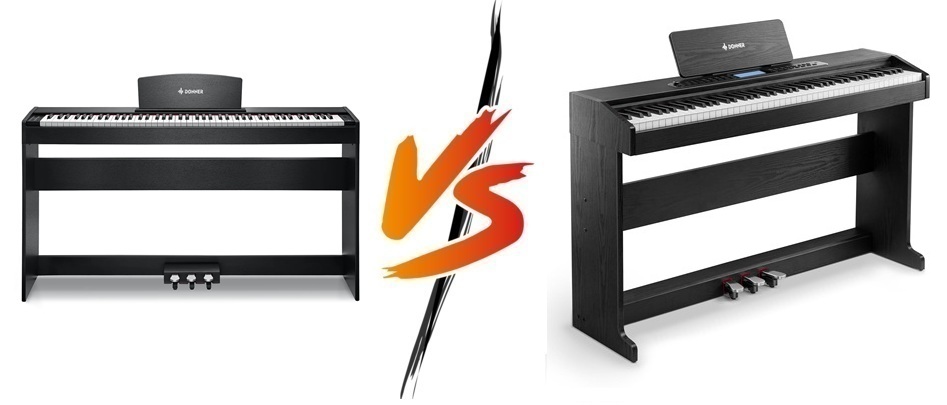
If you’re shopping for an affordable furniture-style digital piano, there’s a good chance you’ve come across the Donner DDP-50 and Donner DDP-95. Both models sit in a similar part of the market: full-sized 88-key digital pianos designed primarily for home use, beginners, hobbyists, and developing players who want something that looks more like a traditional piano than a portable keyboard. Both feature weighted keys, integrated stands, built-in speakers, and learning-focused features. On paper, they seem remarkably similar.
The problem is that once you start comparing specifications, things become less clear.
The DDP-50 is the newer model and focuses heavily on piano realism, simplicity, and value. The DDP-95, meanwhile, offers a much larger feature set, a built-in display, more learning tools, Bluetooth connectivity, and a huge collection of sounds and accompaniment styles.
So which one actually delivers the better experience?
After carefully comparing their design, keyboard action, sound quality, speakers, features, connectivity, and overall value, here’s my detailed assessment.
Donner DDP-50 vs Donner DDP-95 Comparison Chart
If you click the links below, under the product images, you will be redirected to Amazon.com. In case you then decide to buy anything, Amazon.com will pay me a commission. This doesn’t affect the honesty of this review in any way though.
| Specification | Donner DDP-50 | Donner DDP-95 |
|---|---|---|
 |  | |
| Check the best price on Amazon | Check the best price on Amazon | |
| Piano Type | Furniture-style digital piano | Furniture-style digital piano |
| Number of Keys | 88 | 88 |
| Key Action | Fully weighted hammer-action keyboard | Fully weighted hammer-action keyboard |
| Touch Sensitivity | Velocity-sensitive | 16 levels of touch sensitivity |
| Polyphony | 256 notes | 128 notes |
| Piano Sounds | Multi-layer sampled acoustic piano | Multi-layer sampled acoustic piano |
| Total Tones/Voices | Up to 375 tones (varies by region) | 610 tones |
| Rhythms | 100 rhythms | 600 rhythms |
| Demo Songs | 120 songs | 110 songs |
| Accompaniment Styles | Basic rhythm accompaniment | 128 accompaniment styles |
| Display | No dedicated display | 4.3-inch LCD display |
| Speaker System | Built-in stereo speakers | Dual 15W stereo speakers |
| Bluetooth MIDI | No | Yes |
| Bluetooth Audio | No | Yes |
| USB-MIDI | Yes | Yes |
| Headphone Outputs | Yes | Dual headphone outputs |
| Audio Output | Yes | Yes |
| Audio Input | Limited/varies by region | Yes |
| Recording Function | Yes | Yes |
| Recording Capacity | Basic recording functionality | Up to 300 seconds / approximately 5000 notes |
| Metronome | Yes | Yes |
| Split Mode | Yes | Yes |
| Dual/Layer Mode | Yes | Yes |
| Teaching Modes | Basic learning features | 3 dedicated teaching modes |
| App Compatibility | Yes | Yes |
| Pedals | Integrated 3-pedal unit | Integrated 3-pedal unit |
| Cabinet Style | Modern minimalist design | Traditional upright-style design |
| Weight | Approximately 24–25 kg (varies by region) | Approximately 26.2 kg |
| Best For | Piano-focused beginners and intermediate players | Beginners seeking maximum features and versatility |
| My individual reviews | Donner DDP-50 review | Donner DDP-95 review |
Category Comparison
| Category | Winner | Why |
|---|---|---|
| Design & Aesthetics | DDP-50 | Cleaner, more modern, minimalist appearance |
| Keyboard Feel | DDP-50 | Slightly more piano-focused playing experience |
| Piano Sound | DDP-50 | More focused acoustic piano character |
| Sound Variety | DDP-95 | Significantly larger voice library |
| Speakers | DDP-95 | More powerful dual 15W speaker system |
| Learning Features | DDP-95 | Dedicated teaching modes and LCD interface |
| Connectivity | DDP-95 | Bluetooth MIDI and Bluetooth Audio support |
| Polyphony | DDP-50 | 256-note polyphony vs 128-note |
| Recording Features | DDP-95 | More advanced recording capabilities |
| Overall Simplicity | DDP-50 | Less cluttered and easier to focus on playing |
| Overall Versatility | DDP-95 | More sounds, rhythms, and interactive features |
| Value for Serious Piano Study | DDP-50 | Stronger focus on core piano fundamentals |
| Value for Casual Home Use | DDP-95 | More entertainment and learning features |
At a Glance
| If You Want… | Choose |
|---|---|
| The better piano-playing experience | Donner DDP-50 |
| The most features for the money | Donner DDP-95 |
| Higher polyphony | Donner DDP-50 |
| Bluetooth connectivity | Donner DDP-95 |
| More sounds and rhythms | Donner DDP-95 |
| Simpler operation | Donner DDP-50 |
| Better learning tools | Donner DDP-95 |
| A modern minimalist design | Donner DDP-50 |
| An all-in-one beginner piano workstation | Donner DDP-95 |
| The best overall choice for learning piano | Donner DDP-50 |
Design & Build Quality
When comparing digital pianos, most buyers naturally focus on the keyboard action, sound quality, and features. Those are certainly important, but design and build quality should not be overlooked. A digital piano is often a long-term purchase that becomes a permanent fixture in a living room, bedroom, studio, or practice space. Unlike a portable keyboard that gets packed away after each session, a furniture-style digital piano is something you’ll see every day. Its appearance, construction quality, ergonomics, and overall durability all contribute to the ownership experience.
In the case of the Donner DDP-50 and Donner DDP-95, both instruments aim to provide an affordable alternative to traditional acoustic pianos while maintaining an attractive furniture-style appearance. At first glance, they may seem quite similar. Both feature full-size cabinets, integrated stands, three-pedal systems, and a home-focused design philosophy. However, after spending time examining their construction and design choices, some important differences begin to emerge.
Donner DDP-50 Design
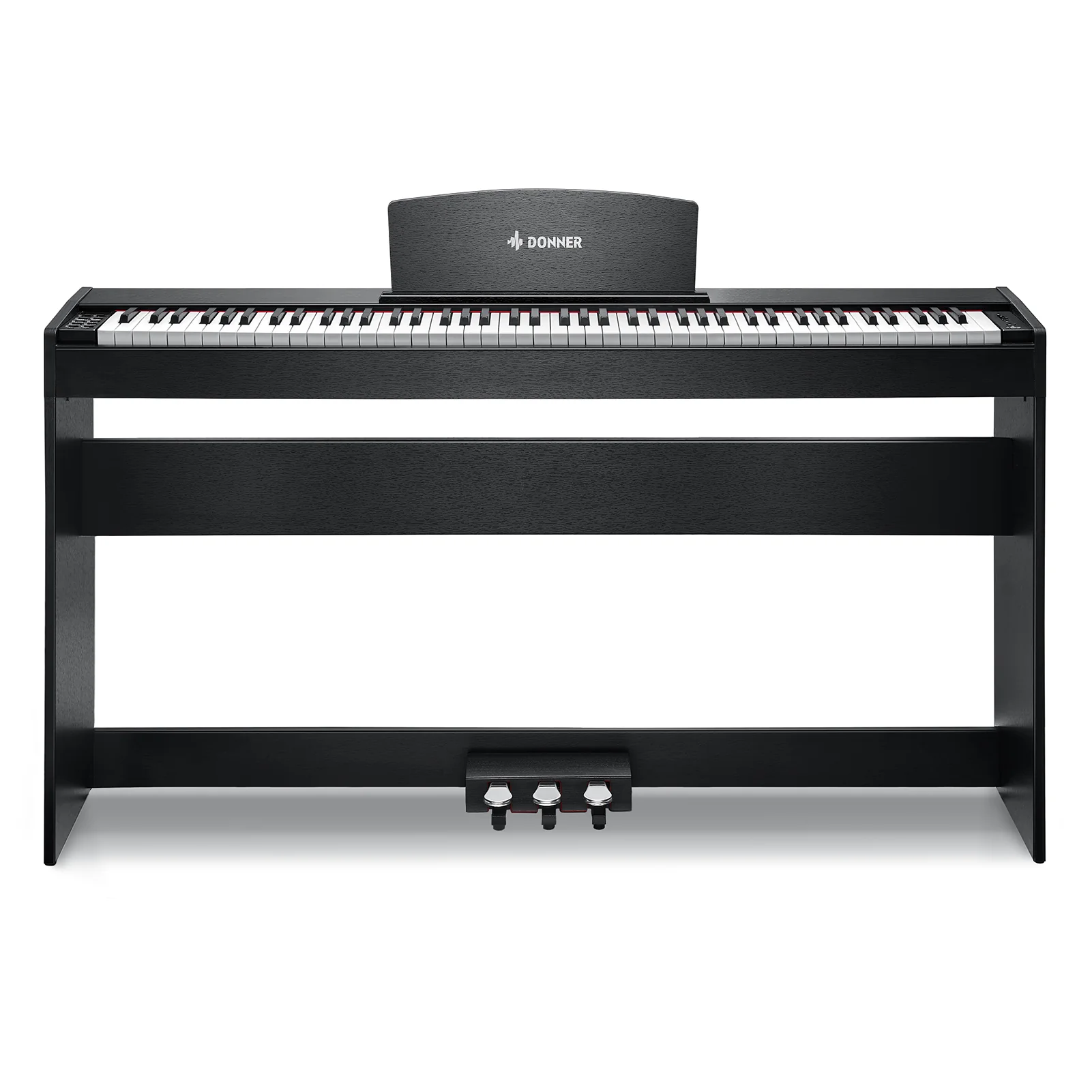
The DDP-50 immediately stands out because of its minimalist approach. Donner clearly designed this instrument with modern interiors in mind. Rather than attempting to imitate a traditional upright piano, the DDP-50 adopts a cleaner and more contemporary aesthetic.
The cabinet features straight lines, a relatively slim profile, and a streamlined appearance that helps it fit comfortably into a variety of spaces. Whether placed in a small apartment, a dedicated music room, or a family living room, the instrument manages to look tasteful without dominating the space.
One of the things I appreciate most about the DDP-50 is that it doesn’t advertise itself as a budget instrument. Many entry-level digital pianos suffer from excessive plastic surfaces, oversized control panels, or awkward design elements that immediately reveal their low-cost origins. The DDP-50 avoids most of these pitfalls.
From a distance, it looks surprisingly refined. The wood-grain finish contributes significantly to this impression. While it obviously doesn’t replicate the craftsmanship of a premium acoustic piano, it provides enough visual warmth to make the instrument feel more substantial than many competitors in the same price category.
The cabinet itself is relatively compact. This can be a major advantage for buyers who have limited floor space. The piano doesn’t feel bulky or oversized, and its streamlined dimensions make it easier to integrate into modern homes where every square meter matters.
Simplicity as a Design Strength
A particularly appealing aspect of the DDP-50 is its restrained control layout.
Many digital pianos attempt to impress buyers with large numbers of buttons, screens, and controls. While those features can be useful, they often create visual clutter. The DDP-50 takes a different approach.
The controls are intentionally minimal and unobtrusive. This creates a cleaner playing environment and reinforces the instrument’s piano-focused identity.
When sitting at the DDP-50, your attention naturally goes toward the keyboard rather than a collection of flashing displays or complicated menus. For players who primarily want to practice piano, this simplicity becomes a genuine advantage.
There’s also a psychological benefit to a cleaner interface. A less cluttered control panel makes the instrument feel less intimidating, particularly for beginners. Instead of spending time navigating menus, players are encouraged to focus on playing.
Build Quality of the DDP-50
Considering its price point, the DDP-50 feels reasonably solid.
The cabinet exhibits minimal flex during normal use, and the integrated stand provides adequate stability. Once assembled properly, the instrument feels secure and planted. There is very little wobble when playing energetic passages, which is important for maintaining a comfortable playing experience.
The pedal assembly is also integrated neatly into the cabinet. Unlike portable keyboards paired with external sustain pedals, the DDP-50’s three-pedal system contributes to the overall impression of a complete piano rather than an upgraded keyboard setup.
The keybed is mounted securely within the chassis, and the overall construction feels capable of handling years of home practice.
Of course, this is still an affordable digital piano. The materials are not luxurious, and close inspection reveals the cost-saving measures necessary to reach its price point. However, nothing about the instrument feels fragile or poorly assembled.
Donner DDP-95 Design
The DDP-95 takes a noticeably different design direction.
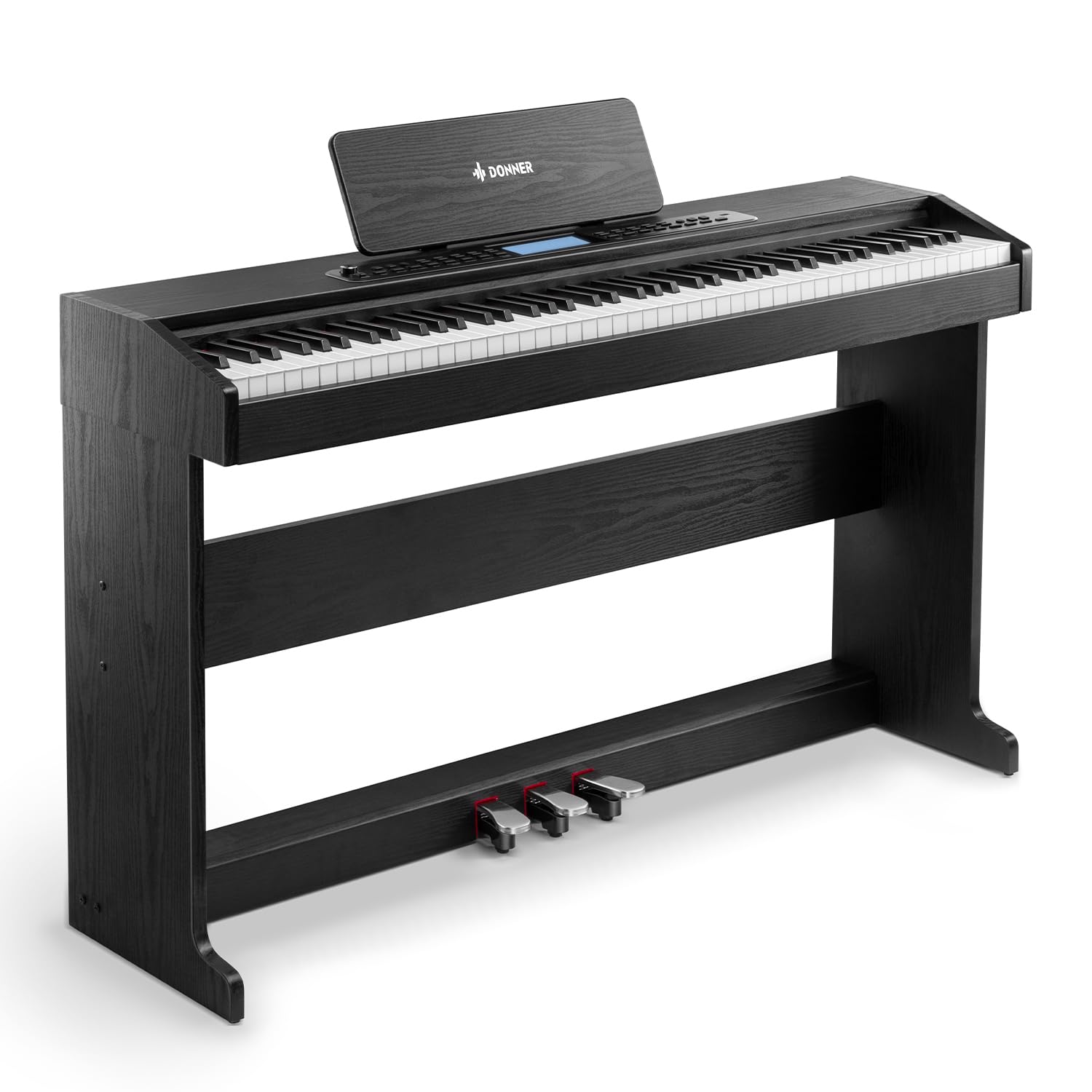
Where the DDP-50 emphasizes simplicity, the DDP-95 embraces functionality. The most obvious example is the inclusion of a 4.3-inch LCD display positioned directly above the keyboard.
This immediately changes the character of the instrument.
Rather than feeling like a traditional piano, the DDP-95 feels more like a hybrid between a digital piano and an arranger keyboard. The display serves as the central hub for navigating the instrument’s extensive collection of sounds, rhythms, learning functions, and settings.
For some users, this will be a significant advantage.
The screen makes it much easier to access the piano’s many features. Instead of memorizing button combinations or consulting the manual repeatedly, players can view information directly on the display.
This improves usability considerably, especially for beginners who may be unfamiliar with digital piano menus.
Visually, however, the screen creates a different aesthetic. The DDP-95 appears more technological and less traditional. Whether this is a positive or negative depends largely on personal taste.
A More Traditional Presence
Compared to the DDP-50, the DDP-95 has a slightly larger and more substantial physical presence.
The cabinet design feels closer to a conventional upright digital piano. It occupies a bit more visual space and projects a more substantial appearance within a room.
Some buyers may actually prefer this. If you’re looking for a digital piano that resembles a traditional instrument, the DDP-95 arguably gets closer to that goal.
The cabinet design creates a stronger sense of permanence and may feel more appropriate in larger rooms where a compact instrument might appear undersized.
The piano’s larger footprint also contributes to a feeling of stability. Once assembled, the DDP-95 feels sturdy and confidence-inspiring.
Build Quality of the DDP-95
The DDP-95 generally maintains the same level of construction quality expected from a modern entry-level furniture-style digital piano.
The cabinet feels durable enough for everyday home use, and the instrument’s weight helps keep it stable during performance.
The integrated stand and pedal system are well implemented, creating a cohesive overall package. The pedal assembly feels secure underfoot and provides a more authentic experience than external pedals commonly found on portable keyboards.
The display is another positive element from a build-quality perspective. It feels properly integrated into the instrument rather than appearing as an afterthought. The interface contributes to the piano’s modern identity and gives the instrument a more sophisticated feel during daily use.
As with the DDP-50, premium materials are understandably absent at this price level. However, the overall construction feels appropriate for the cost, and there are no obvious weaknesses that raise concerns about long-term reliability.
Which Design Is Better?
Choosing a winner in the design category ultimately comes down to priorities.
The DDP-50 is the more elegant instrument. Its minimalist aesthetic, compact cabinet, and uncluttered interface create a refined experience that feels surprisingly mature for an entry-level digital piano. It looks modern, clean, and focused. For players who want a digital piano that blends seamlessly into their home while maintaining a strong piano identity, the DDP-50 has broad appeal.
The DDP-95, on the other hand, prioritizes functionality over minimalism. The integrated display, larger cabinet, and feature-oriented design make it feel more like a complete music workstation. While it may not possess the same understated elegance as the DDP-50, it offers practical advantages that many beginners will appreciate.
Personally, I find the DDP-50’s design more attractive. Its simplicity gives it a timeless quality that should age well over the years. It feels like an instrument designed primarily for playing music rather than navigating features.
That said, buyers who value convenience, visual feedback, and easy access to learning tools may find the DDP-95’s design more useful in day-to-day practice.
Neither piano feels cheaply made, and both offer respectable build quality for their respective price points. The real difference lies in philosophy: the DDP-50 strives to be a piano first, while the DDP-95 strives to be a comprehensive musical learning platform. The better choice depends on which of those approaches aligns more closely with your own needs and expectations.
Keyboard Action and Playing Feel
If there is one category that matters more than any other when evaluating a digital piano, it is keyboard action and playing feel. Sound quality, features, connectivity, and even speaker performance all play important roles, but the keyboard is the part of the instrument you physically interact with every single time you play. A digital piano can have hundreds of sounds and dozens of advanced features, but if the keys feel unrealistic or uninspiring, the overall experience suffers.
This is especially important for beginners. Many first-time buyers assume that sound quality is the most critical factor, but in reality, developing proper piano technique depends heavily on the responsiveness and realism of the keyboard. The way the keys react to different levels of pressure affects dynamics, finger strength, timing, articulation, and overall musical expression.
Fortunately, both the Donner DDP-50 and Donner DDP-95 are designed with this in mind. Unlike entry-level keyboards that use lightweight synth-action keys, both instruments feature fully weighted 88-key keyboards intended to simulate the feel of an acoustic piano. However, despite sharing this basic specification, there are some noticeable differences in how these two instruments approach the playing experience.
Why Keyboard Action Matters
Before diving into the comparison itself, it’s worth discussing why weighted action is so important.
An acoustic piano uses a complex hammer mechanism. When a key is pressed, a hammer strikes a string, producing sound. The keys have resistance, and the amount of force applied directly affects volume and tonal character.
Replicating this experience digitally is one of the biggest challenges for digital piano manufacturers.
The best digital pianos use sophisticated hammer-action systems that attempt to recreate the resistance, weight distribution, and responsiveness of an acoustic instrument. While budget models cannot fully match the experience of a high-end acoustic piano, they can still provide a convincing approximation.
A good keyboard action helps players develop proper finger strength and technique. It also allows for more expressive playing because subtle variations in touch produce noticeable differences in sound.
This is where the DDP-50 and DDP-95 begin to separate themselves from many low-cost competitors.
Donner DDP-50 Keyboard Action
The DDP-50 is clearly designed with piano playing as its primary focus.
From the moment you place your hands on the keyboard, the instrument feels like it wants to be taken seriously as a piano rather than a general-purpose keyboard. The weighted action provides enough resistance to feel substantial without becoming tiring during extended practice sessions.
One of the first things I noticed is that the keys feel relatively balanced across the keyboard. Lower notes naturally feel heavier than higher notes, helping create a more authentic acoustic piano experience. This graded weighting contributes significantly to the instrument’s realism.
For beginners, the DDP-50 provides a useful introduction to proper piano technique. Players transitioning from lightweight keyboards will immediately notice the increased resistance. Initially, this may require some adjustment, but it ultimately encourages better finger control and hand strength.
Intermediate players will likely appreciate the keyboard even more. While it does not compete with premium actions found in significantly more expensive Yamaha, Roland, or Kawai instruments, it performs surprisingly well within its price category.
The action responds predictably to dynamic playing. Soft touches produce quieter notes, while stronger attacks generate greater volume and intensity. This allows players to practice expressive techniques rather than simply triggering notes at a fixed volume.
Consistency Across the Keyboard
One area where budget digital pianos sometimes struggle is consistency.
Certain low-cost instruments may have keys that feel uneven, with some notes requiring more force than others. In extreme cases, individual keys can feel noticeably different from their neighbors.
The DDP-50 performs reasonably well in this regard.
The keyboard feels generally consistent from one end to the other, creating a reliable playing experience. While it may not achieve the precision of premium hammer actions, it avoids many of the issues commonly associated with entry-level instruments.
This consistency becomes particularly important when practicing scales, arpeggios, and classical repertoire, where uneven key response can interfere with technique development.
Playing Classical Music on the DDP-50
Classical players often place the greatest demands on a digital piano’s action.
Pieces by composers such as Chopin, Beethoven, Mozart, and Debussy require a wide range of dynamics and expressive control. Fast passages, delicate phrasing, and nuanced articulation all depend on a responsive keyboard.
The DDP-50 handles these demands surprisingly well for its class.
While advanced pianists will eventually notice the limitations compared to more expensive instruments, beginners and intermediate players should find the action more than capable of supporting their musical growth.
The keyboard encourages proper technique rather than allowing players to rely on shortcuts often associated with lightweight actions.
Donner DDP-95 Keyboard Action
The DDP-95 also features a fully weighted 88-key keyboard and aims to replicate the feel of an acoustic piano. On paper, the specifications appear very similar to the DDP-50, but the overall experience feels slightly different.
The most notable addition is the inclusion of multiple touch sensitivity settings.
This gives players greater control over how the keyboard responds to their playing style. Different sensitivity levels can make the instrument feel lighter or heavier depending on personal preference.
For beginners, this flexibility can be useful.
Some new players initially struggle with fully weighted keyboards because they require more finger strength than unweighted alternatives. The ability to adjust sensitivity can make the learning process feel less intimidating.
More experienced players may also appreciate being able to customize the response for different genres or practice situations.
Feel and Responsiveness
Despite its flexibility, the DDP-95’s action feels slightly less piano-centric than the DDP-50.
This is not necessarily a criticism. Rather, it reflects the overall philosophy of the instrument.
The DDP-95 is designed as a feature-rich learning and entertainment platform. Its extensive collection of sounds, rhythms, and accompaniment features means it must accommodate a wider variety of playing styles.
As a result, the keyboard feels somewhat more versatile but slightly less focused.
When playing acoustic piano sounds, the action remains enjoyable and responsive. However, compared directly with the DDP-50, I find it marginally less convincing as a pure piano experience.
The difference is subtle rather than dramatic.
Many buyers would probably struggle to identify the distinction without playing both instruments side by side. Nevertheless, the DDP-50 feels a little more refined and natural under the fingers.
Dynamic Control and Expression
Dynamic control is one of the most important aspects of any digital piano.
The ability to transition smoothly between soft and loud playing is essential for musical expression.
Both instruments perform reasonably well in this area, but the DDP-50 has a slight advantage.
Its action seems to offer a more direct connection between finger movement and musical result. Changes in touch translate naturally into changes in volume, making expressive playing feel intuitive.
The DDP-95 still performs admirably, particularly given its price point, but its action sometimes feels as though it prioritizes accessibility over realism.
For beginners, this may actually be beneficial.
For developing pianists seeking a closer approximation of an acoustic instrument, the DDP-50 feels slightly more satisfying.
Long Practice Sessions
Comfort during extended practice sessions is another important consideration.
An action that feels too heavy can lead to fatigue, while an action that feels too light can encourage poor technique.
The DDP-50 strikes a strong balance between these extremes. The resistance feels substantial enough to build finger strength while remaining comfortable during longer sessions.
The DDP-95 is similarly comfortable but feels marginally lighter and easier to play. This may appeal to younger students or casual players who prioritize comfort over strict realism.
Neither instrument causes excessive fatigue, which is an important achievement at this price level.
Which Keyboard Is Better?
Comparing the DDP-50 and DDP-95 ultimately reveals two slightly different priorities.
The DDP-50 focuses more heavily on recreating the experience of playing a traditional piano. Its action feels a bit more authentic, its dynamic response feels more natural, and its overall playing experience encourages proper technique development.
The DDP-95 prioritizes flexibility. Its adjustable sensitivity settings and broader feature set make it appealing to beginners who want customization and ease of use. The keyboard remains enjoyable and capable, but it does not feel quite as piano-focused as the DDP-50.
The difference is not enormous, and both instruments represent solid value within the entry-level digital piano market.
However, if keyboard feel is your highest priority, the DDP-50 emerges as the stronger option. It simply feels more like a dedicated piano. Every aspect of the action seems designed to support traditional piano playing, and that focus becomes apparent every time you sit down to practice.
For buyers who view the keyboard as the heart of the instrument, that advantage carries significant weight and helps make the DDP-50 the more compelling choice overall in this category.
Sound Quality
Sound quality is one of the most heavily debated aspects of any digital piano. While keyboard action determines how the instrument feels under your fingers, the sound engine determines how rewarding it is to actually listen to. Even the most realistic keyboard can feel uninspiring if the piano tone lacks depth, character, or responsiveness.
When comparing the Donner DDP-50 and Donner DDP-95, sound quality becomes particularly interesting because the two instruments approach it from different angles. The DDP-50 focuses on delivering a convincing piano-playing experience with an emphasis on its core acoustic piano sounds. The DDP-95, meanwhile, takes a broader approach, offering a much larger library of sounds, accompaniment features, and tonal variety.
As a result, choosing a winner isn’t as straightforward as simply asking which piano sounds better. The answer depends heavily on what type of player you are and how you intend to use the instrument.
What Makes a Digital Piano Sound Good?
Before comparing the two instruments directly, it’s worth discussing what actually contributes to sound quality in a digital piano.
Unlike an acoustic piano, which generates sound through vibrating strings and a wooden soundboard, digital pianos rely on recorded samples or digital modeling technologies. Most affordable digital pianos use samples captured from acoustic pianos. These recordings are stored within the instrument and played back when keys are pressed.
Several factors influence how realistic and enjoyable the final result sounds:
- The quality of the original piano samples
- The number of velocity layers used
- Polyphony capacity
- Dynamic responsiveness
- Speaker performance
- Sound processing algorithms
- Resonance simulation
- Overall tonal balance
At the budget and mid-range level, manufacturers must carefully balance these factors while keeping costs under control.
Both the DDP-50 and DDP-95 make compromises, but they make different ones.
Donner DDP-50 Sound Character
The DDP-50 immediately feels like an instrument designed around piano playing.
When selecting the primary acoustic piano voice, you can tell that Donner devoted significant attention to making it the centerpiece of the experience. The sound is warm, balanced, and generally pleasant across the entire keyboard range.
One thing I appreciate about the DDP-50 is that it avoids sounding overly bright or artificially enhanced. Some entry-level digital pianos attempt to impress buyers with exaggerated treble frequencies that initially seem detailed but quickly become fatiguing during longer playing sessions.
The DDP-50 takes a more restrained approach.
The result is a piano tone that feels relatively natural and easy to listen to. The sound sits comfortably between warm and clear, making it suitable for a wide range of musical styles.
Whether you’re playing classical pieces, movie themes, pop arrangements, worship music, or jazz standards, the main piano voice remains enjoyable.
Dynamic Expression
One of the most important aspects of piano sound is how it responds to changes in playing dynamics.
A good digital piano should not simply get louder when you press harder. Ideally, the tonal character should also evolve, becoming brighter and more energetic as playing intensity increases.
The DDP-50 performs surprisingly well in this regard.
Soft passages retain a gentle and controlled character, while more forceful playing introduces additional presence and attack. This helps create a more realistic and expressive playing experience.
Of course, there are limitations.
Compared to premium instruments from manufacturers such as Yamaha, Roland, Kawai, or Casio’s higher-end models, the DDP-50 lacks some of the nuanced tonal transitions that make expensive digital pianos feel almost acoustic.
However, considering its price category, the piano sound is genuinely impressive.
Performance Across the Keyboard Range
Another strength of the DDP-50 is its overall consistency.
Some budget digital pianos suffer from uneven sampling, where certain areas of the keyboard sound noticeably different from others. You may hear abrupt tonal changes as you move between sample zones, which can make the instrument feel less realistic.
The DDP-50 generally avoids this problem.
The bass notes have enough weight to support left-hand accompaniment without becoming muddy. The middle register, where most piano music is played, sounds balanced and musical. The upper register maintains clarity without becoming excessively thin or harsh.
This consistency contributes significantly to the overall quality of the playing experience.
Additional Sounds on the DDP-50
Although the DDP-50 is primarily focused on piano performance, it still includes a substantial collection of additional sounds.
These voices expand the instrument’s versatility and allow players to experiment with different musical textures.
You’ll find electric pianos, strings, organs, guitars, basses, and other common instrument categories.
Most of these sounds are perfectly usable, though they are not the primary reason to buy the instrument. The acoustic piano voices remain the highlight.
In many ways, this focused approach works in the DDP-50’s favor. Rather than spreading resources across hundreds of sounds, the instrument feels more concentrated on doing one thing well.
Donner DDP-95 Sound Character
The DDP-95 approaches sound quality from a very different perspective.
Where the DDP-50 prioritizes the piano experience, the DDP-95 emphasizes variety.
With hundreds of available tones and a large collection of accompaniment styles, the instrument functions almost like a hybrid between a digital piano and an arranger keyboard.
For many buyers, this immediately increases its appeal.
Instead of being limited primarily to piano sounds, users can explore orchestral instruments, synthesizers, guitars, electric pianos, organs, and many other categories.
This expanded sound library creates opportunities for experimentation and creativity, especially for beginners who enjoy exploring different musical genres.
The Main Piano Sound
The key question, however, is how the DDP-95’s primary piano voice compares to the DDP-50.
The answer is somewhat nuanced.
The DDP-95’s piano sound is certainly capable. It delivers a pleasant tone that works well for practice, learning, and casual performance. Most beginners will likely be satisfied with its quality.
However, when comparing the two instruments side by side, I slightly prefer the DDP-50’s piano tone.
The DDP-50 sounds more focused and cohesive. Its piano voice feels like the central priority of the instrument.
The DDP-95’s piano sound remains enjoyable, but it occasionally feels like one voice among many rather than the defining feature of the instrument.
This isn’t necessarily a flaw. It’s simply a consequence of the DDP-95’s broader design philosophy.
Sound Variety and Creative Possibilities
Where the DDP-95 clearly pulls ahead is in tonal diversity.
Players who enjoy experimenting with different sounds will have far more options available.
The extensive sound library allows users to explore genres that extend well beyond traditional piano music. Layered sounds, accompaniment styles, and rhythm features further increase the instrument’s versatility.
For beginners, this can be particularly valuable.
Learning an instrument is often easier when the experience remains engaging and fun. Having access to a large collection of sounds encourages experimentation and can help maintain motivation during practice.
In this sense, the DDP-95 offers something that the DDP-50 cannot fully match.
Realism Versus Variety
The comparison between these two instruments ultimately comes down to a classic trade-off: realism versus variety.
The DDP-50 concentrates its resources on delivering a stronger piano experience. Its main acoustic piano voice feels more refined, more focused, and slightly more realistic.
The DDP-95 spreads its resources across a much larger collection of sounds and features. As a result, it offers significantly greater versatility but doesn’t quite achieve the same level of focus in its primary piano voice.
Neither approach is inherently better.
The right choice depends entirely on the player’s priorities.
Listening Through Headphones
Many digital piano owners spend a considerable amount of time practicing with headphones.
This makes headphone performance an important part of overall sound quality.
Both instruments benefit from headphone use because it eliminates room acoustics and speaker limitations from the equation.
Through a good pair of headphones, the details of the sound engine become more apparent. In this environment, the DDP-50’s piano-focused character becomes even more noticeable.
The warmth and balance of its primary piano sound translate particularly well to headphone listening.
The DDP-95 also performs admirably, but its strengths remain centered on versatility rather than absolute piano realism.
Which Sounds Better?
If the question is simply, “Which instrument has the better acoustic piano sound?” my answer would be the DDP-50.
The difference is not dramatic, but it is noticeable.
Its piano tone feels more carefully voiced, more cohesive, and more satisfying for dedicated piano practice.
However, if the question becomes, “Which instrument offers the most overall sonic possibilities?” the answer shifts decisively toward the DDP-95.
Its massive collection of sounds, rhythms, and accompaniment features provides far more opportunities for exploration.
For traditional piano players, the DDP-50’s focused sound design will likely be more appealing. For beginners who want variety and entertainment value alongside their piano studies, the DDP-95 may ultimately prove more engaging.
In the end, both instruments perform admirably within their respective price ranges. Neither can compete directly with premium digital pianos costing significantly more, but both deliver enough sound quality to support years of enjoyable practice and musical growth. The DDP-50 wins on piano realism, while the DDP-95 wins on versatility. Which advantage matters more depends entirely on the type of musician you are.
Speaker System
When evaluating a digital piano, the speaker system is often treated as a secondary consideration behind keyboard action and sound quality. In reality, however, speakers play a crucial role in shaping the overall playing experience. Even the best sound engine can only perform as well as the speakers that reproduce it. A beautifully sampled piano tone can lose much of its realism if the onboard speakers lack clarity, power, or balance.
For many players, especially beginners and hobbyists, the built-in speakers will be used almost all of the time. While professional musicians may connect external monitors, amplifiers, or headphones, the average home pianist typically sits down, turns on the instrument, and plays through the integrated speaker system. Because of this, speaker performance has a direct impact on daily enjoyment and long-term satisfaction.
The Donner DDP-50 and Donner DDP-95 both include built-in stereo speaker systems designed for home use, but they approach the task somewhat differently. While neither instrument is intended to replace a dedicated audio system, both aim to provide enough volume and sound quality to create an enjoyable and immersive piano-playing experience.
After examining their performance in detail, some important differences emerge.
Why Speakers Matter More Than Many Buyers Realize
When shopping for a digital piano, it’s easy to focus on specifications such as polyphony, sound libraries, Bluetooth connectivity, and recording functions. Speaker power ratings often receive far less attention.
That can be a mistake.
The speaker system affects nearly every aspect of how the instrument sounds in a real room.
Good speakers contribute to:
- Better tonal balance
- Greater dynamic range
- Improved bass response
- More realistic piano projection
- Better stereo imaging
- Increased immersion during practice
- More enjoyable performances for listeners
Poor speakers, on the other hand, can make even a high-quality piano sample sound thin, boxy, or artificial.
This is particularly important with acoustic piano sounds because a real piano naturally produces a large, room-filling sound. Digital pianos must recreate that experience using relatively compact speaker systems.
At the entry-level and mid-range price points occupied by the DDP-50 and DDP-95, compromises are inevitable. The goal is not perfection but rather achieving the best possible listening experience within a reasonable budget.
Donner DDP-50 Speaker Performance
The DDP-50 is designed primarily as a piano-focused instrument, and that philosophy extends to its speaker system.
Although detailed speaker specifications are not always prominently published across all regions and retailers, real-world use reveals a speaker system that is balanced, competent, and generally well suited to home practice.
One of the first things that stands out about the DDP-50 is that its speakers do not attempt to artificially exaggerate any particular frequency range.
Some budget digital pianos boost treble frequencies to create the impression of greater detail. Initially, this can sound impressive in a showroom environment, but over time it often becomes fatiguing.
The DDP-50 avoids this trap.
Instead, it delivers a relatively natural presentation that complements its piano-focused sound engine. The result is a listening experience that remains comfortable even during extended practice sessions.
Clarity and Detail
Clarity is one of the DDP-50’s stronger characteristics.
Individual notes remain reasonably well defined across the keyboard, allowing melodic lines and harmonic textures to emerge clearly. Chords sound clean and balanced, and the speaker system generally does a good job of preserving the nuances present in the piano samples.
This is especially noticeable when playing slower classical pieces or expressive ballads, where subtle dynamic variations play an important role.
The speaker system allows these details to come through without feeling compressed or overly processed.
For beginners, this clarity helps reinforce proper technique because dynamic differences remain audible and meaningful.
Bass Response
Bass reproduction is one area where affordable digital pianos often struggle.
A real acoustic piano produces substantial low-frequency energy, particularly in the lower octaves. Reproducing this convincingly requires larger speaker drivers and more cabinet volume than budget instruments typically provide.
The DDP-50 performs reasonably well within these limitations.
The lower register possesses enough weight to support left-hand accompaniment and bass lines without sounding weak or completely lacking in depth.
That said, players should maintain realistic expectations.
The instrument does not produce the kind of powerful, room-shaking bass associated with premium digital pianos or acoustic uprights. The lowest notes sound present and musical, but they do not fully recreate the physical sensation of an acoustic piano’s bass strings vibrating through a wooden soundboard.
For home practice, however, the performance is entirely acceptable.
Volume and Room Coverage
The DDP-50 offers sufficient volume for most residential environments.
Whether placed in a bedroom, apartment, practice room, or medium-sized living room, the speakers provide enough output to fill the space comfortably.
At moderate volumes, the sound remains balanced and clear.
As volume levels increase, the system continues to perform respectably, though it eventually reveals the limitations expected at this price point. The highest volume settings may introduce some compression and loss of refinement, but this is common among entry-level digital pianos.
Fortunately, most players rarely need to operate the instrument at maximum volume.
For everyday use, the DDP-50’s speakers provide more than enough power.
Donner DDP-95 Speaker Performance
The DDP-95 takes a somewhat different approach.
Unlike the DDP-50, the DDP-95 is designed not only for piano playing but also for rhythm accompaniment, educational features, backing tracks, and a wide variety of instrument sounds.
As a result, its speaker system must accommodate a broader range of audio content.
One immediate advantage is the published specification of dual 15-watt speakers.
This gives the DDP-95 a total output that is quite respectable for a home digital piano.
While wattage alone does not determine sound quality, it does provide a useful indication of the system’s potential volume and headroom.
In practice, the DDP-95 feels slightly more powerful than the DDP-50.
Fullness and Projection
The DDP-95 creates a somewhat larger sonic footprint within a room.
The additional power helps the instrument project more effectively, making it feel slightly more substantial during performance.
This becomes particularly noticeable when using accompaniment styles, rhythm tracks, or layered sounds.
The speakers handle these more complex arrangements reasonably well, maintaining enough separation to prevent the overall sound from becoming excessively muddy.
For players who enjoy using backing tracks or exploring the instrument’s extensive sound library, this added fullness can be a meaningful advantage.
The DDP-95 feels more comfortable operating as an all-purpose entertainment instrument rather than solely a piano.
Performance with Non-Piano Sounds
One area where the DDP-95 clearly benefits from its broader design philosophy is the reproduction of non-piano sounds.
Because the instrument includes hundreds of voices, ranging from strings and organs to synthesizers and guitars, the speakers must handle a much wider range of frequencies and sonic textures.
The system performs admirably in this role.
String ensembles sound reasonably rich, electric pianos retain good clarity, and accompaniment tracks possess enough energy to keep practice sessions engaging.
While dedicated studio monitors would certainly improve the experience, the built-in speakers do a commendable job considering the instrument’s price.
Listening Fatigue and Everyday Use
Long-term listening comfort is an important but often overlooked aspect of speaker quality.
A speaker system that sounds impressive for five minutes can become exhausting after an hour of practice if certain frequencies are overly emphasized.
Fortunately, both instruments perform well in this area.
Neither piano exhibits the harshness or excessive brightness that sometimes characterizes budget digital pianos.
The DDP-50 feels slightly more refined and piano-focused, while the DDP-95 emphasizes fullness and versatility.
Both approaches have merit, and neither becomes unpleasant during extended use.
Headphones Versus Speakers
It’s important to remember that many players will occasionally use headphones.
When headphones are connected, the differences between the two speaker systems become irrelevant because the sound engine is heard directly.
However, speakers remain extremely important because they define how the instrument sounds during casual practice, family performances, lessons, and social gatherings.
Most owners spend far more time listening through speakers than they initially expect.
For this reason, the quality of the onboard audio system deserves careful consideration.
Which Speaker System Is Better?
Comparing the DDP-50 and DDP-95 reveals two slightly different priorities.
The DDP-50’s speaker system complements its piano-focused identity. It delivers a balanced, natural presentation that supports expressive playing and extended practice sessions. The sound feels controlled, clear, and appropriately refined for a digital piano whose primary purpose is piano performance.
The DDP-95, on the other hand, benefits from greater published power and a design optimized for a wider range of musical activities. Its speakers produce a somewhat fuller and more expansive sound, making the instrument particularly effective when using accompaniment styles, backing tracks, and non-piano voices.
If your primary goal is traditional piano practice, the DDP-50’s balanced presentation may actually be preferable despite its less impressive specifications.
If you value versatility, entertainment features, and room-filling sound, the DDP-95 holds a slight advantage.
Overall, the difference is not dramatic, and both instruments provide speaker performance that exceeds what many buyers might expect at their respective price points. Neither system approaches the richness and depth of premium digital pianos costing significantly more, but both successfully deliver an enjoyable home-playing experience. If forced to choose a winner, the DDP-95 earns a narrow victory thanks to its stronger projection, greater power, and broader versatility, though the DDP-50 remains an excellent performer in its own right.
Functions and Features
While keyboard action and sound quality form the foundation of any digital piano, functions and features often determine how enjoyable and versatile the instrument becomes over time. This is especially true in the entry-level and mid-range market, where manufacturers frequently differentiate their products through learning tools, recording capabilities, sound libraries, practice aids, and smart connectivity options.
The Donner DDP-50 and Donner DDP-95 take noticeably different approaches in this area. The DDP-50 focuses on delivering a streamlined piano experience with a practical set of essential features. The DDP-95, by contrast, embraces a much broader feature set and aims to function as a complete learning and entertainment platform.
Neither philosophy is inherently better. Some players prefer simplicity and minimal distractions, while others appreciate having as many tools as possible available at their fingertips. Understanding these differences is critical because the feature set can significantly influence how you interact with the instrument on a daily basis.
Two Different Design Philosophies
Before examining individual features, it’s important to understand the fundamental difference between these two pianos.
The DDP-50 feels like a piano first and a digital device second.
Most of its functions exist to support piano playing rather than expand beyond it. The focus remains firmly on practice, performance, and musical development. Additional features are present, but they rarely become the center of attention.
The DDP-95 follows a different philosophy.
It feels more like a modern digital music workstation designed for beginners and hobbyists. While piano playing remains its primary purpose, the instrument offers numerous additional tools intended to make learning more interactive and engaging.
This distinction shapes nearly every aspect of the user experience.
Sound Library
One of the most obvious differences between the two models is the number of available sounds.
The DDP-50 includes a substantial collection of voices that extends beyond traditional acoustic piano sounds. Players can access electric pianos, organs, strings, basses, guitars, and various other instrument categories.
For most users, this selection is more than adequate.
The included sounds provide enough variety to experiment with different musical styles without overwhelming the player with endless options. More importantly, the instrument remains focused on its primary role as a digital piano.
The DDP-95 takes things much further.
Its sound library is significantly larger, offering hundreds of voices that cover a broad range of musical genres and instrument types. This expanded selection allows players to explore everything from orchestral arrangements and synth textures to contemporary pop sounds and electronic instruments.
For curious beginners, this can be a major advantage.
The ability to switch instantly between different instruments often makes practice sessions more enjoyable and encourages musical exploration.
Rhythm and Accompaniment Features
This is one area where the DDP-95 establishes a clear lead.
The DDP-50 includes rhythm functions that can provide simple backing patterns for practice and casual performance. These rhythms are useful for developing timing skills and adding a bit of variety to practice sessions.
However, they remain relatively straightforward.
The DDP-95 offers a much more extensive accompaniment system.
With hundreds of rhythm patterns and accompaniment styles available, players can create the feeling of performing with a virtual band. Different styles cover genres such as pop, rock, jazz, blues, Latin music, country, and many others.
For beginners, accompaniment features can make practicing considerably more engaging.
Instead of playing alone, users can perform alongside rhythm sections that respond to chord changes and create a fuller musical experience.
While advanced pianists may rarely use these functions, casual players and hobbyists often find them surprisingly enjoyable.
Learning Tools
The learning features represent one of the most significant differences between these two instruments.
The DDP-50 includes several useful educational tools designed to support skill development. These features help players improve timing, coordination, and overall technique without becoming overly complex.
The piano provides a metronome, recording capabilities, keyboard splitting functions, and compatibility with external learning applications.
These tools are practical and effective.
However, they largely assume that the player already has a structured learning approach, whether through lessons, online courses, books, or self-guided practice.
The DDP-95 takes a much more active role in the learning process.
Its built-in educational functions are clearly designed to assist beginners directly. The integrated display serves as a central hub for accessing teaching modes and practice features.
For new players who may not have formal instruction, these tools can provide valuable guidance.
The learning-oriented design makes the DDP-95 feel more approachable and beginner-friendly, particularly for younger students or self-taught adults.
Split and Dual Keyboard Modes
Both pianos include keyboard modes that expand their versatility.
One particularly useful feature is split keyboard functionality.
This allows the keyboard to be divided into separate sections, each producing different sounds or serving different purposes.
For teachers and students, split mode can be extremely valuable. Both players can use identical pitch ranges simultaneously without needing separate instruments. This simplifies demonstrations and lessons considerably.
Dual mode is also available, allowing two sounds to be layered together.
For example, players can combine piano and strings to create a richer and more cinematic sound. Layering functions can add depth to performances and encourage creative experimentation.
While both instruments offer these capabilities, the DDP-95 generally provides more flexibility due to its larger sound library and expanded feature set.
Recording Functions
Recording is one of the most useful yet underappreciated features on modern digital pianos.
Many players initially ignore it, only to discover later that it becomes one of their most frequently used tools.
Listening back to your own performances can reveal mistakes, timing inconsistencies, dynamic issues, and phrasing problems that are difficult to notice while actively playing.
The DDP-50 includes basic recording functionality that allows players to capture performances for review.
This feature works well and fulfills its intended purpose.
The DDP-95 offers a more advanced implementation.
The recording system integrates more closely with the piano’s educational features and broader functionality. For players interested in tracking progress over time, this expanded capability can be particularly valuable.
Although neither instrument is intended to replace professional recording software, both provide enough functionality for practice and self-assessment.
Metronome and Practice Assistance
A built-in metronome is an essential feature for serious piano study.
Fortunately, both instruments include one.
The metronome helps develop timing, rhythmic accuracy, and consistency. Whether practicing scales, technical exercises, or complete pieces, it remains one of the most important tools available to musicians.
The implementation is straightforward on both pianos, allowing users to adjust tempo according to their needs.
While not particularly exciting, this is one of those features that becomes indispensable over time.
User Interface and Navigation
The way an instrument presents its features can be just as important as the features themselves.
The DDP-50 adopts a minimalist approach.
Controls are intentionally simplified, creating an uncluttered playing environment. This design aligns with the piano’s overall philosophy of focusing on performance rather than menu navigation.
For players who prefer simplicity, this is a significant advantage.
The DDP-95 introduces a dedicated LCD display, which dramatically changes the user experience.
The screen makes navigating sounds, rhythms, settings, and learning tools much easier. Instead of relying on button combinations or memorized shortcuts, users can access information visually.
For beginners, this can reduce frustration and make the instrument feel more approachable.
App Integration and Modern Features
Modern digital pianos increasingly rely on software integration, and both Donner models recognize this trend.
The DDP-50 supports external learning applications that can enhance practice sessions and provide additional educational resources.
The DDP-95 expands on this concept by combining app compatibility with its broader feature set and interactive learning tools.
As online piano education continues to grow, compatibility with learning platforms becomes increasingly valuable.
For many beginners, these integrations can provide structure and motivation that would otherwise be difficult to maintain.
Which Piano Has Better Features?
When evaluating functions and features as a whole, the answer depends entirely on what you want from a digital piano.
The DDP-50 offers a thoughtfully selected collection of features that support piano playing without becoming distracting. Everything feels purposeful and focused. The instrument provides the tools most pianists actually need while maintaining a clean and straightforward user experience.
The DDP-95, however, delivers significantly more functionality. Its expanded sound library, accompaniment styles, teaching tools, display, and interactive features create a much richer technological experience.
For players who enjoy exploring, experimenting, and learning through interactive tools, the DDP-95 is the clear winner.
For players who primarily want to sit down and practice piano without navigating extensive menus or countless options, the DDP-50 may actually feel more appealing despite having fewer features.
Ultimately, this category reflects the broader identities of the two instruments. The DDP-50 prioritizes focus and simplicity, while the DDP-95 prioritizes versatility and engagement. Both approaches have merit, but in terms of sheer functionality, feature depth, and overall versatility, the DDP-95 takes a convincing victory.
Connectivity
Connectivity may not be the first thing most buyers think about when shopping for a digital piano, but it has become increasingly important over the past decade. Modern digital pianos are no longer isolated instruments that simply produce sound through built-in speakers. They are often integrated into broader ecosystems that include computers, tablets, smartphones, recording software, online learning platforms, virtual instruments, and external audio systems.
For some players, connectivity features may only be used occasionally. For others, they become an essential part of daily practice and music production. A digital piano with strong connectivity options can remain useful for many years as a player’s needs evolve, while limited connectivity may eventually become frustrating.
The Donner DDP-50 and Donner DDP-95 both recognize the importance of modern connectivity, but they do so in different ways. The DDP-50 focuses on providing the essential connections that most pianists need, while the DDP-95 expands its capabilities significantly with wireless technologies and additional integration options.
As a result, this is one category where the differences between the two instruments become particularly noticeable.
Why Connectivity Matters
Not long ago, digital piano connectivity mainly consisted of a headphone jack and perhaps a MIDI port.
Today’s players often expect much more.
A modern digital piano may be used for:
- Online piano lessons
- Learning apps
- Recording performances
- Music production
- Virtual instrument control
- Streaming audio
- Silent practice with headphones
- Connecting to external speakers
- Accompaniment playback
- Video creation and content sharing
Each of these activities depends on some form of connectivity.
Even beginners can benefit from these features. Many modern learning platforms use MIDI communication to provide real-time feedback on note accuracy, rhythm, and technique. Without the proper connections, access to these educational tools becomes limited.
For more advanced users, connectivity can significantly extend the lifespan of an instrument by integrating it into a larger musical setup.
Donner DDP-50 Connectivity Overview
The DDP-50 takes a relatively traditional approach to connectivity.
Rather than overwhelming users with numerous options, it focuses on providing the connections most piano players are likely to use on a regular basis.
This approach aligns with the instrument’s overall philosophy of simplicity and piano-focused design.
The available connections allow users to practice privately, connect to learning software, record MIDI data, and integrate the piano into a basic home music setup.
For many players, these capabilities will be entirely sufficient.
USB Connectivity
One of the most important connections on any modern digital piano is USB.
The DDP-50 includes USB functionality that allows communication with computers, tablets, and compatible mobile devices.
This connection opens the door to a wide variety of possibilities.
For example, players can connect the piano to music notation software, digital audio workstations, virtual instrument libraries, and educational applications.
The importance of USB-MIDI should not be underestimated.
Many modern piano-learning platforms rely heavily on MIDI communication. When connected via USB, the software can track which notes are being played, provide performance feedback, and create interactive lessons that would otherwise be impossible.
For beginners, this can dramatically enhance the learning experience.
For more advanced musicians, USB connectivity enables the piano to function as a controller for professional software instruments.
Headphone Connectivity
Headphone support is one of the most frequently used connectivity features on any digital piano.
The ability to practice silently is often one of the primary reasons people choose a digital piano over an acoustic instrument.
The DDP-50 provides headphone connectivity that allows users to practice without disturbing family members, neighbors, or roommates.
This may seem like a basic feature, but its importance cannot be overstated.
Many owners end up using headphones far more often than they initially expect, especially those living in apartments or shared spaces.
The ability to practice at any hour without worrying about noise restrictions can significantly increase practice consistency.
Audio Outputs
The DDP-50 also includes audio output options that expand its versatility.
These outputs allow connection to external speakers, amplifiers, mixers, recording equipment, or sound systems.
While the built-in speakers are perfectly adequate for home use, external audio systems can dramatically improve the listening experience.
This becomes particularly useful for:
- Home performances
- Small gatherings
- Recording projects
- Studio monitoring
- Larger practice spaces
The availability of dedicated outputs helps ensure that the instrument can grow alongside the player’s needs.
App Integration
One of the most practical aspects of the DDP-50’s connectivity is its compatibility with various educational applications.
Digital learning platforms have become increasingly popular among beginners because they offer structured lessons, progress tracking, and interactive exercises.
The DDP-50’s connectivity makes it possible to take advantage of these resources without requiring expensive additional hardware.
For self-taught players, this capability can add tremendous value.
Donner DDP-95 Connectivity Overview
The DDP-95 takes connectivity considerably further.
Where the DDP-50 focuses on core essentials, the DDP-95 embraces a more modern and technology-oriented approach.
This is immediately apparent through its inclusion of Bluetooth functionality, which significantly expands the ways users can interact with the instrument.
The DDP-95 feels designed for an era in which smartphones, tablets, and wireless devices play a central role in music education and entertainment.
Bluetooth MIDI
One of the most useful additions is Bluetooth MIDI.
This feature allows the piano to communicate wirelessly with compatible devices.
The convenience factor is substantial.
Instead of connecting cables every time you want to use a learning app or software instrument, the piano can establish a wireless connection directly.
For many users, this dramatically simplifies the setup process.
The fewer obstacles that exist between turning on the piano and starting practice, the more likely consistent practice becomes.
Bluetooth MIDI is especially appealing for students who frequently use tablets or mobile devices for lessons.
Bluetooth Audio
Bluetooth audio is arguably the DDP-95’s most attractive connectivity feature.
This allows audio from external devices to be streamed directly through the piano’s speaker system.
The practical applications are numerous.
Players can:
- Stream backing tracks
- Play along with songs
- Use online lesson videos
- Listen to accompaniment tracks
- Enjoy music through the piano speakers
This effectively transforms the instrument into a Bluetooth speaker system in addition to a digital piano.
For many buyers, this level of convenience adds significant value.
Instead of juggling separate speakers, cables, and audio systems, everything can be handled through the piano itself.
USB-MIDI Integration
Like the DDP-50, the DDP-95 also supports USB connectivity.
This ensures compatibility with computers, music software, learning platforms, and recording applications.
In practical terms, both instruments perform similarly in this area.
The addition of Bluetooth simply gives the DDP-95 more flexibility regarding how those connections are established.
For users who prefer wired reliability, USB remains available.
For users who prioritize convenience, Bluetooth provides an attractive alternative.
Dual Headphone Outputs
Another thoughtful addition on the DDP-95 is dual headphone support.
This feature may seem minor, but it can be surprisingly useful.
For example:
- Teacher and student can practice together.
- Parents can assist children during lessons.
- Two players can listen simultaneously.
- Silent duet practice becomes possible.
This capability enhances the instrument’s usefulness in educational settings and family environments.
Recording and Production Potential
Both pianos can serve as MIDI controllers for recording and production purposes.
By connecting to a computer, users can access virtual pianos, orchestral libraries, synthesizers, and professional music software.
For aspiring composers and producers, this functionality greatly expands the value of the instrument.
The DDP-95’s wireless options make this process slightly more convenient, but both instruments are capable tools in a home studio environment.
Future-Proofing
One of the most overlooked aspects of connectivity is future-proofing.
A beginner may initially purchase a digital piano solely for practice. Over time, however, interests often evolve.
Many players eventually become interested in:
- Recording music
- Creating videos
- Producing original compositions
- Using virtual instruments
- Participating in online lessons
Strong connectivity ensures that the instrument remains relevant as these interests develop.
In this respect, both pianos perform well, though the DDP-95 offers a greater degree of flexibility thanks to its wireless capabilities.
Which Piano Has Better Connectivity?
The answer here is relatively straightforward.
The DDP-50 provides all of the essential connections that most piano players need. USB integration, headphone support, audio outputs, and app compatibility create a solid foundation that supports learning, practice, and basic recording tasks.
For many traditional piano players, this will be entirely sufficient.
The DDP-95, however, goes beyond the essentials.
Bluetooth MIDI, Bluetooth audio, dual headphone outputs, USB connectivity, and expanded integration options make it significantly more versatile.
The addition of wireless functionality modernizes the user experience and removes much of the friction associated with connecting external devices.
For players who regularly use learning apps, stream backing tracks, practice with online videos, or integrate technology into their musical workflow, the DDP-95 offers a noticeably more convenient experience.
Ultimately, the DDP-50 delivers everything a pianist needs, while the DDP-95 delivers everything a modern digital musician might want. Both perform well, but the broader connectivity package makes the DDP-95 the clear winner in this category. Its combination of wired reliability and wireless convenience creates a level of flexibility that few instruments in its price range can match.
Conclusion
After spending time comparing the Donner DDP-50 and Donner DDP-95 across every major category, one thing becomes clear: these two instruments are aimed at slightly different types of players, even though they occupy a similar price range and share many core features.
The DDP-50 is the more piano-focused instrument. Its strengths lie in the areas that matter most to traditional piano players: a satisfying weighted keyboard, a convincing acoustic piano sound, clean design, and a straightforward user experience. It feels like an instrument designed to encourage practice rather than distract from it. If your primary goal is to learn proper piano technique, improve your playing skills, and enjoy a realistic piano experience without unnecessary complexity, the DDP-50 is likely the better choice.
The DDP-95 takes a broader approach. It offers more sounds, more rhythms, more learning tools, a built-in display, Bluetooth connectivity, and a range of interactive features that make it feel more like a complete home music workstation. For beginners who enjoy exploring different sounds, using accompaniment styles, and taking advantage of modern learning technology, the DDP-95 has a lot to offer. It delivers an impressive amount of functionality for the money and provides a more feature-rich experience overall.
What’s particularly impressive is that neither model feels like a poor value. Donner has done a good job of targeting two different audiences without compromising the essentials. Both pianos provide fully weighted keyboards, attractive furniture-style cabinets, built-in speaker systems, and enough capability to support years of musical development.
If I were recommending a piano to someone who is serious about learning and playing piano as their primary instrument, I would lean toward the Donner DDP-50. Its focus on the core piano experience gives it a slight edge. However, if versatility, connectivity, and interactive features are high on your priority list, the Donner DDP-95 becomes extremely compelling.
In the end, neither choice is wrong. The best piano is the one that fits your goals, your learning style, and the way you actually plan to use it every day.