
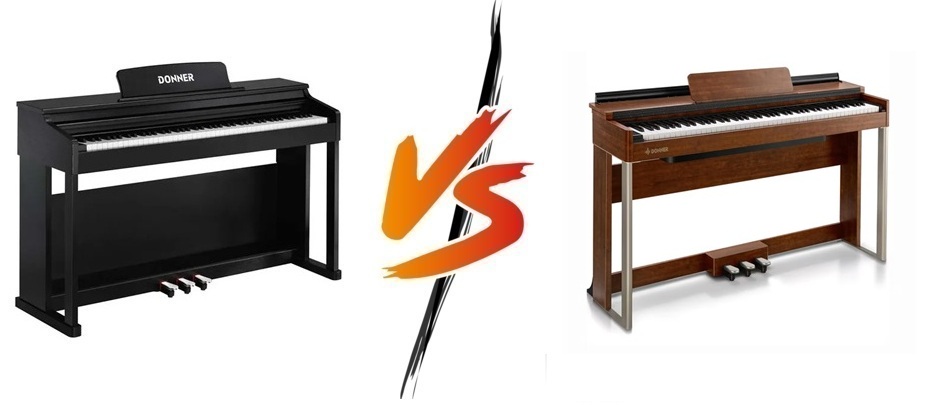
If you’ve been looking at Donner’s console-style digital pianos, you’ve probably landed on the DDP-100 and DDP-200. On paper, they look similar: both are full-size 88-key instruments with furniture-style cabinets, aimed at beginners and intermediate players who want something that feels like a “real” piano.
But once you dig deeper, they’re not the same instrument at all. The DDP-200 is clearly positioned as a step-up model, and the differences show up in ways that actually matter when you sit down and play.
Let’s break this down properly so you can decide which one is worth your money.
Donner DDP-100 vs Donner DDP-200 Comparison Chart
If you click the links below, under the product images, you will be redirected to Amazon.com. In case you then decide to buy anything, Amazon.com will pay me a commission. This doesn’t affect the honesty of this review in any way though.
| Feature | Donner DDP-100 | Donner DDP-200 |
|---|---|---|
 |  | |
| Check the best price on Amazon | Check the best price on Amazon | |
| Type | Console digital piano | Console digital piano |
| Keys | 88 keys | 88 keys |
| Key Action | Fully weighted hammer action | Graded hammer action (DGH) |
| Touch Sensitivity | Yes | Yes (more refined response) |
| Polyphony | Lower / not clearly specified (entry-level range) | 128 notes |
| Sound Engine | Basic sampled piano (AWM-style) | Improved sound engine with multiple grand tones |
| Number of Sounds | Limited (mostly piano-focused) | Multiple grand piano tones |
| Effects | Minimal / basic | Reverb effects (adjustable) |
| Speakers | Basic built-in stereo | 2 x 15W speakers |
| Sound Output | Modest volume and depth | Fuller, louder, more room-filling |
| Pedals | 3 pedals (sustain, soft, sostenuto) | 3 pedals (more responsive) |
| Cabinet Style | Wooden furniture-style | Wooden furniture-style (more refined design) |
| Key Cover | Sliding key cover | Sliding key cover |
| Metronome | Yes | Yes |
| Connectivity | USB MIDI | USB MIDI + Bluetooth MIDI |
| Audio Outputs | Headphone output | Headphone + line out |
| Headphone Use | Yes | Yes (better overall sound quality) |
| External Speaker Support | Limited | Yes (via line out) |
| App Compatibility | Yes (wired) | Yes (wired + wireless) |
| Dimensions | Similar console size | Slightly larger footprint |
| Weight | Lighter | Heavier (~77 lbs) |
| Price Range | Lower (budget-friendly) | Higher (mid-budget) |
| Target Users | Beginners, casual players | Beginners to intermediate players |
| Overall Focus | Simplicity and affordability | Improved realism and flexibility |
| My individual reviews | Donner DDP-100 review | Donner DDP-200 review |
Quick Summary
- Choose the DDP-100 if you want something simple, affordable, and focused purely on basic piano practice.
- Choose the DDP-200 if you want better sound, more realistic key feel, stronger speakers, and modern connectivity that will last longer as you improve.
The table shows it clearly: the DDP-200 isn’t just a small upgrade. It improves almost every core area that affects long-term playing experience.
Design & Build Quality
When you’re buying a console-style digital piano, design and build quality matter more than you might think. This isn’t just a piece of gear you tuck away in a corner or throw in a gig bag. It’s furniture. It sits in your room, becomes part of your daily environment, and often shapes how motivated you feel to actually sit down and play.
Both the Donner DDP-100 and DDP-200 aim to deliver that “real piano at home” feel, but they approach it at slightly different levels of refinement. The differences aren’t just cosmetic. They affect stability, long-term durability, and even the overall playing experience.
Let’s break it down properly.
Overall Design Philosophy
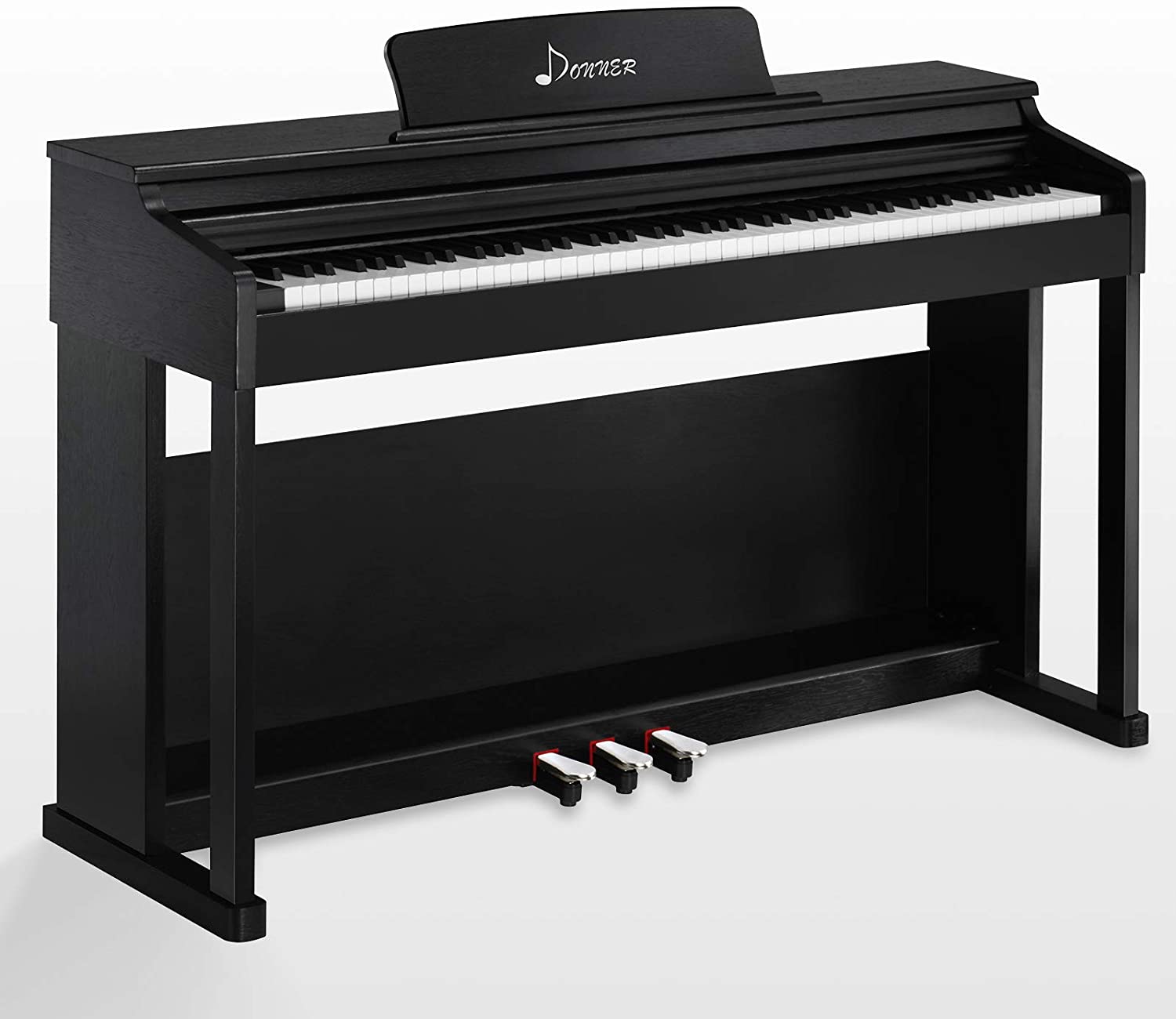
The DDP-100 feels like it was designed to hit a price point first, then built to look decent within that constraint. That’s not necessarily a bad thing. Donner clearly focused on keeping it accessible while still offering a traditional upright piano look.
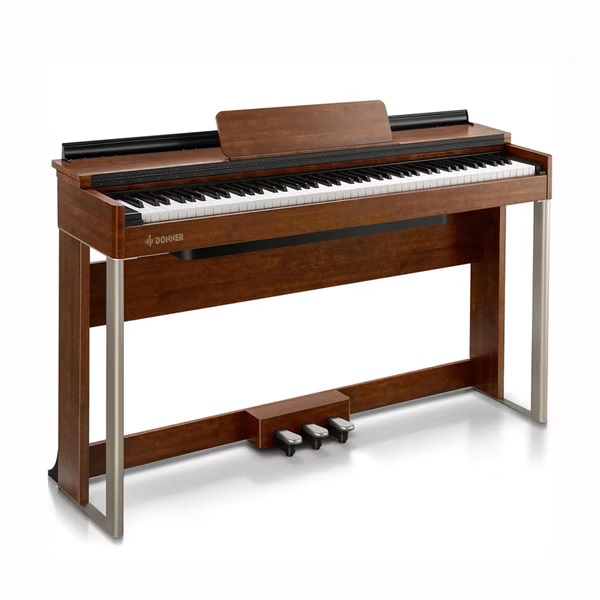
The DDP-200, on the other hand, feels like it started with a different goal. Instead of just being affordable, it tries to feel like a step closer to a “real” home piano. The design is more intentional. It’s not flashy, but it’s more cohesive and refined.
You can see this difference immediately when both are placed side by side. The DDP-100 looks functional. The DDP-200 looks like it belongs in a living room.
Cabinet Construction
Both models use a wooden-style cabinet, but the quality and finish are noticeably different.
On the DDP-100, the cabinet is fairly simple. The panels are clean, but the materials feel a bit lighter and less dense. If you tap on the side, there’s a slight hollowness to it. Again, this is normal for entry-level digital pianos, but it’s something you notice.
Assembly is straightforward, and once put together, it’s stable enough for everyday playing. However, if you push it slightly from the side or lean into it while playing aggressively, you might notice a bit of movement. It’s not alarming, but it reminds you that this is still a budget-friendly build.
The DDP-200 feels more solid right away. The cabinet panels are thicker, the joints feel tighter, and the overall structure has more weight behind it. When you sit down and play, there’s less flex and less vibration coming through the body of the instrument.
That added stability does more than just feel nice. It actually contributes to a more grounded playing experience. When the piano doesn’t shift or resonate awkwardly under your hands, it’s easier to focus on your playing.
Finish and Aesthetics
The finish is another area where the DDP-200 pulls ahead.
The DDP-100 typically comes in a basic matte or semi-matte black (sometimes white, depending on the variant). It looks clean, but it’s clearly on the simpler side. The texture can feel slightly plasticky in places, especially around the keybed and control areas.
It does the job, and in a practice room or bedroom, it blends in fine. But it doesn’t really stand out.
The DDP-200 has a more polished look. The wood finish feels more convincing, and the overall aesthetic is closer to what you’d expect from mid-range console pianos. The lines are smoother, the proportions are better balanced, and the entire unit feels more like a cohesive piece of furniture rather than a keyboard in a stand.
If you care about how your instrument looks in your home, this difference matters more than you might expect. A better-looking piano tends to invite you to sit down and play more often.
Size and Physical Presence
The DDP-100 is slightly more compact and lighter. This makes it easier to move and a bit more forgiving if you’re working with limited space.
That said, the smaller footprint also contributes to its lighter, less substantial feel. It doesn’t quite have that “anchored” presence you get from a traditional upright piano.
The DDP-200 is larger and noticeably heavier. Once it’s assembled, it feels like it’s meant to stay where it is. This added mass gives it a more authentic presence in the room.
There’s a psychological aspect to this. A heavier, more solid instrument tends to feel more serious. It encourages a different mindset when you sit down to play. It’s a subtle thing, but it adds up over time.
Key Cover and Practical Details
Both models include a sliding key cover, which is a nice touch at this price point. It helps protect the keys from dust and gives the instrument a cleaner look when not in use.
On the DDP-100, the key cover works fine but feels a bit lighter and less smooth in its movement. It gets the job done, but it’s not something you’d describe as premium.
On the DDP-200, the key cover feels sturdier and slides more smoothly. It’s a small upgrade, but it adds to the overall sense that this instrument was built with more attention to detail.
Other small touches, like the music stand and pedal assembly, follow the same pattern. The DDP-100’s components are functional. The DDP-200’s feel more solid and better integrated into the design.
Pedal Unit and Base Stability
Both pianos come with a triple pedal unit (sustain, soft, and sostenuto), which is great for developing proper technique.
The difference is in how they’re implemented.
On the DDP-100, the pedal unit is decent but slightly lighter. If you press hard or play aggressively, you might feel a bit of give in the base.
On the DDP-200, the pedals are mounted more securely, and the base feels sturdier. The pedals themselves also have a slightly more realistic resistance, which contributes to a better overall playing experience.
This might seem like a minor detail, but if you’re practicing regularly, you’ll notice it.
Durability and Long-Term Use
Over time, build quality becomes more important than first impressions.
The DDP-100 should hold up fine for casual use and beginner practice. It’s not fragile, but it’s not built for heavy, years-long daily use either. If you treat it well, it’ll serve you, but it doesn’t feel like a long-term investment piece.
The DDP-200, by contrast, feels like it’s built with longevity in mind. The sturdier cabinet, better materials, and tighter construction all suggest that it can handle more consistent use over time.
If you’re someone who plans to practice daily or keep the instrument for several years, that extra durability is worth considering.
Assembly Experience
Both pianos require some level of assembly, and neither is particularly difficult to put together.
The DDP-100 is lighter and easier to handle during setup, which can be helpful if you’re assembling it alone.
The DDP-200, due to its weight and larger panels, can be a bit more challenging. It’s not complicated, but having a second person makes the process smoother.
Once assembled, though, the DDP-200 rewards you with a more stable and premium-feeling result.
Final Thoughts on Design & Build
The DDP-100 delivers exactly what you’d expect from an entry-level console piano. It looks decent, feels acceptable, and gets the job done without unnecessary frills.
The DDP-200 goes further. It doesn’t just improve the look. It improves the feel, the stability, and the overall presence of the instrument.
If your goal is simply to have something to practice on, the DDP-100 is enough.
But if you want a piano that feels like a real part of your home, something that invites you to sit down and play and still feels solid after months or years of use, the DDP-200 is clearly the better-built instrument.
Keyboard and Playing Feel
If there’s one area where a digital piano either wins you over or completely loses you, it’s the keyboard. You can forgive basic speakers. You can live with limited features. But if the keys don’t feel right under your fingers, you’ll notice it every single time you sit down.
This is also where the gap between the Donner DDP-100 and DDP-200 becomes very real. On paper, both offer fully weighted 88-key keyboards. In practice, they deliver two noticeably different playing experiences.
Let’s break it down in a way that actually reflects what it’s like to play them.
The Basics: What “Weighted Keys” Actually Mean Here
Both the DDP-100 and DDP-200 use hammer-action key systems, which is essential if you’re trying to replicate the feel of an acoustic piano. This means:
- The keys have resistance
- They respond to how hard you press them
- They’re designed to build proper finger strength
That’s the baseline. And to be fair, both pianos clear that bar.
But that’s where the similarity starts to fade.
DDP-100 Keyboard Feel
The DDP-100 uses a standard fully weighted hammer-action keyboard. For a beginner instrument, it’s honestly quite solid.
When you first sit down and play it, your immediate impression will likely be: “Yeah, this feels like a piano.” The keys have enough weight to feel realistic, and there’s a decent sense of resistance when you press down.
For beginners, this is important. It helps you:
- Develop proper technique
- Avoid the “light keyboard” habit from cheap keyboards
- Transition more easily to an acoustic piano later
That said, once you spend more time with it, some limitations start to show.
The weighting feels fairly uniform across the keyboard. In a real acoustic piano, the lower keys are heavier and the higher keys are lighter. The DDP-100 doesn’t fully capture that difference. It’s not completely flat, but it’s not especially nuanced either.
This becomes noticeable when you play pieces that move across the full range of the keyboard. The experience feels slightly mechanical, like the keys are responding in a predictable, almost simplified way.
Another thing you’ll notice is the key return and repetition. When playing fast passages, especially repeated notes, the action can feel a bit slow compared to higher-end keyboards. It’s not a dealbreaker, but it does limit expressiveness.
In short, the DDP-100 keyboard is:
- Solid for beginners
- Good for basic practice
- Slightly limited in nuance and responsiveness
DDP-200 Keyboard Feel
Now, moving over to the DDP-200, the difference becomes clear almost immediately.
The DDP-200 uses a graded hammer-action system (marketed as DGH), which aims to more closely replicate the feel of an acoustic piano.
The first thing you notice is the weighting across the keyboard. The lower keys feel heavier, and as you move up, the keys gradually become lighter. This might sound like a small detail, but it makes a big difference in how natural the instrument feels.
When you play scales or pieces that span multiple octaves, the keyboard responds in a way that feels more organic. Your hands adjust naturally, rather than having to compensate for a uniform key feel.
The second major difference is the dynamic response.
On the DDP-200, there’s a wider range between soft and loud playing. You can press lightly and get a gentle tone, or dig in and produce a much stronger sound. More importantly, the transition between those levels feels smoother.
This is where the DDP-100 starts to feel a bit limited in comparison. On that model, the jump between soft and loud can feel slightly compressed. On the DDP-200, you get more control.
Another improvement is repetition and responsiveness.
Fast passages feel easier to execute. Repeated notes respond more quickly. There’s less of that “lag” feeling you sometimes get on entry-level actions. This makes a noticeable difference if you’re playing more advanced material or practicing technique-focused exercises.
Key Texture and Surface Feel
This is a smaller detail, but it still affects the experience.
The DDP-100 keys are smooth and slightly glossy. They feel fine at first, but during longer practice sessions, especially if your hands get a bit sweaty, they can feel slightly slippery.
The DDP-200 keys tend to have a more refined finish. They’re still not fully textured like high-end ivory-feel keys, but they offer a bit more grip. It’s subtle, but it contributes to a more controlled playing experience.
If you practice for long periods, this becomes more noticeable than you might expect.
Noise and Mechanical Feel
No digital piano is completely silent when it comes to key action, but the type of noise matters.
On the DDP-100, the key action produces a bit more mechanical noise. You might hear a soft “thud” when pressing keys, especially if you play with more force. It’s not loud, but it’s there.
On the DDP-200, the action feels more dampened and refined. The movement is smoother, and the mechanical noise is slightly reduced. This adds to the overall sense of quality.
It also matters if you practice late at night or in a quiet environment. Less mechanical noise means less distraction.
Control and Expressiveness
This is where everything comes together.
The DDP-100 gives you basic control. You can play soft, you can play loud, and you can express simple dynamics. For learning fundamentals, that’s enough.
But when you try to push beyond that, you start to feel the limits. Subtle phrasing, delicate dynamics, and expressive playing are harder to achieve.
The DDP-200 opens that up more.
Because of the better weighting and improved dynamic response, you can shape your playing more naturally. Crescendos feel smoother. Soft passages feel more controlled. Loud sections have more presence.
It doesn’t turn you into a concert pianist overnight, but it removes some of the barriers that the DDP-100 puts in your way.
Suitability for Different Skill Levels
This is where the choice becomes clearer.
If you’re a beginner, the DDP-100 is perfectly usable. It teaches you the basics, builds finger strength, and gives you a realistic enough starting point.
If you’re planning to stay at a casual level, it might be all you ever need.
But if you’re serious about improving, the DDP-200 makes more sense.
It gives you:
- A more realistic feel
- Better dynamic control
- A keyboard that won’t hold you back as you progress
In other words, it grows with you.
Transition to Acoustic Piano
One of the main reasons people choose weighted digital pianos is to prepare for playing on acoustic instruments.
The DDP-100 will get you part of the way there. You’ll develop strength and basic control, but the transition to a real piano will still feel like a step up.
The DDP-200 gets you closer. The graded action and improved response make the transition smoother. It’s not identical to an acoustic piano, but it’s a more accurate training ground.
Final Thoughts on Keyboard and Playing Feel
The DDP-100 delivers a solid, no-frills playing experience. It’s reliable, consistent, and good enough for learning and casual playing.
The DDP-200 goes further. It feels more natural, more responsive, and more expressive. It doesn’t just simulate a piano. It starts to feel like one.
If you’re just starting out and want something affordable, the DDP-100 will do the job.
But if you care about how the instrument feels under your fingers, and you want something that won’t limit you as you improve, the DDP-200 is the clear winner.
Sound Quality
Sound is where a digital piano either feels alive or falls flat. You can have a decent keyboard and a nice-looking cabinet, but if the tone doesn’t respond in a satisfying way, you’ll lose interest over time. This is especially true once you move past the beginner stage and start paying attention to nuance, expression, and tone color.
Both the Donner DDP-100 and DDP-200 aim to recreate the sound of an acoustic grand piano using digital sampling. They succeed to different degrees. The gap here is not subtle. It’s one of the biggest differences between the two instruments, and it directly affects how enjoyable they are to play.
Let’s go through it in detail.
How Digital Piano Sound Works (in simple terms)
Before comparing the two, it helps to understand what’s actually happening under the hood.
Digital pianos use recorded samples of real acoustic pianos. When you press a key, the instrument plays back a recording of that note at a certain volume and tone. The quality of the sound depends on a few key things:
- How detailed the samples are
- How many velocity layers are used (soft vs hard playing)
- How smoothly the piano transitions between those layers
- How well the sound engine processes dynamics and resonance
Both the DDP-100 and DDP-200 rely on this approach, but the quality of execution differs quite a bit.
DDP-100 Sound Character
The DDP-100 uses a fairly standard sampled piano sound engine based on AWM-style sampling. In practical terms, this means it’s designed to give you a clean, recognizable piano tone without going too deep into realism.
When you first play it, the sound is pleasant. It’s clear, balanced, and immediately usable. There’s nothing harsh or obviously artificial about it, which is a good sign for an entry-level instrument.
For basic practice, it does exactly what you need:
- Notes are distinct and easy to hear
- The tone is consistent across the keyboard
- It works well for scales, exercises, and simple pieces
However, once you spend more time with it, the limitations start to show.
The biggest issue is depth. The sound feels a bit “flat,” especially in the midrange. It lacks the richness and complexity you’d expect from a real piano. When you play chords, the notes don’t blend together in a particularly interesting way. They sound more like separate tones layered together rather than a cohesive harmonic body.
Another limitation is dynamic variation.
You can play soft and loud, but the transitions between those levels aren’t very detailed. It can feel like the piano is switching between a few preset volume levels rather than responding smoothly to your touch. This makes expressive playing harder.
For example:
- Soft passages can feel slightly dull or muted
- Loud passages can feel a bit harsh or compressed
- The “in-between” dynamics don’t always feel natural
This doesn’t mean the DDP-100 sounds bad. It just means it’s designed for functionality rather than realism.
DDP-200 Sound Character
The DDP-200 takes a noticeable step forward in almost every aspect of sound.
Right away, you’ll hear more depth. The tone feels fuller, especially in the lower register. Bass notes have more weight and presence, which makes a big difference when playing left-hand parts or full chords.
The midrange, which is where most melodies sit, is also more detailed. Notes feel more rounded and less “digital.” There’s a better sense of body to the sound.
One of the key upgrades is the inclusion of multiple piano tones. Instead of being stuck with a single sound, you get several variations of grand piano voices. These aren’t radically different, but they give you options:
- A brighter tone for pop or modern pieces
- A warmer tone for classical or softer playing
- Slight variations in character that keep things interesting
This alone makes the instrument feel less repetitive over time.
Dynamic Response and Expression
This is where the DDP-200 really separates itself.
The dynamic range is wider, meaning there’s a bigger difference between the softest and loudest sounds. More importantly, the transitions between those levels are smoother.
When you press a key lightly, the tone feels genuinely soft and controlled. When you press harder, it opens up naturally instead of jumping abruptly.
This has a big impact on how expressive you can be.
On the DDP-100, you might feel like you’re working around the instrument’s limitations. On the DDP-200, the instrument starts to respond to you instead.
For example:
- Crescendos feel gradual and natural
- Accents have more impact
- Soft playing retains clarity instead of sounding thin
This makes a big difference if you’re playing anything beyond basic exercises.
Polyphony and Note Handling
Polyphony refers to how many notes the piano can produce at once before it starts cutting off older notes.
The DDP-200 offers 128-note polyphony, which is solid for this price range. This means you can:
- Use sustain pedal without notes dropping out
- Play complex pieces with layered chords
- Avoid the “cutoff” effect that cheaper pianos sometimes have
The DDP-100 typically operates at a lower effective polyphony level (even if not always clearly specified), and while it handles simple playing fine, it can struggle a bit more with sustained passages or dense chords.
In real-world use, this shows up when:
- Holding the sustain pedal for longer passages
- Playing fast, layered music
- Combining bass notes with melody and harmony
The DDP-200 handles these situations more gracefully.
Sound Through Speakers vs Headphones
Sound quality isn’t just about the sound engine. It’s also about how that sound is delivered.
Through headphones, both pianos improve significantly. The DDP-100 sounds cleaner and more detailed when you bypass its built-in speakers. If you mostly practice with headphones, this levels the playing field a bit.
However, even through headphones, the DDP-200 still has the edge in depth and realism.
Through built-in speakers, the difference becomes more obvious.
The DDP-100’s speakers are more limited, which affects how the sound is projected. The tone can feel slightly boxed-in, and the bass response is weaker.
The DDP-200, with its more powerful speaker system, allows the sound engine to shine. You hear more of the low-end, more resonance, and a better sense of space.
This makes the instrument feel more immersive, especially when playing in a room rather than through headphones.
Realism Compared to Acoustic Piano
Neither of these pianos fully replicates an acoustic grand piano. That’s expected at this price point.
The DDP-100 gives you a simplified version of a piano sound. It’s accurate enough for learning, but it doesn’t fully capture the complexity of a real instrument.
The DDP-200 gets closer. It adds more nuance, more variation, and a better sense of how a real piano behaves dynamically.
It’s still not perfect, but it crosses an important threshold. Instead of just sounding like a piano, it starts to feel like one.
Long-Term Listening Experience
This is something people don’t always think about when choosing a digital piano.
The DDP-100 sounds fine at first, but over time, the lack of depth and variation can make it feel repetitive. You may find yourself wishing for more tonal options or a richer sound.
The DDP-200 holds up better over long-term use. The improved sound engine and multiple tones help keep the experience fresh. It’s simply more enjoyable to listen to, day after day.
Final Thoughts on Sound Quality
The DDP-100 delivers a clean, functional piano sound that works well for beginners and basic practice. It’s reliable and gets the job done, but it doesn’t go much further than that.
The DDP-200 takes a clear step forward. It offers:
- More depth and richness
- Better dynamic response
- Multiple usable tones
- Stronger overall realism
If sound quality matters to you, and especially if you plan to play regularly or develop your skills, the DDP-200 is easily the better choice.
It doesn’t just sound better. It makes playing more enjoyable, and that’s what ultimately keeps you coming back to the instrument.
Speakers and Audio Output
When people compare digital pianos, speakers are often treated as a secondary detail. That’s a mistake. The speaker system plays a huge role in how the instrument actually feels in your room. It shapes the depth of the sound, the sense of space, and even how connected you feel to what you’re playing.
You can have a great sound engine on paper, but if the speakers can’t deliver that sound properly, the experience falls apart. On the flip side, a well-matched speaker system can make even a modest sound engine feel more alive.
This is one of those areas where the Donner DDP-200 pulls ahead in a very noticeable, practical way.
Why Speakers Matter More Than You Think
Before getting into specifics, it’s worth understanding what you’re really listening for.
A good digital piano speaker system should:
- Reproduce a wide frequency range (from deep bass to clear highs)
- Maintain clarity at both low and high volumes
- Avoid distortion when playing loudly
- Create a sense of space, not just sound coming from a box
If any of these elements are missing, the piano can feel flat or lifeless, even if the underlying samples are decent.
This is exactly what separates the DDP-100 and DDP-200.
DDP-100 Speaker System
The DDP-100 comes with a basic built-in stereo speaker system. It’s designed to be functional and affordable, and in that sense, it does its job.
When you first turn it on and play, the sound is clear enough. You can hear individual notes without any problem, and for quiet practice, it’s perfectly usable.
But after a bit of playing, a few limitations become obvious.
The first thing you notice is the lack of depth. The sound feels somewhat “contained,” like it’s coming from inside a small box rather than filling the room. There’s not much sense of air or space around the notes.
The second issue is bass response.
Lower notes don’t have much weight behind them. When you play in the left hand, especially with chords or octave bass lines, the sound can feel thin. You hear the pitch, but you don’t feel it.
This affects the overall balance of your playing. The right hand tends to dominate simply because the lower register doesn’t have enough presence to support it.
Volume is another factor.
The DDP-100 can get reasonably loud for personal practice, but it doesn’t scale particularly well. As you increase the volume:
- The sound can become slightly harsh
- The clarity starts to drop
- The overall tone feels more compressed
It’s not unusable, but it’s not something you’d want to rely on for filling a larger room or playing for others.
DDP-200 Speaker System
The DDP-200 takes a big step forward here with its dual 15W speaker system.
On paper, that might not seem like a massive upgrade, but in practice, it makes a clear difference.
The first thing you notice is the fullness of the sound.
Notes have more body. The piano doesn’t just sound louder, it sounds bigger. When you play chords, especially in the lower and middle registers, there’s a sense of weight and presence that the DDP-100 struggles to deliver.
Bass response is significantly improved.
Low notes actually feel grounded. You can hear and feel the difference when playing left-hand parts. This creates a more balanced overall sound, where both hands contribute equally to the musical texture.
The midrange also benefits.
Melodies come through more clearly, but without sounding thin or overly bright. There’s a better sense of warmth, which makes longer playing sessions more enjoyable.
Volume and Room Filling Capability
This is where the DDP-200 really separates itself.
It has enough power to fill a small to medium-sized room comfortably. You don’t have to push the volume to its limits to get a satisfying sound.
At moderate volume levels:
- The tone remains clear
- The dynamics are preserved
- The sound feels open rather than compressed
Even when you turn it up, the DDP-200 holds together better than the DDP-100. There’s less distortion, and the sound doesn’t collapse into a harsh or boxy character.
This makes a difference if you:
- Play for friends or family
- Practice without headphones
- Want a more immersive experience
The DDP-100, by comparison, feels more like a personal practice instrument. The DDP-200 feels closer to a small home piano setup.
Speaker Placement and Sound Projection
Another subtle but important factor is how the speakers are positioned.
On the DDP-100, the speakers are fairly standard in their placement. The sound tends to project in a straightforward way, which contributes to that “boxed-in” feeling.
The DDP-200 has a more refined speaker setup, which helps distribute the sound more evenly. Instead of feeling like everything is coming from a single point, the sound spreads out a bit more.
This creates a more natural listening experience. It’s not the same as an acoustic piano, where sound resonates through the entire body, but it’s a step closer.
Playing Feel Through Speakers
This might sound strange, but speakers actually affect how the keyboard feels.
When the sound is fuller and more responsive, your playing feels more connected. You press a key, and the sound that comes back has enough presence to match your input.
On the DDP-100, there’s sometimes a slight disconnect. You press a key, but the sound doesn’t fully reflect the energy of your touch. This can make the instrument feel less responsive, even if the keyboard itself is decent.
On the DDP-200, that connection is stronger. The improved speaker system reinforces the dynamics of your playing, making the whole experience feel more cohesive.
Headphone Experience
Both pianos offer headphone outputs, and using headphones can bypass many of the limitations of built-in speakers.
With the DDP-100, headphones are almost essential if you want to hear the full potential of the sound engine. The tone becomes clearer, and some of the thinness disappears.
The DDP-200 also benefits from headphones, but the difference isn’t as dramatic because the built-in speakers are already doing a better job.
If you plan to practice mostly with headphones, the gap between the two narrows slightly. But it doesn’t disappear entirely. The DDP-200 still offers a more detailed and dynamic sound.
External Audio Options
The DDP-200 also offers more flexibility when it comes to external audio.
With line-out options, you can connect it to:
- External speakers
- Amplifiers
- Recording equipment
This makes it more versatile if you want to upgrade your sound setup later.
The DDP-100 is more limited in this area, focusing mainly on basic headphone and MIDI connectivity.
Long-Term Listening Comfort
This is something you only notice after extended use.
The DDP-100’s speakers can become a bit fatiguing over time, especially at higher volumes. The slight harshness and lack of depth make long sessions less enjoyable.
The DDP-200 is easier on the ears. The fuller sound and better balance reduce listening fatigue, which matters if you practice regularly.
Final Thoughts on Speakers and Audio Output
The DDP-100 offers a basic, functional speaker system that works well for quiet practice and beginners. It’s clear enough, but limited in depth, power, and overall presence.
The DDP-200 goes further in every meaningful way. It delivers:
- Fuller, richer sound
- Better bass response
- Higher volume without distortion
- A more immersive playing experience
If you plan to play mostly with headphones, the difference is less critical, though still present.
But if you want your piano to sound good in a room, to feel engaging without extra equipment, and to support your playing as you improve, the DDP-200’s speaker system is a major advantage.
Features and Functions
When it comes to digital pianos, features can be a bit of a double-edged sword. Some instruments try to pack in hundreds of sounds, rhythms, and learning tools, which can be useful but often end up feeling cluttered. Others take a more focused approach and strip things down to the essentials.
The Donner DDP-100 and DDP-200 both lean toward simplicity, but they do it in slightly different ways. Neither of these pianos is overloaded with features, and that’s actually part of their appeal. They’re designed primarily for playing piano, not for acting like a full workstation keyboard.
That said, the DDP-200 does expand on the basics in ways that make it more flexible and more enjoyable over time.
Let’s take a closer look at what each model offers and how those features translate into real-world use.
Core Philosophy: Simplicity vs Expanded Simplicity
The DDP-100 is very much a “plug in and play” instrument. It keeps things minimal:
- A small set of sounds
- Basic controls
- No unnecessary distractions
This makes it approachable, especially for beginners who might feel overwhelmed by too many options.
The DDP-200 builds on that idea but adds a layer of flexibility. It still feels focused, but it gives you more room to experiment and adapt the instrument to different playing styles.
Think of it like this:
- DDP-100: a straightforward practice piano
- DDP-200: a practice piano with a bit more personality and adaptability
Built-in Sounds and Voices
This is one of the most noticeable differences in the features category.
The DDP-100 keeps things very simple. It focuses primarily on a single main piano sound, sometimes with a small handful of variations or additional tones depending on the version.
For a beginner, this is actually helpful. You’re not distracted by switching between sounds. You sit down, play, and focus on technique.
However, over time, this can feel limiting. Playing the same tone every day can get repetitive, especially if you’re exploring different genres.
The DDP-200 addresses this by offering multiple piano tones, typically centered around different styles of grand piano sounds.
These variations aren’t gimmicky. They’re subtle but useful:
- A brighter tone for pop or contemporary music
- A warmer tone for classical pieces
- Slight tonal shifts that keep practice sessions fresh
This doesn’t turn the DDP-200 into a full multi-instrument keyboard, but it gives you enough variety to avoid monotony.
Effects and Sound Shaping
The DDP-100 offers very limited control over sound shaping. What you hear is mostly what you get. There may be basic reverb or minimal adjustments, but nothing extensive.
This simplicity is fine for beginners, but it also means you have very little control over the character of your sound.
The DDP-200 introduces a bit more flexibility here.
It includes built-in reverb effects, allowing you to adjust the sense of space in your sound. This might seem like a small feature, but it makes a noticeable difference:
- You can create a more “concert hall” feel
- Or keep things dry and focused for practice
Having even a small amount of control over ambience makes the instrument feel more responsive to your preferences.
Metronome and Practice Tools
Both pianos include a built-in metronome, which is essential for practice.
On the DDP-100, the metronome is basic but functional. It helps you keep time, which is all most beginners need.
The DDP-200 also includes a metronome, but it’s typically easier to access and integrate into your playing routine. The interface feels a bit more refined, and the feature itself feels more like part of the instrument rather than an afterthought.
Neither piano goes deep into learning tools. You won’t find:
- Interactive lessons
- Light-up keys
- Built-in tutorials
And honestly, that’s not a bad thing. These are instruments, not teaching systems. If you want guided learning, you’re better off using external apps.
Layering and Split Functions
This is an area where both pianos remain fairly minimal.
The DDP-100 typically doesn’t emphasize advanced functions like layering (combining two sounds) or keyboard splits (assigning different sounds to different sections of the keyboard).
The DDP-200 may offer limited versions of these features depending on the model variant, but they’re not the main focus.
In practical terms, this means:
- These pianos are designed primarily for traditional piano playing
- They’re not built for complex performance setups
If you’re looking for advanced layering or performance features, you’d need to look at higher-end or more workstation-style keyboards.
Pedal Functionality
Both the DDP-100 and DDP-200 come with a triple pedal unit:
- Sustain pedal
- Soft pedal
- Sostenuto pedal
This is a big plus, especially at this price point.
On the DDP-100, the pedals work as expected, but the response can feel slightly basic. The sustain pedal, in particular, may not offer much nuance beyond on/off behavior.
The DDP-200 improves on this with more realistic pedal response. The sustain feels more natural, and there’s often better control over how the sound decays.
This matters more as you progress in your playing. Pedaling is a huge part of expressive piano performance, and having a more responsive system helps.
Control Interface and Usability
The DDP-100 keeps its controls very simple. There are usually a few buttons or a minimal interface that lets you adjust volume, select sounds, and control basic functions.
This simplicity is a strength. You don’t need to read a manual to get started. Everything is straightforward.
The downside is that it can feel a bit limited and less intuitive when you want to do something beyond the basics.
The DDP-200 has a slightly more refined control layout. It still avoids complexity, but it feels more polished.
Functions are easier to access, and the overall interaction with the instrument feels smoother.
It’s not a night-and-day difference, but it contributes to a better overall user experience.
Connectivity as a Feature Extension
While connectivity is often treated as a separate category, it directly affects how useful the features are.
The DDP-100 offers basic USB MIDI connectivity, which allows you to connect to a computer or app.
The DDP-200 expands on this with additional options, including Bluetooth MIDI.
This opens up more possibilities:
- Using learning apps wirelessly
- Connecting to music software without cables
- Expanding the instrument’s capabilities beyond its built-in features
In a way, this turns the DDP-200 into a more flexible platform, even if its onboard features remain relatively simple.
Long-Term Use and Feature Relevance
This is where the difference becomes more important.
The DDP-100 is great at the beginning. Its simplicity helps you focus, and you’re not overwhelmed by options.
But as you improve, you may start to feel its limitations:
- Limited sound variety
- Minimal control over tone
- Fewer ways to customize your experience
The DDP-200 holds up better over time.
It still keeps things simple, but it gives you enough flexibility to grow into:
- Multiple sounds to explore
- Basic sound shaping options
- Better integration with external tools
This makes it more future-proof.
Final Thoughts on Features and Functions
The DDP-100 takes a minimal, focused approach. It gives you exactly what you need to start playing piano and nothing more. For beginners, that’s often ideal.
The DDP-200 builds on that foundation without overcomplicating things. It adds:
- More sound variety
- Better sound control
- Improved usability
- Greater flexibility through connectivity
Neither piano is feature-heavy, and that’s by design.
But if you want an instrument that stays interesting as you improve, and gives you just enough room to grow without becoming overwhelming, the DDP-200 offers a more balanced and versatile feature set.
Connectivity
Connectivity might not be the first thing you think about when buying a digital piano, but it quickly becomes important once you start using the instrument regularly. Whether it’s connecting to learning apps, recording your playing, or integrating with other gear, the way a piano communicates with the outside world can either expand your experience or quietly limit it.
The Donner DDP-100 and DDP-200 take different approaches here. The DDP-100 sticks to the basics, while the DDP-200 adds modern conveniences that make a bigger difference than you might expect.
Let’s walk through this in a practical, real-world way.
Why Connectivity Matters
Before comparing the two models, it’s worth understanding what connectivity actually does for you.
A digital piano isn’t just a standalone instrument anymore. With the right connections, it can:
- Work with learning apps like flowkey or Simply Piano
- Connect to recording software (DAWs)
- Act as a MIDI controller for virtual instruments
- Output sound to external speakers or audio systems
Even if you don’t plan to use these features right away, having them available can extend the life and usefulness of your instrument.
This is where the DDP-200 starts to justify its higher price.
USB MIDI: The Shared Foundation
Both the DDP-100 and DDP-200 include USB MIDI connectivity, which is the most essential feature.
In simple terms, USB MIDI allows your piano to send note data to a computer, tablet, or smartphone. It doesn’t send audio. Instead, it tells the connected device which keys you’re pressing, how hard you’re pressing them, and when you release them.
This opens up a lot of possibilities:
- Using virtual piano sounds on your computer
- Recording MIDI tracks in music software
- Practicing with interactive learning apps
On both models, this connection is straightforward. You plug in a USB cable, connect to your device, and you’re ready to go.
For basic use, the DDP-100 already covers this well. If your main goal is to connect to a laptop or tablet for learning or recording, it gets the job done without complications.
Bluetooth MIDI: The DDP-200 Advantage
This is one of the biggest differences between the two pianos.
The DDP-200 includes Bluetooth MIDI, while the DDP-100 does not.
At first glance, this might not seem like a big deal. After all, you can already connect with a cable. But in practice, Bluetooth changes how you interact with the instrument.
With Bluetooth MIDI, you can:
- Connect wirelessly to apps on your phone or tablet
- Avoid dealing with cables altogether
- Set up your practice space more cleanly
This is especially useful if you’re using mobile devices. Instead of plugging in adapters or managing cables, you can just turn on Bluetooth and start playing.
It also makes the instrument feel more modern. The experience is smoother and more convenient, which matters more than you might expect during daily use.
Audio Outputs and External Sound Options
Another key part of connectivity is how the piano handles audio output.
The DDP-100 is fairly limited here. It typically offers:
- A headphone output
- Basic audio routing through that output
This is fine for personal practice, especially if you’re using headphones. But if you want to connect to external speakers or an amplifier, your options are more limited and less flexible.
The DDP-200 improves on this by including dedicated line-out connections.
This allows you to:
- Connect to external speakers for better sound
- Plug into a home audio system
- Use the piano in a small performance setup
The difference here is not just about sound quality, but about flexibility. With proper line outputs, you’re not relying on the internal speakers. You can upgrade your sound system whenever you want.
This is particularly useful if:
- You want louder, more powerful sound
- You’re playing for others
- You’re recording audio externally
Headphone Connectivity
Both pianos include headphone outputs, which are essential for quiet practice.
On the DDP-100, the headphone experience is straightforward. Plug in your headphones, and the internal speakers are muted. It’s simple and effective.
The DDP-200 offers a similar setup, but often with slightly better implementation. The sound quality through headphones tends to be more refined, partly because of the improved sound engine.
Some versions of the DDP-200 may also include more flexibility, such as better output quality or support for different headphone types.
In practical terms, both pianos handle headphone use well, but the DDP-200 benefits from its overall better audio system.
MIDI as a Creative Tool
If you plan to do any kind of music production, MIDI connectivity becomes more important.
Both the DDP-100 and DDP-200 can function as MIDI controllers. This means you can:
- Use them to play virtual instruments
- Record MIDI tracks in a DAW
- Edit your performances after recording
The difference is in how convenient the process is.
With the DDP-100, you’ll need a wired connection. This works fine, but it can feel a bit restrictive, especially if your setup involves multiple devices.
With the DDP-200, Bluetooth MIDI adds flexibility. You can move around more freely and connect to devices without worrying about cables.
This might not matter for everyone, but if you’re working in a creative or recording environment, it’s a noticeable advantage.
Compatibility with Apps and Software
Both pianos can work with popular learning and music apps, thanks to their MIDI capabilities.
The DDP-100 can connect to apps like:
- flowkey
- Simply Piano
- GarageBand
But again, this requires a wired connection, which can sometimes be inconvenient depending on your device.
The DDP-200 makes this process easier with Bluetooth support.
For example:
- You can connect to your tablet instantly
- No need for adapters or extra cables
- Switching between apps is more seamless
This makes the DDP-200 a better choice if you plan to use digital learning tools regularly.
Setup and Everyday Convenience
This is where the difference in connectivity really shows up.
The DDP-100 is simple but slightly old-school in its approach. You plug things in, and everything works, but there’s a bit more setup involved.
The DDP-200 feels more modern and user-friendly.
Bluetooth reduces friction. Line outputs expand your options. The overall experience is smoother and more adaptable.
These are small improvements individually, but together they make the instrument easier to live with.
Future-Proofing
One of the biggest reasons to care about connectivity is future-proofing.
Even if you don’t use these features now, you might want them later.
The DDP-100 covers the basics, but it doesn’t leave much room for expansion. It’s a more closed system.
The DDP-200 is more open-ended.
With better connectivity, you can:
- Upgrade your sound setup
- Explore new apps and tools
- Integrate the piano into different workflows
This makes it a better long-term investment.
Final Thoughts on Connectivity
The DDP-100 offers the essentials. It gives you USB MIDI and basic headphone connectivity, which is enough for many beginners.
The DDP-200 goes further by adding:
- Bluetooth MIDI for wireless use
- Line outputs for external audio
- Greater flexibility with apps and devices
These upgrades don’t just add features. They change how you interact with the instrument on a daily basis.
If you’re looking for a simple, no-frills setup, the DDP-100 will do the job.
But if you want a piano that fits more naturally into a modern, connected workflow, and gives you room to expand in the future, the DDP-200 is clearly the more capable option.
Conclusion
The Donner DDP-100 and DDP-200 sit in the same general category, but they’re aimed at slightly different users. Both give you a full 88-key weighted keyboard in a cabinet-style design, and both are built around the idea of offering a straightforward, home-friendly piano experience. The difference is in how far they go beyond the basics.
The DDP-100 is the simpler of the two. It does exactly what it needs to do and nothing more. You get a solid beginner instrument with a decent key feel, a usable piano sound, and enough features to support practice. If you’re just starting out or you want a no-nonsense digital piano at a lower price, it makes sense. It’s easy to use, affordable, and reliable for learning fundamentals.
The DDP-200 builds on that foundation in meaningful ways. The keyboard feels more natural, the sound has more depth, and the speakers make a noticeable difference in how the piano fills a room. Add to that better connectivity, more sound options, and a slightly more refined overall design, and it becomes a more complete instrument.
The key question is how long you plan to keep the piano and how serious you are about playing. If you’re testing the waters, the DDP-100 is a safe, budget-friendly entry point. But if you’re already committed, or you want something that won’t feel limiting after a year or two, the DDP-200 is the better choice.
In simple terms, the DDP-100 is good enough to start. The DDP-200 is good enough to grow with.