
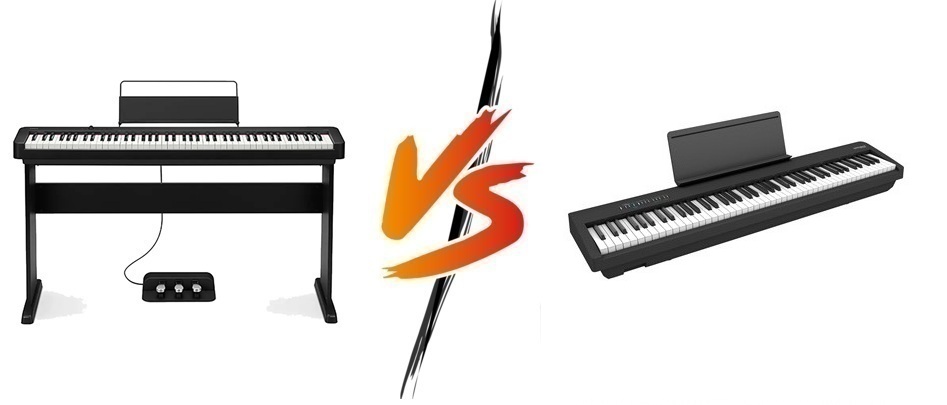
Shopping for an affordable digital piano, the Casio CDP-S160 and Roland FP-30X are two names you’re likely to encounter very quickly. They occupy roughly the same general part of the market, both have 88 weighted keys, both are designed to be portable, and both are aimed at players who want something more serious than a basic keyboard without spending a fortune on a full-size home digital piano.
However, they address different needs.
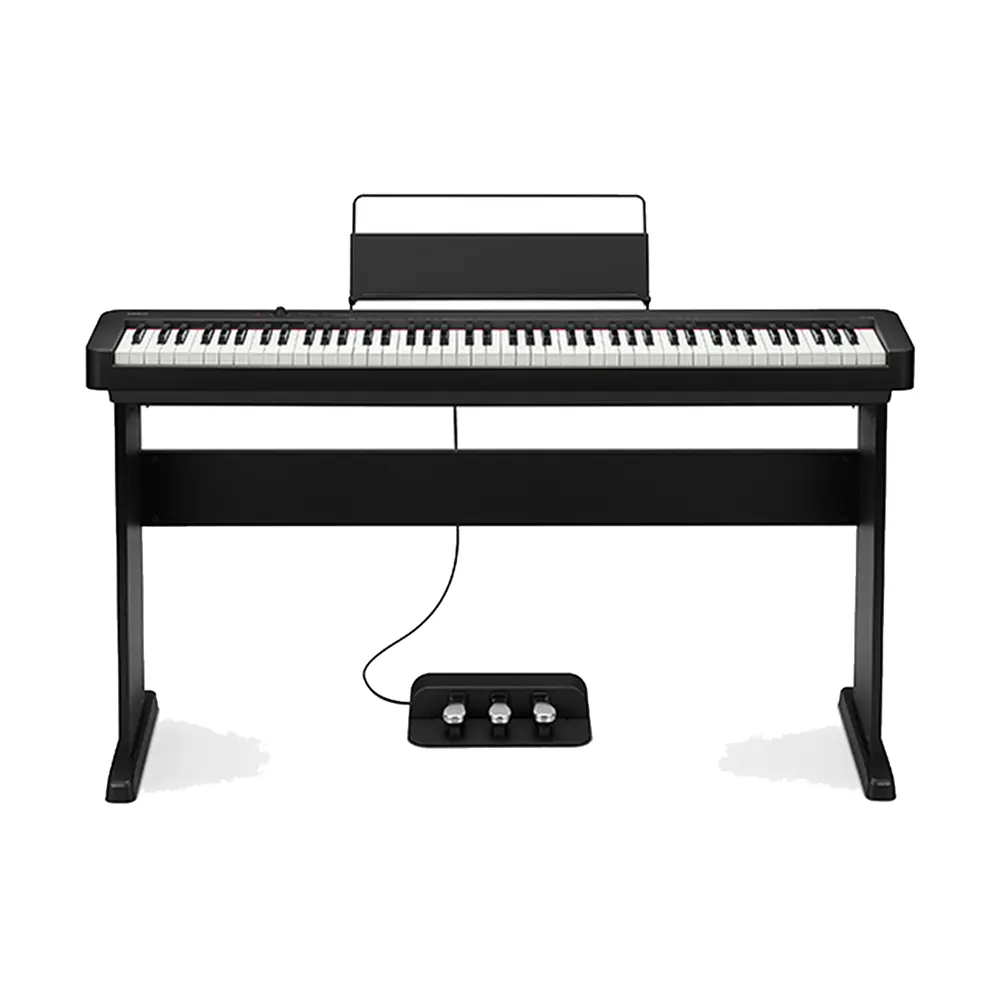
The Casio CDP-S160 is all about simplicity, portability and keeping the price under control. It’s slim and relatively light, and can run on six AA batteries, and gives a beginner the essentials: a full 88-note weighted keyboard, a decent piano sound, speakers, a sustain pedal and a few useful practice functions.
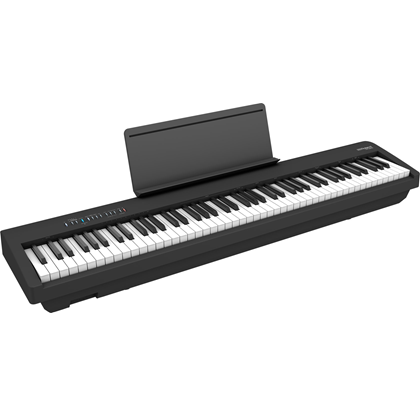
The Roland FP-30X has bigger aspirations. It’s still portable, but its emphasis is much more heavily on playing feel, piano sound, speaker performance and long-term usefulness. Its PHA-4 Standard keyboard is one of the strongest actions you can get in this price range, and it’s more capable due to its SuperNATURAL sound engine, 256-note polyphony, Bluetooth Audio/MIDI, and USB audio.
That difference is important because the FP-30X isn’t simply a more expensive version of the CDP-S160., it’s a more advanced instrument.
Meanwhile, the Casio has a big advantage: it’s easier to justify for casual playing and learning, given its low cost and compact size.
So which one should you buy?
Most serious students should consider the Roland FP-30X. That keyboard and sound offer more room for growth, and it has much better connectivity. But if you’re a beginner on a tight budget, need something exceptionally portable, or don’t care about advanced sounds and recording, the Casio CDP-S160 is a great, budget-friendly option.
Let’s look at why.
Casio CDP-S160 vs Roland FP-30X Comparison Chart
If you click the links below, under the product images, you will be redirected to Amazon.com. In case you then decide to buy anything, Amazon.com will pay me a commission. This doesn’t affect the honesty of this review in any way though.
| Specification | Casio CDP-S160 | Roland FP-30X |
|---|---|---|
 |  | |
| Check the best price on Amazon | Check the best price on Amazon | |
| Type | Portable digital piano | Portable digital piano |
| Number of keys | 88 | 88 |
| Key action | Scaled Hammer Action Keyboard II | PHA-4 Standard |
| Key weighting | Graded/scaled hammer action | Progressive hammer action |
| Touch sensitivity | 3 sensitivity levels | 5 touch settings |
| Key surface | Standard plastic | Ivory/Ebony Feel textured surface |
| Escapement | No | Yes |
| Sound engine | Casio AiR Sound Source | Roland SuperNATURAL Piano |
| Piano tones | Multiple grand piano tones | Multiple acoustic piano tones |
| Total built-in tones | 10 | 56 |
| Maximum polyphony | 64 notes | 256 notes |
| Acoustic piano customization | Limited | Piano Designer |
| Piano resonance features | Basic | String resonance, damper resonance, key-off resonance and other modeling features |
| Layering | Yes | Yes |
| Split mode | No dedicated split function | Yes |
| Duet/Twin Piano | Duet Mode | Twin Piano |
| Metronome | Yes | Yes |
| Tempo range | 20–255 BPM | 5–300 BPM |
| Transpose | Yes | Yes |
| Octave shift | Limited/basic | Yes |
| Built-in recorder | Yes | Yes |
| Recorder capacity | Approximately 2,500 notes | SMF/MIDI recording |
| Demo songs | Yes | Yes |
| Speaker system | 2 × 8W | 2 × 11W |
| Speaker size | Compact built-in speakers | 12 cm speakers |
| Total amplification | 16W | 22W |
| Headphone connection | Yes | Yes, two headphone outputs |
| USB connectivity | USB MIDI | USB MIDI + USB Audio |
| Bluetooth Audio | No | Yes |
| Bluetooth MIDI | No | Yes |
| App compatibility | Casio Music Space | Roland Piano App |
| Computer connectivity | Yes | Yes |
| External MIDI/software instruments | Yes, via USB MIDI | Yes, via USB MIDI/Bluetooth MIDI |
| Piano sound customization via app | Limited | Extensive |
| Battery operation | Yes, 6 × AA batteries | No |
| Approx. battery life | Up to around 13 hours | N/A |
| Music rest | Included | Included |
| Optional stand | Available | KSC-70 |
| Optional 3-pedal unit | Available | KPD-70 |
| Width | 1,322 mm | 1,300 mm |
| Depth | 232 mm | 284 mm |
| Height | 99 mm, excluding music rest | 151 mm, excluding music rest |
| Weight | Approx. 10.5 kg | Approx. 14.8 kg |
| Portability | Excellent | Good |
| Main strength | Compactness and affordability | Keyboard, sound and overall versatility |
| Best suited to | Beginners, students, small spaces | Serious beginners, intermediate players and home musicians |
| Overall advantage | Better value on a tight budget | Better overall instrument |
| My individual reviews | Casio CDP-S160 review | Roland FP-30X review |
The key differences at a glance
The specifications make the overall positioning of the two pianos fairly clear. The Casio CDP-S160 is substantially lighter and slimmer, making it the better choice if portability and limited space are important. Its battery operation is another unusual advantage.
The Roland FP-30X is heavier and deeper, but much of that additional size goes toward a more sophisticated keyboard action and more powerful speaker system. Its PHA-4 Standard action, 256-note polyphony and SuperNATURAL Piano sound engine give it a significant advantage for serious piano playing.
Connectivity is another major difference. The Casio provides the essentials, particularly USB MIDI, while the Roland adds Bluetooth Audio, Bluetooth MIDI and USB Audio, making it considerably more useful for apps, recording and music production.
So, if you’re comparing the two purely on specifications, the Roland FP-30X is the more capable instrument overall. The Casio CDP-S160’s advantage is efficiency: it gives you the essential piano features in a much smaller and lighter package, and at a lower price.
Design & Build Quality
When you first look at the Casio CDP-S160 and Roland FP-30X, it’s easy to assume that they’re basically the same kind of instrument. Both are portable 88-key digital pianos with a simple slab-style design, both can be placed on a keyboard stand, and neither is trying to look like a traditional upright piano. But once you spend some time with them, you realize that the two manufacturers have taken noticeably different approaches to the idea of a “portable digital piano.”
The Casio CDP-S160 is centered around being compact and simple. And the manufacturer hasn’t sacrificed any necessities of a real piano-playing experience. The Roland FP-30X, however, has a different approach. It’s still portable but focuses more on providing a substantial piano experience, which results in a heavier and larger instrument.
You don’t even have to turn them on to notice the difference.
Casio CDP-S160: compactness is the whole point
The CDP-S160 is one of those digital pianos where the dimensions immediately tell you what Casio was trying to achieve. It’s about 1,322 mm wide, 232 mm deep and just 99 mm high without the music rest, while its weight is around 10.5 kg. This makes the CDP-S160 an impressively compact instrument for its class.
The depth is particularly striking. Many 88-key digital pianos need a fairly deep table or stand, whereas the CDP-S160 can fit into spaces that would be awkward for larger instruments. If you live in a small apartment, bedroom or student accommodation, that can make a genuine difference. You can place it on a relatively shallow desk or dedicated keyboard stand, and when you’re finished playing, it doesn’t feel as though you’ve permanently sacrificed half the room to a piano.
Another significant benefit is the low weight of the CDP-S160. The CDP-S160 is light, and moving it around the house isn’t a big deal. Carrying it to another room, putting it in storage or taking it to a lesson is much easier than it would be with a heavier console-style digital piano.
More, it’s light enough to make the word “portable” meaningful.
There are plenty of digital pianos that technically qualify as portable but are sufficiently heavy and cumbersome that most owners will never actually move them. The CDP-S160, however, is an exception. You can easily transport the CDP-S160 if needed.
Casio has maintained a clean design for the CDP-S160 without giving it a cheap look. This body is predominantly plastic, as you’d expect at this price, but it doesn’t have the flimsy, toy-like appearance you sometimes get with inexpensive keyboards. The controls are simple and don’t include many buttons or screens that could be distracting.
This simplicity is appreciated.
Simple design can be beneficial for a digital piano. When I sit down at an instrument like this, I don’t particularly want to spend five minutes navigating menus before I can play a grand piano. The CDP-S160 is clearly designed around the idea that the keyboard itself is the star.
The controls are positioned conveniently around the left side of the keyboard, and the overall layout is easy to understand once you’ve spent a few minutes familiarizing yourself with the various button combinations. Some functions use key combinations and lights since there’s no display. Not having a screen helps keep the design clean and compact.
The music rest is basic. It kind of works but doesn’t feel heavy-duty. This aligns with the instrument’s overall philosophy. A heavy music stand would contradict the CDP-S160’s portable design.
Battery power is a key feature that supports the portable design. The CDP-S160 can run from six AA batteries, with Casio quoting about 13 hours of operation. That’s unusual among 88-key digital pianos and potentially very useful.
You might never use this feature, but it’s a good example of Casio thinking about the instrument as something that doesn’t necessarily have to remain beside a wall outlet. If you’re playing somewhere without convenient mains power, taking the piano outside, or simply moving it around a lot, battery operation gives the CDP-S160 a degree of freedom that the Roland doesn’t have.
Of course, there is a trade-off.
The CDP-S160’s compact size and light weight make it feel less solid. This doesn’t mean it feels flimsy. It doesn’t. It feels like it’s designed to be lightweight. If you’re used to a large acoustic piano or a heavy console digital piano, the CDP-S160 will feel almost surprisingly small.
That can be either a benefit or a drawback depending on what you want.
Roland’s FP-30X is more substantial without being bulky
The Roland FP-30X takes a more substantial approach.
The dimensions are about 1,300 mm wide, 284 mm deep and 151 mm high without the music rest, with a weight of around 14.8 kg. This makes it slightly narrower than the Casio for width, but it’s considerably deeper and heavier.
It’s the weight that kind of matters, not what’s on the spec sheet. When you’re dealing with something that weighs around four kilograms, you notice it in real life.
The FP-30X isn’t hard to move. I don’t think 14.8 kg is heavy for an 88-key digital piano. And many instruments weigh a lot more. It’s just that it feels like something you’ll put in one place and leave there for a while, rather than carrying it around all the time between rooms.
That’s probably exactly what Roland intended.
The FP-30X has a more sophisticated keyboard action. And stronger speaker system, which is why the extra physical substance is useful. This cabinet is designed to accommodate these components, so it was never going to be as slim as the Casio.
The FP-30X has a more substantial feel to it. You don’t get that lightweight keyboard sensation; instead, it feels like you’re playing a proper digital piano.
It’s noticeable, even if the difference isn’t huge.
The Roland’s construction feels solid. It’s not trying to be something else, and that’s reassuring. The instrument has a substantial presence, it’s designed for years of playing, not just a cheap way to get 88 weighted keys.
That doesn’t mean the Casio isn’t durable, it’s just that the two products have different priorities.
Portability versus permanence
This design difference is most useful viewed in this way.
Portability comes first with the Casio, and it’s a home piano second.
The Roland is a home piano and it’s also portable.
Optional accessories make that distinction even clearer.
Casio provides a dedicated stand and three-pedal unit for the CDP-S160, making it possible to set up a more permanent installation. The CDP-S160 can be paired with these accessories to create a more traditional playing experience. Roland’s approach is similar, with the KSC-70 stand and KPD-70 three-pedal unit available for the FP-30X, effectively turning it into a more upright-style digital piano.
They can look pretty convincing in a living room, with the right stand and pedals.
Its solid build, powerful speakers, and more pronounced keyboard action make the Roland a better fit for a permanent installation, that’s my take on it.
The Casio makes sense in situations where a permanent setup isn’t desired, and that’s what it’s good for.
A student in a small apartment could use the CDP-S160 on a stand in front of a desk during the day. It’s also easy to move after practicing, and can be stored away or pushed against a wall. In contrast, a large console-style digital piano would be much more awkward to deal with.
People who move frequently are also in this situation.
Portability really matters if you’re renting, studying at university, or unsure where you’ll live in two years.
Controls and overall aesthetics
Neither piano is going to win a design award for being particularly adventurous.
That’s probably a good thing.
The styling of both is understated and contemporary, with a focus on the keyboard. Decorative details aren’t the main concern, and that’s what helps them blend into a modern home without giving off a strongly technical vibe. They fit in fairly easily.
Roland’s design is a bit more sophisticated, but Casio’s is minimalist.
I like Roland’s physical appearance. It’s more like a real piano, with a solid look and feel.
If good design to you means minimal piano when not in use, the Casio is the better choice.
That large display is missing. Manufacturers have kept front panels simple, which is good for a clean look, but it makes some functions hard to find. Also, the minimal design means some things aren’t immediately clear.
If you’re someone who mostly sticks to the grand piano sound, tweaks the volume, and occasionally switches tones, you won’t have a problem. But for those who use more advanced features, the Roland app is really useful; it gives you a more visual way to control things like Piano Designer settings, which is a big help.
Quality is built into everyday use
At this price, it’s not reasonable to expect these pianos to feel like high-end furniture, and they don’t.
What gets in the way of playing is the construction.
It doesn’t with the Casio.
For home use, the CDP-S160 is more than sufficient. Its lightweight cabinet doesn’t make it feel cheap or unstable; and when placed on a suitable stand, it provides a solid base for practice, which is what matters.
The Roland has a more substantial feel, which I prefer, particularly when playing with force. Playing a solid instrument makes it easier to forget you’re using a digital piano, rather than an acoustic one, and that’s partly psychological. When it feels solid, you can focus on playing.
The cabinet plays a supporting role, and it’s the keyboard action that contributes enormously to that sensation.
Using a proper stand for either instrument is something I’d recommend, especially if you plan on practicing regularly. This is because a stable stand makes a big difference in the overall experience. What’s more, it lets you set the keyboard to the right height, which is crucial, more so than a lot of first-time buyers think.
What makes one better built than the other?
Perceived build quality is where the Roland FP-30X stands out, and it would get my vote.
This instrument feels substantial, stable, and it’s something you’d want to own long-term.
That doesn’t necessarily mean the Casio loses out on design, though.
Casio’s CDP-S160 stands out for its remarkably compact and lightweight design, making it a highly portable 88-key weighted digital piano that doesn’t compromise on build quality. Weighing just 10.5 kg, measuring 232 mm in depth, and featuring battery operation, this instrument is incredibly flexible.
Casio’s design lends itself to mobility, whereas Roland’s is geared more towards serious home use.
What matters is that there’s no one-size-fits-all design, and it’s not about which one is objectively better for everyone.
I’d choose the Roland if I were purchasing a piano for permanent placement in my living room. Its extra weight and depth would be a non-issue for me, and I’d enjoy the heftier feel when playing it.
For a small apartment, student room, or any situation where I’d be moving the piano often, the Casio is definitely worth considering.
Design and build quality verdict
I’d rate the Casio CDP-S160 an 8.5 out of 10 for design and build quality. That design isn’t luxurious, and that’s okay, it’s not trying to be. What’s really useful is its compact size, low weight, and the fact that it’s battery operated, which makes it genuinely practical, not just impressive on paper.
The Roland FP-30X scores around 9 out of 10 in my book. Although it’s heavier and less convenient to move, this extra weight actually contributes to a more authentic playing experience. What you get is a proper digital piano that’s been made portable, rather than a portable keyboard with 88 weighted keys added on.
What you’re buying is what matters most.
Casio’s design says, “Take me anywhere.”
Roland’s says, “Put me in your home and play me for years.”
They’re both successful in their efforts.
Portability is the top priority for the CDP-S160. The FP-30X, on the other hand, is a more substantial instrument, with a refined design that makes it a better long-term choice. It’s the better-designed piano overall.
Keyboard and Playing Feel
The keyboard deserves the most attention in a digital piano. Speakers can be upgraded, sounds can sometimes be supplemented with software and connectivity features become more or less important depending on what you do with the instrument. But the keys are what you physically interact with every time you play.
That’s why the comparison between the Casio CDP-S160 and Roland FP-30X becomes particularly interesting here. Both have 88 full-size keys. And use weighted hammer-action mechanisms, giving beginners a genuine piano experience. The two actions feel different; the Roland has an advantage in dynamics, repetition, control, and realism.
The Casio is good.
The Roland is better.
That important question is whether the difference is large enough to justify the higher price for you.
The Casio CDP-S160 has a surprisingly capable entry-level action
The Casio CDP-S160 uses Casio’s Scaled Hammer Action Keyboard II. The keyboard has 88 full-size keys with graduated weighting, making lower notes feel heavier and upper notes lighter.
That basic design principle is essential.
Acoustic pianos don’t have uniform resistance across all keys. Good digital pianos reproduce some of this experience, with varying mechanisms and hammer weights.
The CDP-S160 does this well, making it a legitimate learning piano.
That’s worth emphasizing because the word “entry-level” can sometimes give the wrong impression. It’s not a keyboard with spring-loaded keys and artificial resistance. This keys have a hammer-action mechanism, making a difference from unweighted keyboards.
For a beginner, that’s a major advantage.
Learning scales, chords, and arpeggios, the Casio gives your fingers something to work against. Pressing keys takes effort, helping develop finger control as you improve.
This action is also touch-sensitive. Playing harder produces a louder sound, playing gently a quieter one. This is fundamental to piano technique; the CDP-S160 responds well for beginners to work on dynamics.
This is where the Casio punches above its price.
You can sit down and practice something like a simple Beethoven piece or a pop ballad and actually work on playing softly and loudly rather than simply pressing keys that all produce roughly the same volume.
For someone buying their first digital piano, that’s exactly what matters.
Where the Casio action starts to show its limitations
That problem is that the CDP-S160’s action doesn’t have the refinement of the Roland.
The Casio gives you the basic physical characteristics of a weighted piano keyboard, but it doesn’t reproduce all the subtleties of an acoustic piano.
Experienced players will notice this fairly quickly.
The response is somewhat less nuanced, particularly when you’re working around the quieter end of the dynamic range. There’s enough sensitivity to make expressive playing possible, but the gradations don’t feel quite as natural as they do on the Roland.
This isn’t necessarily something a beginner will notice.
In fact, if you’ve never owned a weighted digital piano before, you might sit down at the CDP-S160 and be very impressed. And you should be. For the money, it’s a very respectable action.
But compare it directly with the FP-30X and the difference becomes much harder to ignore.
Another limitation is that the Casio doesn’t provide the same kind of physical features as Roland’s PHA-4 Standard action. There’s no escapement simulation, and the keys don’t have the same textured ivory-feel surfaces.
Again, these aren’t mandatory features for learning piano.
They’re refinements.
But refinements are exactly what you start appreciating once you’ve been playing for a while.
The Roland FP-30X offers a more sophisticated playing experience
The Roland FP-30X uses Roland’s PHA-4 Standard keyboard action.
This is a key reason to buy the FP-30X.
PHA-4 Standard is a more advanced action than what you might expect from a mid-priced portable digital piano. It includes 88 weighted keys, escapement and textured key surfaces designed to resemble the feel of ivory and ebony.
You’ll notice the Roland feels more substantial under your fingers.
It has more resistance than a lightweight keyboard, and the action has a more deliberate mechanical feel.
For someone coming directly from an acoustic piano, this is likely to feel familiar.
For someone coming from an unweighted keyboard, it might take a little adjustment.
I wouldn’t say the Roland is easier to play.
It can feel harder in some situations.
The action is more resistant, requiring more effort to move the keys. If you’re accustomed to a light keyboard, the FP-30X can initially feel a little heavy.
That’s not a bad thing.
A realistic piano action shouldn’t feel like a synthesizer keyboard.
The heavier response provides more control, especially for subtle volume and articulation changes.
Is escapement useful or just marketing?
The PHA-4 Standard action includes escapement.
Escapement is a characteristic of acoustic pianos where the key action changes resistance near the bottom of the key travel. You can sometimes feel this as a subtle notch or bump.
On an acoustic piano, it’s part of the action’s mechanical behavior.
The FP-30X recreates that sensation.
Is it necessary?
Not really.
Would I buy the piano specifically because it has escapement?
No.
But a good escapement simulation contributes to the overall impression of playing a piano, not just a weighted keyboard.
It’s a detail that adds to the overall experience, even if it’s not crucial on its own.
That texture of the keys
The Roland’s key surface is another advantage.
The PHA-4 Standard keys have a finish that feels like ivory and ebony.
It’s not just for decoration.
Ivory and ebony have a different feel than smooth plastic. Your fingers don’t slip as much, especially during long practice sessions.
The Roland’s textured surfaces provide more grip and a more natural feel.
The Casio’s keys are usable, but they feel like molded plastic.
That’s not a problem at the Casio’s price point.
Roland has invested more in the playing experience here.
Controlling dynamics
This is probably where the biggest practical difference appears.
Piano playing is not just about pressing the right notes. It’s about controlling how the notes sound.
A good pianist needs to play notes softly, increase intensity, accent strongly, and return to quiet dynamics.
The instrument must respond predictably to changes.
The Casio can handle this.
The Roland does it better.
The FP-30X provides a wider, more natural range from soft to loud playing. This is noticeable when playing slow music or pieces that rely on touch.
With the Casio, the basic relationship between touch and volume is there, but the response can feel slightly more compressed.
You can play expressively.
It doesn’t provide as much feedback through your fingers.
That doesn’t matter for beginner repertoire.
It matters for intermediate and advanced repertoire.
Repetition and fast playing
Another area where the Roland has an advantage is repeated notes.
A good piano action should reset quickly and predictably after a key is released. This becomes more important when you’re playing repeated notes, trills, ornaments and fast passages.
The PHA-4 action feels more controlled in these situations on the Roland.
The Casio can handle normal repertoire but its action isn’t as refined when you demand more.
You’ll notice this difference over time.
You might not notice it during a five-minute demonstration in a music shop.
Play both for an hour and spend some time on scales, repeated notes and fast passages, and you’ll have a much clearer idea of which action suits you.
Then there’s weight and fatigue
There’s another side to this comparison that shouldn’t be overlooked.
It’s the Roland’s action can be tiring due to its weight.
You may notice the resistance if you play for hours, especially with inefficient technique.
That’s why I wouldn’t say the Roland is better for everyone.
Some prefer a lighter action.
The Casio can feel more approachable, especially for younger beginners or people who aren’t accustomed to weighted keys.
But I wouldn’t choose the Casio just because it’s easier to play.
If you’re serious about learning piano, it’s generally better to become comfortable with a proper weighted action rather than choosing the lightest keyboard possible.
The Roland’s resistance can actually be beneficial because it encourages you to develop proper control rather than relying on minimal finger movement.
Touch sensitivity is another aspect
The CDP-S160 has three touch-response settings for adjusting the instrument’s response.
It’s useful, but basic.
The Roland has more advanced touch response control.
Beginners don’t need to worry about this.
I’d recommend starting with the default setting and only changing it once you’ve spent enough time with the instrument to understand what you’re trying to improve.
Changing sensitivity won’t fix poor technique.
The most important thing is learning to control the physical key movement consistently.
Both have a full 88-key range
Both deserve credit for their full 88-key range.
That may sound obvious, but it matters.
Some inexpensive keyboards have fewer keys, which can become limiting as you move into more advanced repertoire.
Both have the full A0 to C8 range.
You can learn any standard repertoire without transposing due to key limitations.
88 keys help beginners develop spatial awareness on a full piano range.
Which feels more like an acoustic piano?
The Roland.
That’s the simple answer.
It’s not identical to an acoustic piano, and claims it’s are exaggerated.
The FP-30X is closer though.
The PHA-4 action has more convincing resistance and better feedback.
The Casio is a good weighted keyboard.
The Roland feels like a digital piano.
It’s a subtle distinction.
What about beginners?
This is where I think the comparison gets interesting.
Beginners don’t need the Roland’s action.
You need an action that teaches proper technique.
The Casio meets this requirement.
A beginner can spend years on the CDP-S160 and develop solid technique.
But if you know you’re serious about learning, I think the Roland is the better investment.
You won’t appreciate the better action immediately. You’ll appreciate it more as you improve.
When you’re struggling through your first scales, the difference may be minor.
The difference becomes obvious when you play complex pieces.
Try them yourself
Keyboard feel is personal.
Specifications can’t describe the feel.
Some love the PHA-4 action.
Others find it heavier than they would like.
Some prefer Casio’s lighter response.
Play both before buying if you can.
Don’t just play the demo.
Spend ten or fifteen minutes with each.
Play some scales.
Play some chords.
Play softly.
Play loudly.
Try playing repeated notes.
Try a familiar piece.
Use the sustain pedal too.
Play at the keyboard extremes.
Ask yourself which gives you more control.
That’s more valuable than choosing based on specs.
The verdict on keyboard and playing feel
This category is decisive.
The CDP-S160 gets 8/10. It’s a good action for the price, suitable for beginners. It’s responsive, reasonably natural and considerably better than the unweighted keyboards found on many inexpensive instruments.
The FP-30X gets 9.5/10.
The PHA-4 action is more sophisticated. The escapement and key surfaces contribute to a better experience. More, the action has enough quality that you can continue to appreciate it as your playing develops.
The Casio is better for a cheap 88-key experience.
The Roland is the better choice if the keyboard itself is a major priority, which it should be for anyone intending to practice seriously.
That’s my approach to this decision.
If you’ve an extra $100, $200 available and you’re wondering where that money should go, I’d spend it on the Roland’s keyboard before worrying about more sounds, apps or connectivity.
Those extras are useful.
You’ll be playing the keys.
Piano Sound
Once you get past the keyboard itself, the piano sound is probably what matters most when deciding between the Casio CDP-S160 and Roland FP-30X. A digital piano can have an excellent action, but if the sound coming through the speakers feels flat, artificial or uninspiring, you won’t enjoy practicing for long.
Neither instrument has a bad piano sound. Both can produce a convincing enough grand piano tone for practice, lessons and casual playing. The Roland FP-30X has a more advanced sound engine, giving players more control over the piano’s character and dynamics.
Casio takes a simpler approach. It offers a few useful sounds, focuses on simple operation, and keeps the hardware compact and affordable.
Roland takes a more ambitious approach. The SuperNATURAL Piano engine, higher polyphony, and sound-shaping options help it respond like an acoustic piano.
The Roland has the advantage on paper.
In practice, the difference is noticeable, but it’s not that simple. The Casio sounds good given its price. The Roland sounds more convincing with closer listening.
The CDP-S160 has a good piano sound without unnecessary complexity
The main piano sound is a key reason the CDP-S160 works well for beginners.
Casio has kept the sound selection relatively small, but the emphasis is on making the essential sounds useful rather than filling the instrument with hundreds of sounds that most piano players will never touch.
It has 10 built-in tones, including the main grand piano sounds. It uses 64-note polyphony, adequate for solo playing.
The sound is recognizable as a digital acoustic grand piano. It has enough brightness to provide clarity, enough bass to give the lower register some authority and enough dynamic variation to make expressive playing possible.
That’s important because inexpensive digital pianos can sometimes produce a piano tone that sounds obviously electronic. Casio avoids that problem.
Playing a simple melody at moderate volume, the CDP-S160 sounds respectable.
Play some chords with the sustain pedal and you get the familiar resonance you’d expect from a digital piano.
Playing harder makes the tone brighter and more forceful.
There’s nothing wrong with it for beginners.
The Casio sound sort of shows its age
The limitations become more apparent when you stop judging the sound simply as “good” or “bad” and start listening to how it behaves dynamically.
Acoustic pianos are complicated. This sound changes based on hammer strike, string interaction, soundboard resonance, and damper effect.
Digital pianos approximate this electronically.
Compromises are inevitable at this price.
The CDP-S160 gives you a reasonable approximation, but the transitions between different playing intensities aren’t as sophisticated as those of the Roland.
The Casio can go from soft to loud, but the intermediate stages don’t always have the same organic quality.
This is noticeable when playing slowly and quietly.
A beginner playing a simple tune may never think about it. But experienced pianists will.
When you play a melody softly on a good acoustic piano, the tone isn’t simply a quieter version of the loud tone. The character changes.
The Roland captures that behavior better.
Roland FP-30X: a more sophisticated piano engine
The FP-30X uses Roland’s SuperNATURAL Piano sound engine, which makes it sound more convincing than the Casio.
Roland’s SuperNATURAL approach combines sampled piano material with modeling techniques for a more continuous response, instead of relying on fixed samples triggered at different velocity levels.
This pretty means the piano feels more connected to your finger movements.
That’s what matters.
The FP-30X offers a more responsive digital representation of a piano, not just a better recording.
Soft playing still yields detailed sound.
As you increase pressure, the tone becomes more forceful.
Hard playing produces more attack and energy.
A good digital piano is defined by its touch-sound relationship.
The Roland handles this well, considering its price.
Expressive playing reveals the difference
If you only play beginner pieces, the difference between the two instruments can seem relatively small.
Simple melodies with basic chords don’t demand much from the sound engine.
Both pianos can handle it.
However, the Roland excels when playing pieces that require dynamic shaping.
Imagine a piece where the right hand plays a quiet melody while the left hand provides a soft accompaniment.
The Casio can do this.
The Roland makes it easier to balance the melody. And accompaniment, thanks to its smoother response to key velocity differences.
This also applies to crescendos.
A good crescendo is a continuous progression, not just quiet to loud.
The Roland offers more room for expression within that progression.
This sort of matters for classical players, and also benefits those playing ballads, jazz, or expressive pop.
Piano character
The two instruments have different overall characters.
The Casio has a straightforward, functional character that works well for practice.
The Roland’s sound is more complex.
The tone has more depth, especially with the sustain pedal and overlapping notes.
The low register is heavier, and the upper register has a clearer presence.
These differences aren’t huge at low volume with mediocre headphones.
Good headphones or the Roland’s speakers make these differences easier to appreciate.
This is one reason I wouldn’t judge either piano exclusively through a short demonstration video online. Recordings often flatten the differences between digital pianos because you’re hearing another recording of a recording.
You need to play them in person.
Polyphony matters more than it initially appears
A key technical difference is polyphony.
The Casio CDP-S160 has 64-note polyphony.
The Roland FP-30X has 256-note polyphony.
A four-times-higher polyphony figure doesn’t mean that the Roland is four times better sounding, of course.
For basic piano playing, 64 notes can be perfectly adequate.
But think about what happens when you press the sustain pedal.
Notes continue sounding after you’ve released the keys. If you’re playing chords, melodies and bass notes simultaneously, the number of active notes can build up surprisingly quickly.
Add sympathetic resonance, layered sounds, or complex arrangements.
The Roland’s 256-note polyphony gives it considerably more breathing room.
You won’t constantly hear notes being cut off on the CDP-S160.
You won’t.
It’s more accurate to think of the Roland’s higher polyphony as headroom. It means the sound engine is less likely to run into limitations when you’re asking it to reproduce complicated passages.
This is reassuring for advanced players.
Sustain pedal behavior
That sustain pedal is crucial to the piano sound, and the Roland’s engine has an edge here.
Pressing the sustain pedal on an acoustic piano does more than just extend note length. This action changes the instrument’s behavior, as dampers lift off the strings.
Other strings begin to resonate sympathetically.
The sound takes on more complexity.
The Roland uses resonance modeling. And its piano engine to replicate this behavior.
The result is that sustained chords can feel richer and more three-dimensional.
The Casio supports damper pedal use, delivering a decent sustain effect for casual playing, though it lacks the Roland’s complexity.
This won’t be a deal-breaker for beginners.
For those tackling advanced classical repertoire, this is another reason to prefer the Roland.
Piano customization
This is another area where the Roland is more flexible.
The FP-30X is compatible with Roland’s Piano Designer system, letting you tweak the piano sound.
You can alter parameters such as lid position, string resonance, damper resonance, key-off resonance and individual-note characteristics.
It sounds complicated, but the concept is simple.
You can customize the piano to your preferences, rather than being limited to a single version.
Need a brighter piano?
You can adjust it to be brighter.
Need something softer and more intimate?
You can tweak the relevant characteristics.
Need to experiment with resonance?
The system offers that option.
The Casio lacks the Roland’s customization depth.
This isn’t necessarily a problem, though.
Most beginners won’t want to spend an evening tuning virtual strings.
They just want to play.
And the Casio is arguably better for that kind of user because it doesn’t overwhelm you with options.
However, the Roland’s flexibility becomes valuable as you gain experience.
Speakers change the way the piano sound is perceived
It’s impossible to discuss the sound of these instruments without talking about their speakers.
The Casio has a 16W stereo amplification system, with 8W per speaker.
The Roland uses 22W, with 11W per speaker, and its larger speakers produce a fuller sound.
This difference matters.
The actual sound engine could be excellent, but if the speakers are small and underpowered, you won’t hear the full benefit.
The Casio’s speakers are fine for home practice. They provide enough volume for a bedroom, study, or small living room.
However, the sound can become thin when you turn up the volume.
The Roland has more authority.
The lower frequencies have more physical presence, and the piano feels less confined to the space immediately around the keyboard.
This contributes to the Roland’s more realistic sound.
It’s not just the engine.
It’s the whole system.
Headphones reveal another side of the comparison
The difference changes slightly when practicing with headphones.
Headphones eliminate the speaker factor, letting you focus on the engine itself.
The Roland’s greater sophistication becomes apparent here.
The Casio is still usable with headphones, but the Roland sounds more spacious and detailed.
You don’t necessarily need expensive headphones.
A decent pair of closed-back headphones can reveal differences not noticeable through speakers in a busy room.
This is why I recommend trying both with headphones if you can test them in a store.
Is the Casio sound sufficient for a beginner?
Absolutely.
I don’t want to overlook this amid all the praise for Roland.
The Casio CDP-S160 doesn’t sound bad.
It’s a sensible-sounding digital piano for its target market.
If you’re learning piano from scratch, your biggest concerns should be getting the correct notes, developing rhythm, learning proper technique and practicing consistently.
The difference between a good and great piano engine isn’t as important as those things.
A student who practices regularly on the CDP-S160 will improve far more than a student who buys the FP-30X and rarely sits down to play.
This is why the Casio is still a good option.
But will the sound become limiting?
This is a more important consideration.
If you’re serious about playing piano long-term, you’ll likely notice the Casio’s limitations eventually.
As you improve, your playing becomes more dynamic.
You listen more carefully.
You notice the difference between clean and harsh tones.
You pay attention to how notes interact under the sustain pedal.
You become more sensitive to the instrument’s character.
At that point, the Roland’s sound engine is more valuable.
I see the two pianos differently because of this.
The Casio’s sound is designed to make it a good entry-level piano.
The Roland’s sound is designed to be good enough that an experienced pianist can continue enjoying it.
This distinction matters.
Other sounds and variety
The Roland offers more choices.
The CDP-S160 has 10 tones, but the FP-30X has 56 tones and more sounds through the Roland Piano App.
This isn’t strictly part of the “piano sound” comparison, but it matters to the overall experience.
The Roland has multiple acoustic piano variations, electric pianos, organs, strings, and other sounds.
If you’re primarily a classical pianist, you may spend 95 percent of your time using the main grand piano.
Having alternatives is helpful.
An electric piano sound can be perfect for jazz.
A softer piano can work well for pop.
A piano-and-strings combination can be useful for songwriting.
The Casio doesn’t have nearly as much variety.
Which piano sounds more acoustic?
The Roland FP-30X does.
That’s the conclusion I’d reach after considering the sound engine, dynamic response, polyphony, resonance, customization and speakers.
But there’s an important qualification.
Neither sounds exactly acoustic.
A good acoustic grand has characteristics that a portable digital piano can’t fully reproduce. There’s no vibrating soundboard, no physical interaction between hammers and strings, and sound doesn’t radiate through the room the same way.
The Roland gets closer than the Casio.
At this price, that’s impressive.
Verdict on piano sound
The Casio CDP-S160 gets around 8/10 for piano sound.
It’s clear, pleasant, and expressive enough for learning and practice. It doesn’t need to be a high-end acoustic piano simulation. It does a good job for its price and audience.
The Roland FP-30X gets a 9/10.
The SuperNATURAL Piano engine, 256-note polyphony, better resonance, greater customization, and stronger speakers create a more convincing and satisfying experience.
The most important difference isn’t that the Roland simply sounds “nicer.”
The Roland responds more naturally to playing.
That makes the difference.
If you’re only going to play occasionally, the Casio’s piano sound is more than enough.
If you’ll practice several times a week for years, this category matters more.
And if the two pianos are close enough in price that you can comfortably afford either, the Roland’s superior sound is one of the strongest reasons to choose it.
The Casio has a good sound.
The Roland is a more expressive instrument you can grow into.
I think that’s worth the extra cost.
Speakers
Built-in speakers are easy to overlook when comparing digital pianos. Most buyers understandably focus on the keyboard action and piano sound first, and if you’re planning to practice mainly with headphones, the speaker system might seem almost irrelevant.
Don’t dismiss it that quickly.
You hear the speakers every time you play without headphones. That speakers determine the instrument’s satisfaction in a living room, how well you can hear the bass and treble registers, how sustained chords sound, and whether it stays clear when played forcefully.
The Roland FP-30X has an advantage over the Casio CDP-S160 in this area.
The Casio’s speaker system is usable and suitable for a portable digital piano. The Roland’s system is more powerful and fuller, and it’s more convincing, it makes the piano sound more like an instrument than a keyboard.
At low volume, the difference isn’t enormous.
Turn it up and play dynamically; the Roland pulls away when you listen carefully.
Casio CDP-S160: compact speakers for a compact piano
The CDP-S160 has a stereo speaker system with 8W + 8W amplification, totaling 16 watts.
Compared to larger digital pianos, 16 watts isn’t impressive on paper.
It’s adequate in practice.
That’s an important distinction.
It’s not designed to fill a large hall or compete with a band. The CDP-S160 is a slim, portable piano for personal practice, lessons, and casual home playing.
This speakers work for those purposes.
In a bedroom or small living room, the volume is comfortable. You don’t need to max out the volume to hear the instrument, and at moderate levels the piano sound is reasonably clear.
The tonal balance lets you hear both hands.
The bass is present, and the treble doesn’t get muffled. You get a full representation of the piano’s range.
A beginner only needs that.
That speakers’ limitations become apparent when you ask more of them.
The physical design basically matters
That biggest constraint isn’t Casio’s amplifier.
It’s the instrument’s size.
The CDP-S160 is extremely slim, measuring only around 232 mm in depth. This slim design is great for portability but leaves little space for a large speaker enclosure.
Speakers need space, too.
A compact chassis can hold a sophisticated digital piano engine, but acoustics can’t be completely overcome.
A larger speaker system can move more air and generally gives you more scope for producing a strong low end and a convincing sense of physical presence.
Portability is a priority for Casio.
The speaker system is a compromise as a result.
It’s a sensible compromise, though.
The Casio’s sound in practice
The CDP-S160’s speakers are pleasant at moderate volume.
There’s little to complain about for simple practice pieces, scales, and chords.
This piano sound is clear, easy to follow, and you can hear the register difference.
The speakers won’t frustrate you if you practice quietly in the evening.
Problems emerge when the volume increases.
The sound doesn’t necessarily become unpleasant immediately, but it can begin to lose some of its sense of depth. The lower frequencies don’t have the same physical weight as they do on the Roland, and the whole presentation can feel somewhat confined.
The piano sounds like it’s coming from the keyboard, not the room.
That’s not bad, though.
But it’s different from the impression produced by a stronger speaker system, where the sound seems to occupy more of the room.
Roland FP-30X: a much stronger speaker system
The FP-30X has two 12 cm speakers with 11W + 11W amplification, totaling 22 watts.
But wattage isn’t the whole story.
Having two 11W speakers doesn’t automatically mean better sound than another pair with a higher number.
The speakers, cabinet, amplifier and digital processing all play a role. But the FP-30X sounds clearly better.
The Roland has a bigger sound.
That’s probably the simplest way to describe it.
The piano has more authority in the lower register, more presence in the middle, and enough high-frequency clarity for detailed playing to sound lively.
More, the instrument doesn’t seem to run out of breath as quickly when you turn up the volume.
Volume and quality aren’t the same thing
It’s worth making an important distinction here.
A speaker being louder doesn’t make it better.
If maximum volume was all you cared about, you could connect either piano to an external amplifier and fix the problem.
The Roland’s speaker system makes the sound more substantial.
Bass notes have more weight.
The midrange is fuller.
Sustained chords have more body and depth.
And when playing aggressively, the piano stays clearer.
That point matters.
An acoustic piano can produce a tremendous amount of energy when you strike the keys hard. A good digital piano needs enough amplification to reproduce some of that sense of impact.
The Casio can get loud.
The Roland sounds more at ease.
Quiet playing
Interestingly, the difference isn’t only about loud playing.
The Roland’s speakers also make quiet playing more satisfying.
This might seem counterintuitive, but a speaker system with more headroom can reproduce subtle changes in level without everything sitting close to the noise floor.
If you’re practicing a quiet classical piece, the FP-30X can sound more spacious and intimate.
The Casio plays quietly, but the presentation is flatter.
This reinforces the difference between the two instruments seen in the keyboard and piano sound sections.
The Roland provides more dynamic information.
The Casio gives the basics.
The room honestly matters
When discussing speakers, it’s easy to forget you’re not listening in a vacuum.
The room greatly affects the sound of a digital piano.
Against a wall in a small room with hard surfaces, the Casio can sound lively.
In a large, open room with soft furniture, it may seem quieter.
The same applies to the Roland too.
Positioning matters too.
If you put the piano on a desk, some of the sound can reflect off the surface. With a dedicated stand, the speakers interact differently with the room.
Roland includes a setting to improve the FP-30X’s sound on a tabletop or desktop.
That’s thoughtful since portable digital pianos are often used that way.
The Casio lacks the same speaker-placement improvements.
Speaker direction and how sound is projected
That speakers’ physical positioning affects how sound is perceived.
A traditional acoustic piano has sound radiating through its large structure.
A digital piano approximates this with small speakers.
The FP-30X better creates the impression that sound comes from the instrument, filling the space around it.
The CDP-S160 is more direct.
You hear the speakers rather than the room being filled with piano.
This isn’t a major problem if you’re sitting close.
It’s another Roland advantage when sitting several meters away.
Practicing with others in the room
This is where the Roland’s speaker advantage can become particularly useful.
Imagine taking a lesson at home.
With the Casio, the teacher can hear the piano, but you may need to turn the volume up high to play alongside conversation or ambient noise.
The Roland has more headroom, so you can maintain a comfortable level without pushing the speakers.
The same applies if you’re playing alongside another acoustic instrument.
Either piano works if a guitarist plays softly.
The Roland’s stronger output is more valuable when playing with a louder instrument.
Neither is meant to replace a PA system.
But the Roland is more capable in informal ensembles.
What about external speakers?
It’s important to consider.
If you absolutely love the Casio’s keyboard and price but aren’t satisfied with its speakers, you can potentially connect external amplification depending on your setup. So the Casio’s speaker limitation isn’t set in stone.
But adding external speakers changes the economics.
Buying decent monitors or a dedicated keyboard amplifier means spending more money and taking up space.
The Roland has an advantage: you don’t need external speakers for ordinary home use.
This built-in speakers are good enough for a satisfying experience.
That matters if you want a simple setup.
Headphones change things
Headphones make this consideration largely irrelevant.
Both the CDP-S160 and FP-30X can be used with headphones, and this is one of the most important features for apartment dwellers or anyone who practices late at night.
You don’t need to worry about disturbing others with headphones.
You also hear the sound directly, with less room influence.
This makes the Casio more competitive, though.
If you know that 90 percent of your practice will be done with headphones, I wouldn’t pay a large premium for the Roland solely because its speakers are better.
The keyboard and sound engine would still be reasons to consider the Roland, but the speaker advantage becomes much less important.
Speaker quality and the sound engine
The speakers and piano engine are related.
The Roland’s SuperNATURAL engine produces a more detailed sound, and its speakers reproduce that sound better.
It’s important.
A sound engine is only useful if you can hear its effects.
The Casio’s engine is less sophisticated, and its speakers are more modest too.
So the two systems are reasonably matched.
The Casio doesn’t feel like it has a great engine hidden by terrible speakers.
It feels like a budget digital piano where the electronics and amplification have been designed around the same price-conscious philosophy.
The Roland feels like an integrated instrument with a keyboard, sound engine, and amplification that work together.
Can the Casio get loud enough?
Yes, it’s.
I don’t want to exaggerate the difference here.
The CDP-S160 isn’t quiet.
It has enough volume for normal practice at home.
You’ll hear yourself fine sitting in front of it.
You won’t need an external amplifier just to practice with the Casio.
The issue is more about quality at higher volume.
The Roland has more headroom and sounds more comfortable at high volumes.
The Casio can sound more compressed and less full when pushed.
That won’t matter much for a beginner playing at moderate volumes.
It matters more for experienced players who play dynamically.
Bass response, though
The bass register is where you’ll easily hear the difference.
Low piano notes need speakers that can move air to sound convincing.
The Casio’s compact speakers can reproduce the low frequencies, but they don’t have the same authority.
The Roland’s larger speakers provide more weight.
Left-hand playing is more satisfying with the Roland.
With the sustain pedal, the Roland gives you more of that large instrument resonance feel.
The Casio sounds compact.
That’s no surprise given the size difference.
Treble response, also
The Roland also has an advantage in the upper register, although it’s somewhat less dramatic.
The FP-30X produces a clear treble that keeps notes distinct during fast passages.
The Casio is also clear, but its overall presentation can sound a little less sophisticated.
You’ll notice this when playing complex chords with many upper-midrange and treble notes.
The Roland keeps things more separated.
Is the Roland speaker system good enough for performance?
It works for small informal performances. But for serious stage performances, it’s probably not enough on its own.
That distinction matters.
The FP-30X has enough output for home use, lessons and small informal settings but professional performance situations usually involve a PA system or dedicated amplification.
And the Roland can feed external equipment when needed.
You’re not limited to the built-in speakers.
The Casio can also be integrated, but the Roland’s connectivity makes it more flexible for musicians moving beyond home practice.
Speaker placement and furniture are important
If you’re buying either piano for permanent home use, I’d also think about the stand.
A dedicated stand isn’t just about appearance.
It puts the keyboard at the right height and gives the speakers more room to project.
The FP-30X can be paired with the KSC-70 stand for a more upright setup.
Casio also offers a compatible stand.
If you put either piano on a table, consider how the surface affects the sound.
A hard tabletop can make the sound brighter or more reflective.
A soft or heavily furnished room can absorb some of the high frequencies.
You don’t need to be an acoustics expert.
Don’t judge the speakers based on one unusual position.
The Roland sounds better without headphones?
The FP-30X.
Clearly.
The Casio is good for personal practice, but the FP-30X’s stronger amplification and larger speakers give it more presence.
This makes the FP-30X appealing if you don’t like headphones.
There’s something satisfying about sitting down, switching on the piano and hearing a full, room-filling instrument immediately.
You don’t have to put on headphones or connect anything else.
The FP-30X provides that experience more convincingly than the CDP-S160.
For apartment living, it’s less obvious?
This is slightly less obvious.
If you live in a small apartment and mostly practice with headphones, the Casio’s compact size may actually make it the better overall choice.
But if you play through the speakers often, the FP-30X is more enjoyable.
The choice depends on your practice habits.
If you’re worried about disturbing neighbors, speaker quality may not matter much.
If you’ve a quiet environment and play without headphones often, I’d favor the FP-30X.
Verdict on the speakers
The Casio CDP-S160 gets around 7.5/10 for its speakers.
That’s not a criticism, but an acknowledgment of its design priorities. This speakers are adequate for their purpose. They’re clear, loud enough for home practice, and balanced.
But they don’t have much extra headroom, and the compact body limits how much physical presence they can produce.
The FP-30X gets 9/10.
Its 11W + 11W amplification and larger speaker system produce a much fuller and more satisfying sound. It has greater bass weight, better dynamic impact, and more presence. It also holds together better when turned up.
That distinction is simple:
The Casio speakers function.
The FP-30X speakers are part of the appeal.
If you’re mostly using headphones, this shouldn’t decide it. But if you intend to sit down and play through the built-in speakers most of the time, the FP-30X is worth the extra money.
In fact, I’d argue that the speaker system is one of the less obvious reasons the Roland feels like the more substantial instrument overall. Its better keyboard gets most of the attention, and rightly so, but the stronger speakers contribute to the sense that you’re sitting in front of a real musical instrument rather than a compact electronic keyboard.
The Casio’s speakers do what they need to at its price.
The FP-30X’s speakers make you want to keep playing.
Features & Functions
Casio CDP-S160 and Roland FP-30X are primarily digital pianos, not keyboards with many arranger features, rhythms. And complicated functions. This is key, as neither is competing with a workstation or arranger keyboard.
It’s all about piano playing.
Both have 88 weighted keys, multiple sounds, transpose functions, metronomes, recording capabilities, and connection options. However, the Roland FP-30X has more features when you look closer.
Casio takes a simple approach. It provides the functions most beginners actually need and keeps the interface relatively straightforward.
Roland offers more tools for practice, performance, and customization. This makes it more versatile, but also means more to learn.
For a beginner, Casio’s simplicity can be an advantage.
Experienced players will prefer Roland’s extra features.
Casio CDP-S160: keeping the essentials
The CDP-S160 has a relatively short feature list compared with many modern digital pianos, but that isn’t necessarily a weakness.
Casio has concentrated on the things that are most useful to someone who wants to learn and play piano.
It has 10 built-in tones, including acoustic and electric piano, organs, and other voices. It can layer two tones, combining sounds like piano and strings.
It also has a metronome, transpose function, touch-response settings, and duet mode.
Those are exactly the kinds of features a beginner is likely to use.
The metronome is important. New players often underestimate how useful it’s to practice with a consistent beat. Being able to slow down difficult passages and gradually increase the tempo is one of the simplest ways to improve technique.
The CDP-S160 provides a tempo range of 20 to 255 BPM, giving you plenty of room for both slow practice and faster exercises.
The transpose function is also useful.
If you’re playing with a singer or another instrument and the song is in a tough key, you can change the pitch without changing what you play.
You may not use it daily, but it’s convenient when needed.
Layering and tone selection
The CDP-S160 can layer two sounds.
You can have piano sound with something else, like strings.
It’s a simple feature, but it can make the instrument considerably more interesting.
Beginners might use it for fun.
Experienced players might use it for a fuller arrangement.
The limitation is the small sound selection.
Ten tones isn’t many.
But if you’re primarily buying the CDP-S160 as a piano, that may actually be an advantage. You don’t have to deal with hundreds of similar sounds.
You turn it on, select piano, and play.
That’s the point.
Duet mode
Casio has a duet mode that divides the keyboard into two identical pitch ranges.
This is useful for lessons.
A teacher and student can sit together and play the same notes on their parts of the keyboard.
It’s also useful for a parent helping a child learn.
You can show on one side while the student plays on the other.
It’s simple, but practically valuable.
Recording
The CDP-S160 includes a basic MIDI recorder.
It can store one song with one track, with about 2,500 notes of recording capacity.
It’s not a replacement for a sequencer, but that’s okay.
It’s for practice.
Record yourself, listen back, and see how you sound.
It’s useful because it’s hard to judge your playing while performing.
A recording can reveal uneven timing, missed notes, inconsistent dynamics and other problems you may not notice while playing.
The recorder is basic.
For multiple tracks, editing, or arrangements, you need a computer or another device.
Casio Music Space
The CDP-S160’s compatibility with Casio’s Music Space app is interesting.
The app can provide more control and learning functions, including a piano remote controller, score viewing and music-player capabilities.
This is useful because the CDP-S160 itself has a deliberately minimalist control panel.
Casio uses your phone or tablet for a more visual interface.
For beginners, that can make some functions easier to understand.
You can also use the app to work with music and adjust playback, which can be helpful when learning songs.
It doesn’t turn the CDP-S160 into a completely different instrument, but it adds a useful modern layer to an otherwise very traditional control system.
Casio CDP-S160 and Roland FP-30X are digital pianos first. And foremost, lacking the many arranger features, rhythms, and complicated functions found in other keyboards. Neither competes with workstations or arranger keyboards, focusing instead on their core functionality.
Piano playing is what it’s all about.
They share some key features, like 88 weighted keys. And multiple sounds., both have transpose functions and metronomes, and they can record and connect to other devices. The Roland FP-30X has more features, though, when you dig deeper.
Casio keeps things simple, offering the functions that beginners really need, and it has a pretty straightforward interface too.
Roland provides a lots of tools for practice, performance, and customization, making it more versatile. However, this also means there’s more to learn and figure out.
Casio’s simplicity is an advantage for a beginner.
Players with experience tend to prefer the extra features that Roland offers.
Essentials are what the Casio CDP-S160 keeps.
The CDP-S160 doesn’t have a lot of features, which sets it apart from many modern digital pianos; but that’s not a bad thing.
Casio focuses on what’s most useful for someone learning and playing piano.
This instrument features 10 built-in tones, such as acoustic and electric piano, organs, and other voices, and it’s also possible to layer two tones, combining sounds like piano and strings.
The app features a metronome, it has transpose function, there are touch-response settings, and it includes duet mode.
A beginner will probably use features like those.
New players often don’t realize how much practicing with a consistent beat can help. It’s useful. A metronome lets you slow down tough parts and then gradually increase the speed, which is a simple way to get better at playing.
You get a tempo range of 20 to 255 BPM with the CDP-S160. This gives you room for slow practice and faster exercises.
The transpose function is useful too.
When playing with a singer or another instrument, and the song is in a tough key, it’s possible to change the pitch without altering the notes being played.
It’s not something you use every day, but it’s convenient to have when you need it.
Layering and tone selection
The CDP-S160 allows layering of two sounds.
Piano sound can be combined with something else, like strings.
This feature may be simple, and it makes the instrument more interesting.
It’s for fun, beginners might use it.
For a fuller arrangement, experienced players might use it.
One limitation is that it has a small sound selection.
Tones are limited to ten isn’t a lot.
If the CDP-S160 is being bought mainly as a piano, this might be a plus. It means not having to sift through hundreds of similar sounds.
Select piano and it’s ready to play as soon as you turn it on.
That’s the point.
Duet mode
Casio’s keyboard has a duet mode which splits it into two identical pitch ranges.
This is useful for lessons.
A teacher and student can sit together, and they play the same notes on their parts of the keyboard.
Parents helping their kids learn also find it useful.
The teacher show on one side and the student works on the other.
It’s valuable, and pretty simple too.
Recording
The C!DS160 comes with a basic MIDI recorder.
This device has enough space to hold one song, and that song can have one track, which can include around 2,500 notes.
That’s not what it’s meant to be, a sequencer replacement, and that’s alright.
For practice, that’s what it’s for.
Record yourself and listen back to hear how you sound.
Because it’s difficult to assess your performance while playing, this is helpful.
Uneven timing, missed notes, and inconsistent dynamics can be exposed by a recording, revealing problems that may go unnoticed during playback.
That recorder is pretty simple.
To work with multiple tracks, do editing, or make arrangements, you’ll need to use a computer or another device.
Casio Music Space
What’s interesting is the CDP-S160’s compatibility with Casio’s Music Space app.
The app provides more control and learning functions. It has a piano remote controller and can view scores. The app also has music-player capabilities.
The CDP-S160’s deliberately minimalist control panel is the reason this is useful.
Casio use a phone or tablet to provide a more visual interface.
That makes some functions easier to understand for beginners.
The app also lets you work with music, adjusting playback as needed, which is useful for learning songs.
The CDP-S160 remains largely the same instrument, yet it gains a practical modern layer on top of its traditional control system.
Bluetooth MIDI
Bluetooth MIDI is also supported by the Roland.
For musicians, Bluetooth MIDI is more important than Bluetooth Audio, as it enables wireless communication with compatible apps.
The piano can be used with software instruments and educational applications, no physical MIDI cable needed.
The FP-30X feels more modern than the CDP-S160 because of this.
For a beginner, it may not matter.
But for those into technology, recording, or music production, it’s a big plus.
USB audio and MIDI
The FP-30X also has USB audio/MIDI connectivity.
You can connect it to a computer and use music-production software.
For instance, you can play the keyboard into a DAW and record MIDI information.
And you can use software instruments.
It opens up a whole new world.
The piano becomes a controller, recording device, and compositional tool all at once.
The CDP-S160 has USB MIDI connectivity, so it’s not totally cut off from computer-based music.
But the Roland’s USB audio capabilities make it more thorough.
File playback
The Roland offers broader music file support, including WAV and MP3 playback via compatible USB storage.
This feature is useful for performance and practice.
You can play along with backing tracks.
The Casio is limited in this area.
This doesn’t matter if you’re buying a piano just for classical practice.
But for piano practice, songwriting, and casual performance, the Roland is more capable.
Headphone outputs
The FP-30X has two headphone outputs: a standard 1/4-inch connection and a smaller stereo connection.
It’s surprisingly useful.
Two people can listen at the same time during lessons.
You don’t need speakers when practicing with someone else.
The Casio has a headphone/output connection, but it’s not as flexible.
This shows Roland thought about the instrument as part of a music setup.
Connectivity as a feature, not an accessory
This is probably the biggest difference between the two pianos when it comes to functions.
The Casio has connectivity because it’s useful.
The Roland has connectivity because Roland expects the piano to become part of a larger digital music environment.
That’s a different approach.
The CDP-S160 is self-contained.
The FP-30X is more open-ended, though.
You can connect a tablet, computer, headphones, external devices and apps and gradually expand what the piano can do.
That might be overkill for some.
But for others, it’s what they want.
Which has the better features?
The Roland FP-30X wins.
The Casio CDP-S160 covers the essentials. It has enough functions for learning, practicing and casual playing, and its relatively simple interface is arguably better suited to someone who doesn’t want to spend time reading manuals.
The Roland, however, offers more.
You get more sounds, piano customization, Dual and Split modes, Twin Piano, app integration, Bluetooth Audio, Bluetooth MIDI, USB audio/MIDI, and more recording capabilities and integration options.
That makes it more future-proof.
Are more features always better?
No, not always.
This is where I think the Casio deserves some credit.
Manufacturers can easily turn a digital piano into a list of features.
More sounds.
More rhythm options.
Extra menus.
More controls.
Better connectivity.
More apps.
However, those features don’t necessarily improve your piano skills.
If you’re buying your first piano and your main objective is to learn, the CDP-S160’s relatively simple feature set can actually be refreshing.
You’ll have fewer distractions.
You choose a sound and start practicing.
The Roland offers more options, but it’s easy to get sidetracked by exploring them instead of playing.
Serious musicians will find the extra features useful.
Verdict on features and functions
The Casio CDP-S160 gets around 7.5/10 from me.
It has the essential functions most beginners need, and Casio deserves credit for avoiding unnecessary complexity. Features like metronome, transpose, layering, duet mode, recorder, and app support provide a good starting point for learning.
I’d rate the Roland FP-30X 9/10.
The Roland FP-30X offers a wider range of sounds, Piano Designer, recording options, Twin Piano mode, Bluetooth Audio, Bluetooth MIDI, USB audio/MIDI, and app integration, making it more versatile.
The question is, how much of that functionality will you actually use.
If you’re only learning classical pieces, you might not use all the Roland’s features.
But if you’re into pop, jazz, songwriting, recording, online lessons, or music production, the extra features become more valuable.
The Roland doesn’t win just because it has more features.
It wins because the features it adds are generally useful.
That’s an important difference.
The Casio has everything you need to get started with piano.
The Roland gives you everything you need to start, and then some, with room to explore different types of music.
Connectivity
Connectivity is one of those areas that can look relatively unimportant when you’re buying a digital piano. After all, the main reason you’re buying a piano is to play it, not to connect it to your phone. And modern digital pianos are designed to work within a larger setup. You might want to connect headphones for silent practice, a tablet for lessons, a computer for recording, an external sound source for backing tracks, or music-production software for virtual instruments. Once you start doing those things, the quality and flexibility of the connections become much more important.
The Roland FP-30X has a clear advantage over the Casio CDP-S160 in this area.
The Casio covers the essentials, and for a beginner who simply wants to practice at home, its connectivity is probably enough. The Roland, however, is much more versatile. It has Bluetooth Audio, Bluetooth MIDI and USB audio/MIDI functionality, as well as more extensive integration with Roland’s apps.
The difference isn’t necessarily about having more ports for the sake of having more ports. It’s about how easily each piano can become part of a modern music setup.
Casio CDP-S160: straightforward and functional
The CDP-S160’s approach to connectivity is fairly traditional.
A USB Type-B port connects the piano to a computer or compatible smart device, and there’s a combined headphone/output connection. Casio also supports its Music Space app, which gives the piano some additional functionality when paired with a phone or tablet.
This meets the needs of most basic uses.
You can connect the piano to a computer and use it as a MIDI controller.
You can practice with headphones.
You can use Casio’s app-based features.
This is a reasonable set of connections for a first digital piano.
However, the CDP-S160 lacks the Roland’s wireless flexibility. Without built-in Bluetooth Audio or Bluetooth MIDI, you’re more reliant on physical cables and adapters for modern devices.
This may seem like a minor issue.
But it can be surprisingly noticeable in daily use.
USB MIDI: the Casio’s most important connection
The USB connection is probably the most important connectivity feature on the CDP-S160.
Connect the piano to a computer and you can transmit MIDI information from the keyboard.
This means the Casio can control music software as a MIDI controller.
This offers many more possibilities than the built-in sounds alone suggest.
For example, you could use the Casio keyboard to play a virtual grand piano on a computer with a digital audio workstation. You could also control virtual electric pianos, organs, synthesizers, and orchestral instruments.
This is particularly useful since the physical keyboard’s quality remains relevant even when you’re not using the Casio’s internal sounds.
The keyboard becomes an input device for your computer.
That’s valuable for someone who wants to experiment with music production without a huge budget.
MIDI has limitations
MIDI and audio are different in a way that’s worth knowing.
MIDI doesn’t send the actual sound of the piano.
It sends information about your playing, like which key you pressed, how hard. And when you released it.
Then your computer or software uses that information to produce sound.
This is an advantage in many cases.
You can record a MIDI performance, fix wrong notes, change the sound, and edit the timing later.
But the Casio’s USB connection isn’t the same as having a built-in USB audio interface.
To record the Casio’s actual sound, you need a different approach, using its audio output and the right recording equipment.
The Roland is more flexible in this regard.
Roland FP-30X: a much more modern approach
The FP-30X has USB MIDI, USB audio, and Bluetooth.
This combination makes it easier to integrate into a modern setup.
You can connect it wirelessly for some functions, and the USB connection gives you a reliable wired option for recording and production.
This is a strong reason to choose the Roland if you’re interested in recording.
You’re not just buying a digital piano.
You’re buying a keyboard that can be part of a home studio.
Bluetooth Audio
Bluetooth Audio is probably the feature that will be most immediately useful to ordinary users.
It lets you send audio from a compatible phone or tablet to the FP-30X, and it plays through the piano’s speakers.
It sounds simple, but it solves a common problem.
Suppose you’re learning a song from YouTube, Spotify or another music app.
With the Casio, you can play the song through your phone, tablet or separate speakers and play the piano alongside it.
With the Roland, the backing track can come through the piano’s own speaker system.
This creates a more unified practice setup.
You can hear the backing track and your piano playing from the same physical instrument.
It’s useful for pop and contemporary music.
You can also use it to play along with tutorial videos.
If a teacher show a passage in a video, you can listen to it through the FP-30X and then play along.
That makes Bluetooth Audio a feature that sounds like a gimmick but is genuinely useful once you have it.
Bluetooth MIDI
Bluetooth MIDI is different.
It allows MIDI communication between the piano and devices, instead of sending audio.
The FP-30X can communicate wirelessly with certain apps.
It’s useful for piano-learning apps, notation software, and other MIDI-compatible programs.
The advantage is convenience.
You don’t need to run a USB cable from the piano to your tablet to use an app.
You can sit at the piano and communicate with your device wirelessly, which is convenient.
There can still be situations where a wired connection is preferable, particularly if you’re recording or want maximum reliability, but Bluetooth MIDI is an excellent convenience feature.
Roland Piano App
Another major advantage of the FP-30X is its relationship with Roland’s Piano App.
The app gives a more visual way to control the instrument.
This is useful since the FP-30X has a modest control panel. Some of its deeper functions aren’t particularly intuitive if you’re trying to access everything using button combinations.
Using a tablet or smartphone makes it easier to navigate those settings.
You can work with piano settings, access more functions and manage various aspects of the instrument from the app.
For beginners, this can make the piano less intimidating.
It also makes customization faster for experienced players.
Casio Music Space
To be fair, Casio also has a strong app ecosystem around the CDP-S160.
Casio Music Space offers tools for practice and learning, like score viewing and music playback.
So the Casio is not completely disconnected from modern app-based learning.
The difference is the Roland’s broader hardware connectivity platform for its apps.
The Casio app is useful too.
Roland’s app integration, Bluetooth, and USB connectivity make it more thorough.
USB audio on the Roland
USB audio is important for recording.
Connected to a computer, the FP-30X can be an audio device, not just MIDI.
That can simplify a home recording setup.
The piano can connect its digital audio to the computer, no extra hardware needed.
For a beginner getting into music production, this can save both money and frustration.
You can record your piano playing directly into compatible software, work with it in a DAW and build arrangements around it.
This is a big difference between the two instruments.
The Casio is a capable MIDI device.
The Roland is more like a complete digital music interface.
Connecting to a computer
Both pianos can be useful with computers, but they appeal to slightly different users.
With the Casio, the computer connection is mostly about MIDI control and app integration.
This is fine for someone experimenting with virtual instruments.
The Roland has a more thorough computer relationship.
You can use MIDI, USB audio and compatible software, giving you considerably more options for recording and production.
If you’re planning to use Ableton Live, Logic, Cubase, GarageBand or another DAW, the Roland is the more flexible foundation.
The Casio can still work perfectly well in that environment, but you may need more equipment depending on exactly what you’re trying to accomplish.
Headphone connectivity matters
Headphone connectivity is crucial for digital pianos, especially in shared living spaces.
Both support headphones.
The Casio provides a headphone/output connection that can also serve other purposes depending on the setup.
Roland offers two headphone outputs.
That may seem excessive until you consider how useful it can be.
A teacher and student can both wear headphones during a lesson.
Two people can practice together without using the speakers.
You can sit beside someone else and play without disturbing the rest of the household.
It’s a small feature, but a very practical one.
Bluetooth and latency
One thing worth remembering is that wireless connectivity isn’t automatically better for every purpose.
Bluetooth Audio introduces some latency.
For listening to music, that’s generally irrelevant.
If you’re watching a video, the delay can sometimes be noticeable depending on the device and setup.
For playing a MIDI keyboard, low latency is particularly important.
That’s why a wired USB connection remains preferable for serious recording and performance applications.
The Roland’s Bluetooth functionality should therefore be viewed as a convenience rather than a replacement for every wired connection.
External audio equipment
Neither piano is intended to replace a professional audio interface or PA system.
Roland’s connectivity makes it easier to add external gear.
You can send audio to compatible equipment, use headphones, connect to computers and work with apps.
FP-30X is more flexible than Casio.
If you’re planning to perform regularly, record music or build a home studio, this should be taken seriously.
You may not need all of these features on day one.
But you might appreciate them two years from now.
Connecting a phone or tablet
For casual users, this may actually be the most important difference.
Modern piano learning is increasingly app-based.
You might use YouTube tutorials, interactive piano lessons, sheet-music applications, backing-track apps or music streaming services.
Roland fits into this environment.
The Casio can work with some of those applications through its USB connection and Music Space ecosystem, but the experience is less smooth.
Roland’s Bluetooth means no cable tangle.
That sounds trivial until you’ve done it repeatedly.
Convenience matters because anything that makes practice easier can make you more likely to practice.
Is the Casio’s connectivity enough?
For many buyers, yes.
I don’t think CDP-S160 should be criticized for having less.
If you’re a beginner who wants to:
Practice with headphones
Connect the piano to a computer
Use MIDI software
Work with Casio’s learning tools
Occasionally record performances
CDP-S160 can handle that.
You don’t need Bluetooth to learn piano.
You don’t need USB audio to become a good pianist.
And you certainly don’t need wireless MIDI to practice scales.
Casio’s connectivity is adequate.
Who should choose the Roland?
I favor FP-30X for more than traditional practice.
If you’re interested in:
Music production
Recording
Virtual instruments
Online piano lessons
Backing tracks
Songwriting
Playing along with streamed music
Connecting tablets and computers
Using piano apps
Roland’s connectivity is a big advantage.
You aren’t necessarily going to use every feature immediately.
But having them available means you won’t have to replace the piano later simply because your interests have expanded.
Connectivity and long-term ownership
Roland has a strong argument here.
A piano can remain physically usable for many years, but technology changes.
This apps and software you use today won’t necessarily be the apps you use five years from now.
Having multiple connection options gives the instrument a better chance of remaining useful as your setup evolves.
The Casio’s USB MIDI connection is a well-established standard and should remain useful for a long time.
But Bluetooth Audio, Bluetooth MIDI and USB audio give the Roland considerably more flexibility.
If you’re buying with the expectation that you’ll own the piano for five or ten years, that matters.
Connectivity verdict
I’d give the Casio CDP-S160 around 7/10 for connectivity.
It has the essential wired connections, USB MIDI support, headphone connectivity and compatibility with Casio’s Music Space ecosystem. For a beginner, that’s enough to integrate the piano with a computer or mobile device and explore digital learning and music production.
But it’s clearly a more basic system.
Roland FP-30X gets 9.5/10.
Roland’s options make it more versatile.
Casio connects when needed.
Roland lives in a connected environment.
That’s a meaningful advantage if you’re interested in modern music technology.
If you’re buying your first piano and have no interest in recording, apps or music production, I wouldn’t let connectivity alone persuade you to spend more on the Roland. The Casio gives you enough to get started and then some.
But if you can imagine yourself connecting a tablet for lessons, streaming backing tracks through the piano, recording into a computer or experimenting with virtual instruments, the FP-30X is a much better long-term choice.
And this is ultimately where the Roland starts to justify its higher price.
CDP-S160 is a simple digital piano with useful connectivity.
The FP-30X is a digital piano that can also function as part of a much broader music system.
For casual players, that distinction may never matter.
For serious learners, creators and musicians, it can be one of the most valuable differences between the two.
Conclusion
The Casio CDP-S160 and Roland FP-30X are good digital pianos but they target different buyers. The Casio’s main strength is its genuine 88-key weighted piano experience in a compact, lightweight, and affordable package. The Roland costs more, but the extra money gets you a better keyboard action, more convincing piano sound, stronger speakers, and more advanced connectivity and functions.
For beginners on a tight budget, the CDP-S160 is an easy piano to recommend. The keyboard is good enough to develop proper technique; the piano sounds are respectable, and the design is straightforward, so you can focus on playing. Its low weight and compact dimensions are also major advantages if you’re short on space or expect to move the piano regularly.
However, the FP-30X is the better instrument overall. The PHA-4 Standard keyboard is the main reason I’d choose the FP-30X. The action feels more refined, giving you greater control as you develop your playing. With Roland’s SuperNATURAL piano engine, 256-note polyphony, better speakers, Piano Designer customization, and excellent Bluetooth and USB connectivity, the FP-30X is a more compelling long-term investment.
My recommendation is straightforward. If price, portability, and simplicity are your priorities, buy the Casio CDP-S160. Buy the Roland FP-30X if you can afford the extra cost and intend to take piano seriously.
The Casio offers good value, but I’d rather own the Roland for several years. The advantages aren’t just extra features on a spec sheet. You can feel and hear the advantages every time you play.
That makes the Roland FP-30X the overall winner for me, while the Casio CDP-S160 is the better choice for budget and portability.