
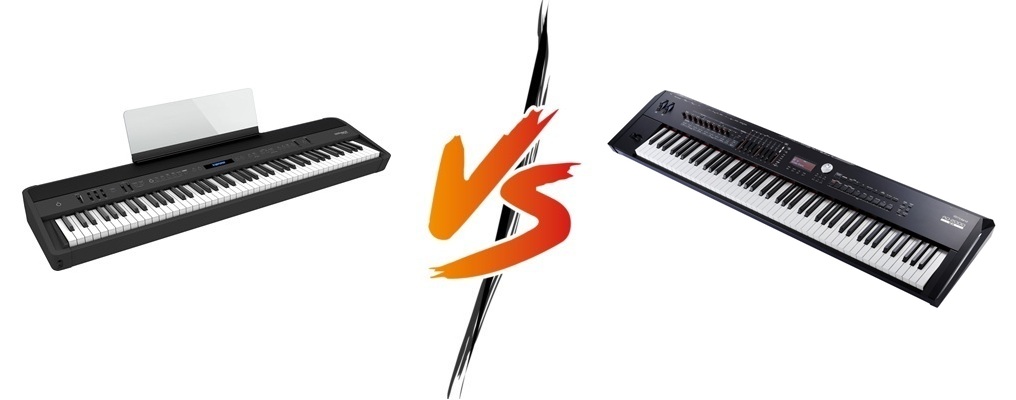
If you’re shopping in the premium Roland lineup, chances are you’ve narrowed your choices down to two instruments that couldn’t be more closely related while serving very different purposes: the Roland FP-90X and the Roland RD-2000.
At first glance, they share quite a bit. Both feature Roland’s flagship PHA-50 hybrid wooden keyboard. Both deliver exceptional piano sounds. Both are built to a high standard and carry premium price tags. It’s easy to assume the RD-2000 is simply the “better” version because it costs more.
After spending time with both instruments, I don’t think that’s the right way to look at them.
These pianos were designed with completely different players in mind. The FP-90X is primarily a premium home and portable digital piano that happens to include many professional features. The RD-2000, on the other hand, is a professional stage piano built for musicians who perform, record, and need extensive real-time control.
That difference influences nearly every aspect of their design.
If your primary goal is enjoying beautiful piano sounds at home, the FP-90X may actually be the smarter purchase despite costing less. If you’re regularly playing live, controlling software instruments, or managing complex performances, the RD-2000 easily justifies its higher price.
This comparison looks beyond the specifications and focuses on what it’s actually like to live with each instrument.
Roland FP-90X vs Roland RD-2000 Comparison Chart
If you click the links below, under the product images, you will be redirected to Amazon.com. In case you then decide to buy anything, Amazon.com will pay me a commission. This doesn’t affect the honesty of this review in any way though.
| Feature | Roland FP-90X | Roland RD-2000 |
|---|---|---|
 |  | |
| Check the best price on Amazon | Check the best price on Amazon | |
| Type | Portable Digital Piano | Professional Stage Piano |
| Keyboard | 88-key PHA-50 Hybrid Keyboard (Wood/Plastic) | 88-key PHA-50 Hybrid Keyboard (Wood/Plastic) |
| Key Surface | Ivory Feel with Escapement | Ivory Feel with Escapement |
| Touch Sensitivity | Adjustable (100 levels + fixed) | Adjustable (Multiple Touch Curves & User Settings) |
| Sound Engine | PureAcoustic Piano Modeling | V-Piano Modeling + SuperNATURAL Piano Engine |
| Maximum Polyphony | Unlimited (Piano), 256 Notes (Other Sounds) | Unlimited (V-Piano), 128 Notes (SuperNATURAL) |
| Built-in Sounds | Over 360 Tones | Over 1,100 Sounds |
| Acoustic Piano Sounds | Yes | Yes |
| Electric Piano Sounds | Yes | Extensive Professional Collection |
| Organ Sounds | Basic | Virtual Tone Wheel Organ Engine |
| Synth Sounds | Basic Selection | Extensive Synth Library |
| Layers/Splits | Dual, Split, Twin Piano | Up to 8 Internal Zones + 8 External Zones |
| Built-in Speakers | Yes | No |
| Speaker Configuration | 2 × 25W + 2 × 5W (4-Speaker System) | None |
| Bluetooth Audio | Yes | Yes |
| Bluetooth MIDI | Yes | Yes |
| USB Audio Interface | Yes | Yes |
| USB MIDI | Yes | Yes |
| Audio Outputs | Stereo Line Out (L/Mono, R) | Main Out (XLR & 1/4″), Sub Outs |
| Audio Inputs | Stereo Input | Stereo Input |
| Headphone Outputs | 2 | 2 |
| Pedal Inputs | Damper, Pedal Unit | Damper + 2 Assignable Pedals |
| MIDI Ports | USB MIDI | USB MIDI + 5-pin MIDI In/Out |
| Display | LCD Display | Larger LCD Display |
| Real-Time Sliders | No | 9 Sliders |
| Assignable Knobs | Limited | 8 Assignable Knobs |
| Performance Memories | Registrations | Scenes |
| Internal Recorder | Yes (Audio & MIDI) | Yes |
| Rhythm Accompaniment | Yes | No |
| Metronome | Yes | Yes |
| Piano Designer | Yes | Yes |
| Weight | 23.6 kg (52 lbs) | 21.7 kg (47.8 lbs) |
| Dimensions (W × D × H) | 1,340 × 390 × 136 mm | 1,417 × 367 × 141 mm |
| Available Finishes | Black, White | Black |
| Included Pedal | DP-10 Sustain Pedal | DP-10 Sustain Pedal |
| My individual reviews | Roland FP-90X review | Roland RD-2000 review |
Quick Summary
| Category | Winner |
|---|---|
| Keyboard Action | Tie |
| Acoustic Piano Sound | Tie (FP-90X slightly more piano-focused) |
| Electric Pianos | RD-2000 |
| Sound Library | RD-2000 |
| Built-in Speakers | FP-90X |
| Live Performance Features | RD-2000 |
| MIDI Controller Capabilities | RD-2000 |
| Home Practice | FP-90X |
| Portability | RD-2000 (slightly lighter) |
| Ease of Use | FP-90X |
| Overall Value for Home Pianists | FP-90X |
| Overall Value for Gigging Musicians | RD-2000 |
Design & Build Quality
When comparing two premium digital pianos like the Roland FP-90X and the Roland RD-2000, it’s tempting to jump straight into the keyboard action or sound engine. After all, those are the features that usually influence a buying decision the most. However, the design and overall build quality of an instrument have a much bigger impact on the ownership experience than many people realize.
These are instruments you’ll spend hundreds or even thousands of hours with. You’ll touch every button, move the instrument, connect cables, adjust controls, and simply look at it every time you sit down to play. A piano that feels well designed encourages you to practice and perform, while one with a frustrating layout or poor ergonomics can slowly become an annoyance, even if it sounds fantastic.
Roland has a long history of building durable keyboards, and both the FP-90X and the RD-2000 reflect that reputation. Neither feels like a budget instrument, but they approach design from two completely different philosophies.
The FP-90X is designed primarily as a premium digital piano for home players, educators, and musicians who occasionally take their instrument to rehearsals or performances. The RD-2000, meanwhile, is unapologetically built for the stage. It assumes that its owner will be transporting it regularly, plugging it into professional sound systems, and making adjustments in the middle of a live performance.
That difference shapes nearly every design decision Roland made.
Roland FP-90X: Elegant Simplicity
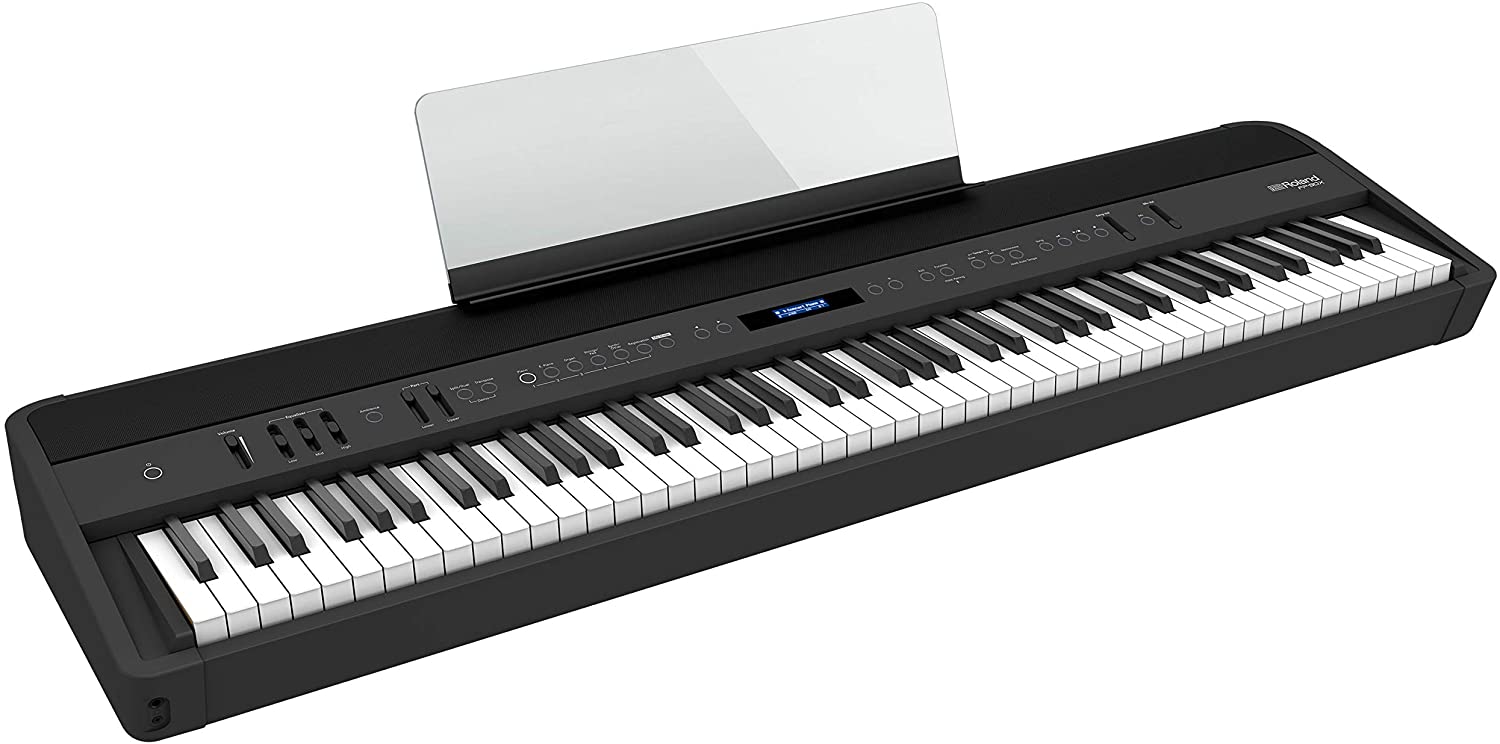
The FP-90X has an understated appearance that feels timeless. Rather than trying to impress with an overwhelming number of controls, Roland chose a clean, minimalist layout that lets the keyboard remain the visual centerpiece.
Viewed from a distance, it almost resembles a traditional digital piano more than a synthesizer or workstation. The control panel sits discreetly above the keys, with a modest LCD display surrounded by a sensible collection of buttons. Everything feels neatly organized, and there is very little visual clutter.
This simplicity is one of the FP-90X’s biggest strengths.
If your primary goal is sitting down and playing the piano, you won’t find yourself distracted by dozens of flashing lights or unfamiliar controls. The interface encourages you to focus on music rather than technology.
That doesn’t mean the FP-90X lacks features. In fact, it offers a surprisingly deep level of customization once you begin exploring the menus. You can adjust piano character, resonance, ambience, key touch, and numerous other parameters. The difference is that these features stay out of your way until you actually need them.
For many pianists, that’s exactly how a digital piano should behave.
The cabinet itself is solid and reassuringly rigid. There is very little flex anywhere along the chassis, even when lifting the instrument from one end. The finish feels durable and resistant to fingerprints, although, like most matte black instruments, it will eventually collect dust that requires occasional cleaning.
One small detail worth mentioning is the way the controls are spaced. Roland has left enough room between buttons that accidental presses are rare, even during quick adjustments. It may sound like a minor consideration, but it’s something you’ll appreciate over months or years of ownership.
Roland RD-2000: Built for Professional Work
If the FP-90X is designed to disappear beneath your hands, the RD-2000 is designed to put complete control at your fingertips.
The first impression is striking.
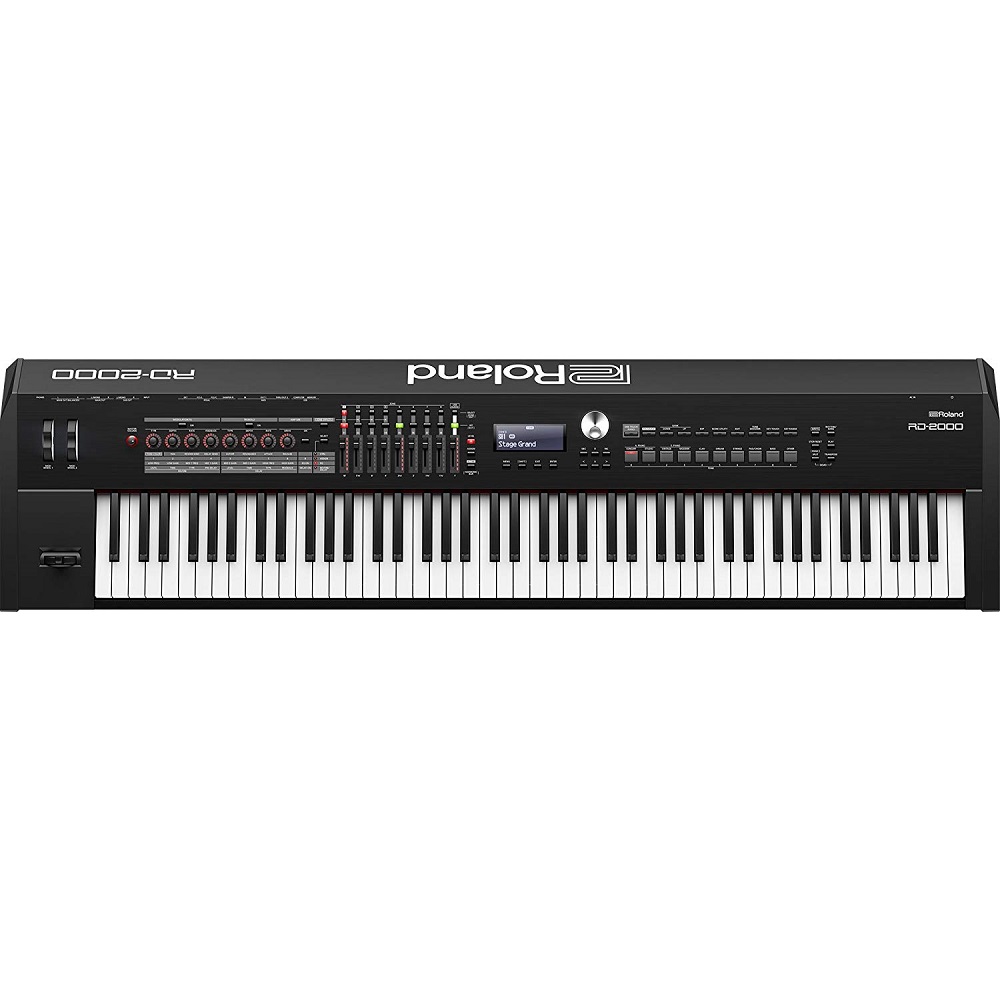
Nearly every inch of the top panel serves a purpose. Sliders line one side of the instrument. Rotary knobs occupy another section. Dedicated buttons control layers, zones, effects, scenes, and sound categories. Unlike the FP-90X, which hides many functions within menus, the RD-2000 places them directly in front of you.
For a new owner, this can honestly be intimidating.
It’s easy to sit in front of the RD-2000 for the first time and wonder where to begin. Compared to the relatively straightforward FP-90X, the stage piano almost looks like the cockpit of an aircraft.
Fortunately, that complexity is intentional.
Professional musicians often need to make rapid adjustments during a live performance. They can’t afford to stop playing while navigating multiple menu pages. A dedicated slider or button is always faster than scrolling through an LCD screen.
Once you understand the layout, the design begins to make perfect sense.
Changing the balance between piano and strings takes seconds.
Adjusting organ drawbars feels natural.
Switching performances is immediate.
Controlling external MIDI equipment becomes remarkably straightforward.
The RD-2000’s interface rewards familiarity. The more time you spend with it, the more efficient it becomes.
Materials and Construction
Both instruments demonstrate Roland’s reputation for solid engineering.
The chassis feel robust without being unnecessarily bulky. Buttons provide reassuring tactile feedback, while knobs rotate smoothly with enough resistance to avoid accidental movement. Nothing rattles or feels loose.
This level of build quality inspires confidence.
Digital pianos are significant investments, and buyers naturally expect them to last for many years. Based purely on physical construction, both the FP-90X and RD-2000 appear capable of handling long-term ownership without issue.
The PHA-50 keyboard contributes significantly to this premium feel. Although the key action itself deserves its own discussion, it’s worth noting here that the wooden side panels of the keys reinforce the impression of quality every time you play. The instrument simply feels expensive in the best possible way.
The side panels and overall cabinet construction also deserve praise. Neither piano creaks when lifted, and both feel rigid enough to survive frequent movement without developing structural issues.
That said, neither instrument should be mistaken for a lightweight keyboard.
Portability
Despite both being marketed as portable digital pianos, portability is relative.
The FP-90X weighs approximately 24 kilograms (53 pounds). That’s manageable for occasional transport, but it’s certainly not something most people will want to carry up flights of stairs every weekend.
If your performances are infrequent, this probably won’t be a major concern. You can load it into a car, bring it to a rehearsal, or take it to a small venue without too much difficulty. However, you’ll almost certainly want a sturdy case with wheels if you plan to move it regularly.
The RD-2000, despite offering considerably more professional hardware and controls, actually weighs slightly less at around 21.7 kilograms (48 pounds).
That difference may not sound dramatic on paper, but in practice, every kilogram matters when lifting an instrument into a vehicle or onto a stage.
This is one of those surprising situations where the stage piano is actually easier to transport than the home-oriented model.
Of course, weight is only one part of portability.
The absence of built-in speakers on the RD-2000 means you’ll also need external amplification, monitor speakers, or headphones wherever you play. By contrast, the FP-90X is completely self-contained. You can place it on a stand, connect the sustain pedal, plug it into the wall, and start playing immediately.
For home musicians, that’s a genuine advantage.
User Experience
Good industrial design isn’t just about appearance. It’s about making an instrument enjoyable to use every day.
The FP-90X succeeds because it rarely gets in your way.
Power it on, select a piano sound, and you’re ready to play within seconds. Every design decision seems intended to reduce distractions and create an experience that feels as close as possible to sitting at an acoustic piano.
The RD-2000 aims for something entirely different.
Its design encourages interaction.
Instead of hiding complexity, it celebrates it. The controls invite experimentation, whether you’re layering sounds, assigning MIDI zones, adjusting effects, or creating elaborate live performance setups.
Neither philosophy is inherently better.
The better choice depends entirely on the person using the instrument.
If you’re primarily a pianist who wants a premium digital piano that blends naturally into your practice routine, the FP-90X’s elegant simplicity is hard to fault. It looks refined, feels well built, and offers exactly the right amount of control without becoming overwhelming.
If you’re a professional keyboardist juggling multiple sounds, backing tracks, virtual instruments, and live performances, the RD-2000’s busy control surface becomes one of its greatest strengths. What initially appears complicated soon becomes an incredibly efficient workflow.
Which Design Is Better?
This is one of the few categories where declaring a winner would be misleading because each instrument succeeds at the job it was designed to do.
The FP-90X delivers a cleaner, more inviting experience that most home players will appreciate from the moment they switch it on. It feels refined, modern, and intentionally uncomplicated.
The RD-2000, on the other hand, is built like a professional tool. Every slider, knob, and button exists for a reason, and experienced performers will quickly discover just how much those dedicated controls improve efficiency on stage.
In terms of build quality, both instruments are excellent. Roland hasn’t cut corners with either model, and both feel capable of providing years of reliable service. The real difference lies not in how well they’re built, but in who they’re built for.
If your idea of the perfect digital piano is one that lets you forget about technology and simply enjoy playing, the FP-90X has the edge.
If you want an instrument that places professional-level control literally beneath your fingertips, the RD-2000 is one of the most thoughtfully designed stage pianos Roland has ever produced.
Keyboard Action
For many pianists, the keyboard action is the single most important factor when choosing a digital piano. You can always connect better speakers, upgrade your headphones, or even use external software instruments if you’re unhappy with the factory sounds. The feel of the keys, however, is something you interact with every second you’re playing. If the action doesn’t feel right, no amount of impressive technology elsewhere can fully make up for it.
Fortunately, this is an area where both the Roland FP-90X and the Roland RD-2000 excel.
One of the reasons this comparison can be so difficult is that Roland chose to equip both instruments with the same flagship key action: the PHA-50 (Progressive Hammer Action 50). This is one of Roland’s most respected keyboard mechanisms and has earned a strong reputation among both hobbyists and professional players.
At first glance, that might suggest there’s nothing to compare. If the action is identical, surely the playing experience must be identical as well.
In reality, it’s a little more nuanced than that.
While the physical key action is the same, the way each instrument responds to your playing can feel slightly different because of differences in sound engines, velocity curves, and each piano’s overall purpose. Understanding these subtleties is important because they influence how connected you feel to the instrument.
The PHA-50 Action
Roland introduced the PHA-50 as a premium hybrid keyboard that combines traditional materials with modern engineering.
Unlike many digital piano actions that rely entirely on plastic keys, the PHA-50 uses a hybrid construction featuring wooden sides paired with a durable molded inner frame. The idea is to capture some of the natural feel and stability of wooden keys while avoiding issues such as warping, cracking, or excessive maintenance.
It’s a clever approach that works remarkably well.
The keys have a reassuring solidity that immediately distinguishes them from the lighter actions found on entry-level digital pianos. They don’t feel hollow or flimsy, and there’s a subtle sense of mass beneath your fingertips that makes the playing experience more convincing.
At the same time, the action remains extremely consistent.
Every key moves with the same level of precision, and the mechanism feels carefully engineered rather than simply heavy for the sake of appearing realistic.
Some manufacturers equate realism with increasing the weight of the keys, but that can quickly become tiring during long practice sessions. Roland has avoided that trap.
The PHA-50 feels substantial without ever becoming sluggish.
Key Weight and Balance
One of the first things I noticed while moving through different styles of music was how balanced the action feels across the keyboard.
The bass keys naturally carry more resistance than the treble keys, mimicking the graduated hammer weighting of an acoustic grand piano. This transition is smooth and subtle. There’s never a point where the weighting suddenly changes or draws attention to itself.
That consistency makes a real difference during longer playing sessions.
Whether you’re performing delicate classical repertoire, fast jazz improvisation, or energetic pop arrangements, the keyboard feels predictable and responsive.
Fast passages remain comfortable.
Repeated notes respond reliably.
Large dynamic changes feel easy to control.
Perhaps more importantly, the action never feels like it’s fighting against you.
Some digital pianos have actions that feel impressive during a brief demonstration in a music store but become surprisingly fatiguing after an hour of practice. The PHA-50 strikes a nice balance between realism and comfort.
I found it equally enjoyable during technical exercises, scales, and extended repertoire practice.
Surface Texture
Roland also deserves credit for paying attention to smaller details that contribute to the overall playing experience.
The white keys feature an ivory-feel texture, while the black keys have a slightly matte finish designed to improve grip.
This may seem like a minor feature, but it becomes surprisingly valuable during long practice sessions or live performances under warm stage lighting.
Your fingers maintain better traction, reducing the slippery feeling that glossy plastic keys sometimes develop.
Unlike some textured key surfaces that feel rough or artificial, Roland has kept the texture subtle.
You notice it without constantly thinking about it.
It’s one of those design choices that quietly improves the overall experience.
Escapement Simulation
Both instruments include escapement simulation, which recreates the slight notch that pianists feel when pressing the keys of a grand piano very slowly.
On an acoustic grand, this sensation comes from the hammer mechanism disengaging just before striking the strings.
Roland’s implementation is tasteful.
It’s noticeable if you’re deliberately playing very slowly or practicing soft passages, but it never feels exaggerated.
Some manufacturers seem eager to emphasize escapement as a marketing feature, making the bump more pronounced than it should be.
Roland avoids that mistake.
The effect simply contributes to the realism without constantly reminding you it’s there.
Dynamic Control
A great keyboard action isn’t just about physical feel.
It also needs to translate your musical intentions accurately.
This is where both the FP-90X and RD-2000 perform exceptionally well.
The dynamic range is wide and easy to control.
Soft playing feels expressive rather than weak.
Medium dynamics transition naturally.
Powerful fortissimo passages have authority without becoming harsh.
This wide dynamic range allows you to shape phrases naturally instead of feeling restricted by the keyboard.
Playing expressive classical music particularly highlights this strength.
Small variations in finger pressure produce equally subtle changes in volume and tone, making it easier to communicate musical ideas rather than simply triggering notes.
Jazz players will appreciate how responsive the action feels during improvisation.
Pop musicians benefit from the keyboard’s consistency when playing rhythmic accompaniment.
Even organ and synthesizer sounds remain surprisingly playable despite the fully weighted action, although dedicated waterfall keys would still be preferable for serious organ work.
Is It Close to an Acoustic Piano?
This is always one of the hardest questions to answer because every acoustic piano feels different.
A well-maintained concert grand plays very differently from an upright piano that has seen decades of use.
Rather than trying to imitate one specific instrument, the PHA-50 captures the broader experience of playing a high-quality acoustic piano.
The key travel feels natural.
The return speed is excellent.
The resistance changes smoothly throughout each keystroke.
Most importantly, the action encourages expressive playing rather than limiting it.
No digital piano can perfectly recreate every aspect of an acoustic grand, particularly the complex interaction between hammers, strings, and escapement mechanisms.
However, Roland comes impressively close.
After a few minutes of playing, it’s easy to stop thinking about the keyboard itself and simply focus on the music.
Ultimately, that’s the highest compliment you can pay any digital piano action.
FP-90X: A Pianist’s Experience
Although the physical action is identical, the FP-90X feels slightly more focused on delivering a traditional piano-playing experience.
The default touch settings pair beautifully with the PureAcoustic Piano Modeling engine, creating an instrument that feels remarkably cohesive.
Sit down, select the Concert Piano, and everything responds in a way that feels familiar.
The keyboard encourages expressive phrasing, careful pedaling, and dynamic nuance.
Because the FP-90X has relatively few distractions on its control panel, your attention naturally remains on the keys.
This psychological aspect shouldn’t be underestimated.
The instrument feels like a piano first and a digital device second.
For classical players, teachers, students, and anyone who spends most of their time practicing solo piano repertoire, this focused experience is one of the FP-90X’s greatest strengths.
RD-2000: The Performer’s Perspective
The RD-2000 uses the same action but presents it within a very different environment.
Instead of existing solely to recreate the acoustic piano experience, the keyboard becomes part of a larger performance system.
One moment you’re playing a concert grand.
The next you’re layering strings.
Then you’re switching to Rhodes, organ, synth pads, or controlling external software instruments.
The action proves remarkably versatile across all of these sounds.
That’s one of the reasons the RD-2000 has become so popular among touring keyboardists.
Many weighted actions feel excellent for piano but awkward for electric pianos or synthesizer parts.
The PHA-50 manages to bridge those worlds surprisingly well.
Is it the ideal action for Hammond organ glissandos?
No.
Would a dedicated synth player prefer semi-weighted keys?
Probably.
But for musicians who need one keyboard capable of handling virtually every sound in a live performance, the compromise is exceptionally well judged.
Touch Sensitivity and Customization
Both instruments allow you to adjust touch sensitivity to match your playing style.
This is particularly useful because pianists have very different preferences.
Some players naturally produce a lighter touch and benefit from a more responsive velocity curve.
Others prefer to work harder for louder dynamics, closely mimicking the resistance of certain acoustic grands.
Roland offers multiple touch settings along with user customization, allowing you to tailor the keyboard to your personal technique.
This flexibility also makes the instruments suitable for households where multiple people share the same piano.
A beginner can select a lighter response, while an experienced pianist may prefer a heavier setting that offers greater dynamic control.
It’s a practical feature that many owners end up appreciating far more than they initially expect.
Which Keyboard Action Is Better?
This is one category where declaring a winner simply isn’t possible because, from a mechanical standpoint, both instruments offer the same outstanding action.
If you’re hoping the RD-2000 delivers a noticeably superior keyboard because it costs more, you’ll probably be surprised.
It doesn’t.
Likewise, the FP-90X doesn’t feel like a compromise simply because it’s the less expensive model.
Both provide one of the finest weighted keyboard actions currently available in a portable digital piano.
The differences lie not beneath your fingers, but in the experience surrounding the keyboard.
The FP-90X presents the action within an environment dedicated to immersive piano playing, making it feel especially rewarding for solo practice and traditional repertoire.
The RD-2000 places that same excellent keyboard into a far more flexible performance platform, where it supports everything from acoustic piano to layered stage setups and advanced MIDI control.
In the end, Roland made the right decision by refusing to differentiate these models through artificial compromises. Buyers at either price point receive a genuinely premium keyboard action, and that’s something that deserves recognition. Whether you choose the FP-90X or the RD-2000, you’ll be getting an action that is responsive, expressive, comfortable over long sessions, and capable of satisfying even demanding pianists for years to come.
Piano Sound
If the keyboard action determines how connected you feel to the instrument, the piano sound determines whether you actually enjoy sitting down and playing it. It’s the characteristic you’ll hear every time you press a key, and for many musicians, it’s ultimately the deciding factor between two otherwise excellent digital pianos.
This is also one of the most interesting areas of comparison between the Roland FP-90X and the Roland RD-2000 because, while both instruments produce outstanding piano sounds, they approach the task from slightly different directions.
On paper, it might seem like the RD-2000 should have a clear advantage. It’s Roland’s flagship stage piano, it costs considerably more, and it’s designed for professional musicians. In reality, however, the gap between these two instruments is much smaller than many buyers expect.
If your primary concern is the quality of the acoustic piano itself, the FP-90X is every bit as impressive as its more expensive sibling. The RD-2000 certainly offers greater flexibility and a much broader palette of sounds, but when it comes to sitting down and enjoying a beautiful grand piano tone, the two instruments are remarkably close.
Roland’s Approach to Piano Sound
Unlike manufacturers that rely almost entirely on multi-layered samples, Roland has spent years developing piano modeling technology.
The FP-90X features Roland’s PureAcoustic Piano Modeling engine, which creates the sound of a piano in real time rather than simply playing back recordings of individual notes. Instead of switching between a limited number of velocity layers, the instrument continuously models how a real piano behaves.
This has several important advantages.
The transition between soft and loud playing feels exceptionally smooth. There are no obvious points where one sample layer suddenly gives way to another. Notes bloom naturally as you increase your touch, making expressive playing feel more convincing.
Repeated notes also benefit from this approach. On many sample-based instruments, rapid repetitions can reveal the fact that you’re hearing the same recording over and over again. Roland’s modeling technology avoids much of this repetition, creating a more organic playing experience.
The RD-2000 takes a slightly different approach by combining Roland’s SuperNATURAL technology with its extensive collection of stage-oriented sounds. While the exact technologies differ across sound categories, the end result is an instrument capable of delivering highly expressive acoustic pianos alongside an enormous range of electric pianos, organs, synths, and other performance voices.
For most players, the practical difference isn’t that one sounds dramatically better than the other.
It’s that each instrument emphasizes different strengths.
The Character of the FP-90X
The FP-90X immediately impresses with its warmth.
The default Concert Piano has a rich, full-bodied tone that feels inviting from the first chord. There’s plenty of detail across the frequency spectrum without becoming overly bright or clinical.
Some digital pianos try to create excitement by emphasizing the upper frequencies. This can sound impressive during a short demonstration in a music store because the piano cuts through ambient noise and immediately grabs your attention.
Unfortunately, that same brightness can become tiring after an hour of practice.
Roland wisely avoids that trap.
The FP-90X delivers clarity without harshness. High notes sparkle naturally, while the middle register remains warm and expressive. The bass has enough weight to support the overall sound without becoming muddy.
This balanced tonal character makes the instrument suitable for an enormous range of repertoire.
Classical music benefits from its dynamic nuance.
Jazz standards sound warm and intimate.
Pop ballads have enough presence to sit comfortably in a mix.
Film music feels cinematic without becoming overly dramatic.
Perhaps most importantly, the sound encourages long practice sessions.
There were several occasions where I sat down intending to test a few features and ended up playing for far longer than planned simply because the piano was enjoyable to listen to.
That’s something specifications can’t measure, but it’s one of the highest compliments you can give any instrument.
The Character of the RD-2000
The RD-2000 approaches piano sound with a performer’s mindset.
Its acoustic piano voices are excellent, offering plenty of detail, projection, and dynamic control. They have a slightly more forward presentation that helps them cut through a live band without excessive equalization.
This makes perfect sense given the instrument’s intended audience.
A piano that sounds beautifully mellow in a quiet living room may disappear once guitars, drums, bass, and vocals enter the picture.
The RD-2000’s piano tones maintain clarity even within dense arrangements.
That doesn’t mean they sound aggressive.
Rather, they possess a confidence that works particularly well in live performance.
When playing solo through quality studio monitors, I actually found the differences between the FP-90X and RD-2000 smaller than I expected.
Both produce convincing grand piano sounds with impressive realism.
If someone played either instrument behind a curtain using similar settings, I suspect many listeners would struggle to identify which was which.
The RD-2000’s advantage isn’t necessarily the quality of its primary acoustic piano.
Its advantage lies in everything surrounding it.
Dynamic Expression
One area where both instruments excel is dynamic response.
The relationship between your fingers and the resulting sound feels wonderfully natural.
Play gently, and the piano responds with delicate, intimate tones.
Increase your touch gradually, and the sound grows smoothly rather than jumping between noticeable volume levels.
Strike the keys with confidence, and the instrument rewards you with a full, powerful fortissimo that remains musical instead of becoming brittle.
This smooth dynamic transition is one of the greatest benefits of Roland’s technology.
Expressive phrasing feels intuitive because the instrument faithfully follows your intentions.
You don’t find yourself adjusting your technique to compensate for limitations in the sound engine.
Instead, the piano simply reacts.
That creates a stronger emotional connection between player and instrument.
Resonance and Pedaling
Modern digital pianos are expected to recreate far more than individual notes.
A real acoustic piano is an incredibly complex instrument where every string interacts with every other string. The sustain pedal changes the entire character of the instrument, allowing sympathetic vibrations and resonances to develop naturally.
Roland has done an admirable job recreating these subtle details.
Damper resonance adds depth when using the sustain pedal.
String resonance enriches held chords.
Key-off behavior contributes a small but noticeable sense of realism when releasing notes.
None of these elements feel exaggerated.
Instead, they work together quietly in the background to create a more believable playing experience.
This is especially noticeable in slower classical repertoire where sustained harmonies have time to develop.
Debussy, Chopin, and many Romantic works benefit enormously from these subtle interactions.
Without them, digital pianos can sometimes sound overly clean or sterile.
With them, the instrument begins to breathe more like an acoustic piano.
Tone Customization
One area where Roland deserves considerable praise is customization.
Both instruments allow players to shape their piano sound rather than accepting a single factory preset.
You can adjust brightness, resonance, ambience, tuning, touch response, and various tonal characteristics to better suit your personal preferences.
This flexibility is valuable because piano tone is deeply subjective.
Some players prefer bright, articulate instruments that project clearly.
Others want darker, warmer sounds for solo practice.
Rather than insisting there’s one “correct” piano tone, Roland gives users the tools to create something that matches their own ears.
The FP-90X, in particular, makes this process surprisingly approachable.
It’s easy to make meaningful adjustments without becoming overwhelmed by technical parameters.
The RD-2000 naturally offers even greater flexibility, especially for live performers who need different sounds for different songs or venues.
Beyond Acoustic Piano
This is where the RD-2000 begins to separate itself.
While the FP-90X focuses primarily on delivering an exceptional piano-playing experience, the RD-2000 expands into a complete professional sound library.
Its electric pianos deserve special mention.
The Rhodes-inspired sounds are among the finest Roland has ever produced.
Warm, expressive, and beautifully responsive, they capture the subtle bark and character that make vintage electric pianos so enjoyable to play.
The Wurlitzer voices have the slightly gritty personality players expect.
FM electric pianos provide the crisp attack familiar from countless recordings of the 1980s.
The organ sounds are equally impressive, particularly when combined with the RD-2000’s physical drawbar controls.
Layer these instruments with strings, pads, or synthesizers, and the stage piano becomes an incredibly versatile performance machine.
The FP-90X includes additional sounds as well, but they’re clearly secondary to its acoustic piano focus.
For many home users, that’s perfectly acceptable.
For working professionals, the RD-2000’s expanded sound library represents genuine value.
Headphones and Personal Practice
Both instruments perform exceptionally well when played through quality headphones.
This is an important consideration because many owners spend most of their practice time using headphones, particularly in shared living spaces.
The stereo imaging feels spacious.
Dynamic detail remains intact.
The subtle resonances and tonal variations become even easier to appreciate in a quiet listening environment.
Long practice sessions remain enjoyable without the compressed or artificial quality sometimes associated with lower-end digital pianos.
A good pair of studio headphones reveals just how much detail Roland has built into these sound engines.
Which Piano Sounds Better?
This question has a surprisingly complicated answer.
If we’re talking purely about the experience of playing an acoustic grand piano, I don’t believe there’s a decisive winner.
The FP-90X produces one of the most satisfying piano sounds in Roland’s entire lineup. It’s warm, expressive, beautifully balanced, and encourages extended playing sessions. For dedicated pianists, it’s difficult to ask for much more.
The RD-2000 is equally capable of producing convincing acoustic piano tones, but its strengths extend well beyond that single sound. Its acoustic pianos are designed to perform confidently on stage, while its remarkable collection of electric pianos, organs, synths, and layered textures transforms it into an instrument capable of covering virtually any musical situation.
That’s the key distinction.
The FP-90X is designed to be an exceptional piano.
The RD-2000 is designed to be an exceptional keyboard.
If your musical life revolves around practicing classical repertoire, playing jazz standards, accompanying singers, or simply enjoying the sound of a beautifully voiced grand piano at home, the FP-90X gives you very little reason to spend more money.
If, on the other hand, you regularly move between acoustic piano, Rhodes, Wurlitzer, Hammond organ, layered orchestral textures, and complex live performance setups, the RD-2000’s broader sonic capabilities more than justify its position as Roland’s flagship stage piano.
Neither instrument disappoints. Both deliver premium piano sounds that are expressive, detailed, and deeply enjoyable to play. The real question isn’t which one sounds better, but whether your musical needs stop at a superb acoustic piano or extend into the far wider world of professional keyboard performance.
Speakers
The speaker system is one of the biggest practical differences between the Roland FP-90X and the Roland RD-2000, and it’s also one of the easiest aspects to overlook when comparing specifications online.
Many buyers naturally focus on the keyboard action, sound engine, or connectivity. Those are certainly important, but speakers have a direct impact on how enjoyable an instrument is to use every single day. They determine how the piano fills a room, how immersive your practice sessions feel, and whether you can simply switch the instrument on and start playing without thinking about additional equipment.
In this category, the FP-90X and the RD-2000 take completely different approaches.
The FP-90X includes one of the most powerful built-in speaker systems you’ll find in a portable digital piano. It’s designed to function as a complete instrument on its own, whether you’re practicing at home, teaching a lesson, or performing in a smaller venue.
The RD-2000, on the other hand, doesn’t include built-in speakers at all.
At first glance, this may seem like an obvious advantage for the FP-90X, but the reality is a little more complicated. The absence of speakers on the RD-2000 isn’t a cost-cutting measure or an oversight. It’s a deliberate design choice that reflects the needs of professional musicians.
Understanding why Roland made these decisions helps explain which instrument is actually the better fit for your own playing environment.
Roland FP-90X: A Complete Piano Experience
One of the biggest advantages of the FP-90X is that everything you need is already built into the instrument.
Set it on a stand, plug in the power cable, connect the sustain pedal, and you’re ready to play.
There’s no need for studio monitors.
No keyboard amplifier.
No PA system.
No additional cables.
That level of convenience shouldn’t be underestimated.
For many home pianists, the ability to simply sit down and play without setting up external equipment is one of the reasons they choose a premium digital piano in the first place.
Roland clearly understands this, and the FP-90X’s speaker system reflects that philosophy.
Rather than treating the speakers as an afterthought, Roland designed them to complement the instrument’s piano modeling engine. The result is a surprisingly immersive playing experience that feels much closer to an acoustic piano than many portable digital pianos manage to achieve.
The speakers produce a sound that feels spacious, balanced, and powerful enough for most everyday situations.
Whether you’re practicing scales, working through classical repertoire, or casually playing your favorite songs after work, the instrument fills the room comfortably without requiring excessive volume.
Power and Projection
One of the first things you’ll notice about the FP-90X is that it sounds much bigger than many competing portable digital pianos.
The built-in amplification delivers impressive headroom, allowing the instrument to maintain clarity even as the volume increases.
This is important because some digital pianos begin to sound compressed or strained when pushed toward their maximum output.
The FP-90X doesn’t suffer from that problem nearly as much.
Instead, the sound remains composed and well controlled.
Bass notes retain their weight.
Middle frequencies stay warm and full.
Treble notes continue to sparkle without becoming harsh.
The overall presentation feels remarkably confident.
In a typical living room, music room, or teaching studio, there’s more than enough volume available.
In fact, many owners will rarely need to push the volume control beyond the halfway point.
This generous amount of power also makes the FP-90X suitable for smaller performances where external amplification isn’t practical.
Coffee shops, restaurants, intimate wedding ceremonies, rehearsal spaces, and classroom demonstrations are all situations where the built-in speakers perform admirably.
While they won’t replace a dedicated PA system for larger venues, they handle modest performance environments better than many people expect.
Sound Quality
Volume is only part of the equation.
Equally important is the quality of the sound itself.
Roland has done an excellent job tuning the speaker system to complement the piano sounds.
The tonal balance feels natural rather than exaggerated.
The bass has satisfying depth without becoming boomy.
The middle register, where most piano music lives, remains rich and expressive.
The upper register is detailed without sounding brittle.
This balance makes long practice sessions particularly enjoyable.
Bright, overly aggressive speaker systems can become fatiguing after an hour or two of playing.
The FP-90X avoids this problem by presenting the piano in a way that feels relaxed and musical.
Even at moderate listening levels, individual notes remain clearly defined.
Complex chords don’t blur together.
Fast passages maintain excellent articulation.
Perhaps most importantly, the speakers allow the expressive qualities of Roland’s piano modeling engine to come through naturally.
Subtle changes in dynamics remain easy to hear.
Soft passages retain their character.
Loud passages have impact without becoming unpleasant.
Stereo Imaging
Another area where the FP-90X performs well is stereo imaging.
Although no built-in speaker system can perfectly recreate the scale of a concert grand piano, Roland has managed to produce a convincing sense of width and space.
The piano doesn’t feel like it’s coming from a single point beneath the keyboard.
Instead, the sound spreads naturally across the instrument.
This creates a more immersive playing experience, particularly when seated directly in front of the keyboard.
Classical music benefits greatly from this presentation.
Large arpeggios feel expansive.
Wide left-hand accompaniments remain distinct from the melody.
Pedaled passages develop a pleasing sense of atmosphere.
The stereo field also contributes to a stronger emotional connection with the instrument.
You’re not simply hearing notes.
You’re hearing a piano occupying space.
The RD-2000: No Built-In Speakers
The first time many buyers discover that the RD-2000 has no speakers, their reaction is often surprise.
After all, this is one of Roland’s most expensive digital pianos.
Shouldn’t a flagship instrument include everything?
Not necessarily.
The RD-2000 was designed from the ground up as a professional stage piano.
Professional keyboardists almost never rely on built-in speakers during performances.
Instead, they connect directly to front-of-house PA systems, stage monitors, keyboard amplifiers, studio monitors, or in-ear monitoring systems.
In that environment, built-in speakers offer very little practical benefit.
In fact, they can actually create problems.
Internal speakers add weight.
They occupy valuable space inside the chassis.
They consume power.
They can even interfere with stage monitoring if they’re projecting sound in directions the performer doesn’t need.
By removing them entirely, Roland was able to reduce weight while focusing the instrument’s design on professional performance.
It’s a decision that makes complete sense for the intended audience.
What This Means for Home Players
For someone purchasing a digital piano primarily for home use, however, the lack of speakers changes the ownership experience considerably.
Every practice session requires external audio equipment.
That might mean a pair of studio monitors.
A keyboard amplifier.
A home stereo system.
Or headphones.
While none of these options are inherently difficult to use, they introduce additional expense and complexity.
Instead of simply pressing the power button and playing, you’ll often need to power up multiple devices and adjust their volume.
This isn’t a major inconvenience if you’re accustomed to working in a recording studio.
For casual home use, though, it becomes noticeable surprisingly quickly.
The FP-90X feels self-contained.
The RD-2000 feels like part of a larger system.
Neither approach is wrong.
They simply suit different lifestyles.
External Speakers and Professional Monitoring
Of course, the absence of internal speakers also means the RD-2000 places no limitations on your monitoring setup.
You can pair it with whatever amplification best suits your needs.
High-end studio monitors reveal incredible detail.
Professional keyboard amplifiers provide substantial stage volume.
Large PA systems allow the instrument to fill concert venues with ease.
This flexibility is one of the reasons so many touring musicians choose stage pianos without speakers.
They’re free to optimize their sound for each performance environment rather than relying on a built-in system that must work everywhere.
The RD-2000 excels in these situations.
Its audio outputs deliver clean, professional-quality signals that respond beautifully to external amplification.
When connected to a quality monitoring system, the instrument sounds absolutely outstanding.
Headphone Performance
Fortunately, both instruments perform exceptionally well with headphones.
This deserves mention because many owners spend the majority of their practice time playing quietly.
Whether you’re practicing late at night, living in an apartment, or simply preferring private listening, headphones become an important part of daily use.
Both the FP-90X and RD-2000 produce detailed, spacious headphone sound with excellent stereo imaging.
Dynamic expression remains intact.
Subtle resonances remain audible.
The overall presentation feels natural rather than artificially compressed.
If you primarily practice with headphones, the speaker differences become far less significant.
However, the FP-90X still retains the advantage of allowing you to switch effortlessly between headphones and its built-in speakers without changing your setup.
Which Approach Is Better?
This is another category where context matters more than specifications.
If you’re looking for a digital piano that functions as a complete instrument straight out of the box, the FP-90X is clearly the better choice.
Its speaker system is genuinely excellent.
It’s powerful enough for home use, musical enough to do justice to Roland’s piano modeling engine, and capable of handling smaller performances without additional equipment.
For most pianists, it’s exactly what a premium digital piano should include.
The RD-2000 isn’t trying to compete in that category.
Instead, it assumes you’ll already have professional monitoring available.
Viewed from that perspective, omitting the speakers is actually a logical design decision rather than a compromise.
Professional performers gain a lighter instrument with greater flexibility and no unnecessary components.
Home players, however, may find the extra equipment requirement less appealing.
Ultimately, the speaker category reflects the broader philosophy behind both instruments.
The FP-90X is designed to be a complete piano that fits naturally into everyday life. Everything you need is built in, making practice simple, enjoyable, and immediate.
The RD-2000 is designed to be the heart of a professional keyboard rig. It expects to work alongside amplifiers, studio monitors, or PA systems, and it performs exceptionally well in those environments.
If your piano will spend most of its life in a living room, studio, or teaching space, the FP-90X offers one of the finest built-in speaker systems in its class and provides a noticeably more convenient ownership experience.
If your instrument is destined for stages, rehearsals, recording sessions, and touring, the RD-2000’s speaker-less design becomes a strength rather than a weakness. It’s a reminder that professional instruments aren’t always about including more features. Sometimes they’re about including only the features that truly matter.
Features and Functions
Once you move beyond the keyboard action and piano sound, the Roland FP-90X and Roland RD-2000 begin to reveal just how differently they were designed. This is the section where the two instruments truly diverge, and where the price difference between them starts to make sense.
Both pianos are packed with features, but they’re not trying to accomplish the same goals.
The FP-90X is designed to enhance the experience of playing the piano. Its features focus on making practice more enjoyable, allowing for a degree of sound customization, and adding conveniences like Bluetooth connectivity and recording. Everything feels centered around the pianist.
The RD-2000 takes a much broader approach. Rather than simply being a digital piano, it’s designed to function as the centerpiece of an entire performance setup. It combines the role of stage piano, MIDI controller, sound module, and performance workstation into a single instrument.
Neither philosophy is inherently better.
In fact, many players would never use half of the RD-2000’s capabilities, while others would quickly outgrow the FP-90X if they regularly perform on stage.
The question isn’t which instrument has more features.
It’s whether those features actually benefit the way you play.
Roland FP-90X: Features That Support Playing
The FP-90X immediately feels approachable.
Power it on, and within seconds you’re playing a grand piano. There are no complicated startup procedures or elaborate menu systems standing between you and the keyboard.
That’s intentional.
Roland clearly wanted the FP-90X to feel like an instrument rather than a computer.
Despite this simplicity, there’s a surprising amount happening beneath the surface.
One of the most useful features is the ability to customize the piano itself. You’re not limited to Roland’s factory presets. Instead, you can adjust characteristics such as brightness, resonance, ambience, touch response, lid position, and various tonal parameters to create a sound that better matches your personal taste.
Some players enjoy bright, articulate pianos that project clearly.
Others prefer darker, more mellow tones for classical music.
Rather than forcing everyone to accept a single interpretation of how a piano should sound, Roland gives owners meaningful control without making the process overly technical.
Importantly, these adjustments remain optional.
If you’re perfectly happy with the factory settings, you can ignore the customization menus entirely.
That’s a thoughtful balance between simplicity and flexibility.
Practice-Oriented Features
The FP-90X includes several features that are genuinely useful for everyday practice.
The onboard metronome is easy to access and works exactly as expected. While this might sound like a basic inclusion, it’s surprising how many digital pianos bury simple practice tools inside complicated menu systems.
Recording functionality is equally convenient.
Being able to record yourself and immediately listen back is one of the most effective ways to identify timing issues, uneven dynamics, or phrasing that might not be obvious while you’re playing.
The recording process is straightforward enough that you’re likely to use it regularly instead of viewing it as a novelty.
The piano also supports split and dual modes, allowing you to layer sounds or divide the keyboard between two instruments.
For example, you might combine piano with strings for cinematic pieces or split the keyboard between bass and piano for jazz practice.
These features aren’t particularly unusual in premium digital pianos, but Roland has implemented them cleanly and without unnecessary complexity.
Bluetooth Integration
One of the most practical modern features on the FP-90X is Bluetooth connectivity.
This includes both Bluetooth Audio and Bluetooth MIDI.
Bluetooth Audio allows you to stream music directly through the piano’s speaker system.
For many players, this becomes surprisingly useful.
You can play along with backing tracks.
Practice with recordings.
Stream lessons from online platforms.
Or simply enjoy listening to music through the piano when you’re not playing.
It’s a feature that integrates naturally into daily use.
Bluetooth MIDI is equally valuable.
Instead of connecting cables every time you want to use a music education app or notation software, compatible devices can communicate wirelessly.
For students and teachers, this level of convenience can make digital learning significantly more enjoyable.
The technology works quietly in the background, which is exactly how it should.
Roland RD-2000: Built for Performance
The RD-2000 operates on an entirely different level.
Calling it a digital piano almost undersells what it can do.
This is a professional performance instrument designed for musicians who require immediate access to multiple sounds, extensive MIDI control, sophisticated layering, and deep customization during live performances.
Its feature set is enormous.
Fortunately, Roland has organized these capabilities remarkably well.
Instead of forcing users through endless menu pages, many of the most important controls are available directly on the front panel.
This physical workflow becomes one of the instrument’s greatest strengths.
Layers, Splits, and Zones
Perhaps the RD-2000’s most impressive feature is its ability to manage complex keyboard setups.
Professional performers rarely play a single piano sound throughout an entire concert.
One song may require acoustic piano layered with strings.
The next might call for electric piano and synth pad.
Another could require separate bass and organ sounds assigned to different areas of the keyboard.
The RD-2000 handles these situations effortlessly.
Its zone system allows multiple internal and external sounds to be controlled simultaneously.
Each zone can be assigned independently, with dedicated controls for volume, transposition, MIDI routing, and numerous other parameters.
The physical sliders deserve special praise.
Instead of navigating menus to balance different layers, you simply move a slider.
It’s immediate.
Intuitive.
And incredibly useful during live performance.
Once you’ve experienced this workflow, returning to menu-driven systems feels surprisingly restrictive.
Scene Memory
Another professional feature that dramatically improves usability is Scene Memory.
Rather than rebuilding your keyboard setup every time you perform a song, the RD-2000 allows complete performance configurations to be saved and recalled instantly.
A single Scene can include:
- Selected sounds
- Layer configurations
- Split points
- Effects settings
- MIDI assignments
- Controller behavior
- Zone information
- Volume balances
For gigging musicians, this is invaluable.
Instead of spending valuable time making adjustments between songs, you simply recall the appropriate Scene and continue performing.
The transition is fast enough to feel seamless in most live situations.
Real-Time Controls
This is arguably where the RD-2000 justifies much of its higher price.
The front panel is filled with dedicated sliders, rotary encoders, buttons, and assignable controls.
These aren’t decorative additions.
They dramatically improve workflow.
Need more strings in the chorus?
Move a slider.
Need to brighten the electric piano?
Turn a knob.
Need to bring in a synth layer?
Press a button.
Every adjustment happens in real time without interrupting the performance.
Professional musicians understand just how valuable this can be.
Audience members may never notice the technology itself, but they certainly notice when transitions feel smooth and performances remain uninterrupted.
Effects Processing
Both instruments include high-quality effects, but the RD-2000 offers considerably greater flexibility.
Individual sounds can be processed with dedicated effects, allowing players to build polished performance setups without relying heavily on external equipment.
Electric pianos benefit particularly from this.
Classic tremolo.
Phaser.
Chorus.
Amp simulations.
Vintage-style modulation.
These effects contribute significantly to the authenticity of the RD-2000’s non-acoustic sounds.
The interface also encourages experimentation.
Because many parameters are directly accessible, you’re more likely to tweak sounds during rehearsals and performances rather than simply accepting the factory presets.
Controller Capabilities
Another major distinction is the RD-2000’s role as a MIDI controller.
Modern performers increasingly rely on software instruments running on laptops.
Virtual pianos.
Synthesizers.
Orchestral libraries.
Backing tracks.
The RD-2000 integrates beautifully into these environments.
Its assignable controls, extensive MIDI implementation, and multiple keyboard zones allow it to function as the central controller for an entire performance system.
For studio musicians, composers, and touring keyboardists, this capability alone may justify choosing the RD-2000 over the FP-90X.
The FP-90X certainly supports MIDI, but it isn’t designed to replace a dedicated master keyboard.
Ease of Use
Despite offering fewer features, the FP-90X actually has a significant advantage in one important area.
It’s much easier to learn.
Most owners will understand the majority of the instrument within a single afternoon.
The interface remains clean and logical.
The learning curve is gentle.
The RD-2000 demands considerably more time.
There’s no way around it.
With so many professional capabilities available, mastering the instrument requires patience.
Fortunately, the effort pays off.
The more familiar you become with the RD-2000, the faster and more efficient it becomes.
Professional users often praise it precisely because nearly every important function is accessible once you understand the layout.
Which Feature Set Is Better?
It’s tempting to assume that the RD-2000 wins this category simply because it offers more.
In terms of sheer quantity, that’s certainly true.
Its professional feature set is vastly more comprehensive than the FP-90X.
However, more features don’t automatically translate into a better ownership experience.
For many pianists, the FP-90X actually offers the more satisfying balance.
Every feature feels relevant.
Nothing seems included merely to inflate the specification sheet.
The instrument stays focused on helping you enjoy playing the piano.
The RD-2000 is different.
It isn’t trying to simplify anything.
Instead, it gives professional musicians virtually every tool they might need for demanding live performances, studio sessions, and advanced MIDI control.
That level of flexibility comes with greater complexity, but it’s complexity that serves a clear purpose.
Ultimately, the FP-90X excels because it knows exactly what it wants to be: a premium digital piano with thoughtful modern conveniences and enough customization to satisfy most players without overwhelming them.
The RD-2000 excels because it refuses to compromise. It’s not simply a digital piano with extra features. It’s a complete performance platform capable of adapting to almost any musical situation.
For home pianists, teachers, students, and anyone whose primary focus is practicing and enjoying piano music, the FP-90X offers everything you’ll realistically need and presents it in a way that feels approachable from day one.
For gigging musicians, producers, worship keyboardists, and performers managing multiple sounds throughout a show, the RD-2000’s extensive feature set transforms it from an instrument into the command center of an entire musical rig. That’s where its true value lies, and it’s why it continues to be one of Roland’s most respected stage pianos.
Connectivity
Connectivity may not be the most exciting aspect of a digital piano, but it’s one of the most important when you consider how these instruments fit into a modern musical setup. Very few musicians use their digital piano completely on its own anymore. Whether it’s connecting to a computer for recording, using educational apps on a tablet, plugging into external speakers, controlling virtual instruments, or performing through a professional PA system, today’s digital pianos need to communicate with a wide variety of devices.
This is another area where the Roland FP-90X and the Roland RD-2000 reveal their very different design philosophies.
The FP-90X offers excellent connectivity for home users, students, teachers, and musicians who occasionally perform or record. It includes everything most pianists will realistically need while keeping the overall experience straightforward.
The RD-2000, meanwhile, expands on those capabilities significantly. Its connectivity isn’t simply more extensive for the sake of having a longer specification sheet. Instead, it’s designed to function as the central hub of a professional keyboard rig, capable of managing complex stage setups and integrating seamlessly into recording studios.
For some buyers, the FP-90X already provides more than enough connectivity.
For others, the RD-2000’s additional options can dramatically improve workflow.
USB Audio and MIDI
One of the most useful features found on both instruments is USB connectivity.
Years ago, connecting a digital piano to a computer often required separate MIDI interfaces, audio interfaces, and multiple cables. Fortunately, modern Roland instruments simplify this process considerably.
Both the FP-90X and the RD-2000 support USB MIDI, allowing them to communicate directly with computers, tablets, and compatible mobile devices.
For many players, this is one of the most valuable features available.
If you’re learning piano using educational software, USB MIDI allows your computer to recognize every note you play with excellent accuracy.
Notation programs can automatically record performances.
Digital audio workstations can capture MIDI data for editing and orchestration.
Virtual piano libraries can replace the instrument’s internal sounds while retaining the feel of Roland’s excellent keyboard action.
The connection process is straightforward and reliable.
Simply connect a compatible USB cable, and the piano becomes available to supported software.
There’s very little technical knowledge required, making these features accessible even to musicians with limited recording experience.
USB Audio
USB Audio is another major advantage, particularly for anyone interested in recording.
Rather than routing audio through an external microphone or separate recording interface, both instruments can send digital audio directly to a computer.
This significantly simplifies home recording.
The signal remains clean because it avoids unnecessary analog conversions.
There are fewer cables to manage.
Setup takes only a few minutes.
For songwriters, composers, and hobbyists creating recordings at home, this level of convenience can make a real difference.
Instead of spending time troubleshooting hardware, you can focus on making music.
The FP-90X handles this role extremely well.
The RD-2000, however, offers even greater flexibility for professional production environments where multiple audio streams and advanced routing may be required.
Bluetooth Connectivity
The FP-90X distinguishes itself by offering an exceptionally polished Bluetooth experience.
Both Bluetooth Audio and Bluetooth MIDI are included, making wireless integration surprisingly practical.
Bluetooth Audio allows your smartphone, tablet, or computer to stream music directly through the piano’s built-in speaker system.
This feature proves useful in more situations than many people initially expect.
Students can play along with lesson videos.
Teachers can demonstrate musical examples.
Backing tracks become immediately available without additional cables.
You can even use the FP-90X as a high-quality speaker system for casual listening when you’re not practicing.
Because everything happens wirelessly, setup remains clean and uncluttered.
Bluetooth MIDI is equally valuable.
Compatible learning apps can communicate directly with the piano, eliminating the need for USB cables during everyday practice.
For many home users, this convenience quickly becomes something they use almost every day.
The RD-2000 also supports modern connectivity, but its focus leans much more toward professional wired environments where maximum reliability is essential.
On stage, wired connections remain the standard because they eliminate concerns about wireless interference or connection stability.
Roland clearly designed each instrument with its primary audience in mind.
Audio Outputs
One of the biggest differences between these two instruments becomes apparent when examining their audio outputs.
The FP-90X includes stereo line outputs that allow the piano to connect directly to powered speakers, keyboard amplifiers, mixers, or PA systems.
For occasional performances, this is more than sufficient.
Simply connect the appropriate cables, adjust the output level, and you’re ready to perform.
The process is uncomplicated, which suits the FP-90X’s overall philosophy.
The RD-2000 expands significantly on this foundation.
Professional musicians often require greater flexibility.
Different stage setups demand different routing options.
Monitor mixes may need to be separated from front-of-house audio.
Recording sessions sometimes require independent outputs.
The RD-2000 accommodates these situations with a more comprehensive output section designed specifically for professional use.
This added flexibility may not matter to someone practicing in a spare bedroom.
For touring musicians, however, it can simplify stage setup considerably.
Audio Inputs
Both instruments also include audio inputs, allowing external devices to be played through the piano.
This may sound like a minor feature, but it’s surprisingly practical.
You can connect:
- Smartphones
- Tablets
- Music players
- External keyboards
- Audio playback devices
On the FP-90X, these signals play through the built-in speakers, making it easy to practice alongside recordings without requiring additional equipment.
This is especially useful for students learning songs by ear or practicing with backing tracks.
The RD-2000 naturally assumes that external monitoring will already be part of the setup, but the audio input remains equally valuable for integrating additional sound sources into a professional performance environment.
Headphone Connections
Both the FP-90X and the RD-2000 include high-quality headphone outputs, an essential feature for many modern pianists.
Whether you’re practicing late at night, living in an apartment, teaching in a shared space, or simply preferring private listening, headphones often become the primary way you’ll hear the instrument.
Roland has paid attention to the quality of these outputs.
The signal remains clean.
Stereo imaging is impressive.
Dynamic range is preserved.
The result is an enjoyable listening experience that encourages long practice sessions without sounding compressed or artificial.
The FP-90X naturally benefits from allowing instant switching between headphones and its built-in speaker system.
The RD-2000 relies more heavily on headphones during personal practice because it lacks internal speakers altogether.
For many owners, investing in a quality pair of studio headphones becomes almost essential.
Pedal Connectivity
Pedals are another area where connectivity directly affects musical expression.
Both instruments support sustain pedals, but Roland goes well beyond the basics.
The FP-90X supports optional triple-pedal units that provide soft, sostenuto, and damper pedals similar to an acoustic grand piano.
Half-pedaling is also supported, allowing for more expressive performances and greater realism in classical repertoire.
For home pianists, this covers virtually every requirement.
The RD-2000, however, takes pedal connectivity much further.
Professional performers often assign pedals to functions extending well beyond sustain.
Pedals can trigger effects.
Advance performances.
Control volume.
Activate rotary speaker simulations.
Switch layers.
Modify parameters during live performance.
This extensive assignability transforms the pedals into active performance controls rather than simple accessories.
For stage musicians, that level of flexibility is incredibly valuable.
MIDI Control
This is one area where the RD-2000 clearly establishes itself as the more advanced instrument.
While both pianos transmit and receive MIDI information effectively, the RD-2000 offers a far more comprehensive implementation.
Multiple keyboard zones can independently control external synthesizers, software instruments, rack modules, or additional keyboards.
Each zone can transmit on different MIDI channels with independent controller assignments.
For professional keyboard rigs, this flexibility is indispensable.
A single keyboard can simultaneously control multiple virtual instruments while still playing its own internal sounds.
Complex live setups become much easier to manage.
The FP-90X certainly functions well as a MIDI controller for basic situations, but it was never intended to replace a dedicated master keyboard.
The RD-2000 absolutely can.
Studio Integration
If your primary goal is recording, both instruments integrate smoothly into modern studios.
The FP-90X excels in home recording environments where simplicity is a priority.
Its USB audio, USB MIDI, and Bluetooth capabilities make connecting to recording software refreshingly straightforward.
Most users will be producing music within minutes.
The RD-2000 feels more at home in professional studios.
Its advanced routing, controller capabilities, and extensive connectivity allow it to function as the centerpiece of larger production systems.
Whether controlling virtual orchestras, recording multiple keyboard parts, or managing external hardware synthesizers, it offers considerably greater flexibility.
That flexibility naturally comes with a steeper learning curve, but experienced users will appreciate the additional control.
Everyday Convenience
One aspect that’s easy to overlook is how connectivity affects everyday ownership.
The FP-90X consistently prioritizes convenience.
Wireless features reduce cable clutter.
Built-in speakers eliminate the need for external monitoring.
Connections are simple and intuitive.
Everything encourages spontaneous playing.
The RD-2000, by contrast, assumes a more deliberate workflow.
Before playing, you’ll often connect monitors, audio interfaces, MIDI equipment, pedals, or additional keyboards.
This setup takes longer, but it also creates a vastly more capable performance environment.
Neither experience is inherently better.
They simply reflect different priorities.
Which Instrument Offers Better Connectivity?
From a purely technical perspective, the RD-2000 wins.
Its professional-level connectivity is significantly more comprehensive than the FP-90X’s. Multiple outputs, advanced MIDI implementation, extensive pedal assignments, sophisticated controller functionality, and flexible routing make it one of the most capable stage pianos available for professional musicians.
However, technical superiority doesn’t always translate into greater practical value.
For many pianists, the FP-90X actually provides the more satisfying connectivity experience because everything feels appropriately balanced. USB Audio and MIDI work flawlessly, Bluetooth integration is genuinely useful, audio connections cover typical performance needs, and the overall setup remains simple enough that technology rarely gets in the way of making music.
The RD-2000 is built for musicians whose setups continue well beyond the piano itself. It expects to communicate with computers, virtual instruments, mixers, stage boxes, synthesizers, external controllers, and professional audio systems. In those environments, its expanded connectivity isn’t just helpful, it’s essential.
Ultimately, both instruments succeed because they serve different audiences exceptionally well. The FP-90X offers modern, user-friendly connectivity that enhances everyday practice and occasional recording without overwhelming the player. The RD-2000 provides the kind of deep integration that professional performers and studio musicians demand, allowing it to function as the command center of an entire musical ecosystem.
If your digital piano will primarily be a self-contained instrument with occasional connections to a computer or tablet, the FP-90X has everything you’re likely to need. If your piano will sit at the heart of a sophisticated stage or studio setup involving multiple devices, software instruments, and professional audio equipment, the RD-2000’s extensive connectivity easily justifies its flagship status.
Conclusion
The Roland FP-90X and the Roland RD-2000 are two outstanding digital pianos, but after spending time with both, it’s clear that they shouldn’t be viewed as direct competitors. While they share Roland’s excellent build quality, the superb PHA-50 keyboard action, and premium piano sounds, they were created with very different musicians in mind.
If your priority is finding the best possible digital piano for home practice, lessons, recording, or occasional live performances, the FP-90X is incredibly difficult to beat. It combines a realistic playing experience with powerful built-in speakers, intuitive controls, Bluetooth connectivity, and a refined design that keeps the focus where it belongs: on playing the piano. It’s an instrument that feels complete straight out of the box, requiring very little setup before you can sit down and enjoy making music.
The RD-2000, on the other hand, is designed for musicians whose needs extend well beyond solo piano playing. Its extensive sound library, real-time performance controls, advanced MIDI implementation, flexible zone management, and professional connectivity make it one of the most capable stage pianos available. It demands a greater investment of both money and time, but for gigging musicians, studio professionals, worship keyboardists, and performers managing complex setups, it delivers capabilities that the FP-90X simply isn’t designed to offer.
In the end, choosing between these two instruments isn’t about deciding which one is objectively better. It’s about being honest about how you actually plan to use your piano.
For most home pianists, students, teachers, and hobbyists, I believe the Roland FP-90X offers the stronger overall value. It delivers an exceptional piano-playing experience without asking you to pay for professional features you may never use.
If live performance is at the center of your musical life, however, the Roland RD-2000 fully earns its reputation as one of the finest stage pianos Roland has ever built. Buy the instrument that matches your real-world needs, and you’ll end up with a piano you’ll enjoy playing for many years to come.