
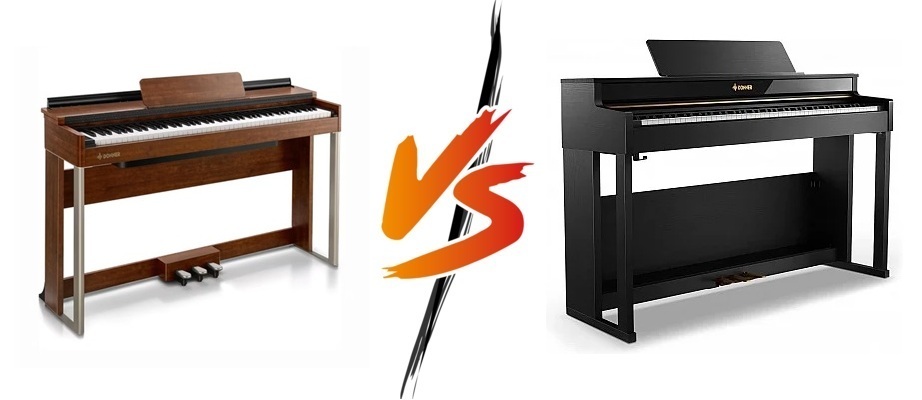
If you’ve been looking at affordable home digital pianos lately, there’s a good chance you’ve come across the Donner DDP series. The DDP-200 and DDP-400 sit in an interesting part of the market: they aim to give you the furniture-style digital piano experience without charging the kind of money brands like Yamaha, Roland, or Kawai usually ask for comparable models.
On paper, the two pianos look fairly similar. Both are full-size 88-key digital pianos designed primarily for home use. Both include weighted hammer-action keyboards, built-in speakers, triple pedals, and modern connectivity. Both are targeted at beginners and intermediate players who want something that feels more like a real piano than a portable keyboard.
But once you actually dig into them, the differences become much more meaningful than the spec sheet suggests.
The DDP-200 is the simpler, cleaner, more beginner-focused instrument. The DDP-400 aims higher. It tries to feel more premium, more expressive, and more performance-oriented. The price difference reflects that.
So the real question becomes this:
Is the DDP-400 genuinely better enough to justify spending more money, or is the DDP-200 the smarter buy for most people?
After comparing the two in detail, the answer depends heavily on what kind of player you are.
This review goes deep into every important category: design, keyboard feel, sound engine, speakers, realism, features, connectivity, daily usability, and long-term value. I’ll also point out where Donner cuts corners, because no instrument at this price point is perfect.
By the end, you should have a very clear idea of which piano fits your needs best.
Donner DDP-200 vs Donner DDP-400 Comparison Chart
If you click the links below, under the product images, you will be redirected to Amazon.com. In case you then decide to buy anything, Amazon.com will pay me a commission. This doesn’t affect the honesty of this review in any way though.
| Feature | Donner DDP-200 | Donner DDP-400 |
|---|---|---|
 |  | |
| Check the best price on Amazon | Check the best price on Amazon | |
| Piano Type | Furniture-style digital piano | Furniture-style digital piano |
| Keys | 88 keys | 88 keys |
| Keyboard Action | Weighted hammer-action keyboard | Weighted graded hammer-action keyboard |
| Touch Sensitivity | Yes | Yes |
| Key Feel | Good for beginners, slightly lighter feel | More refined and realistic feel |
| Polyphony | 128-note polyphony | 128-note polyphony |
| Sound Engine | Sample-based piano engine | Improved sample-based piano engine |
| Piano Tone Character | Bright and clean | Fuller and warmer |
| Built-In Sounds | Multiple instrument voices | More instrument voices and improved layering |
| Speakers | Dual speaker system | More powerful dual speaker system |
| Speaker Performance | Clear but somewhat limited bass | Fuller sound with stronger bass response |
| Headphone Support | Yes | Yes |
| Bluetooth | Limited/basic Bluetooth support | Improved Bluetooth functionality |
| USB MIDI | Yes | Yes |
| MIDI Compatibility | Compatible with DAWs and learning apps | More polished DAW and app integration |
| Recording Function | Basic recording | Improved recording functionality |
| Metronome | Yes | Yes |
| Dual Mode / Layering | Yes | Yes, more refined implementation |
| Pedals | Triple pedal unit included | Triple pedal unit included |
| Cabinet Design | Slim modern design | More premium and substantial design |
| Finish Quality | Good for entry-level | More refined overall finish |
| Weight & Stability | Lightweight and compact | Heavier and more stable |
| Best For | Beginners and casual players | Serious beginners and intermediate players |
| Acoustic Piano Realism | Moderate realism | More convincing realism |
| Room Projection | Smaller, narrower sound projection | Larger, more immersive projection |
| Ease of Use | Very beginner-friendly | Beginner-friendly with more flexibility |
| Long-Term Growth Potential | Limited for advanced progression | Better for long-term development |
| My individual reviews | Donner DDP-200 review | Donner DDP-400 review |
Design & Build Quality
When people shop for a digital piano, they often focus almost entirely on sound and keyboard action. That makes sense, because those are obviously the most important parts of the playing experience. But design and build quality matter more than many buyers initially realize, especially for instruments that are going to live permanently inside a home.
Unlike a portable keyboard that gets tucked away after use, furniture-style digital pianos become part of the room. You look at them every day. You sit at them for long practice sessions. They influence the atmosphere of your space. And over time, small details in construction quality start to matter a lot more than they do during the first ten minutes of ownership.
This is actually one of the reasons the Donner DDP series has become popular. Donner clearly understands that many buyers want something that feels more mature and intentional than a basic plastic keyboard on an X-stand. Both the DDP-200 and DDP-400 aim to create the experience of owning a “real” home piano while still staying affordable.
That said, the two models approach design differently, and the differences become more noticeable the longer you spend with them.
Donner DDP-200 Design Philosophy
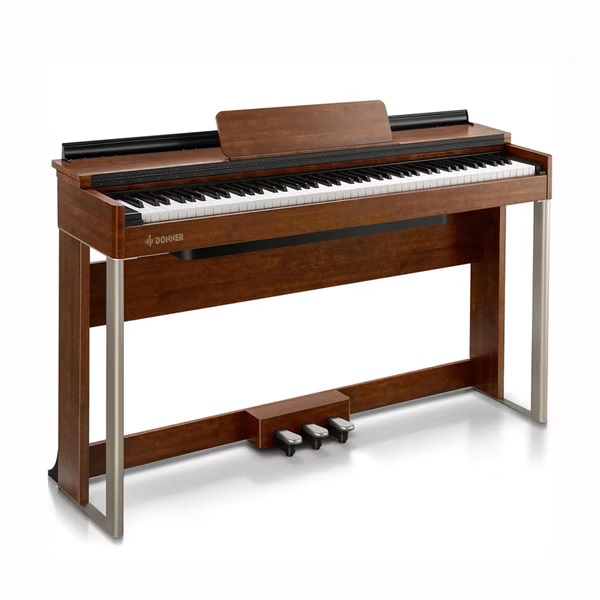
The DDP-200 leans heavily into minimalism. The overall look is modern, clean, and fairly compact. Instead of trying to imitate a traditional upright piano with bulky cabinetry and decorative details, it takes a more contemporary approach.
The cabinet is slim and visually lightweight, which works especially well in apartments, bedrooms, and smaller living rooms. It doesn’t dominate a space the way some furniture-style digital pianos can. If your home has a modern aesthetic with simple furniture and neutral colors, the DDP-200 blends in naturally.
One thing Donner deserves credit for is restraint. A lot of budget digital pianos try too hard to appear luxurious and end up looking cheap because of overly glossy finishes or fake decorative elements. The DDP-200 avoids that mistake. The design is understated and relatively tasteful.
From a distance, the piano actually looks more expensive than it is.
The matte-style finish helps here. It avoids fingerprints reasonably well and gives the cabinet a cleaner, less plasticky appearance. The front profile is also slim enough that the instrument doesn’t visually clutter the room.
For many buyers, especially adult beginners, this matters more than people think. If a piano looks attractive and inviting, you’re simply more likely to sit down and practice.
The control panel design is another area where the DDP-200 keeps things simple. The controls are fairly discreet and don’t overwhelm the instrument visually. Some cheaper digital pianos feel cluttered with buttons and labels everywhere. The DDP-200 manages to preserve a cleaner appearance.
Still, once you move beyond first impressions, the budget limitations begin to show.
The cabinet materials feel decent but not especially premium. The wood-texture finish looks acceptable, but close inspection reveals its artificial nature fairly quickly. Certain sections of the chassis and side panels feel somewhat hollow when touched.
The music rest is another reminder that this is ultimately an entry-level instrument. It works fine functionally, but it lacks sturdiness. Thicker music books can make it feel slightly unstable, and the overall construction doesn’t inspire huge confidence.
The pedal assembly is reasonably solid, though. Since the triple-pedal unit is integrated into the stand rather than being a loose external pedal, the experience feels much closer to using an actual piano. That’s a major advantage over cheaper portable keyboard setups.
In terms of stability during playing, the DDP-200 performs adequately for normal use. For beginner and casual intermediate playing, the frame stays stable enough. However, more aggressive playing can reveal some cabinet vibration and slight movement in the structure.
This is one of those details that sounds minor on paper but subtly affects realism. Acoustic pianos feel physically grounded. Lightweight digital pianos sometimes remind you they’re electronic instruments because of how the cabinet responds mechanically during energetic playing.
The DDP-200 doesn’t feel flimsy exactly, but it doesn’t fully escape that budget digital piano sensation either.
Assembly is fairly straightforward, which is important for home users. Most people should be able to put the instrument together in under an hour with basic tools. The instructions are simple enough, and the overall structure isn’t overly complicated.
As an overall package, the DDP-200 succeeds because it understands its audience well. It’s designed for buyers who want something visually attractive, compact, approachable, and affordable. It accomplishes that goal effectively, even if it doesn’t fully disguise its cost-cutting in certain areas.
Donner DDP-400 Design Philosophy
The DDP-400 takes a more ambitious approach.
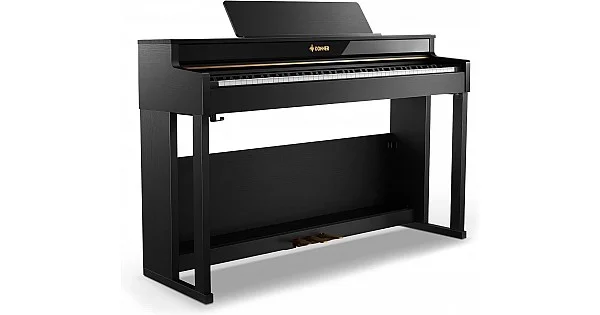
Where the DDP-200 feels intentionally minimalist, the DDP-400 feels designed to create a stronger impression of owning a serious home piano. The cabinet is larger, deeper, and noticeably more substantial overall.
Immediately, the instrument has more physical presence.
This doesn’t necessarily mean it’s gigantic or overly traditional-looking. Donner still keeps the design relatively modern. But compared side-by-side, the DDP-400 feels more mature and refined.
One of the biggest improvements is overall structural solidity. The cabinet feels sturdier during playing, and there’s less flex or vibration when playing dynamically. That increased stability genuinely improves the user experience because the instrument feels more anchored and piano-like.
The keybed integration also feels tighter and more cohesive. On cheaper digital pianos, the keyboard can sometimes feel visually and physically separated from the cabinet itself. The DDP-400 does a better job creating the impression of a unified instrument.
The finish quality is another step up.
Again, this is not premium hardwood craftsmanship. It’s important to keep expectations realistic at this price point. However, the textures, panel alignment, and overall fit-and-finish feel more polished than the DDP-200.
The control layout is cleaner as well. The interface feels more integrated into the piano rather than simply attached to it. This contributes to the more upscale appearance.
One subtle but important difference is the visual proportions of the instrument. The DDP-400 simply looks more balanced. The deeper cabinet and more refined lines help it resemble a higher-end digital piano rather than a budget model trying to imitate one.
The music rest also feels sturdier and more reliable. It handles larger books more confidently and contributes to the piano’s more premium feel overall.
Another improvement is the sense of durability during daily use. The DDP-400 gives stronger long-term ownership vibes. The buttons feel firmer, the chassis feels denser, and the overall construction inspires more confidence.
This matters because digital pianos are long-term purchases for many people. Even casual players may keep the same instrument for years. A piano that feels slightly more robust can make ownership more satisfying over time.
The pedal system is also stronger overall. Pedal resistance feels more convincing, and the integration with the cabinet feels tighter and more stable.
One area where the DDP-400 particularly succeeds is avoiding the “cheap beginner piano” look. Some affordable digital pianos immediately signal their price category visually. The DDP-400 does a surprisingly good job appearing more expensive than it is.
In a living room environment, it genuinely works as furniture rather than simply functioning as equipment.
That doesn’t mean it competes aesthetically with premium Yamaha Clavinovas or high-end Kawai cabinetry. Those instruments still feel noticeably more luxurious. But considering the price difference, Donner does a respectable job narrowing the gap visually.
Final Thoughts on Design & Build
Both the DDP-200 and DDP-400 succeed in delivering attractive home digital piano designs at accessible prices, but they cater to slightly different expectations.
The DDP-200 prioritizes simplicity, compactness, and modern minimalism. It’s visually appealing, beginner-friendly, and practical for smaller spaces. Its weaknesses mostly appear in material quality and structural refinement.
The DDP-400 feels more serious in almost every way. It has better physical presence, stronger cabinet stability, cleaner finishing, and a more premium overall impression. It feels less like an affordable compromise and more like a thoughtfully designed home instrument.
If aesthetics and compactness are your top priorities, the DDP-200 remains appealing.
But if you want the piano that feels more substantial, more durable, and more convincing as a long-term home instrument, the DDP-400 is clearly the stronger design overall.
Keyboard Action and Playing Feel
If there’s one category that ultimately determines whether a digital piano feels satisfying long term, it’s the keyboard action.
Sound quality matters, of course. Features matter too. But the physical interaction between your fingers and the keys is what defines the experience every single time you sit down to play. A digital piano can have beautiful samples and modern connectivity, but if the keyboard feels artificial or unresponsive, the instrument becomes harder to enjoy over time.
This is especially important for beginners.
A poor keyboard action can encourage bad habits, weaken finger control, and make the transition to an acoustic piano more difficult later on. On the other hand, a well-designed action can make practice more enjoyable and help develop proper technique naturally.
The difference between the Donner DDP-200 and DDP-400 becomes very noticeable in this area. Both use weighted hammer-action keyboards, and both are significantly better than unweighted entry-level keyboards. But once you spend real time with them, the DDP-400 clearly feels like the more refined instrument.
That doesn’t automatically make the DDP-200 bad. In fact, for many beginners, it will feel impressively realistic compared to cheaper alternatives. But the deeper you go into expressive playing and technical control, the wider the gap between the two pianos becomes.
Donner DDP-200 Keyboard Experience
The DDP-200 uses a fully weighted 88-key hammer-action keyboard designed to simulate the feel of an acoustic piano. Right away, that gives it a major advantage over basic keyboards with semi-weighted or synth-style actions.
For someone upgrading from a cheap portable keyboard, the difference feels dramatic.
The keys have real resistance. You need actual finger weight to press them. Dynamics respond to touch variation, meaning softer playing produces quieter notes and harder playing increases volume and intensity. This immediately makes the instrument feel more musical and expressive than non-weighted alternatives.
For beginners learning proper piano fundamentals, this is extremely important.
The keyboard also uses graded weighting, meaning lower keys feel slightly heavier while higher keys feel lighter. Acoustic pianos naturally behave this way because of the physical mechanics inside the instrument, so graded weighting helps digital pianos feel more authentic.
In practice, the DDP-200 does a reasonably good job here for its price category.
The action feels substantial enough to support beginner technique development, chord practice, scales, and basic repertoire. Casual players will likely find the experience enjoyable and realistic enough for daily practice.
However, after extended use, several limitations become noticeable.
The first issue is refinement.
The DDP-200 action feels slightly mechanical compared to more advanced digital pianos. There’s a certain springiness underneath the keys that occasionally reminds you you’re playing an electronic instrument rather than an acoustic one.
This becomes more noticeable during slower expressive pieces where subtle touch control matters.
Fast note repetition can also feel somewhat limited. On acoustic pianos, repeated notes rebound naturally because of the complex hammer mechanism. The DDP-200 occasionally struggles to recreate that fluidity, especially during technical passages or classical repetitions.
Another weakness is dynamic nuance.
The piano does respond to soft and hard playing, but the transition between dynamic layers sometimes feels compressed. In other words, there are fewer subtle gradations between very soft and very loud playing than you’d experience on a higher-end instrument.
For beginners, this may not matter much initially. But intermediate players often notice that expressive phrasing becomes harder to control precisely.
The key texture itself is acceptable but not particularly premium. The surface has enough grip to avoid feeling slippery, but it doesn’t fully replicate the slightly textured ivory-like feel found on more expensive digital pianos.
One thing worth mentioning is fatigue during longer sessions.
The DDP-200 action isn’t overly heavy, which can actually benefit younger beginners and casual players. It’s approachable and not intimidating. However, the lighter and slightly less refined feel can become somewhat tiring during extended practice because your fingers are constantly compensating for the action’s limitations.
The bottoming-out sensation is another area where the budget nature appears. When pressing keys aggressively, the impact at the bottom of the key travel feels harder and less cushioned than on more advanced actions.
Again, none of this makes the keyboard bad.
For the price, the DDP-200 performs perfectly respectably. In fact, compared to many ultra-budget digital pianos, it’s genuinely solid. The issue is simply that once you compare it directly with the DDP-400, the differences in realism and refinement become difficult to ignore.
Donner DDP-400 Keyboard Experience
The DDP-400 immediately feels more mature under the fingers.
Even within the first few minutes of playing, the action feels heavier, more controlled, and more convincing overall. The difference isn’t subtle enough that only professionals would notice it. Most players, including beginners, will probably sense that the DDP-400 feels more piano-like.
One of the biggest improvements is consistency across the keyboard.
The weighting transitions feel smoother and more balanced from bass to treble. Lower notes carry satisfying heft without becoming sluggish, while upper-register notes remain responsive and easier to articulate quickly.
The key movement itself also feels more fluid.
On the DDP-200, there are moments where the mechanism slightly reminds you of its internal spring and sensor system. The DDP-400 minimizes that sensation much more effectively. Key travel feels smoother and less abrupt during both downward presses and release movements.
This creates a more immersive playing experience because the instrument interferes less with your musical intentions.
That’s really the defining difference between beginner-level and better digital piano actions. A weaker action constantly reminds you you’re adapting to the instrument. A stronger action allows you to focus more fully on the music itself.
The DDP-400 gets significantly closer to that experience.
Dynamic response is another major improvement.
Soft playing feels easier to control, which matters enormously for expressive music. On cheaper actions, pianissimo passages can feel difficult because the sensors don’t always respond consistently at very low velocities. The DDP-400 handles subtle touch much better.
This becomes especially noticeable in classical and cinematic pieces where emotional phrasing relies heavily on dynamic control.
At the other end of the spectrum, louder playing also feels more satisfying. The keys maintain stability and resistance better during aggressive passages, helping the instrument feel less overwhelmed by energetic playing.
Fast repetitions and technical passages improve noticeably too.
The DDP-400 isn’t a high-end concert action, but it responds more naturally during scales, arpeggios, repeated chords, and faster repertoire. Intermediate players will appreciate this immediately.
Another strength is the key texture and overall tactile sensation.
The keys feel slightly more premium under the fingers, with a more convincing matte finish that improves grip during long sessions. It’s a subtle difference, but over time it contributes to a more enjoyable experience.
The bottoming-out feel is also softer and less harsh than the DDP-200. This matters because pianists spend thousands of hours physically interacting with the keyboard. Small improvements in mechanical comfort add up significantly over long-term use.
One area where the DDP-400 particularly succeeds is emotional responsiveness.
This may sound vague, but pianists usually understand it immediately when they feel it. The instrument reacts more naturally to musical intention. Crescendos feel smoother. Delicate phrasing feels easier to shape. Rhythmic playing feels more connected.
The piano becomes more expressive rather than simply functional.
That’s a major reason why intermediate players are likely to outgrow the DDP-200 much faster than the DDP-400.
Acoustic Realism and Long-Term Satisfaction
Neither piano fully replicates the complexity of a high-quality acoustic grand piano. That’s important to say clearly.
Premium digital pianos from Yamaha, Roland, and Kawai still offer more advanced actions with superior escapement simulation, key pivot lengths, repetition systems, and tactile realism.
However, within their respective price categories, both Donner models perform reasonably well.
The DDP-200 gives beginners an accessible and competent weighted-key experience that supports proper learning. It’s vastly superior to non-weighted keyboards for developing piano fundamentals.
The DDP-400, meanwhile, feels like a genuine step toward serious piano realism. The action is more nuanced, more stable, and more satisfying to grow into over time.
This distinction becomes increasingly important the longer you own the instrument.
A beginner might initially feel happy with either keyboard. But after six months or a year of regular practice, the quality of the action starts influencing motivation, enjoyment, and expressive growth much more heavily.
That’s where the DDP-400 justifies its higher price most convincingly.
Final Verdict on Keyboard Action
The DDP-200 offers a respectable weighted keyboard experience for beginners and casual players. It delivers enough realism to support proper practice and feels dramatically better than entry-level non-weighted keyboards.
But its limitations become noticeable once technique and musical sensitivity improve.
The DDP-400 is simply the more refined instrument. Its smoother action, better dynamic control, stronger repetition response, and more convincing tactile realism create a significantly more satisfying playing experience overall.
If you’re a casual beginner on a tight budget, the DDP-200 is absolutely usable and enjoyable.
But if keyboard feel is a major priority, or if you plan to play seriously for years, the DDP-400 is the piano that will keep rewarding you long after the beginner phase ends.
Sound Quality
Sound quality is one of the most difficult things to evaluate when buying a digital piano because it involves much more than whether the piano simply sounds “good” or “bad.”
Almost every modern digital piano can produce a pleasant piano tone at first listen. Even relatively inexpensive instruments have improved dramatically over the past decade. The real differences start appearing after longer playing sessions, especially when you begin paying attention to realism, dynamic response, tonal depth, sustain behavior, speaker interaction, and emotional expressiveness.
This is where the gap between entry-level and more refined digital pianos becomes noticeable.
The Donner DDP-200 and DDP-400 actually share some similarities in their overall tonal direction. Both aim for a modern, polished piano sound rather than an ultra-dark or heavily vintage character. Neither instrument sounds muddy or thin in the way many older budget digital pianos sometimes did.
However, once you spend real time with them side by side, the DDP-400 clearly offers a more mature and immersive sound experience.
The DDP-200 sounds competent and enjoyable for casual practice. The DDP-400 sounds more expressive, more layered, and more emotionally convincing overall.
Donner DDP-200 Sound Character
The first thing most players notice about the DDP-200 is clarity.
The piano tone is clean, bright, and immediately accessible. Notes cut through clearly without excessive muddiness, and the overall sound profile feels modern rather than overly mellow or vintage.
For beginners, this actually works quite well.
A brighter piano tone can make mistakes easier to hear, which is helpful during learning. Chords remain articulate, scales sound clean, and simple melodies project nicely through the built-in speakers.
The DDP-200 also avoids one of the biggest problems found in very cheap digital pianos: artificial harshness. Some low-end instruments have brittle high frequencies that become unpleasant quickly. The DDP-200 manages to stay reasonably balanced, especially at moderate volumes.
For casual home practice, the piano sound is absolutely usable and enjoyable.
That said, once you start listening more critically, the limitations become more apparent.
The biggest issue is depth.
The DDP-200’s piano tone sounds somewhat two-dimensional compared to more advanced digital pianos. The notes are clear, but they don’t always feel rich or organically layered. You hear the pitch and attack cleanly, but there’s less harmonic complexity underneath the sound.
Acoustic pianos are filled with subtle overtones, sympathetic resonance, and constantly evolving tonal textures. The DDP-200 captures the basic shape of a piano sound, but not as much of that deeper complexity.
This becomes especially noticeable during sustained chords.
On a more advanced instrument, chords continue evolving as notes interact with one another naturally. On the DDP-200, the sustain behavior feels simpler and more sample-based. Notes decay predictably, but not always organically.
Headphone use reveals this even more clearly.
Through headphones, you can hear the looping and repetition in the sample layers more easily. Long sustained notes occasionally expose the limitations of the sound engine because the tonal evolution feels somewhat static.
Another area where the DDP-200 struggles slightly is dynamic realism.
The piano does respond to soft and hard playing, but the tonal transitions between velocity layers aren’t always smooth. Sometimes the instrument shifts a little too abruptly from mellow to bright tones depending on how aggressively you strike the keys.
For beginner players, this probably won’t matter much initially. But intermediate players often become sensitive to this because expressive piano playing depends heavily on subtle tonal gradations.
The low end is another mixed area.
Bass notes sound acceptable, but they don’t carry the deep resonance or physical warmth of more advanced instruments. Lower octaves occasionally feel slightly thin, especially through the built-in speakers.
Still, considering the price category, the DDP-200 performs better than many people would expect.
It doesn’t sound toy-like. It doesn’t sound embarrassingly synthetic. For casual practice, lessons, and recreational playing, it provides a perfectly respectable piano experience.
The additional instrument voices are more of a bonus feature than a major selling point. Electric pianos, strings, organs, and layered sounds exist mainly to add versatility. Some are decent enough for casual experimentation, but none are exceptional.
Most owners will probably spend the vast majority of their time using the primary acoustic piano voice.
Donner DDP-400 Sound Character
The DDP-400 immediately sounds fuller and more developed.
Compared side by side with the DDP-200, the first thing you notice is increased warmth and dimensionality. The sound feels less flat and more immersive overall.
This doesn’t necessarily mean the DDP-400 is dramatically darker in tone. It still retains clarity and brightness when needed. But the piano has more body underneath the notes, particularly in the midrange and lower frequencies.
That added depth changes the emotional experience of playing quite a bit.
Chords feel richer. Melodies feel more expressive. The instrument responds with greater tonal complexity when you vary your touch.
This is one of the biggest strengths of the DDP-400: dynamic responsiveness.
Soft playing produces gentler, rounder textures that feel more natural and controlled. As you increase intensity, the piano opens up gradually instead of jumping abruptly between tonal layers.
That smoother dynamic transition helps the instrument feel more alive.
On expressive pieces, especially classical or cinematic music, the difference becomes very noticeable. The DDP-400 allows for more nuanced phrasing and emotional shaping than the DDP-200.
The sustain behavior is also significantly improved.
When holding chords or using the damper pedal, notes blend together more naturally. There’s a stronger sense of resonance and interaction between tones, which contributes heavily to realism.
Again, it’s important to stay realistic here. The DDP-400 is not competing directly with premium modeling-based digital pianos costing several times more. But within its category, the sustain and resonance simulation are genuinely respectable.
The bass response also feels more convincing.
Lower octaves carry greater weight and warmth, which helps the entire piano feel more substantial. This matters particularly for classical repertoire, left-hand accompaniment patterns, and cinematic music where low-end presence creates emotional impact.
The midrange deserves praise too.
Many budget digital pianos struggle with midrange congestion or boxiness, especially through built-in speakers. The DDP-400 manages to sound smoother and more open overall.
One thing I particularly appreciate is reduced listening fatigue.
The DDP-200’s brighter sound profile can become slightly tiring during long sessions because the tonal complexity is relatively limited. The DDP-400 sounds more balanced and easier to listen to for extended periods.
This matters a lot for daily practice.
A piano that sounds pleasant for ten minutes isn’t necessarily satisfying for two-hour practice sessions. The DDP-400 handles long-term listening much better.
Headphone performance is another clear improvement.
Many digital pianos sound impressive through speakers but reveal weaknesses immediately through headphones. The DDP-400 holds up surprisingly well in private listening situations.
The stereo image feels wider, tonal transitions feel smoother, and the overall experience becomes more immersive.
For apartment players or night practice, this is a major advantage.
Realism Compared to Acoustic Pianos
Neither the DDP-200 nor DDP-400 fully recreates the complexity of a high-end acoustic piano.
That’s simply the reality of this price range.
Acoustic pianos produce incredibly complicated interactions between strings, wood resonance, hammer mechanics, and room acoustics. Even expensive digital pianos struggle to replicate every nuance perfectly.
However, realism exists on a spectrum.
The DDP-200 gives you a recognizable and enjoyable piano sound suitable for learning and casual playing. It captures the core identity of an acoustic piano reasonably well, even if subtle details are simplified.
The DDP-400 moves noticeably closer to authentic piano behavior.
The improved dynamic response, richer sustain, stronger bass presence, and more layered tonal structure create a more emotionally convincing experience overall.
For intermediate players, this matters enormously because musical expression becomes more dependent on subtle tonal control over time.
Speaker Interaction and Sound Projection
Part of what makes the DDP-400 sound better isn’t only the sound engine itself. The speaker system also contributes significantly.
The DDP-200’s speakers reproduce the piano competently, but the sound projection feels relatively narrow. The piano sounds like it’s coming from the instrument.
The DDP-400 creates more room-filling presence. The sound spreads more naturally through the space, which enhances immersion considerably.
This makes the piano feel physically larger and more piano-like overall.
The improved bass response also contributes to realism because acoustic pianos generate substantial low-frequency energy in real rooms.
Final Verdict on Sound Quality
The Donner DDP-200 delivers a respectable and enjoyable piano sound for beginners and casual players. It’s clean, clear, modern-sounding, and perfectly capable for home practice.
However, its tonal depth, sustain realism, and dynamic nuance remain somewhat limited.
The DDP-400 sounds significantly more mature.
Its richer tonal complexity, smoother dynamic response, stronger resonance, fuller bass, and more immersive projection create a far more satisfying musical experience overall.
For beginners, either piano may sound impressive initially.
But over time, especially as musical sensitivity develops, the DDP-400’s superior sound quality becomes increasingly valuable. It’s the kind of piano that encourages longer practice sessions because the instrument itself feels more expressive and emotionally rewarding to play.
Speaker System
The speaker system is one of the most underrated parts of a digital piano.
A lot of buyers focus heavily on keyboard action and sound samples while barely thinking about the actual speakers inside the instrument. On paper, that makes sense. After all, if the piano has a good sound engine, shouldn’t it automatically sound good?
Not necessarily.
The speaker system is what brings the sound engine into the physical world. It determines how the instrument fills a room, how immersive the piano feels while playing, how convincing the bass response is, and whether dynamics feel emotionally impactful or flat.
You can have excellent piano samples ruined by weak speakers.
And unfortunately, this is an area where many budget digital pianos cut corners.
Small speakers, weak amplifiers, poor cabinet acoustics, and limited bass response are extremely common in entry-level instruments. Some digital pianos sound decent through headphones but thin and lifeless through their built-in speakers.
This is one of the reasons acoustic pianos feel so satisfying physically. You don’t just hear the sound. You feel it moving through the room and resonating through the instrument itself.
Obviously, no affordable digital piano fully replicates that experience. But some get closer than others.
Between the Donner DDP-200 and DDP-400, the DDP-400 clearly delivers the stronger and more immersive speaker performance. The difference is noticeable not only in volume but also in fullness, room projection, and overall realism.
The DDP-200’s speakers are functional and perfectly usable for practice. The DDP-400’s speakers contribute much more actively to the musical experience.
Donner DDP-200 Speaker Performance
The DDP-200’s speaker system is best described as competent but limited.
At moderate volume levels, the piano sounds clear and reasonably balanced. For beginner practice, lessons, and casual playing in smaller rooms, the speakers perform well enough to create an enjoyable experience.
The midrange frequencies are actually fairly clean. Melodies come through clearly, chords remain articulate, and basic dynamics are reproduced adequately.
This is important because some very cheap digital pianos sound muddy or boxy even at normal listening levels. The DDP-200 avoids the worst of those problems.
For everyday home use, especially in apartments or bedrooms, the speaker system is entirely functional.
The problems begin appearing when you start asking the system to sound bigger, richer, or more realistic.
The first noticeable limitation is bass response.
Lower octaves lack physical depth and resonance. You hear the notes clearly enough, but you don’t really feel them. Acoustic pianos naturally produce significant low-frequency energy that gives the instrument warmth and presence. The DDP-200 struggles to recreate that sensation convincingly.
This becomes especially obvious during left-hand-heavy music, cinematic pieces, or classical repertoire with strong bass accompaniment.
Instead of sounding deep and resonant, the lower range can feel somewhat lightweight.
Volume handling is another area where the DDP-200 reveals its budget nature.
At moderate levels, the piano sounds pleasant enough. But once you increase the volume significantly, the speakers begin sounding strained. High frequencies become sharper, the sound loses warmth, and the overall presentation becomes flatter.
The instrument doesn’t distort horribly, but it stops feeling immersive.
This matters more than people think because piano music relies heavily on dynamic range. Loud passages should feel expansive and emotionally powerful. On the DDP-200, louder playing sometimes just feels louder rather than bigger.
The sound projection also feels relatively narrow.
The piano sounds like it’s coming directly from the instrument itself rather than filling the room naturally. Acoustic pianos disperse sound broadly through wood resonance and string vibration. Budget digital pianos often sound more directional and contained.
The DDP-200 falls into that category.
In smaller rooms, this may not be a major issue. But in larger spaces, the sound can feel somewhat thin and localized.
Cabinet resonance is another subtle limitation.
Furniture-style digital pianos often use their cabinet design to enhance speaker projection and warmth. The DDP-200’s lighter construction doesn’t contribute much acoustic reinforcement, so the overall sound remains somewhat dry compared to more substantial instruments.
One thing worth mentioning is that the DDP-200 sounds noticeably better through headphones than through its built-in speakers.
This is common among budget digital pianos.
The internal sound engine itself is actually fairly decent for the price, but the speakers simply can’t reproduce its full potential. Through quality headphones, the piano gains clarity and depth that the onboard system partially masks.
For players who practice mostly with headphones, this reduces the importance of the speaker limitations considerably.
Still, if you enjoy the feeling of hearing the piano naturally in the room, the DDP-200’s speaker system eventually starts feeling somewhat restrictive.
Donner DDP-400 Speaker Performance
The DDP-400 immediately sounds larger, fuller, and more immersive.
This isn’t just about volume. Plenty of digital pianos can get loud. The important difference is how the sound occupies physical space and how naturally the instrument projects its tone into the room.
Compared directly with the DDP-200, the DDP-400 creates a much more convincing sense of presence.
The bass response is the first thing most people notice.
Lower octaves carry significantly more body and warmth. Chords feel grounded instead of lightweight, and left-hand passages gain emotional weight that the DDP-200 sometimes lacks.
This changes the playing experience dramatically.
Piano music relies heavily on resonance and tonal depth. When the lower register feels physically substantial, the instrument becomes more emotionally satisfying to play.
The DDP-400 handles this far better than its smaller sibling.
The overall tonal balance is also more refined.
Where the DDP-200 can become slightly harsh at higher volumes, the DDP-400 remains smoother and more controlled. High frequencies retain clarity without becoming brittle, and the midrange feels more open and natural.
This contributes heavily to long-term listening comfort.
A piano that sounds exciting for five minutes can become fatiguing after an hour if the speakers exaggerate certain frequencies or lack tonal depth. The DDP-400 performs much better during extended practice sessions.
Dynamic projection is another major improvement.
Soft playing feels intimate and delicate, while louder passages expand naturally into the room. The speaker system supports the instrument’s dynamic range more convincingly, making crescendos and expressive phrasing feel emotionally impactful.
This is one of the areas where digital pianos either feel alive or mechanical.
The DDP-400 gets significantly closer to feeling alive.
Room-filling capability is noticeably stronger too.
The sound disperses more broadly instead of feeling trapped inside the cabinet. Even though it’s still clearly a digital piano, the instrument creates a more immersive listening environment overall.
This matters especially in living rooms or larger practice spaces where the DDP-200 can sometimes feel sonically small.
Another important difference is how the speaker system interacts with the cabinet itself.
The DDP-400’s more substantial construction helps reinforce the sound physically. The cabinet contributes subtle resonance and projection that make the instrument feel more cohesive.
This doesn’t fully recreate acoustic piano resonance, but it narrows the gap noticeably.
The stereo image also feels wider and more spacious.
This becomes particularly noticeable when using layered sounds, sustain-heavy passages, or ambient pieces. The piano creates a stronger sense of dimensionality instead of sounding flat and centralized.
At higher volumes, the DDP-400 maintains composure much better too.
The speakers don’t sound as strained, and the piano retains warmth and clarity even during energetic playing. This gives the instrument more headroom for expressive music.
For home players, this means the piano feels more satisfying both quietly and loudly.
Headphones vs Built-In Speakers
Both pianos benefit from headphone use, but the DDP-400 maintains its advantage there as well.
The DDP-200 improves substantially through headphones because the limitations of the onboard speakers disappear. You hear greater detail, cleaner sustain, and more tonal nuance.
However, the DDP-400 still sounds more immersive overall thanks to its stronger sound engine and broader tonal depth.
One interesting difference is emotional immersion.
With the DDP-200, headphones often feel almost necessary to hear the instrument at its best. With the DDP-400, the built-in speakers already create a satisfying enough experience that headphones become optional rather than essential.
That’s a meaningful distinction for players who enjoy practicing openly in a room instead of isolating themselves with headphones constantly.
Realism and Physical Presence
Speaker systems affect more than just audio quality. They influence how physically believable a digital piano feels.
Acoustic pianos create vibration, air movement, and spatial projection naturally. Digital pianos attempt to simulate this through speaker placement, cabinet design, and amplification.
The DDP-200 captures the basic functionality of piano playback.
The DDP-400 moves closer toward recreating the physical experience of hearing a real instrument in a room.
That added physicality makes the piano feel more emotionally engaging over time.
Final Verdict on Speaker System
The Donner DDP-200’s speakers are perfectly usable for beginner practice and casual home playing. They reproduce the piano clearly enough and perform reasonably well at moderate volumes.
But the system lacks depth, projection, and low-end richness.
The DDP-400 offers a substantially more immersive speaker experience.
Its stronger bass response, wider sound projection, smoother tonal balance, and greater dynamic capability help the instrument feel far more realistic and emotionally satisfying overall.
For players who primarily use headphones, the difference may matter less.
But for anyone who values room-filling sound and a more authentic home piano experience, the DDP-400 clearly delivers the stronger performance.
Features and Functions
When people think about digital pianos, they often divide them into two broad categories.
There are instruments that try to recreate the traditional piano experience as purely as possible, and there are instruments that lean more heavily into digital functionality with extra sounds, recording tools, learning features, connectivity options, and performance settings.
The Donner DDP-200 and DDP-400 sit somewhere in the middle.
Neither piano is overloaded with advanced workstation-style controls or endless menus. These are still primarily home digital pianos focused on piano playing first. But both models include enough modern functionality to make them more flexible than a simple acoustic piano replacement.
The important difference is how those features are implemented.
The DDP-200 keeps things fairly minimal and beginner-oriented. The DDP-400 expands the functionality in ways that make the instrument feel more capable long term, especially for intermediate players or people interested in music production, layering sounds, and broader creative use.
What I appreciate about both pianos is that Donner generally avoids overcomplicating the interface. Some affordable digital pianos try to impress buyers with giant feature lists, but the actual user experience becomes frustrating because basic functions are buried behind confusing button combinations and poorly designed controls.
The DDP series mostly avoids that problem.
Still, there are meaningful differences between the two models once you start exploring what they can actually do.
Donner DDP-200 Features
The DDP-200 is clearly designed with simplicity in mind.
At its core, it aims to provide the essential digital piano experience without overwhelming new players with excessive technical complexity. In many ways, that’s actually a smart design decision because beginners often care more about ease of use than having hundreds of editable parameters.
Out of the box, the DDP-200 covers the fundamental functions most casual players need.
You get multiple instrument voices, including acoustic pianos, electric pianos, strings, organs, and a few additional sounds. These aren’t studio-grade professional voices, but they’re perfectly fine for experimentation and casual playing.
Most people will spend the majority of their time using the primary piano voice anyway, but having extra sounds adds variety and keeps practice sessions more engaging, especially for younger players.
The electric piano sounds are decent enough for pop and jazz practice, while the string layers can create a fuller cinematic sound when combined with the piano.
The DDP-200 also includes standard dual-mode functionality, allowing players to layer two sounds together simultaneously. This is a common feature on digital pianos and can be surprisingly enjoyable for ambient playing or film-style music.
For example, layering piano and strings creates a much larger, more atmospheric sound that some players will really enjoy.
Split functionality is more limited compared to higher-end instruments, but that’s not unusual in this category.
The built-in metronome is another important inclusion.
This sounds basic, but a good metronome is essential for proper piano practice. The DDP-200 allows players to practice rhythm and timing without needing external devices or apps. For beginners especially, having the metronome integrated directly into the instrument is convenient and practical.
The recording functionality is fairly simple but useful.
Players can record performances for playback and self-evaluation, which is actually one of the most effective ways to improve timing and musical consistency. Hearing yourself objectively often reveals mistakes you don’t notice while actively playing.
That said, the recording system remains fairly basic overall. This is not a sophisticated multi-track recording environment designed for serious production work.
The user interface itself is intentionally straightforward.
Controls are relatively easy to learn, and the piano doesn’t require much menu navigation for everyday use. This helps reduce frustration for beginners who may not be technologically inclined.
One thing worth mentioning is that the DDP-200 avoids feature overload.
That may sound like criticism, but honestly, there’s something refreshing about a digital piano that doesn’t constantly distract you with endless options. Some players simply want to sit down and practice piano without navigating layers of settings.
The downside is that advanced users may eventually feel constrained.
Customization options are relatively limited. Sound editing is minimal. There’s less control over nuanced parameters like touch curves, resonance behavior, EQ shaping, or detailed layering adjustments.
The DDP-200 is designed primarily to function well immediately rather than offering deep personalization.
For many beginners, that’s perfectly fine.
Donner DDP-400 Features
The DDP-400 builds on the DDP-200’s foundation while making the instrument feel much more versatile and future-proof overall.
One of the first things you notice is that the piano simply feels more capable.
There are more sounds, more flexibility in layering and customization, and stronger integration with modern workflows. The instrument still prioritizes simplicity compared to professional stage pianos, but it clearly targets players who may grow into more advanced needs over time.
The additional sound library is one improvement.
Again, this is still fundamentally a piano-focused instrument, so don’t expect massive synthesizer-style sound collections. But the included voices generally feel a bit more polished and expressive compared to the DDP-200.
Layering capabilities also feel more refined.
The DDP-400 handles dual voices more smoothly, and the sound combinations feel more balanced overall. Layered piano-and-string setups sound fuller and more immersive, partly because the underlying sound engine and speakers are stronger.
This gives the instrument greater versatility for cinematic music, worship playing, contemporary arrangements, and casual composition.
The recording features are another noticeable improvement.
The DDP-400 feels more useful as a practice and creative tool because recording functionality integrates more naturally into the user experience. Players interested in evaluating performances regularly or sketching musical ideas will appreciate the smoother workflow.
One of the most important upgrades is responsiveness.
The DDP-400 simply feels more polished operationally. Menu navigation feels smoother, controls feel more refined, and overall interaction with the instrument feels less budget-oriented.
That might sound minor, but it influences daily usability significantly.
A digital piano should ideally disappear into the background while you focus on music. Clunky controls and awkward menus constantly remind you you’re operating electronics rather than simply playing an instrument.
The DDP-400 minimizes that feeling much better.
Another area where the DDP-400 pulls ahead is modern integration.
Bluetooth functionality improves convenience considerably, especially for players using mobile learning apps, backing tracks, or casual wireless audio streaming. This makes the piano feel much more current and adaptable to modern practice habits.
Today, many pianists regularly combine traditional practice with educational apps, online lessons, YouTube tutorials, and DAW integration. The DDP-400 accommodates that lifestyle more naturally.
The MIDI implementation also feels stronger overall.
For players interested in connecting the piano to recording software or virtual instruments, the DDP-400 integrates more smoothly into music production setups. Latency performance feels stable, and the instrument behaves more confidently as a controller keyboard.
This becomes increasingly valuable as players advance.
A beginner may only care about basic practice initially, but over time many musicians become curious about recording, composing, arranging, or using software instruments. The DDP-400 supports those transitions better.
Another important difference is long-term usability.
The DDP-200 feels optimized for immediate beginner accessibility. The DDP-400 feels designed to remain satisfying as the player grows.
That distinction matters.
Some entry-level digital pianos feel limiting surprisingly quickly because the feature set is so stripped down. The DDP-400 gives players more room to evolve without immediately feeling the need to upgrade.
Simplicity vs Flexibility
This comparison ultimately comes down to what kind of player you are.
The DDP-200 succeeds because it focuses on essentials. It gives beginners the core tools they actually need without creating unnecessary complexity. For casual players, this simplicity can honestly be a strength rather than a weakness.
The DDP-400 offers broader functionality while still remaining approachable.
Importantly, it doesn’t become intimidating. Donner avoids turning the instrument into a confusing technology showcase. The added features generally enhance usability rather than distracting from piano playing.
That balance is important because many digital pianos either become too limited or too complicated.
The DDP-400 lands closer to the middle ground successfully.
Features That Matter Most Long Term
One thing worth mentioning is that not all digital piano features matter equally over time.
Many buyers initially get excited about huge voice counts and novelty sounds but rarely use them after the first few weeks. The features that actually remain valuable long term are usually the practical ones:
- Reliable recording
- Good connectivity
- Easy sound layering
- Smooth interface design
- Learning integration
- Stable MIDI functionality
- Convenient headphone use
- Flexible practice options
This is where the DDP-400 justifies its higher positioning most effectively.
Its features don’t simply exist to inflate the specification sheet. Most of the improvements contribute meaningfully to real-world usability and long-term ownership satisfaction.
Final Verdict on Features and Functions
The Donner DDP-200 offers a clean, beginner-friendly feature set that covers all the essentials without overwhelming the user. It’s approachable, practical, and easy to live with daily.
For many casual players, that simplicity will actually feel ideal.
The DDP-400 expands the functionality in ways that make the instrument feel more versatile, more modern, and more future-proof overall. Better layering, stronger recording tools, smoother operation, Bluetooth integration, and improved workflow all contribute to a more polished experience.
If your goal is straightforward home piano practice with minimal complexity, the DDP-200 delivers perfectly adequate functionality.
But if you want a digital piano that can grow alongside your musical interests and remain flexible long term, the DDP-400 is clearly the more capable instrument.
Connectivity
Connectivity has become one of the most important parts of modern digital pianos, even for players who initially think they won’t care about it.
Ten or fifteen years ago, many people bought digital pianos simply as standalone practice instruments. You turned them on, played music, maybe plugged in headphones, and that was the entire experience.
Today, digital pianos exist inside a much larger ecosystem.
Players use learning apps, virtual instruments, recording software, online lessons, Bluetooth audio, MIDI sequencing, DAWs, educational platforms, and streaming devices. Even complete beginners often end up connecting their piano to a tablet or computer sooner than they expected.
Because of this, connectivity is no longer just a bonus feature. It directly affects how flexible and future-proof a digital piano feels over time.
The Donner DDP-200 and DDP-400 both include the essential modern connections most home players need, but the DDP-400 handles connectivity with noticeably more confidence and polish overall.
The DDP-200 covers the basics competently. The DDP-400 feels better prepared for modern music workflows and evolving practice habits.
For some buyers, the difference won’t matter much.
For others, especially players interested in long-term growth, recording, or app integration, the gap becomes surprisingly important.
Why Connectivity Matters More Than People Expect
A lot of beginners assume they only need a piano for traditional practice. That’s understandable. But digital pianos tend to become more integrated into daily technology use over time.
For example, many new players quickly discover piano-learning apps that provide interactive lessons and real-time feedback. Others start watching online tutorials and want to play along with backing tracks or instructional videos.
Some players become interested in recording themselves.
Others eventually explore virtual piano software, which can dramatically improve sound quality by using advanced piano libraries on a computer.
Even casual users often appreciate simple conveniences like Bluetooth audio streaming or easy headphone integration.
This is why weak connectivity can make a digital piano feel outdated surprisingly quickly.
A piano may sound and play reasonably well, but if it struggles to integrate smoothly with modern devices, the overall ownership experience becomes more limiting over time.
Donner DDP-200 Connectivity
The DDP-200 provides the essential connectivity features most beginner and casual players need.
At its core, the piano supports USB MIDI functionality, which is arguably the most important digital piano connection today.
USB MIDI allows the piano to communicate with computers, tablets, smartphones, and music software. This means the DDP-200 can function as both a digital piano and a MIDI controller.
For beginners, this opens the door to educational apps and interactive learning platforms.
Apps that display sheet music, track timing accuracy, or teach note recognition often rely on MIDI communication to function properly. The DDP-200 handles these basic educational tasks reasonably well.
For more advanced users, USB MIDI also allows connection to DAWs like Ableton Live, Logic Pro, or FL Studio.
This means you can use the piano to trigger virtual instruments, record MIDI performances, compose music, or control software-based piano libraries.
Latency performance is generally acceptable for home use.
That’s important because poor MIDI latency creates a disconnected feeling between pressing a key and hearing sound from external software. The DDP-200 performs well enough for normal practice and casual production work.
The piano also includes standard headphone connectivity, which is essential for apartment practice and late-night sessions.
This may seem basic, but headphone implementation matters enormously in real-world use. Fortunately, the DDP-200 handles headphone practice reasonably well.
Using headphones actually improves the listening experience significantly because it bypasses some of the limitations of the built-in speaker system.
The piano also supports sustain pedal integration through its built-in triple pedal system, which helps maintain a more authentic piano experience.
Audio connectivity remains fairly straightforward overall.
The DDP-200 focuses on practical essentials rather than offering extensive professional routing options. For most beginners, this is perfectly fine. The average home player probably doesn’t need advanced audio outputs or complex studio integration.
However, the limitations become more noticeable as user expectations grow.
One issue is that the overall connectivity experience feels somewhat basic and utilitarian rather than seamless.
The piano technically supports modern workflows, but it doesn’t always feel deeply integrated into them. In some situations, the DDP-200 feels more like a traditional digital piano that happens to include MIDI rather than a fully connected modern music device.
Bluetooth functionality is one area where this becomes noticeable.
Depending on the version and configuration, wireless integration feels more limited compared to newer competitors. This reduces convenience for players who want cable-free practice setups with tablets or smartphones.
The interface surrounding connectivity also feels somewhat minimal.
There’s less polish overall in how the piano communicates settings, pairing behavior, or integration status. Again, none of this makes the instrument unusable. It simply feels more entry-level in execution.
For strictly traditional piano practice, these limitations may barely matter.
But for players who increasingly rely on apps, software, or digital workflows, the DDP-200 can start feeling slightly dated faster than the DDP-400.
Donner DDP-400 Connectivity
The DDP-400 approaches connectivity in a more modern and confident way.
Right away, the instrument feels more naturally integrated into contemporary music environments. The difference isn’t only about having more features. It’s about how smoothly those features function in daily use.
USB MIDI functionality remains central here as well, but the implementation feels more polished overall.
Connection stability feels stronger, responsiveness feels more immediate, and the piano behaves more confidently when integrated into DAWs or educational software.
This matters because reliability is extremely important for digital workflows.
There’s nothing more frustrating than unstable MIDI behavior, dropped connections, or inconsistent communication with software. The DDP-400 minimizes those frustrations much better.
One of the biggest upgrades is Bluetooth integration.
For many modern players, Bluetooth support dramatically improves convenience. Wireless communication with tablets, phones, and learning apps creates a cleaner and more flexible setup overall.
You can stream backing tracks, connect educational apps, or integrate mobile devices without constantly dealing with cables.
This may sound minor initially, but once you get used to wireless convenience, it becomes surprisingly difficult to give up.
The DDP-400 feels much more current because of this.
Another major advantage is compatibility with virtual instruments and software piano libraries.
Many digital pianists eventually discover that software pianos can provide extraordinarily realistic sound quality. Libraries like those used in professional music production often surpass built-in digital piano sounds by a huge margin.
The DDP-400 functions more naturally in that environment.
Its MIDI response feels more refined, and the overall experience of using the piano as a controller keyboard feels smoother and more satisfying.
This makes the instrument more future-proof.
A beginner may initially use only the internal sounds. But over time, they may become interested in software instruments, composition, arranging, or recording. The DDP-400 adapts to those evolving interests more comfortably.
The headphone experience also feels slightly more refined overall.
This is partly because the DDP-400’s internal sound engine is stronger, but the connectivity implementation itself also feels cleaner and more polished. Headphone practice becomes more immersive and enjoyable.
Another important difference is workflow integration.
The DDP-400 simply behaves more naturally as part of a larger digital music setup. Whether you’re practicing with apps, recording MIDI, using virtual pianos, or streaming audio, the instrument feels designed with modern usage patterns in mind.
This contributes heavily to long-term satisfaction.
Digital pianos increasingly function as hybrid instruments sitting between traditional piano practice and digital creativity. The DDP-400 embraces that role more successfully than the DDP-200.
Connectivity for Different Types of Players
Not every player needs advanced connectivity features.
For someone focused entirely on traditional piano practice, basic headphone support and occasional MIDI use may be more than enough.
In that situation, the DDP-200 covers the essentials competently.
But modern piano learning increasingly overlaps with technology.
Students use apps. Teachers assign digital exercises. Musicians record ideas into laptops. Hobbyists experiment with virtual instruments. Casual players stream backing tracks from phones and tablets.
This is where the DDP-400 starts making much more sense.
Its connectivity doesn’t just exist on a spec sheet. It actively improves convenience, flexibility, and creative possibilities during real-world ownership.
Longevity and Future-Proofing
One of the most overlooked aspects of connectivity is long-term relevance.
A digital piano may feel perfectly adequate today, but technology habits evolve quickly. Features that seem optional initially often become standard expectations later.
Bluetooth integration is a perfect example.
Ten years ago, it was considered premium convenience. Today, many users expect wireless functionality automatically.
The DDP-400 feels better positioned for that evolving environment.
Its broader and more polished connectivity options help ensure the instrument remains adaptable as musical habits change over time.
Final Verdict on Connectivity
The Donner DDP-200 offers all the essential connectivity most beginners and casual players need. USB MIDI support, headphone connectivity, and basic digital integration are all present and functional.
For straightforward piano practice and occasional software use, it performs perfectly adequately.
The DDP-400, however, feels significantly more modern and flexible overall.
Its stronger Bluetooth integration, smoother MIDI implementation, better software compatibility, and more polished workflow create a much more connected and future-proof experience.
If your needs are simple and traditional, the DDP-200 handles the basics well.
But if you want a digital piano that integrates naturally into modern music technology and remains adaptable long term, the DDP-400 is clearly the stronger choice.
Conclusion
The Donner DDP-200 and Donner DDP-400 are both strong examples of how far affordable digital pianos have come in recent years. Neither instrument feels like a cheap toy, and both succeed in delivering a genuinely enjoyable home piano experience at prices that are far more accessible than many premium competitors.
That said, these two pianos are not equally matched.
The DDP-200 is clearly aimed at beginners, casual players, and budget-conscious buyers who want the essential digital piano experience without spending heavily. It offers a clean modern design, a respectable weighted keyboard, decent piano sounds, and enough features to support learning and daily practice comfortably. For someone starting their piano journey, it absolutely gets the job done.
The DDP-400, however, feels like the more complete and refined instrument in almost every category that matters long term.
The keyboard action is smoother and more expressive. The sound engine feels fuller and more dynamic. The speaker system creates a more immersive experience. The cabinet feels sturdier and more premium. Connectivity and features also feel more modern and future-proof.
Most importantly, the DDP-400 is simply more satisfying to play over extended periods of time.
That distinction becomes increasingly important as your skills improve. A beginner may initially feel happy with either piano, but intermediate players will likely outgrow the DDP-200 much faster. The DDP-400 provides more room for musical growth and remains enjoyable longer before upgrade temptation sets in.
Ultimately, the better choice depends on your goals and budget.
If you want a stylish, affordable digital piano for casual home learning, the DDP-200 offers very good value for money.
But if you can comfortably stretch your budget and you’re serious about practicing regularly, developing technique, or keeping the instrument for many years, the DDP-400 is the piano that makes more sense overall.
It’s not just better on paper. It’s the more rewarding instrument to actually live with daily.