
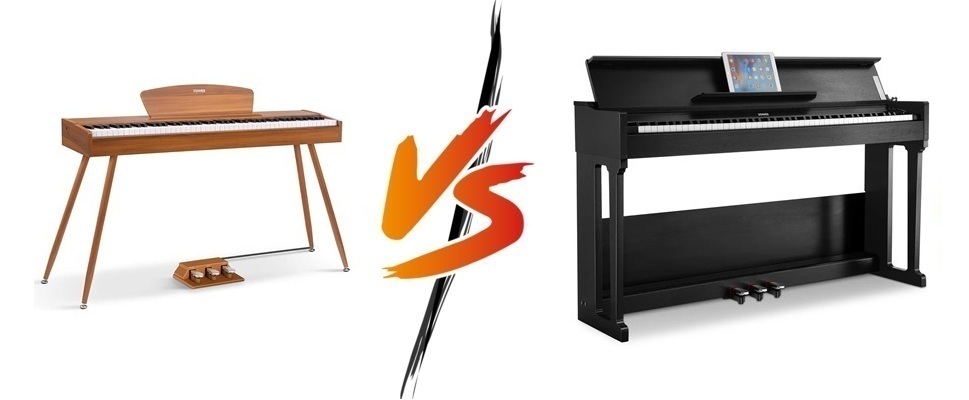
If you’re in the market for an affordable digital piano that doesn’t feel cheap, the Donner DDP-80 and DDP-90 are two models you’ve probably seen. They’re both full-sized, full-featured, and aimed at players who want a realistic piano feel without breaking the bank. But beyond the similar specs on paper, there are some meaningful differences that can affect real-world playability, tone, and long-term satisfaction. In this review, we’ll dig into every aspect of both models — from design and feel to sound engines, speakers, functions, connectivity, and overall value — so you can decide which one is the better fit for you.
Donner DDP-80 vs Donner DDP-90 Comparison Chart
If you click the links below, under the product images, you will be redirected to Amazon.com. In case you then decide to buy anything, Amazon.com will pay me a commission. This doesn’t affect the honesty of this review in any way though.
| Feature | Donner DDP-80 | Donner DDP-90 |
|---|---|---|
 |  | |
| Check the best price on Amazon | Check the best price on Amazon | |
| Keyboard | 88 keys | 88 keys |
| Key Action | Fully weighted hammer action | Fully weighted hammer action (slightly firmer feel) |
| Touch Sensitivity | Yes (velocity-sensitive) | Yes (velocity-sensitive, adjustable) |
| Key Surface | Smooth plastic | Smooth plastic (slightly more textured feel) |
| Polyphony | Typically 128 notes | Typically 128 notes |
| Built-in Sounds | Limited (primarily acoustic piano focus) | Multiple voices (acoustic piano, electric piano, strings, organ, etc.) |
| Dual / Layer Mode | Limited or not available | Yes (layering supported) |
| Split Mode | No | Available (model dependent) |
| Built-in Metronome | Yes | Yes |
| Recording Function | Minimal or none | Yes (basic onboard recording) |
| Speakers | Dual built-in speakers | Dual built-in speakers (slightly stronger output) |
| Amplifier Power | Moderate (home practice level) | Slightly higher output (better room fill) |
| Headphone Output | Yes | Yes |
| USB MIDI | Yes (USB-B connection) | Yes (USB-B connection) |
| Line Outputs | Typically via headphone out | Dedicated line out (varies by version) |
| Bluetooth | Generally no | Model dependent (some versions may include MIDI Bluetooth) |
| Pedals | 3-pedal unit (sustain, soft, sostenuto) | 3-pedal unit (sustain, soft, sostenuto) |
| Cabinet Style | Slim, modern furniture design | Traditional console design |
| Music Rest | Minimalist design | Traditional, sturdy music rest |
| Assembly Required | Yes | Yes |
| Intended Use | Beginner-focused, minimalist home piano | Beginner to intermediate, feature-rich home piano |
| My individual reviews | Donner DDP-80 review | Donner DDP-90 review |
Quick Summary of Differences
- Design:
DDP-80 prioritizes aesthetics and minimalism.
DDP-90 prioritizes functionality and traditional layout. - Sound Variety:
DDP-80 keeps it simple.
DDP-90 offers more instrument voices and layering. - Speaker Strength:
DDP-90 has slightly more headroom and fuller projection. - Features & Growth Potential:
DDP-90 offers more long-term flexibility for progressing players.
Design & Build Quality
When people shop for a digital piano, they usually focus on sound and key feel first. That makes sense. Those are the core elements of playing. But design and build quality matter more than most beginners and intermediate players realize.
Why? Because this instrument is going to live in your home. You’ll see it every day. You’ll sit at it when you’re motivated, and you’ll also walk past it when you’re not. The way it looks, the way it feels physically, and how solid it seems all influence how often you actually play.
The Donner DDP-80 and the Donner DDP-90 take noticeably different approaches to design philosophy, even though they sit in the same price category. One leans hard into minimalist furniture aesthetics. The other leans toward practical, traditional digital piano design.
Let’s break it down carefully.
Overall Visual Aesthetic
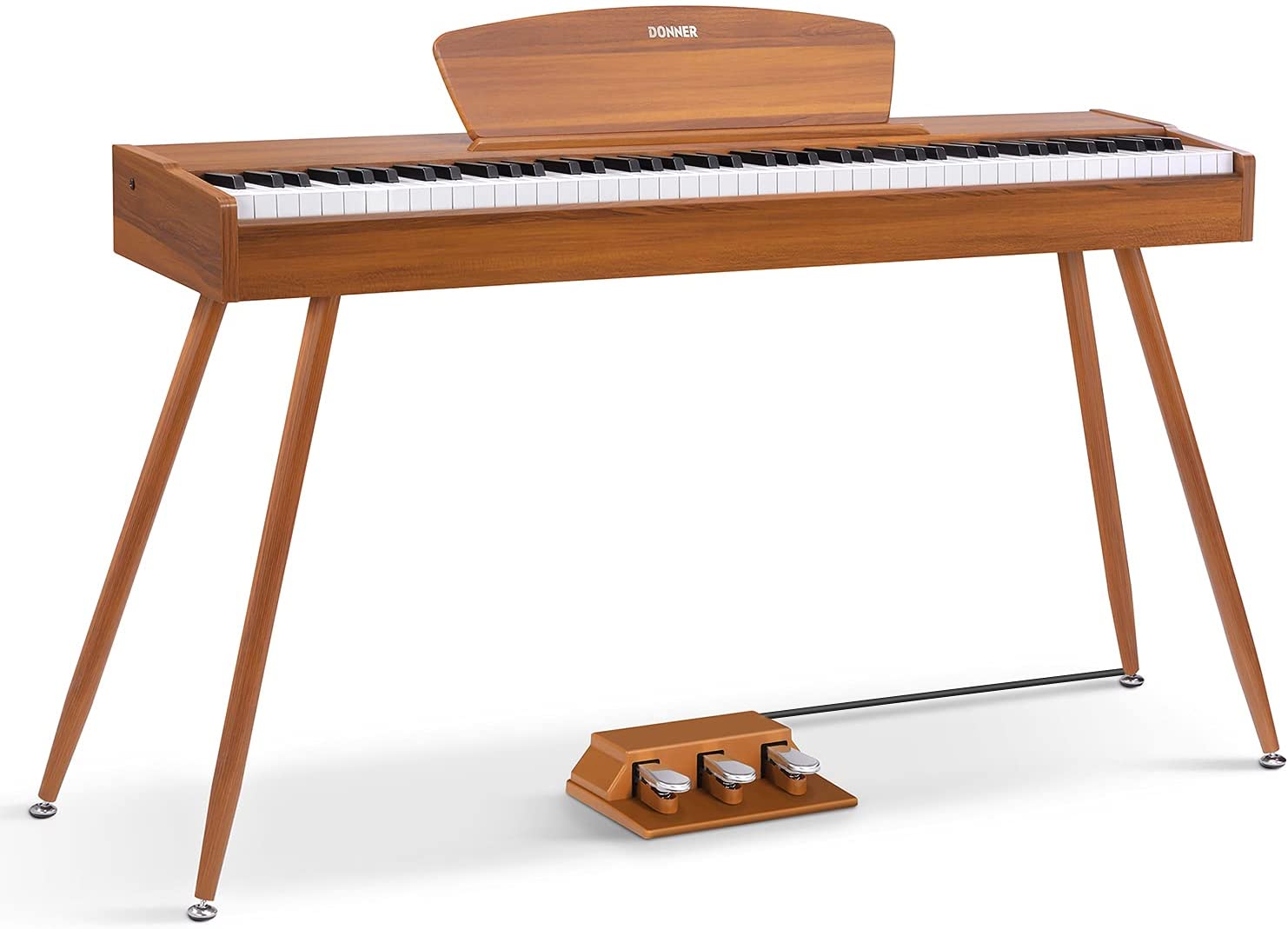
The DDP-80 immediately stands out. If you didn’t know it was a digital piano, you might mistake it for a modern console table at first glance. It has clean lines, wood-style paneling, and a slim profile that feels inspired by Scandinavian interior design trends.
It doesn’t try to look like a stage instrument. There are no flashing displays, no obvious button clusters, and no complex control panels staring back at you. The controls are subtle and integrated in a way that keeps the front-facing appearance clean.
For many buyers, especially beginners furnishing their first apartment or setting up a living room practice space, this is a big deal. The DDP-80 feels like décor. It blends in rather than dominating the room.
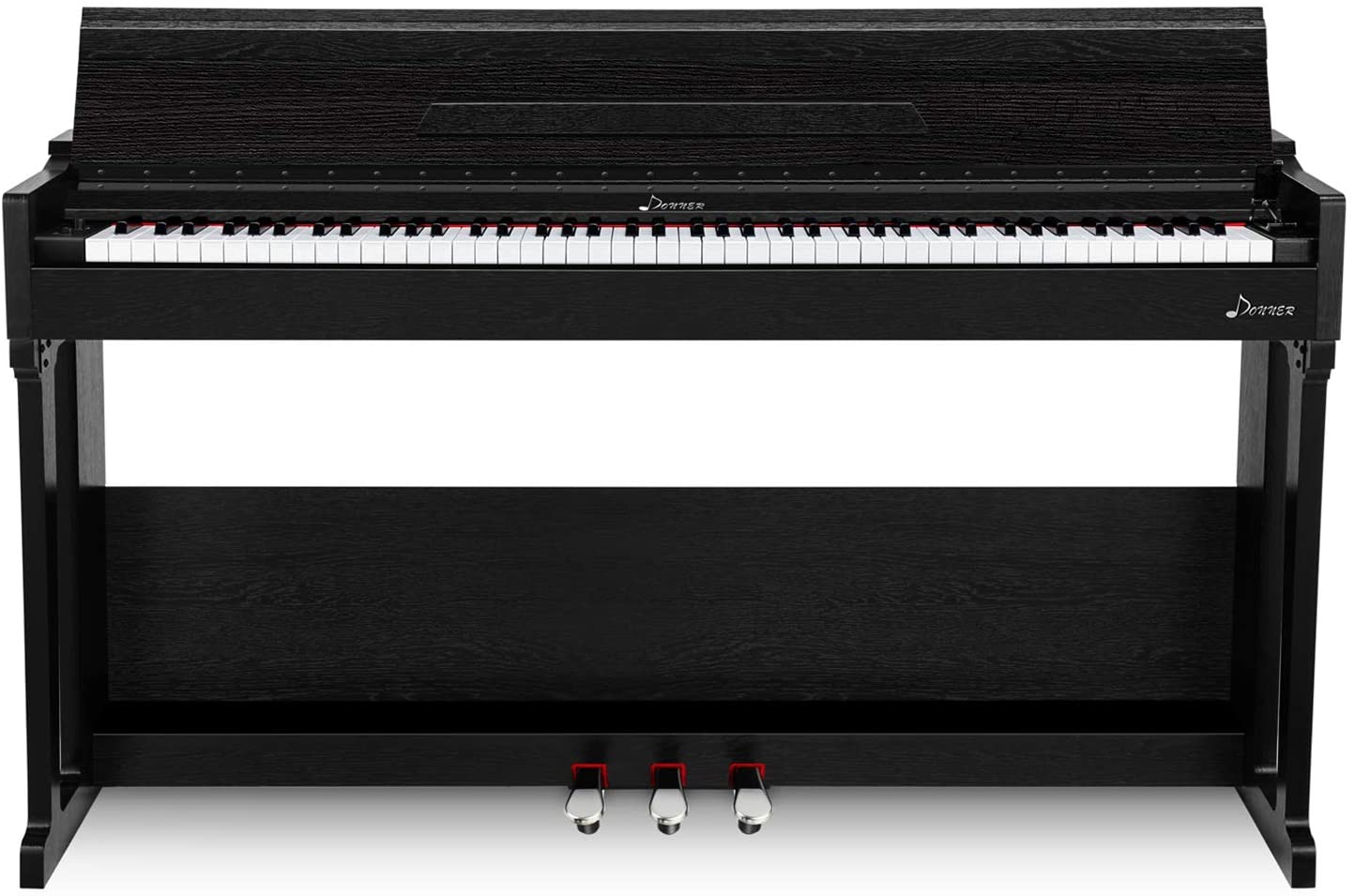
The DDP-90, by contrast, looks more like what most people expect from a home digital piano. It has a traditional cabinet shape, visible music rest, and clearer control access. It still looks neat and modern, but it’s less of a design statement and more of a practical instrument.
Some people will prefer that. It feels purpose-built. Less trendy, more timeless.
If you’re placing the piano in a shared family space where aesthetics matter, the DDP-80 has the edge. If you want something that clearly communicates “this is a serious practice instrument,” the DDP-90 wins.
Cabinet Construction and Materials
Neither of these pianos uses premium hardwood construction. That would be unrealistic at this price. Both rely on engineered wood materials with laminate finishes.
That said, the DDP-80 often feels slightly more refined in surface presentation. The wood-grain finish is smooth, consistent, and visually appealing from a few feet away. Up close, you can tell it’s not solid wood, but it doesn’t feel cheap.
The DDP-90 uses similar materials but leans more into a classic digital piano look. The finish is clean and functional, though slightly less distinctive. It doesn’t try to mimic high-end acoustic cabinetry as strongly as the DDP-80 does.
In terms of structural integrity, both models are reasonably stable once assembled. They don’t wobble under normal playing. The frames hold up well during moderate dynamic playing, even for intermediate users who strike the keys with more force.
However, neither feels ultra-heavy or immovable. If you push hard against the side panels, you may notice slight give. That’s typical in this price bracket and not necessarily a flaw, but it’s worth acknowledging.
The DDP-90 sometimes feels marginally sturdier in the lower cabinet area, particularly around the pedal unit. The DDP-80’s slim design can make it feel a bit lighter overall.
Assembly Experience
Both pianos require some assembly out of the box. You’re not getting a fully built console delivered ready to play.
The process is manageable for one person, though two people make it easier. Instructions are generally straightforward. Panels attach with bolts and included tools.
The DDP-80’s minimalist frame means slightly fewer bulky components, so setup can feel a bit faster. The DDP-90’s more traditional cabinet adds a little extra weight and structure, which may take more care during assembly.
Neither requires advanced technical skill. If you’ve assembled basic furniture before, you’ll be fine.
One thing beginners sometimes overlook is long-term durability of assembled furniture-style digital pianos. Over time, if moved frequently, bolts can loosen. This applies equally to both models. Periodic tightening helps maintain stability.
Keybed Integration and Front Profile
The DDP-80’s keybed is integrated into a slim housing that keeps the front profile minimal. When viewed from the side, it looks elegant and understated. There’s no bulky underside.
This can be appealing visually, but it also means there’s less of that traditional acoustic piano depth under the keys. For some players, that slightly changes the visual reference point when sitting down.
The DDP-90 has a slightly deeper cabinet beneath the keybed. It looks more like a standard upright-style digital piano. This may feel more familiar to players transitioning from acoustic uprights.
Neither design affects playability in a major mechanical sense, but psychologically, the DDP-90 can feel more “piano-like” in form factor.
Music Rest and Practical Design Choices
The DDP-90 typically includes a clearly defined, sturdy music rest designed for sheet music or tablets. It feels secure and purpose-built.
The DDP-80’s music rest, depending on version, is more minimalist. It may appear slimmer or less prominent. It works, but it’s clearly designed to preserve the aesthetic.
If you’re someone who practices with thick classical books or large binders, the DDP-90’s more traditional rest may feel more reliable.
For casual players using a tablet, both work fine.
Pedal Unit Integration
Pedal design is often overlooked in budget digital pianos.
Both models generally offer a three-pedal unit integrated into the cabinet. The pedals are metal-finished and visually aligned with traditional piano styling.
The DDP-90’s pedal housing sometimes feels slightly more substantial. It sits in a slightly deeper cabinet base, which can make the pedals feel more grounded.
The DDP-80’s slim design means the pedal bar is visually lighter. It works well, but the entire aesthetic remains minimal.
From a purely structural standpoint, neither pedal unit feels loose or unstable during normal playing. They’re functional and reliable within their category.
Long-Term Wear and Everyday Use
For beginner and intermediate players, durability over years of practice is important.
Both pianos are designed primarily for home use. They’re not built for constant gigging or heavy transportation. If kept stationary in a room, they hold up well.
The laminate finishes resist scratches reasonably well, though sharp impacts will leave marks. The key surfaces are durable enough for daily practice, and the cabinets don’t show wear quickly under normal conditions.
If you have pets or small children, the DDP-80’s sleek lines might be more prone to visible scuffs simply because of its lighter aesthetic. Darker finishes on the DDP-90 may hide minor wear slightly better.
Which Feels More Premium?
This depends on what you define as premium.
If premium means visually striking and furniture-like, the DDP-80 feels more upscale than its price suggests.
If premium means traditional, sturdy, and built like a serious instrument, the DDP-90 edges ahead.
Neither is luxury-tier. But neither feels disposable either.
Final Thoughts on Design & Build
The DDP-80 prioritizes aesthetic appeal and minimalism. It’s designed to fit beautifully into modern homes and make beginners feel proud to display their instrument.
The DDP-90 prioritizes practicality and slightly more traditional structure. It looks less like décor and more like a practice instrument, which many intermediate players appreciate.
If your piano will live in a shared living room where design matters, the DDP-80 may inspire you to sit down and play more often simply because it looks inviting.
If your priority is long-term, focused practice with a slightly more grounded cabinet feel, the DDP-90 makes a strong case.
Both are well-built for their price. The difference isn’t about quality versus poor quality. It’s about philosophy: minimalist lifestyle instrument versus functional home piano.
And that distinction alone may make your decision clearer than any spec sheet ever could.
Keyboard Action & Playing Feel
If there’s one area where digital pianos truly separate themselves, it’s the keyboard action. You can forgive limited features. You can work around average speakers. But if the keys don’t feel right under your fingers, you’ll notice it every single time you sit down to play.
For beginners and intermediate players especially, key feel isn’t just about comfort. It directly affects technique, finger strength, dynamics, and long-term development. A keyboard that’s too light can slow your growth. One that’s too heavy or uneven can cause fatigue or frustration.
Both the Donner DDP-80 and the Donner DDP-90 offer 88 fully weighted keys with hammer action. On paper, that sounds identical. In practice, the experience isn’t quite the same.
Let’s break this down carefully.
What “Weighted” Actually Means Here
First, it’s important to set expectations.
In this price range, you’re getting a simulated hammer action system. That means there’s internal weighting designed to mimic the feel of an acoustic piano, but you’re not getting complex wooden key actions or high-end graded hammer mechanisms like you’d find in more expensive models.
Both pianos aim to recreate:
- Heavier feel in the lower register
- Lighter feel in the upper register
- Velocity sensitivity (volume changes based on how hard you press)
For beginners, the key takeaway is simple: both are significantly better than unweighted or semi-weighted keyboards. If you’re choosing between these and a basic 61-key synth-style keyboard, either Donner will feel much closer to a real piano.
Now let’s talk specifics.
DDP-80 Key Action: Light, Accessible, Beginner-Friendly
The DDP-80 has a relatively light hammer action. When you press the keys, the resistance is present, but it doesn’t require a lot of force. The keys return quickly, and the overall feel is smooth rather than heavy.
For complete beginners, this can actually be a benefit.
When you’re first learning:
- Your finger strength is still developing
- Your wrists may be tense
- You’re focusing on coordination more than expression
A lighter action makes early practice less physically demanding. You can play longer sessions without fatigue. Scales and basic exercises feel manageable instead of tiring.
The downside becomes noticeable as you progress.
Intermediate players may start to feel that:
- The resistance lacks depth
- Dynamic control feels slightly compressed
- Fast passages can feel a bit springy
That “springy” quality is subtle but real. When you release a key quickly, the return feels more mechanical than organic. On slow, expressive pieces, it’s less noticeable. On fast classical runs or repeated notes, it becomes clearer.
Another factor is key texture. The DDP-80’s keys are smooth plastic. They’re comfortable, but they don’t have a textured, ivory-like finish. If your hands sweat during longer sessions, the smooth surface may feel slightly slippery compared to higher-end keytops.
Still, within its price range, the DDP-80 delivers a respectable experience. It’s not toy-like. It’s not overly mushy. It simply leans toward accessibility rather than realism.
DDP-90 Key Action: Slightly Firmer, More Balanced
The DDP-90 feels noticeably more grounded.
The first thing you’ll likely notice is that the keys require slightly more resistance. Not dramatically more, but enough to feel closer to a traditional upright piano.
This matters for intermediate players working on:
- Controlled dynamics
- Finger independence
- Expressive phrasing
The weighting across the keyboard also feels more balanced. Lower keys have a bit more substance, and the transition to lighter upper keys feels more gradual.
Where the DDP-80 can sometimes feel a little uniform in resistance, the DDP-90 gives a slightly stronger sense of register differentiation. That subtle realism adds up over time.
The key return on the DDP-90 also feels more stable. Less bounce, less springiness. Repeated notes feel more controlled. Fast passages feel more predictable under your fingers.
For someone practicing classical repertoire, this makes a difference. Trills, arpeggios, and dynamic swells feel easier to shape intentionally.
The key surface is still plastic, but often feels marginally more textured. Not dramatically so, but just enough to give your fingers a slightly more secure grip during longer sessions.
Dynamic Control and Expression
Both pianos are velocity-sensitive, meaning the volume changes depending on how hard you strike the keys. But the nuance of that response differs slightly.
On the DDP-80, dynamic transitions are present but somewhat limited. You can play soft and loud, but the steps between dynamic layers feel less gradual. If you’re playing gently, you may notice that the volume jumps slightly when you cross certain thresholds.
For beginners, this won’t be a major issue. You’re still learning to control pressure and timing. The DDP-80 gives you enough variation to develop basic expressive control.
On the DDP-90, dynamic response feels smoother. There’s a slightly wider sense of gradation between pianissimo and forte. It doesn’t feel like a dramatic leap in technology, but it feels more refined.
If you’re working on pieces that rely heavily on expressive contrast, the DDP-90 provides a bit more room to shape phrases intentionally.
Noise and Mechanical Feel
Another subtle factor is mechanical noise. Budget digital pianos sometimes produce slight thumping sounds when keys bottom out.
The DDP-80 can produce mild mechanical noise during aggressive playing. It’s not distracting at moderate volume, but in very quiet practice sessions, you may notice it.
The DDP-90 tends to feel a little more dampened. The key landing feels slightly softer and less plasticky.
Neither is silent mechanically, but neither is excessively loud either. In normal home use, this isn’t a dealbreaker.
Long-Term Development Considerations
This is where things get important for beginners thinking ahead.
If your goal is to eventually transition to an acoustic upright or grand piano, developing proper finger strength and control matters.
The DDP-80’s lighter action won’t prevent you from improving, but you may experience a small adjustment period when moving to a heavier acoustic instrument later.
The DDP-90’s firmer feel prepares you slightly better for that transition. It trains your fingers to work against more resistance, which builds strength over time.
For intermediate players already practicing more complex pieces, the DDP-90 simply feels less limiting.
Fatigue and Comfort
There’s a flip side to heavier action: fatigue.
Some beginners find slightly heavier keys tiring during the first few months of practice. If you’re playing 30–45 minutes a day, the DDP-80’s lighter feel might keep practice sessions more comfortable early on.
However, as your strength develops, that lighter feel may start to feel less satisfying.
The DDP-90 strikes a middle ground. It’s not heavy enough to feel intimidating, but not so light that it feels overly synthetic.
Overall Playing Experience
When you sit down at the DDP-80, the experience feels approachable and easy. It’s forgiving. It invites casual playing. It works well for pop songs, beginner classical pieces, and basic technique exercises.
When you sit down at the DDP-90, it feels slightly more serious. The added resistance gives you feedback. It responds with a bit more authority. It feels closer to what you’d expect from a traditional digital piano designed for steady progress.
Final Thoughts on Keyboard Action
Neither of these actions competes with mid-range or premium digital pianos. That’s just the reality of the price bracket.
But between the two:
- The DDP-80 prioritizes comfort and accessibility.
- The DDP-90 prioritizes realism and progression.
If you’re an absolute beginner who wants a comfortable, non-intimidating entry point, the DDP-80 will serve you well.
If you’re a beginner planning to commit long-term, or an early intermediate player already working on expressive control, the DDP-90 offers a more satisfying and growth-friendly key action.
In the long run, key feel shapes your development more than almost any other factor. And in this comparison, the DDP-90 has a slight but meaningful edge.
Sound Quality
Sound is the emotional core of any piano. You can have a beautiful cabinet and decent key action, but if the tone doesn’t inspire you, you won’t feel connected to the instrument. For beginners and intermediate players especially, sound quality plays a big role in motivation. When you press a key and the tone responds in a way that feels rich and satisfying, you want to keep playing.
Both the Donner DDP-80 and the Donner DDP-90 use sampled acoustic piano sounds. That means recordings of real acoustic pianos have been captured at different dynamic levels and mapped across the keyboard. In this price range, you’re not getting complex physical modeling or ultra-detailed multi-gigabyte sample libraries. But that doesn’t automatically mean the sound is bad. It just means expectations need to be realistic.
Let’s break down how each instrument actually sounds in everyday use.
Core Piano Tone
The most important sound on both instruments is the default acoustic piano patch. That’s what most beginners will use 90 percent of the time.
The DDP-80 leans toward a warm, slightly mellow piano tone. It isn’t overly bright or aggressive. The midrange is smooth, and the high notes are clear without being sharp. This works well for casual home playing, pop songs, and lighter classical pieces.
When you sit down and play simple chords or beginner repertoire, the sound feels pleasant and balanced. It doesn’t immediately scream “cheap digital keyboard.” For someone just starting out, it’s more than enough to develop ear training and basic musical sensitivity.
Where you start to hear limitations is in complexity. Sustained chords don’t have the layered harmonic richness you’d hear in a more advanced digital piano. The decay feels somewhat linear. The overtones are present, but not deeply textured. If you hold a chord and really listen, the sound doesn’t evolve much over time.
The DDP-90 feels slightly fuller right out of the gate. The low end has a bit more body, and the upper register feels a touch more open. It’s not a dramatic difference, but side by side, the DDP-90’s piano tone tends to feel a little more rounded and complete.
The bass notes in particular carry slightly more weight. For intermediate players working on left-hand voicings or fuller accompaniment patterns, this makes a difference. The instrument feels more supportive.
Dynamic Layers and Responsiveness
Dynamic response is where digital pianos often reveal their price point. Acoustic pianos can produce an enormous range of tonal variation depending on touch. Budget digital pianos usually simulate this with a limited number of velocity layers.
On the DDP-80, you can clearly play soft and loud. The instrument responds to changes in pressure. But the transitions between dynamic levels can sometimes feel stepped rather than seamless. When you move from very soft playing to moderately soft, the change in volume and tone can feel slightly abrupt.
For beginners, this isn’t likely to be a major issue. You’re still developing control, and the instrument does reward changes in touch. It’s expressive enough for learning phrasing and basic dynamics.
For intermediate players working on nuanced repertoire, the limitations become more noticeable. Pianissimo passages can feel somewhat similar to mezzo piano in tonal color. Forte passages are clear but don’t fully bloom with complexity.
The DDP-90 handles dynamic gradation a bit more smoothly. There’s a slightly more natural sense of progression as you increase velocity. Soft notes feel distinct from medium notes, and louder strikes carry a bit more tonal bite.
It’s still not a high-end dynamic engine, but the added smoothness makes expressive playing more satisfying. Crescendos feel more organic. Gentle melodic lines feel easier to shape intentionally.
Sustain and Resonance
One of the hardest things for budget digital pianos to replicate is resonance. On an acoustic piano, when you press the sustain pedal, strings vibrate sympathetically. Notes interact with each other. The sound breathes.
The DDP-80 offers basic sustain functionality. When you hold the pedal, notes ring out naturally enough for standard practice. However, the resonance effect is relatively simple. You don’t get a complex bloom of interacting overtones. Instead, you hear a sustained version of the sampled sound.
For most beginners, this is perfectly fine. Chords sustain. Legato playing works. You can practice pedal technique without issue.
Intermediate players, especially those playing classical pieces that rely heavily on pedal nuance, may notice that the resonance feels somewhat flat. There’s less sense of depth when multiple notes are held together.
The DDP-90 tends to offer slightly more convincing sustain behavior. The decay feels a bit more layered. When you hold a chord with pedal down, the sound retains clarity a little better instead of blending into a uniform wash.
Again, this is a subtle difference, but it contributes to a more immersive playing experience.
Additional Instrument Sounds
The DDP-80 keeps things simple. Its focus is primarily on acoustic piano tones, with limited additional voices depending on the version. This aligns with its minimalist philosophy. It’s built to be a straightforward piano experience, not a multi-instrument workstation.
If you’re someone who mainly wants to practice piano repertoire, this simplicity isn’t a drawback. In fact, it keeps distractions to a minimum.
The DDP-90 usually includes a broader selection of sounds. Electric pianos, strings, organ tones, and possibly a few other voices are available. These won’t compete with dedicated stage keyboards, but they’re useful for variety.
For beginners, having access to an electric piano sound can make practice more fun. Switching tones occasionally keeps things fresh. For intermediate players experimenting with pop, jazz, or worship music, layered sounds can add creativity.
Sound Through Speakers vs Headphones
Both instruments benefit from headphone use. Through headphones, the piano samples often sound clearer and more detailed than through built-in speakers.
On the DDP-80, headphones reveal slightly better clarity in the upper registers. The limitations in dynamic layering are still present, but the overall tone feels cleaner compared to the built-in speaker output.
The DDP-90 also sounds more refined through headphones. The bass response feels tighter, and the midrange feels more focused.
If you plan to practice primarily with headphones, the sound gap between the two narrows slightly. If you rely heavily on built-in speakers, the DDP-90 maintains a small advantage.
Recording and MIDI Use
When connected via USB MIDI to a computer, both instruments can trigger virtual piano software. This is important because it means the onboard sound isn’t the final limit of your tone.
If you eventually use higher-quality virtual instruments, the keyboard action becomes more important than the internal sound engine. In that context, both instruments can serve as capable controllers.
However, if you’re relying strictly on internal sounds without external software, the DDP-90 offers a slightly richer standalone experience.
Long-Term Sound Satisfaction
Here’s the honest perspective.
For beginners in their first one to two years, the DDP-80’s sound will feel satisfying and musical. It won’t hold you back from learning. It provides enough dynamic range and tonal clarity to develop proper technique.
As you move into intermediate territory and start focusing more on expressive nuance, the DDP-90’s slightly fuller tone and smoother dynamic response feel more rewarding.
Neither instrument replicates the complexity of an acoustic grand. But within their budget class, both perform respectably.
Final Thoughts on Sound Quality
The DDP-80 delivers a warm, clean piano tone that works well for beginners and casual players. It prioritizes simplicity and usability over tonal complexity.
The DDP-90 adds a bit more depth, slightly smoother dynamics, and a broader tonal palette. It feels more adaptable as your musical sensitivity grows.
If sound realism and expressive control are high priorities for you as an intermediate player, the DDP-90 holds a modest but meaningful edge. If you’re just starting out and want a pleasant, reliable piano tone without overcomplication, the DDP-80 will serve you well.
In the end, both instruments provide solid sound for their price. The difference isn’t night and day. It’s about refinement, subtlety, and how much room you want for expressive growth over time.
Speakers & Volume
When people compare digital pianos, built-in speakers don’t always get the attention they deserve. Most buyers focus on key action and sound engine specs, which makes sense. But here’s the reality: for beginners and intermediate players practicing at home, the speakers are your primary sound system.
If the speakers are weak, thin, or distort easily, even a decent piano sample can feel underwhelming. On the other hand, a solid speaker system can make a modest sound engine feel fuller and more immersive.
Both the Donner DDP-80 and the Donner DDP-90 are designed as home console pianos with built-in amplification. Neither is meant to replace a professional PA system. But the way they project sound in a typical room does matter.
Let’s break down what you can realistically expect from each.
Speaker Configuration and Power
In this price range, you’re not getting high-wattage, multi-speaker systems with advanced spatial projection. These are modest internal speaker setups designed primarily for personal practice and small room use.
The DDP-80 features a basic dual-speaker system integrated into its slim cabinet. The speakers are positioned to project sound outward and slightly downward. Because of the minimalist cabinet design, there isn’t a large acoustic chamber inside the body to reinforce bass frequencies.
The DDP-90 typically offers slightly stronger amplification and a bit more internal cabinet space. The speaker placement tends to feel more traditional, allowing for slightly better sound dispersion within a room.
On paper, the difference in wattage may not look dramatic. In practice, however, the DDP-90 generally sounds a bit more powerful and room-filling at moderate volumes.
Volume Range and Headroom
For beginners, one of the most common concerns is simple: can it get loud enough?
Both pianos can easily fill a bedroom or small living room at comfortable practice levels. You won’t struggle to hear yourself unless you’re in a very large, open space.
The DDP-80 performs well at low to moderate volumes. In quiet evening practice sessions, it sounds clear and balanced. At around 40 to 60 percent volume, it delivers a pleasant tone without strain.
As you increase the volume closer to maximum, the limitations begin to show. The bass can feel slightly compressed, and the upper mids can become a bit sharp. It’s not harsh, but you can tell the speakers are working near their limits.
The DDP-90 handles higher volumes a little more confidently. It maintains clarity better as you approach the upper end of the volume range. The bass response, while still modest compared to premium instruments, feels more stable and less compressed.
If you occasionally play more energetically or want to perform informally for family or friends in the same room, the DDP-90 has a slight edge in headroom.
Bass Response
Bass response is one of the biggest differentiators in built-in digital piano speakers.
Acoustic pianos generate deep, resonant low frequencies through large wooden bodies. Digital pianos rely on small speakers inside relatively compact cabinets. That’s a big challenge.
The DDP-80’s slim design limits the size of its internal acoustic chamber. As a result, the lowest bass notes sound present but not particularly powerful. They’re audible, but they don’t carry the same depth you’d feel from a larger system.
For beginners practicing scales, chords, or simple left-hand patterns, this is not a major issue. The notes are clear and usable. But for intermediate players working on fuller arrangements with strong bass accompaniment, the low end may feel slightly thin.
The DDP-90 benefits from a somewhat deeper cabinet design. That extra internal space helps reinforce bass frequencies just enough to be noticeable. The lowest keys feel a bit more grounded. Chords with left-hand octaves have slightly more body.
Neither instrument delivers subwoofer-level bass. But the DDP-90 creates a more balanced tonal picture across the full keyboard.
Clarity and Midrange Detail
Most piano music lives in the midrange. That’s where melodies and harmonies sit.
The DDP-80 does a respectable job reproducing midrange frequencies. Notes are clear, and the sound remains defined at moderate volumes. For solo practice, it’s entirely functional.
However, when playing dense chords or complex passages, the sound can blend together slightly. The speaker system doesn’t separate individual notes with high precision.
The DDP-90 offers a bit more clarity in these situations. The midrange feels more open, and chords retain slightly better definition. This helps intermediate players who are focusing on voicing and balance between melody and accompaniment.
It’s not a dramatic leap in quality, but the difference becomes more apparent during layered or dynamic pieces.
Stereo Imaging and Sound Projection
Another subtle factor is stereo imaging. A well-designed speaker system creates a sense of width and depth, even in a small room.
The DDP-80 projects sound in a straightforward, somewhat direct manner. You hear the notes clearly in front of you, but the spatial dimension feels relatively flat.
The DDP-90 tends to create a slightly wider sound field. The stereo effect feels a bit more natural, especially when sitting centered at the keyboard. This enhances immersion, even if only modestly.
Room placement also matters. Because both pianos project sound outward, placing them directly against a wall can slightly reinforce bass frequencies. Corner placement may boost low end further, though it can also make the sound feel more boomy.
Playing With Others
Neither of these pianos is designed for band rehearsal or stage performance using built-in speakers alone.
If you plan to play alongside other instruments acoustically, such as guitar or vocals, both may struggle to keep up at higher volumes without sounding strained.
In these situations, external amplification or using the line outputs becomes important.
For simple duet practice or playing with a teacher in a quiet room, both are more than adequate.
Headphone Experience
For many beginners and intermediate players, headphones are a major part of the experience. Late-night practice, shared living spaces, and focused study all make headphones valuable.
Both the DDP-80 and DDP-90 support headphone output, and in many cases, the internal sound engine actually shines more through headphones than through speakers.
With headphones, you bypass the physical limitations of small built-in speakers. The tone feels clearer, more detailed, and more balanced across frequencies.
In this context, the speaker difference between the two models becomes less important. If you expect to use headphones most of the time, either instrument will perform well.
Long-Term Satisfaction
Here’s where speaker quality matters more than you might expect.
In the first few months of learning, most beginners are focused on notes and rhythm. But as your ear develops, you become more sensitive to tonal depth and projection.
The DDP-80’s speakers will serve beginners well. They are clear, functional, and sufficient for personal practice.
The DDP-90’s slightly stronger system provides a bit more breathing room as your musical expectations grow. It sounds fuller, especially when playing dynamic pieces or lower-register-heavy music.
Over time, that added fullness can make practice sessions feel more rewarding.
Final Thoughts on Speakers & Volume
Both pianos are clearly designed for home practice, not performance. They perform well within that intended role.
The DDP-80 delivers clean, usable sound at moderate volumes, with some limitations in bass depth and high-volume clarity.
The DDP-90 offers slightly stronger projection, better bass support, and more stable performance at higher volumes.
If you primarily practice alone in a bedroom or small space, the difference may not be dramatic. If you value fuller room sound and occasionally play at higher volumes, the DDP-90 holds a modest but noticeable advantage.
Neither will replace external speakers or a stage setup. But within their category, both are competent, with the DDP-90 offering a bit more power and presence overall.
Features & Functions
When it comes to digital pianos, features can either enhance your experience or clutter it. For beginners especially, too many buttons and menus can feel overwhelming. For intermediate players, too few functions can feel limiting after a year or two of progress.
This is where the design philosophies of the Donner DDP-80 and the Donner DDP-90 clearly separate.
The DDP-80 takes a minimalist approach. It aims to replicate the simplicity of an acoustic piano. The DDP-90, on the other hand, embraces the fact that it’s a digital instrument and gives you more tools to work with.
Neither approach is objectively better. It depends on what kind of player you are and how you plan to use the instrument.
Let’s go through the feature sets carefully.
Overall Philosophy
The DDP-80 is intentionally simple. When you sit down, you’re meant to play piano. That’s it. The controls are minimal, and most of the time, you won’t interact with them much after initial setup.
For many beginners, this is a good thing. There’s no confusion. No scrolling through menus. No accidental button presses that change your sound mid-practice. It feels closer to an acoustic experience in that sense.
The DDP-90 acknowledges that digital pianos offer extra possibilities. It includes more accessible controls, more sounds, and more built-in functionality that can support practice and experimentation.
If you enjoy exploring features, the DDP-90 will feel more flexible. If you prefer a distraction-free experience, the DDP-80 keeps things streamlined.
Sound Selection
The DDP-80 typically offers a limited number of onboard sounds. The primary focus is the acoustic piano tone, with possibly a few additional variations depending on the version.
You’re not buying the DDP-80 for instrument variety. It’s designed to be a straightforward piano instrument. For beginners who mainly want to learn proper technique and repertoire, that focus makes sense.
The DDP-90 usually includes a broader sound bank. In addition to acoustic piano, you may find electric piano tones, strings, organ sounds, and other common digital piano voices.
These additional sounds aren’t professional-grade in depth, but they’re useful. Switching to an electric piano patch can make practice more fun. Layering strings under a piano sound can add emotional texture when experimenting with composition.
For intermediate players who are branching into pop, jazz, or worship music, this expanded palette adds versatility.
Dual and Split Modes
One of the most practical digital piano features is dual mode, also known as layering. This allows you to combine two sounds at once, such as piano and strings.
The DDP-80’s minimalist design means it often lacks advanced layering functionality. What you hear is generally what you get.
The DDP-90 typically supports dual mode, allowing you to layer sounds. This can be surprisingly useful. A subtle string layer under a piano tone can create a fuller sound for ballads or ambient pieces.
Some versions may also offer split mode, where different sounds are assigned to different sections of the keyboard. For example, bass on the left hand and piano on the right. This is helpful for certain styles and practice scenarios.
For beginners, these features are not essential. For intermediate players exploring creativity, they add meaningful flexibility.
Built-In Metronome
A metronome is one of the most important practice tools for developing timing and rhythm.
Both pianos generally include a built-in metronome function. However, accessibility differs.
On the DDP-80, accessing the metronome may involve holding specific key combinations rather than pressing clearly labeled buttons. This keeps the surface clean but can require checking the manual.
The DDP-90 usually provides more direct access to metronome controls. Adjusting tempo and turning it on or off feels more intuitive.
For serious practice, ease of access matters. If you’re working with scales, exercises, or repertoire at varying tempos, the DDP-90 makes tempo adjustments quicker and more convenient.
Recording Function
Recording yourself is one of the fastest ways to improve.
The DDP-80 generally does not emphasize onboard recording capabilities. It’s meant to function like a traditional piano rather than a digital workstation.
The DDP-90 often includes basic recording functionality. This allows you to record your performance internally and play it back. It’s usually simple one-track recording, not full multi-track production, but it’s still valuable.
For beginners, recording can help identify mistakes you don’t notice while playing. For intermediate players, it becomes a powerful self-assessment tool.
Having this feature built in adds a layer of growth potential.
Touch Sensitivity Settings
Both instruments offer touch sensitivity adjustment, allowing you to modify how the keyboard responds to velocity.
This is helpful if you:
- Prefer a lighter feel
- Want stronger dynamic contrast
- Are adjusting to different repertoire styles
The DDP-80 supports velocity sensitivity but may have fewer preset curves or less accessible adjustment controls.
The DDP-90 usually provides more flexible control over touch response, giving you slightly more customization.
While beginners may not immediately use this feature, intermediate players often appreciate the ability to fine-tune response.
Transpose and Tuning
Transpose functionality allows you to shift the pitch of the keyboard up or down in semitone increments without changing finger positions.
Both models typically include transpose capability. This is helpful for:
- Accompanying singers
- Playing along with recordings
- Adjusting to different keys without relearning fingerings
Tuning adjustments are also generally available, allowing slight pitch calibration.
These features are practical and expected in modern digital pianos. Neither instrument has a significant advantage here.
User Interface and Controls
The DDP-80 hides many functions behind key combinations. This keeps the panel visually clean but can make advanced adjustments less intuitive.
The DDP-90 tends to provide more visible controls. Buttons are easier to identify, and accessing features requires less memorization.
For beginners who don’t plan to change settings often, the DDP-80’s simplicity works fine. For players who like to experiment or adjust settings frequently, the DDP-90 feels more convenient.
Connectivity for Extended Features
Both instruments include USB MIDI connectivity, which opens the door to using apps and recording software.
However, when relying strictly on internal features without external devices, the DDP-90 provides more standalone functionality.
Long-Term Feature Value
The question is not which piano has more features. It’s which features you’ll actually use.
If your primary goal is to practice piano seriously with minimal distractions, the DDP-80’s simplicity can help you stay focused.
If you enjoy experimenting with different tones, layering sounds, recording progress, and adjusting settings, the DDP-90 offers more long-term engagement.
As players move from beginner to intermediate levels, curiosity often increases. Having extra tools available can support that growth.
Final Thoughts on Features & Functions
The DDP-80 is intentionally restrained. It delivers core piano functionality without feature overload. For pure piano study and aesthetic simplicity, it works well.
The DDP-90 embraces digital flexibility. It adds layers of functionality that enhance practice, creativity, and long-term progression.
For absolute beginners who want a clean, straightforward instrument, the DDP-80 may feel refreshingly simple.
For beginners planning to stick with piano and intermediate players already exploring dynamics, layering, and recording, the DDP-90 offers more room to grow.
In this category, the DDP-90 clearly provides more versatility. Whether you need that versatility depends entirely on your goals.
Connectivity
Connectivity is one of those categories that beginners often overlook at first, but it becomes increasingly important over time. When you’re just starting out, you might think, “I just need something that makes sound.” But as you progress, you may want to connect to apps, record into a computer, use better virtual instruments, or practice silently with high-quality headphones.
This is where digital pianos separate themselves from acoustic instruments. The ability to connect to other devices opens up a completely different layer of flexibility.
Both the Donner DDP-80 and the Donner DDP-90 offer modern digital connectivity options, but the way those features integrate into each instrument’s design philosophy is slightly different.
Let’s break this down carefully and realistically.
USB MIDI Connectivity
The most important connectivity feature on both models is USB MIDI.
MIDI does not transmit sound. It transmits data. That data includes which key you press, how hard you press it, when you release it, and pedal information. When connected to a computer or tablet, this data can control virtual instruments or interact with learning software.
Both the DDP-80 and DDP-90 include USB MIDI functionality, typically via a USB-B port (the standard square printer-style connection).
For beginners, this means you can connect your piano to:
- Learning apps
- Online lessons
- Notation software
- Recording programs (DAWs)
If you’re using apps that provide real-time feedback on notes and rhythm, USB MIDI is essential. Both pianos support this without issue.
From a purely functional standpoint, neither model has a major advantage here. They both act as reliable MIDI controllers for external software.
Using Virtual Piano Software
Here’s where connectivity becomes powerful.
The built-in piano sounds on both instruments are good for the price, but they aren’t high-end. With USB MIDI, you can connect either piano to a computer and use premium virtual piano libraries that cost far more than the instruments themselves.
When you do this, the onboard sound engine becomes less important. The key action becomes the main factor. The piano essentially turns into a controller for professional-grade software.
Both the DDP-80 and DDP-90 handle this role well. Latency depends more on your computer setup than the piano itself.
For intermediate players interested in recording or upgrading their tone without buying a new instrument, this is a major advantage.
Headphone Outputs
Headphone connectivity is crucial for home players.
Both pianos include headphone outputs that allow silent practice. When headphones are plugged in, the internal speakers automatically mute. This is ideal for late-night practice or shared living spaces.
The sound through headphones is typically clearer and more detailed than through built-in speakers, simply because you bypass the limitations of small speaker systems.
For beginners, this means you can practice anytime without disturbing others.
For intermediate players, headphone practice allows focused listening and detailed self-assessment.
Both models perform well here. There’s no significant difference in headphone quality between the two.
Audio Outputs
Some versions of the DDP-90 may include dedicated line outputs in addition to headphone jacks, while the DDP-80 often keeps connectivity more minimal.
Line outputs allow you to connect directly to:
- External speakers
- Amplifiers
- Audio interfaces
- PA systems
If you plan to play for small gatherings or want better room sound, having proper line outputs is useful.
The DDP-80 can still connect to external amplification through headphone output, but that’s not always as clean or flexible as dedicated line outputs.
For beginners practicing strictly at home, this difference may not matter. For intermediate players thinking about informal performances or better sound systems, the DDP-90 offers slightly more flexibility.
Recording to a Computer
If you want to record your playing, connectivity becomes essential.
There are two main ways to record:
- Record MIDI data into a DAW
- Record audio output through an interface
With USB MIDI, both pianos allow you to record note data directly into software. This lets you edit mistakes, change sounds afterward, or notate your performance.
If you want to record the actual audio sound of the piano, you’ll typically connect through headphone or line outputs into an audio interface.
The DDP-90’s slightly stronger output options can make this process smoother, especially if it includes dedicated line outs. The DDP-80 can still do it, but the workflow may be slightly more basic.
For intermediate players exploring composition or content creation, this difference can matter over time.
Compatibility With Learning Apps
Many beginners today use piano learning apps alongside traditional lessons.
Both pianos are compatible with most MIDI-based learning platforms. Once connected via USB, they can send note data to apps that provide real-time feedback.
This is one of the biggest advantages of buying a modern digital piano over an acoustic instrument.
The setup process is straightforward on both models. You connect a USB cable to your device (sometimes with an adapter depending on tablet type), and the piano is recognized as a MIDI controller.
From a compatibility standpoint, both perform equally well.
Bluetooth Connectivity
Depending on the specific version and market, Bluetooth functionality may or may not be included.
In general, the DDP-80 tends to focus less on wireless features and more on simplicity. The DDP-90 sometimes offers expanded connectivity options, but not always Bluetooth audio.
If Bluetooth MIDI is available, it allows wireless connection to apps. However, wired USB remains more stable and reliable, especially for serious practice.
For beginners, Bluetooth convenience is nice but not essential. For intermediate players working with recording software, wired connections are usually preferred anyway.
Pedal Data Transmission
Connectivity isn’t just about keys. Pedal data matters too.
Both pianos transmit sustain pedal information via MIDI. This allows virtual instruments to respond naturally when connected to software.
If you upgrade your sound through a computer, your pedal technique will still translate properly.
More advanced pedal nuance, like half-pedaling, depends on hardware support and configuration. In this category, both models remain within standard budget-level implementation.
Long-Term Flexibility
Here’s where connectivity becomes a long-term investment factor.
A digital piano with good connectivity can grow with you.
At first, you may use it purely as a standalone instrument.
Later, you might:
- Use learning software
- Record performances
- Upgrade sounds via virtual instruments
- Connect to better speakers
Both the DDP-80 and DDP-90 allow that path. Neither locks you into a closed system.
However, the DDP-90’s slightly more expanded output options and feature integration make it feel more adaptable for evolving needs.
Simplicity vs Expansion
The DDP-80 stays true to its minimalist philosophy even in connectivity. It provides the essentials and avoids clutter.
The DDP-90 embraces broader functionality. It feels more like a digital hub rather than just a piano.
For beginners who value simplicity and don’t plan to explore software or recording heavily, the DDP-80 covers all necessary basics.
For intermediate players curious about recording, producing, or expanding their setup, the DDP-90 offers a bit more breathing room.
Final Thoughts on Connectivity
Both pianos offer solid foundational connectivity. USB MIDI and headphone support make them compatible with modern learning tools and recording workflows.
The DDP-80 keeps things straightforward and minimal. It connects reliably but doesn’t emphasize advanced routing or output flexibility.
The DDP-90 offers slightly more versatility in how you integrate it into a broader setup. For players thinking ahead to recording, external speakers, or more advanced use cases, that flexibility matters.
In practical terms, either instrument can serve as the center of a beginner or intermediate home setup. The difference is not dramatic. But if long-term expandability is important to you, the DDP-90 holds a small but meaningful advantage in connectivity options.
Conclusion
Choosing between the Donner DDP-80 and the Donner DDP-90 really comes down to priorities.
If you strip everything back, both are capable beginner-to-intermediate instruments. They offer fully weighted 88-key keyboards, usable piano tones, solid home-practice speaker systems, and modern USB MIDI connectivity. Neither is a toy. Neither will block your progress in the early years of learning. From a purely functional standpoint, you can build strong fundamentals on either one.
Where they differ is in philosophy.
The DDP-80 is about simplicity and design. It looks beautiful in a living room. It avoids feature overload. It invites you to sit down and just play. For beginners who want a clean, non-intimidating experience and care about aesthetics, it’s an appealing choice. It feels intentional and distraction-free.
The DDP-90 leans toward practicality and growth. The slightly firmer key action, fuller speaker response, broader feature set, and added flexibility make it better suited for players who plan to progress steadily. If you’re already practicing regularly, working through structured lessons, or thinking ahead to more expressive repertoire, the DDP-90 gives you a bit more headroom.
Neither instrument is perfect. Both sit comfortably in the budget category. But if long-term development is your main goal, the DDP-90 is the safer investment. If style, simplicity, and a clean home aesthetic matter most, the DDP-80 may be the one you’ll enjoy seeing and playing every day.
In the end, the best piano is the one you’ll actually sit down and use consistently.