
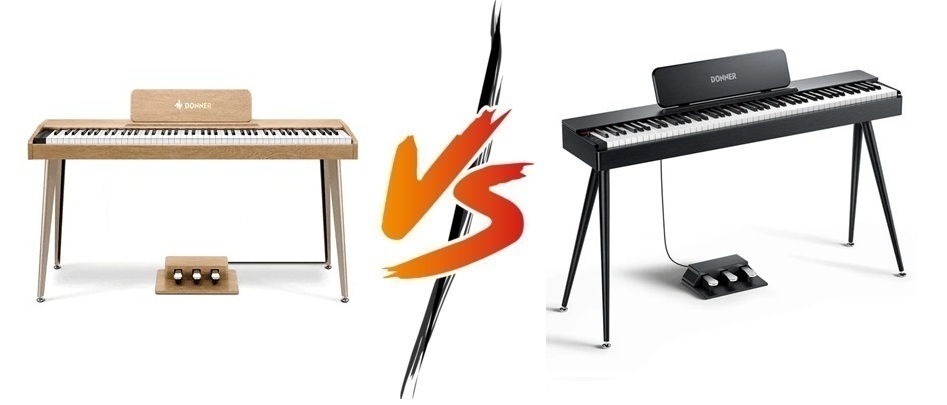
If you’re comparing the Donner DDP-60 and the Donner OURA S100, you’re probably trying to figure out which one gives you the best mix of feel, sound, features and overall value. On paper they look similar: both are 88-key home digital pianos aimed at beginners and casual players. But once you look closer, they’re actually built for different kinds of players and different kinds of homes. The DDP-60 leans toward being a furniture-style piano with bigger speakers and lots of preset sounds, while the OURA S100 focuses on realistic touch, simple controls and modern Bluetooth features. I spent time going through the specs, reading user feedback and looking at how each piano is meant to be used day-to-day. The goal here is to lay out the practical differences in a clear, honest way so you can decide which one fits how you want to play — not just which one looks good on a product page.
Donner DDP-60 vs Donner OURA S100 Comparison Chart
If you click the links below, under the product images, you will be redirected to Amazon.com. In case you then decide to buy anything, Amazon.com will pay me a commission. This doesn’t affect the honesty of this review in any way though.
| Category | Donner DDP-60 | Donner OURA S100 |
|---|---|---|
 |  | |
| Check the best price on Amazon | Check the best price on Amazon | |
| Type | Furniture-style home digital piano | Slim digital piano / modern console |
| Keys | 88 full-size, semi-weighted | 88 full-size, graded hammer-action |
| Touch Sensitivity | Adjustable, basic | Adjustable, more refined |
| Sound Engine | Basic PCM sample set | Higher-quality multi-sample engine |
| Polyphony | Approx. 128 (varies by batch) | Approx. 128 or higher (varies) |
| Voices / Tones | ~128 sounds | ~30–45 higher-quality voices (focus on realism) |
| Demo Songs | ~30 built-in | ~20–30 built-in |
| Speakers | 2 × 15W | 2 × 25W (varies slightly by unit) |
| Speaker Quality | Loud, boxy, warm | Clearer, fuller, better dynamic response |
| Bluetooth | Bluetooth Audio only (no MIDI) | Bluetooth MIDI (often Bluetooth Audio as well) |
| USB Connection | USB-MIDI | USB-MIDI |
| AUX Input | Usually none | Sometimes available depending on batch |
| Headphone Output | One or two jacks | One (sometimes two) |
| Pedals | Three-pedal unit included with stand | Single sustain pedal or optional three-pedal unit |
| Half-Pedaling | Limited | Usually supported or simulated better |
| Stand | Fixed furniture cabinet | Slim stand (varies by package) |
| Weight | ~44 lbs (20 kg) | ~27–34 lbs (12–15 kg), depending on stand |
| Dimensions | Approx. 53 × 13 × 29 in | Approx. 52 × 11 × 30 in (with stand) |
| Controls | Simple buttons, no screen | Cleaner interface; some versions include display |
| Learning Features | Lesson mode, metronome | Lesson mode, better app compatibility |
| Best For | Beginners who want a furniture-style piano with strong speakers | Learners who prioritize touch, sound quality, and Bluetooth MIDI |
| Price Range | Lower | Slightly higher |
| My individual reviews | Donner DDP-60 review | Donner OURA S100 review |
Design & Build Quality
The DDP-60 and the OURA S100 take very different approaches to design, and those choices affect everything from how they look in your home to how sturdy they feel when you sit down to practice. Design is not only about appearance. It also affects how stable the instrument is, how comfortable it feels during long sessions, how easy it is to assemble, and how well it holds up after months or years of daily use. Since these two pianos target different kinds of players, their design priorities are not the same. The DDP-60 aims for a traditional furniture-style experience. The OURA S100 leans toward a modern, streamlined layout that tries to look clean without drawing attention to itself. What follows is a deeper look at how each model is built, how it fits into a home, and what you can expect from the overall physical experience.
Overall design philosophy
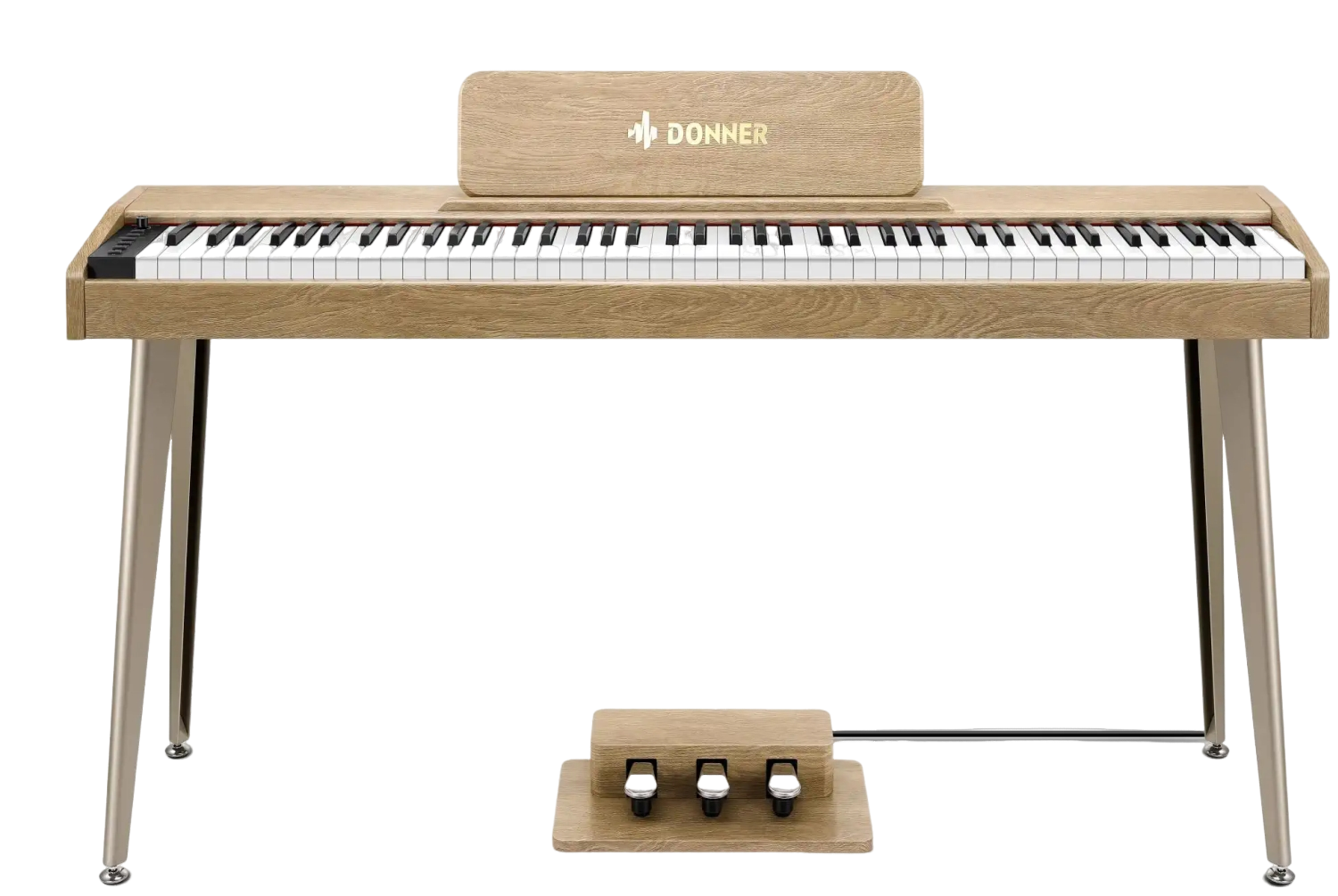
When you see a DDP-60 in a product photo, the first thing you notice is that it looks like a compact upright piano. The body has a full wooden frame, a raised back panel, and a fallboard that lifts to reveal the controls. It is meant to blend into a living room or a study and pass as a piece of furniture when not in use. Donner clearly wanted the DDP-60 to feel familiar to people who grew up with upright pianos or those who simply like the idea of one in the house.
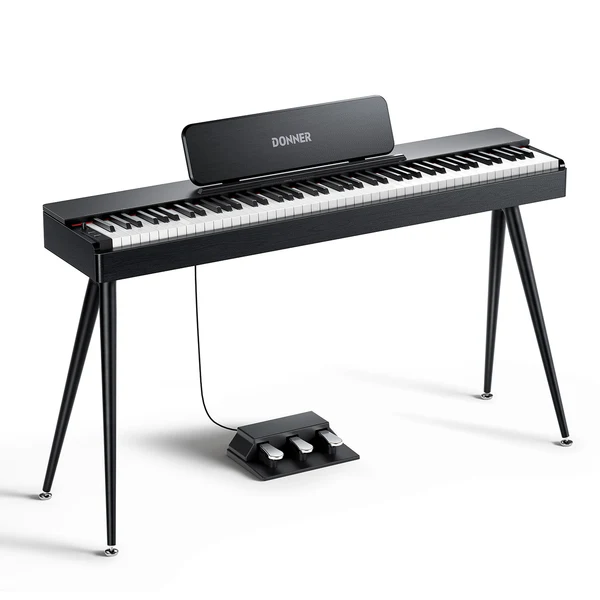
The OURA S100 makes a different impression. Its frame is slimmer. Its lines are straighter. The controls are kept minimal and clean. Depending on the bundle, it may sit on a simple wooden stand or on open tube legs that give it a lighter profile. This piano is aimed at players who want something that looks modern and tidy rather than traditional. If the DDP-60 tries to mimic classic decor, the OURA S100 aims to look like modern Scandinavian furniture.
Material quality and finish
The DDP-60 uses a particleboard or MDF-style body wrapped in a wood-grain laminate. It is not real hardwood, but it feels sturdy enough once assembled. The finish looks better from a few feet away than from very close, but that is typical for digital pianos in this price range. The laminate is smooth and resistant to fingerprints, which helps keep the piano looking clean. The keybed area has enough weight that the instrument feels anchored when you play. You do not get the wobble you sometimes see in cheap keyboard stands.
The OURA S100 also uses composite wood materials, though its finish tends to look slightly more modern. The edges are cleaner and the color options tend to favor lighter tones that fit into contemporary decor. Because the cabinet is slimmer, it weighs less. This can be an advantage if you need to move it around the room. The downside is that the lighter structure can feel less anchored when you play aggressively. Still, when assembled correctly, the S100 holds up well. The stand attaches firmly to the main body with multiple screws, which keeps movement under control.
Size and footprint
The DDP-60 is the larger of the two. It has a taller rear panel and a deeper base. This gives it the presence of a small upright piano. If you want something that fills a space visually, the DDP-60 is the one that does that. The wider base and heavier body help the instrument stay solid under your hands. The tradeoff is that it takes more space and is harder to reposition once assembled. You will want to pick its location before putting it together.
The OURA S100 is more compact. Its body is shorter and the stand has a smaller footprint. This is ideal for apartments, bedrooms, or multipurpose rooms. It can sit against a wall without dominating the area. If you like the idea of keeping the piano in a workspace or a corner where you also keep a desk or bookshelf, the S100 is easier to integrate. The tradeoff is that visually it does not have the same presence as a full upright-style digital piano.
Assembly experience
Assembling the DDP-60 takes some patience simply because of its size and weight. Most people will need two people to lift the main body into place on the stand. The pieces line up cleanly, but the weight distribution can be awkward during assembly. Once everything is screwed in, the piano feels stable. The pedals attach in a fixed unit built into the stand, which adds to the furniture-like feel.
The OURA S100 is much easier to assemble. You can put it together by yourself in under an hour. The main body is lighter, so lifting it onto the stand is manageable for one person. The pedal unit attaches to the bottom bar of the stand with straightforward hardware. The end result is solid, though you will notice that the whole instrument can shift slightly if you lean into it with a lot of force. For normal practice, this is not a problem.
Control layout and ease of use
The DDP-60 places its buttons inside the fallboard area. When the fallboard is up, you see a row of buttons and a small screen. When the fallboard is down, the piano looks like a closed acoustic. The appeal is clear if you care about appearance, but there is a tradeoff. You have to open the fallboard to change settings, which interrupts the clean look during use. The buttons are simple and easy to understand, but the control panel looks more like a keyboard than an acoustic.
The OURA S100 keeps controls minimal. There are only a few buttons on the top left area, and many functions are selected through key combinations. The look is clean, and you can sit at the S100 without feeling like you are dealing with a gadget. However, the key-combination method takes a bit of practice to memorize. If you often switch voices or settings, you may find yourself checking the manual until you get used to it.
Pedal design
Both models include a three pedal unit. The DDP-60’s pedals are built into the base, which gives the setup a classic upright feel. The pedal bar is sturdy and does not shift. The pedals themselves have a medium-weight feel that works well for beginners.
The OURA S100 includes a three pedal unit that attaches to the stand. Because the stand is lighter, you may feel a slight shift if you press very hard. For normal playing it works fine and feels natural. The pedal positions match the spacing of an acoustic piano closely enough that beginners will not have trouble adapting.
Stability and long term durability
The DDP-60’s heavier build gives it the edge in stability. Once it is in place, it does not move, and the body absorbs key vibration well. Over time, the heavier structure tends to hold up to regular practice without loosening. The cabinet feels like it is built to live in one spot for years.
The OURA S100 is stable enough for normal playing, though its lighter frame means you may feel subtle movement if you play with a lot of force. The materials seem durable for the price, and the finish holds up well to light cleaning. Because the cabinet is slimmer, it is important to check the screws once in a while if you move it.
Overall impressions
The DDP-60 wins in presence and solidity. It feels more like a piece of furniture and suits a living room where you want the piano to be part of the decor. It is heavier, more planted, and visually closer to a traditional upright.
The OURA S100 wins in simplicity and modern appeal. It looks cleaner, takes less space, and is easier to move and assemble. It feels practical and contemporary rather than ornamental.
If you want, I can now expand the next section in the same style or help you adjust tone or length.
Key Action
Key action is the part of a digital piano that most directly shapes how you connect with the instrument. It affects how expressive you can be, how quickly you can play repeated notes, how much finger strength you build, and whether your technique will transfer smoothly to an acoustic piano. Even if two pianos share similar specs, the feel under your fingers often makes the real difference. The Donner DDP-60 and the Donner OURA S100 take two different approaches to key action: semi-weighted versus graded hammer. On paper that may sound like a small distinction, but in practice it changes almost everything about how each piano plays. This section takes a deeper look at how each action works, how it feels, where each one excels, and who will benefit from which style.
What semi-weighted action feels like in daily use
The DDP-60 uses a semi-weighted keybed. Semi-weighted keys use a combination of springs, light weights, and electronic sensing to approximate piano-like resistance without the mechanical hammers you find in acoustic pianos or in higher-end digital models. The result sits somewhere between the lightness of a synth and the firmness of a proper hammer action.
When you press a key on the DDP-60, the key goes down with moderate resistance, but that resistance doesn’t increase much as you push deeper into the key. The sensation is fairly linear: the key starts light, continues light, and bottoms out smoothly. For beginners, this can feel comfortable and approachable. There’s no initial heaviness to get used to, and the keys respond quickly with very little effort. If you’re coming from a non-weighted keyboard, the DDP-60 may feel familiar and easy to adapt to.
However, the action doesn’t fully reflect the mechanics of an acoustic piano. On a real piano, the lower keys feel heavier and have more travel, while the higher keys feel lighter and shallower. Semi-weighted keys don’t mimic that gradient. They feel nearly identical across the range. For casual players, this isn’t a big issue. For students trying to develop nuanced technique, it becomes a limitation, because finger strength and control rely on the subtle differences that graded hammer actions provide.
Repeated notes on the DDP-60 are reasonably responsive, but the spring-based feel can bounce back a little faster than a hammer action would. That quick return can be helpful for some musical styles, especially pop, organ patches, or anything where fast repeated taps matter more than acoustic realism. But in classical or expressive playing, the lack of weight and inertia can make it harder to phrase softly with control. It’s playable, just not as nuanced.
How graded hammer action changes the experience
The OURA S100 uses a graded hammer action, which attempts to recreate how real piano hammers feel. “Graded” means the lower keys are heavier and require more effort, while the upper keys gradually become lighter, matching the behavior of an acoustic. The “hammer” part means the weighting is mechanical rather than spring-based. Instead of a spring returning the key to position, a hammer mechanism adds actual physical resistance and mass.
When you strike a key on the S100, the first thing you notice is the weight. It’s heavier than the DDP-60 and closer to what you’d expect from an entry-level acoustic upright. The resistance changes subtly depending on how hard you play. If you press gently, you can control the attack and produce very soft notes. If you strike firmly, the action handles that force without feeling mushy or overly compressed.
The graded nature of the action also affects how you play scales. On the S100, your left hand gets a touch more resistance, which helps build finger strength and control. Your right hand moves more freely in the higher octaves. This natural shift trains your hands the way an acoustic piano would, making it easier to transition between instruments later.
One of the biggest advantages of the S100’s action is expressive control. Because the keybed has more weight and a more realistic pivot mechanism, you get clearer feedback when playing soft passages, repeated notes, or dynamic crescendos. It responds well to subtle changes in touch, which helps you shape phrases with intention rather than brute force.
Noise and key feel
Both pianos have plastic keys, but the finishing differs slightly. The DDP-60’s keys feel smooth and standard for its price range. They don’t have texture, and the surface is a bit glossy. This is typical for semi-weighted keyboards and doesn’t necessarily feel cheap, but it doesn’t offer the grip of higher-end matte keys.
The OURA S100 tends to lean toward a slightly more refined feel. The keys are still plastic, but the surface has a softer, more matte finish. This matters more than you might expect. When you practice for long periods, glossy keys can feel slippery, especially on black keys. Slight texturing helps your fingers stay centered, making trills, octave passages, and fast transitions easier.
As for noise, semi-weighted keys often make more audible “thock” sounds because of their spring structure. The DDP-60 is not excessively loud, but you can hear the action more clearly when playing without headphones. The OURA S100’s hammer mechanism typically produces a deeper, more muted sound, making it less distracting.
Fatigue and long-term playability
One of the practical consequences of choosing between semi-weighted and hammer action is fatigue. Semi-weighted actions like the DDP-60 are easier on the fingers at first. Beginners often feel comfortable right away because the keys require less force. If you’re casually playing or practicing simple pieces, this easy action can help you focus on notes and rhythm rather than fighting the instrument.
But for serious practice, a hammer action like the S100’s is more beneficial. It develops hand strength and accuracy over time, the same way an acoustic piano would. If a student learns on a semi-weighted action and later switches to an acoustic or a heavier digital piano, they often struggle with control and endurance. The S100 avoids that problem by providing realistic weight from the beginning.
How each action handles soft and loud playing
Dynamic control is where the difference becomes most noticeable.
On the DDP-60, it’s possible to play softly, but the transition between soft and loud feels narrower. You can control dynamics, but not with the same precision. The action tends to want to return quickly to its resting position, which can make very soft passages feel a bit jumpy.
On the OURA S100, soft playing is easier and more predictable. The weight of the hammer mechanism gives you something to “push against,” so even gentle key presses feel controlled. Loud passages feel satisfying too because you can dig in without bottoming out too quickly.
Who each action is best for
The DDP-60’s semi-weighted action works well for:
- casual players who want a comfortable keybed
- beginners who value light touch over acoustic realism
- people who mainly play pop, chords, or simple arrangements
- households where multiple non-pianists might use the instrument
The OURA S100’s graded hammer action fits:
- beginners who want to learn proper technique
- students taking lessons
- returning adults who want an instrument that behaves like an acoustic
- anyone wanting more expressive control
Overall impression of both actions
If you’re evaluating purely on how close the action feels to a real piano, the OURA S100 is the clear winner. Its graded hammer mechanism, textured keys, and more refined dynamic range make it a better practice tool for most players.
The DDP-60’s semi-weighted action has its place, especially if you prefer a lighter feel or want something easy to play right out of the box. It’s not bad—it’s simply geared toward players who prioritize comfort and casual use rather than traditional pianistic technique.
Sound Quality
Sound quality is where digital pianos either start to win you over or quietly disappoint you. Even if you’re not a trained musician, your ear can tell when a piano voice feels full, resonant, and expressive versus when it sounds flat or synthetic. The Donner DDP-60 and the Donner OURA S100 approach sound in different ways, and the differences become more noticeable the longer you play. The DDP-60 leans on broader volume and a larger selection of sounds, while the OURA S100 focuses on cleaner sampling and tone that matches its more realistic key action. This section looks at the depth of the piano voices, how each model handles dynamics, how the built-in speakers influence your experience, and what these two instruments deliver when you sit down and actually play something expressive.
General tone character of each model
The DDP-60’s primary piano voice has a bright, slightly synthetic character that’s common in semi-weighted digital pianos. It tries to sound clear enough to cut through a room, and it succeeds at that, mainly because of its stronger built-in speakers. When you play simple pop chords or melody lines, it sounds clean and pleasant. The attack of each note is crisp, which helps beginners hear articulation clearly. But when you start playing more nuanced passages—soft runs, sustained notes, or expressive classical lines—the tone doesn’t always evolve the way an acoustic piano would. The core sample is solid for casual use, but it doesn’t have much depth or variation in the harmonics as you move between soft and loud playing.
The OURA S100, by contrast, aims for a more “piano-forward” tone. Its main grand piano voice has a more natural attack, a cleaner sustain, and a more believable decay. It’s not as full or complex as higher-end digital pianos, but it has a smoother blend between soft and loud notes. The result is that the S100 feels more coherent when you play expressive music. Even though its speakers aren’t as powerful as the DDP-60’s, the underlying samples feel more refined. You can hear more detail in the midrange, which is where most expressive playing happens.
Dynamic response and expressiveness
Dynamic response is where the difference in key action also plays a role. Because the S100 uses a graded hammer action, it translates your touch into a wider range of sound variations. The softer samples actually come through, so when you feather the keys, you get a gentle tone that feels intentional. Likewise, when you dig in, the piano responds with more body rather than just a louder version of the same basic tone.
On the DDP-60, the dynamic layers are more limited. You can play soft or loud, but the jump between those layers sometimes feels abrupt. If you press lightly, you get a quieter note, but the texture of that quiet note doesn’t feel much different from a medium-volume note. That makes it harder to shape long phrases with subtle shading. For pop-style playing or simple pieces, this isn’t a big issue, but for classical players or anyone studying expressive control, it can feel restrictive.
Sustain, decay, and realism
Realistic sustain and decay are part of what makes acoustic pianos sound alive. On the DDP-60, sustained notes have a clean but somewhat short decay. They fade out quickly and uniformly, which works fine for simple songs but can feel abrupt if you’re trying to play pieces with long, singing lines. There’s not much interaction between notes—the kind of harmonic “bloom” you hear on acoustic pianos.
The OURA S100 offers a slightly more natural decay. Notes ring out longer and fade more gradually, giving the impression of a real instrument resonating. The sustain pedal feels more connected to the sound because the piano samples respond in a smoother, more blended way. While the S100 still doesn’t produce the full, rich resonance of high-end digital pianos with multi-layer sympathetic resonance, it does enough to create musical phrasing that feels coherent and warm. It’s simply more satisfying to play expressive music on.
Sample quality across the keyboard range
The lower octaves are often the most revealing part of cheaper digital pianos. On the DDP-60, the bass notes have a punchy attack but can sound a little hollow or “one-dimensional” when sustained. They serve their purpose for rhythm and accompaniment but lack the deep harmonic complexity of better-sampled instruments.
The OURA S100’s bass notes feel more stable and grounded. They’re not overly boomy, and while they don’t have the full weight you’d hear from high-end models, they do feel more controlled and substantial than the DDP-60’s. This matters when you’re playing pieces that rely on left-hand weight or when you’re using the sustain pedal to build harmonic foundation.
The middle range—the heart of most piano music—is where the S100’s samples shine most clearly. The DDP-60’s midrange sounds pleasant but can feel a bit flat at times, while the S100 maintains clarity, a better sense of depth, and a cleaner transition between velocity layers.
The upper octaves on both pianos are serviceable. The DDP-60 leans bright and a little glassy; the S100 offers slightly smoother, less piercing highs. Neither reaches professional-level tonal refinement, but the S100 is more balanced and less fatiguing to the ear over longer practice sessions.
Non-piano voices
The DDP-60 offers a generous list of voices—over a hundred. Most of them are functional but not outstanding. The electric pianos, organs, strings, and pads work well for casual experimentation, and they’re fun to play with if you enjoy variety. Because the DDP-60’s speakers are relatively powerful, these voices fill the room nicely, especially when layered or used with built-in rhythms.
The OURA S100 has a smaller selection of voices but focuses more on quality than quantity. Its electric pianos and organs are cleaner, and its layering options (like piano + strings) feel more polished. If you care about realism, the S100’s smaller but more curated voice set is the better fit. If you want sheer variety, the DDP-60 wins.
Speaker influence on perceived sound
Speakers change everything about how a digital piano sounds. The DDP-60 has two 15-watt speakers, which produce more volume and stronger bass presence. If you play without headphones and want the piano to fill a living space, the DDP-60 has a clear advantage. Even if the samples aren’t as refined, the raw volume makes the piano feel bigger and more energetic.
The OURA S100 uses smaller speakers—around 10 watts each. They’re loud enough for bedrooms and practice rooms, but they won’t push air through a larger space like the DDP-60 can. What the S100 relies on instead is tonal clarity. At moderate volumes, it sounds clean and balanced. If volume is a priority, the DDP-60 is the better choice; if accuracy and nuance matter more, the S100 wins.
Headphone experience
Headphones change the equation because they bypass the speakers entirely. Through headphones, the DDP-60’s limitations are clearer. The sound can feel thinner, and the gaps in sample realism stand out more.
The OURA S100’s samples hold up better in headphones. The tone feels fuller and more layered, and the dynamic transitions feel smoother. If you plan to practice quietly at night or in shared spaces, the S100 delivers a better headphone experience.
Overall sound verdict
The DDP-60’s sound is bold, bright, and versatile. It has loud speakers and lots of tones to explore. It’s great for casual players, pop music, and anyone who wants solid sound projection in a home environment.
The OURA S100’s sound is more refined. It’s cleaner, more expressive, and more satisfying for nuanced playing. While its speakers aren’t as powerful, the underlying piano samples are simply better.
Speakers & Amplification
Speakers and amplification play a much bigger role in a digital piano than most people realize. They affect not only how the instrument sounds to the people in the room, but also how inspiring it feels to play. A good set of speakers can make even a modest set of samples feel lively and expressive. Weak speakers can make great samples feel dull. The Donner DDP-60 and the Donner OURA S100 take noticeably different approaches. The DDP-60 relies on power and projection. The OURA S100 focuses more on clarity and balance. Both approaches have strengths, but they create very different playing experiences. This section breaks down how the two pianos compare in terms of speaker wattage, placement, clarity, room presence, headphone performance, and how each instrument responds when pushed to higher volumes.
Power and wattage differences
The first obvious difference is raw power. The DDP-60 uses two 15-watt speakers, giving it a total of 30 watts of output. For a piano in this price range, that’s pretty bold. Most budget digital pianos fall somewhere between 10 and 20 watts total, so Donner clearly wanted the DDP-60 to stand out in volume and projection. When you sit at the DDP-60 and play with the volume turned up, you can feel the sound filling the room. Even in a medium-sized living space, the DDP-60 can hold its own without feeling weak or thin.
The OURA S100 takes a different approach. It uses smaller speakers—usually around 10 watts each—for a total of roughly 20 watts. It’s plenty loud for bedroom practice, apartment use, or acoustic-style playing, but it doesn’t have the same sense of power as the DDP-60. You can turn it up and still not get the same air movement or low-end punch. For some players this won’t matter at all; for others it will be an important factor.
Volume itself isn’t the whole story, though. The quality and placement of speakers can matter more than the wattage number printed on the box.
Speaker placement and projection
The DDP-60 places its speakers in a way that favors upward projection, so the sound rises toward your ears and spreads through the room. When you’re sitting at it, the sound feels full and immediate. If you’re a casual player or someone who enjoys the sensation of a piano “filling the space,” this design helps create that impression.
The OURA S100 also uses upward-facing speakers, but they don’t fill the space as aggressively. The sound feels more contained, almost like it’s meant for the player rather than the whole room. This can actually work well for practice because the sound doesn’t bounce around as much. It’s focused and clear, supporting careful listening. But if you’re the type who likes your piano to double as a music-maker for the whole family to hear, the S100 won’t deliver the same presence as the DDP-60.
Low-end response and bass performance
Bass response is where the DDP-60’s extra wattage pays off. It’s not subwoofer-level, of course, but there’s enough low-end warmth to give chords and sustained left-hand notes some presence. When you play something that leans on the lower octaves—say, a simple left-hand octave pattern or a rich, low chord—the DDP-60 produces a satisfying thump that feels physical.
The OURA S100 has a more controlled, polite bass. It’s cleaner, and arguably more accurate to the underlying samples, but it doesn’t deliver the same sense of weight. For classical music, jazz, or expressive playing, this cleaner bass can actually help avoid muddiness. For pop songs, chord-heavy playing, or for people who just enjoy a robust sound, the DDP-60 might feel more rewarding.
Clarity and detail at mid and high volumes
Here’s where the roles reverse a bit. While the DDP-60 is more powerful, its sound can become slightly less clean as you turn up the volume. The speakers can handle loudness, but the clarity in the midrange isn’t always perfect when pushed. This isn’t a deal-breaker; it’s typical for speakers in this price range. But it does mean that if you frequently play at higher volumes, you may notice some harshness or slight distortion, especially in the upper octaves.
The OURA S100 holds its clarity better at medium-to-high volumes. Even though it doesn’t get as loud, the tone stays clean. There’s less harshness, and the midrange in particular—where most melodies live—remains smooth. If you prioritize tonal accuracy over sheer volume, the S100 has the advantage.
Stereo image and sense of space
Stereo imaging refers to how wide the sound feels. The DDP-60’s speaker layout creates a reasonably broad stereo image. When you play arpeggios or wide left-hand/right-hand patterns, you can hear the spread clearly. The piano feels larger than the instrument itself, which contributes to the sense of physical presence.
The OURA S100 produces a narrower stereo field. It still separates left and right channels, but the overall image isn’t as wide. This isn’t necessarily a drawback; it makes the piano feel more intimate and direct. But if you like a wide, immersive stereo spread—especially for cinematic or layered voices—the DDP-60 gives a slightly more spacious impression.
Performance at low volumes
This is an underrated part of speaker design. Many digital pianos sound good when loud but lose warmth and clarity at low volumes.
The DDP-60 does fairly well at low volumes but can feel a little thin. The louder sample layers don’t fully come through, and the speakers don’t have the same presence unless you turn things up.
The OURA S100 performs better at low levels. Its speakers seem tuned to keep clarity even when quiet. This makes it useful for night practice, shared apartments, or situations where you want to play without disturbing others but still want a pleasing tone.
Pedal interaction and resonance perception
When you use the sustain pedal, the quality of the speakers helps determine how natural the sustain feels. On the DDP-60, long pedal passages sound louder and bigger, but they can feel a little cloudy at higher volumes. The sustain doesn’t blend as smoothly, partly because of the piano samples and partly because of the speakers’ tuning.
On the OURA S100, sustained passages sound cleaner and more controlled. The speakers don’t exaggerate the sustain, so it blends more naturally. If you’re practicing classical pieces that rely heavily on pedal work, the S100 gives you a clearer picture of what’s happening harmonically.
Headphone performance vs speaker performance
It’s worth noting that neither piano’s speakers reflect the full quality of its underlying samples. Through headphones, the difference in sample clarity becomes more obvious, and the OURA S100 pulls ahead because its samples are more refined.
Through speakers, the DDP-60 feels larger and more impressive.
Through headphones, the S100 feels more natural and detailed.
If you plan to play mostly through headphones, the speaker difference becomes less important. If you plan to play mostly through the onboard speakers, the difference matters more.
Who benefits from which speaker system
The DDP-60’s speaker system is ideal for:
- players who want the piano to fill the room
- families who want the instrument to double as a “home music center”
- people who enjoy bold sound and strong bass
- casual players who prefer louder, energetic playback
The OURA S100’s speakers work best for:
- players who value clarity and accuracy
- students focusing on expression and nuance
- people who practice quietly or live with others
- anyone who plans to pair the piano with headphones often
Overall impression
If your priority is volume, punch, and room-filling sound, the DDP-60 clearly wins. Its speakers are louder, stronger, and more energetic.
If your priority is clarity, accuracy, and controlled listening, the OURA S100 does a better job. It’s not as loud, but it gives a more honest picture of your playing.
Functions & Features
Digital pianos aren’t just about the keys and the sound. The features built around the instrument can shape how you practice, how you learn, and how much you enjoy using it day to day. This includes everything from onboard sounds to Bluetooth support, metronomes, recording functions, layering options, learning tools, and how easy it is to navigate the controls. The Donner DDP-60 and the Donner OURA S100 share some basics, but they have noticeably different priorities. The DDP-60 packs in more “fun” features—larger sound banks, rhythm accompaniments, and extra voices—while the OURA S100 focuses on a cleaner interface, Bluetooth MIDI integration, and tools aimed at practicing and developing proper technique. Both approaches have strengths, but they appeal to different types of players. Below is a detailed look at how the two pianos compare in real-world use.
Voice selection and sound banks
The DDP-60 is built for variety. It includes over a hundred voices, ranging from acoustic pianos to electric keys, organs, pads, strings, and synth-like tones. Are all of them high quality? Not really. Many of the extra voices feel like typical budget digital-piano presets—fun to try but not something you’ll use daily. But the sheer number encourages exploration. Beginners and casual players often enjoy flipping through sounds to see what inspires them. Kids especially tend to dive into the sound list and experiment.
The OURA S100 takes a different path. It has far fewer voices—closer to a curated set than a buffet. Its focus is on quality over quantity. You get a handful of piano variations, some electric pianos, a couple of strings and pads, and a few other useful tones. While it’s more limited, the voices tend to sound cleaner and more usable. If you’re the type of player who sticks with two or three main sounds, the S100 is more satisfying. If you want a hundred options to explore, the DDP-60 has the advantage.
Layering and splitting sounds
Both pianos offer layering (playing two sounds at once) and split mode (assigning different voices to left and right). The DDP-60’s layering is simple to activate and works well for combinations like piano + strings or electric piano + pad. Because its speakers are powerful, layered sounds fill the room nicely. The downside is that some combinations can get muddy, especially when both sounds lean heavily on the low end.
The OURA S100 offers layering too, and the results generally feel more polished because the voices blend more naturally. A piano + strings layer on the S100 often sounds cleaner and softer, which works well for expressive playing. Splitting is also supported, and the S100’s better action helps keep your left and right hand parts distinct even when using two different tones.
Built-in effects and control over tone
Both pianos include basic digital effects like reverb and chorus. On the DDP-60, reverb tends to be fairly strong even at low settings, which can make the piano sound bigger but also exaggerates some of the sample limitations. Chorus adds a nice shimmer to electric pianos but isn’t likely to get much use for acoustic tones.
The OURA S100’s effects are more subtle. Its reverb feels cleaner and gives the piano a bit more space without overwhelming the tone. The chorus effect is mild but usable for electric sounds. The S100 doesn’t overload you with effect options, but the ones it provides feel well-tuned.
Neither piano offers detailed EQ adjustment or advanced tone shaping. That’s expected at this price level, and most players won’t miss it.
Metronome and practice tools
A digital piano’s built-in metronome can be more important than its flashy voices. The DDP-60 includes a standard metronome with adjustable tempo. It’s easy to access and straightforward.
The OURA S100 also includes a metronome, but it integrates a bit more cleanly with the interface. The tone of the click is slightly softer and less harsh, which makes it easier to use for long practice sessions. The S100 also tends to encourage more “proper practice” because of its accurate action and cleaner sound, so the metronome becomes a more valuable tool.
Neither piano offers advanced practice features like guided lessons, built-in tutorials, or finger-tracking displays. You’d need to rely on apps for that, which both models can connect to in different ways.
Recording and playback functions
The DDP-60 includes a simple built-in recorder. It’s convenient if you want to capture a practice session, check your progress, or store short performance ideas. The recording quality isn’t studio-grade, but it works well for understanding how your playing sounds and identifying mistakes.
The OURA S100 also includes recording, but its interface for accessing the feature is slightly more intuitive. The recorded playback generally sounds clearer on the S100 because of its better samples, so reviewing your playing can feel more natural. Both pianos support single-track recording only. If you want multi-track layering or more complex composition features, you’ll need to record into an external app or DAW.
Rhythm accompaniments and extra-fun features
This is an area where the DDP-60 clearly goes farther. It includes several rhythm accompaniments—basic drum patterns that you can turn on to play along with. They’re simple and not particularly realistic, but they add some fun to practice and can help beginners learn timing in a more engaging way.
The OURA S100 doesn’t include rhythm accompaniments. It sticks to the essentials and focuses on providing a clean, piano-centric experience. If you enjoy built-in backing patterns, the DDP-60 wins. If you prefer a minimalist approach, the S100 will feel less cluttered.
Bluetooth capabilities
Bluetooth is one of the most practical features in modern digital pianos. It lets you connect to music apps, learning tools, DAWs, or even just stream audio from a phone.
The DDP-60 usually includes Bluetooth audio only. That means you can stream music from your phone through the piano’s speakers to play along, but the piano cannot send MIDI signals to apps via Bluetooth. This limits your options if you want to use interactive apps like Flowkey, Simply Piano, or online notation tools that respond to your playing.
The OURA S100 includes Bluetooth MIDI, which is far more useful. With Bluetooth MIDI, you can pair the piano with a tablet or laptop and use it with learning apps, virtual instruments, or DAWs without cables. This makes the S100 much more flexible for practice, teaching, and recording.
For anyone planning to use the piano with modern piano-learning apps, the S100 is the clear winner.
Interface and ease of use
The DDP-60’s interface includes more buttons and options because it has so many voices and rhythms. Most of the controls are straightforward, but the larger number of features means you’ll sometimes need to memorize certain button combinations.
The OURA S100 keeps things simpler. The interface is cleaner, with fewer buttons and a more streamlined feel. If you value simplicity, the S100 is easier to learn and harder to “mess up” by accidentally activating something.
Overall feature impression
The DDP-60 is the feature-rich option. It offers:
- a large library of voices
- rhythm accompaniments
- strong Bluetooth audio for play-along use
- more variety for experimentation
It feels like a fun, accessible instrument for households, kids, and casual players.
The OURA S100 is the more musician-focused option. It offers:
- Bluetooth MIDI
- cleaner, more realistic voices
- more polished layering
- a simple, practice-friendly interface
It feels designed for learning, for serious practice, and for players who don’t need dozens of extra features.
Connectivity
Connectivity is one of the most overlooked parts of a digital piano, but it affects how flexible the instrument will be over the long term. Even if you’re not planning to connect the piano to software today, you might want to try online lessons later, use a DAW, record MIDI, or hook it into an audio interface. Good connectivity makes the piano future-proof, while limited connections can box you in without you noticing at first. The Donner DDP-60 and the Donner OURA S100 both offer the essentials, but they differ in meaningful ways—especially when it comes to Bluetooth capabilities, which can completely change how the piano interacts with apps and computers. This section takes a deep look at all the inputs, outputs, and connection methods of each model, how they perform in real use, and who each approach suits best.
Bluetooth: audio vs MIDI
This is the biggest functional difference between the two instruments.
The DDP-60 uses Bluetooth Audio only. This means you can stream audio into the piano from a phone or tablet. For example, you can play YouTube videos, backing tracks, or music through the piano’s built-in speakers and play along. It’s convenient if you want to practice with songs you love or run play-along tracks without plugging in external speakers. For casual use, this is fun and practical.
However, Bluetooth audio is one-way. The piano can’t send MIDI data to apps wirelessly, so interactive learning apps that listen and respond to your playing—Flowkey, Simply Piano, Skoove, Yousician, Playground Sessions—won’t work with the DDP-60 unless you connect a cable. Bluetooth audio also has slight latency, so while it’s great for listening, you wouldn’t want to use it for anything that requires tight timing.
The OURA S100 supports Bluetooth MIDI, which is far more useful for musicians and students. With Bluetooth MIDI, the piano can send and receive note data wirelessly. That means:
- Learning apps can detect your playing instantly.
- Sheet-music apps can turn pages or track your notes.
- You can record MIDI directly into a DAW without cables.
- Virtual instruments on a tablet or laptop can play in real time.
Bluetooth MIDI is low-latency and stable enough for actual performance and practice, not just playback. If you want to integrate the piano into a modern learning setup, the S100 is leagues ahead of the DDP-60.
The S100 also supports Bluetooth Audio on many units, so you get both wireless features in one instrument, though Bluetooth MIDI is the real highlight.
USB and MIDI ports
Both models include a USB port for connecting to a computer, but the type and ease of use differ slightly.
The DDP-60 typically includes USB-MIDI, where the piano acts as a MIDI controller. You can connect it to a PC or Mac via USB and send MIDI data to recording software, virtual instruments, and learning apps. This works well and is reliable, though you’ll need the appropriate USB cable. This connection is essential if you want to do interactive learning, since Bluetooth audio doesn’t let the piano communicate with apps.
The OURA S100 also includes USB-MIDI, but the integration feels a bit smoother. Apps tend to recognize it quickly, and the S100’s more realistic key action makes it a better controller for playing soft instruments and DAW instruments. Because the S100 also supports Bluetooth MIDI, USB becomes optional rather than required.
Neither instrument includes the older 5-pin DIN MIDI ports commonly found on professional keyboards. Most modern players use USB anyway, so this isn’t a big drawback, but if you’re connecting to older hardware, keep that limitation in mind.
Headphone jacks and quiet practice
Both the DDP-60 and the OURA S100 offer a headphone output, which is essential for late-night practice or apartments.
The DDP-60 usually includes two headphone jacks, often placed under the front left of the keybed. This makes it easy to plug in two sets of headphones at once—perfect for teacher-student sessions or shared practice without bothering anyone in the house. The placement is practical, though reaching under the piano can take a moment.
The OURA S100 typically includes one headphone jack, but some units offer two. The placement varies slightly depending on the revision, but it’s usually somewhere accessible, often on the front underside. The S100’s sound tends to be cleaner in headphones because its sample quality is higher. This matters if you’ll be practicing quietly most of the time.
Both instruments mute their speakers automatically when headphones are connected.
Audio output and external speakers
This is an area where the two pianos differ in philosophy.
The DDP-60 doesn’t usually include a dedicated line-out port. If you want to connect it to external speakers or an audio interface, you’ll need to use the headphone jack as an audio-out. This works, but it isn’t ideal because headphone outputs often produce noisier or slightly boosted signals. For casual use, it’s fine. For clean recording or amplified performance, it’s less than perfect.
The OURA S100 typically has the same limitation: no dedicated line-out. You must use the headphone jack if you want to send audio to external speakers. Given that both models target home players rather than performers, this isn’t surprising, but it does mean neither keyboard is ideal for playing live unless you’re okay working through a headphone-output workaround.
That said, because the S100 has cleaner samples, you’ll usually get a cleaner signal when running it through speakers than you would with the DDP-60.
Audio input
The DDP-60’s Bluetooth audio doubles as an audio input—you don’t get a physical AUX-in jack, but Bluetooth lets you stream music through the piano’s speakers.
The OURA S100 varies by model, but most versions include Bluetooth Audio as well. Some include a wired AUX-in jack, but it’s not guaranteed. If your unit has it, you can plug in a phone or tablet without depending on Bluetooth.
Pedal connection
Both models offer a port for their included sustain pedal. The DDP-60 comes with a basic switch pedal if you buy the keyboard-only version, but the furniture bundle includes a proper three-pedal unit. The connector is a proprietary multi-pin cable that plugs into the back panel. The pedal feel itself is basic but functional.
The OURA S100 usually includes a single sustain pedal by default, though many packages include a three-pedal unit. The sustain pedal port is standard for digital pianos, and half-pedaling is usually supported depending on the package. The overall sustain response tends to feel a bit more natural because of the S100’s better sound engine and action, but the connections themselves are simple and reliable.
App compatibility
App compatibility is where the S100 really stands out.
Because the DDP-60 doesn’t send MIDI over Bluetooth, most learning apps need the USB cable to detect your playing. This is fine at a desk but less convenient on a couch or with a tablet on the music stand.
The OURA S100 works fluidly with:
- Flowkey
- Simply Piano
- Skoove
- Yousician
- Perfect Piano
- Most iPad DAWs (GarageBand, Cubasis, etc.)
Bluetooth MIDI makes the connection seamless. If you plan to learn using apps, this is one of the biggest differences between the two pianos.
Overall connectivity impression
The DDP-60’s connectivity is built around:
- Bluetooth audio
- USB-MIDI
- Dual headphone jacks
- Basic pedal connections
It’s functional for beginners and casual home players, but not ideal for app-based learning unless you’re okay with wires.
The OURA S100’s connectivity is built for the modern learner:
- Bluetooth MIDI (huge advantage)
- USB-MIDI
- Clean headphone output
- Often Bluetooth audio as well
It’s the more flexible, future-proof instrument.
Pedals & Practice Features
Pedals and practice tools don’t get as much marketing attention as sound or key action, but they matter more than most beginners realize. Good pedals make phrasing smoother and more expressive, while reliable practice features help you learn efficiently without needing extra gear. Both the Donner DDP-60 and the Donner OURA S100 offer the basics, but the way they handle their pedal systems and practice tools reflects their different priorities. The DDP-60 leans toward a furniture-style setup that looks complete out of the box. The S100 leans toward a musician-first approach that focuses on the feel and responsiveness of the pedal and the usefulness of its built-in functions.
Pedal systems
The pedal situation is one of the clearer differences between these two models.
The DDP-60, when bought in its full furniture bundle, comes with a three-pedal unit built into the stand. It looks like a traditional acoustic piano setup, and for some players that visual familiarity adds to the sense of “real instrument” presence in the room. The pedals themselves are serviceable, though not particularly refined. They’re light in resistance and a bit springy. For basic sustain work, they’re fine, but you don’t get a very detailed half-pedal response. If you’re a complete beginner, you may not notice this at first. If you’re an intermediate player or someone who practices expressive pieces, you’ll feel the limitation more clearly. In short: the DDP-60 pedals do the job, but they’re more about aesthetics and convenience than realism.
The OURA S100, depending on the bundle, may come with a single sustain pedal or a three-pedal unit similar to the DDP-60’s. The single pedal is usually a heavier, more piano-like footswitch. It feels sturdier than what you usually get in budget sets. The three-pedal version offers slightly better resistance and a more consistent activation point compared to the DDP-60’s. More importantly, the S100’s sound engine handles pedal behavior more naturally. Even if the hardware feels similar to the DDP-60’s, the effect you hear—longer decay, cleaner sympathetic resonance, smoother soft pedal response—is noticeably better. If half-pedaling is important to you, the S100’s responsiveness will feel more believable.
Sustain behavior and musical expression
The sustain on the DDP-60 does what it needs to do for basic pieces: hold notes, blend chords, and create a fuller sound. But because the piano uses a simpler sound engine, long sustained passages can sound a bit static. Notes don’t bloom or evolve much. This isn’t a knock on the sustain pedal itself, but rather how the piano reacts to it. For pop songs, practice drills, and simple classical pieces, it’s fine. For more expressive playing, it feels limited.
The OURA S100 benefits from its more detailed samples, so the sustain feels more natural. Notes ring out with a bit more life, and releasing the pedal feels more controlled. The difference isn’t night and day, but it’s enough that someone practicing expressive repertoire will notice and appreciate the improvement.
Practice modes and built-in tools
Both the DDP-60 and the OURA S100 include basic practice features—metronome, demo songs, and lesson mode—but they differ in usefulness.
The DDP-60 includes a straightforward metronome with adjustable tempo. It also has a split/layer function and simple lesson mode where the left and right hand parts can be practiced separately. It’s convenient but feels like an older generation of digital piano tools. There’s no fine control over things like tone changes in lesson mode, and you can’t save practice settings. For casual players, it’s enough. For structured learners, it can feel limiting.
The OURA S100 offers the same basics—metronome, split, dual mode—but the execution feels cleaner. The metronome sounds better, the controls are more intuitive, and the display (if your version has one) makes switching modes easier. The S100 also integrates more smoothly with app-based learning because of Bluetooth MIDI. Many players end up relying on apps like Simply Piano or Skoove, which detect notes automatically and provide feedback. The S100 becomes a more powerful learning tool the second you pair it with an app, whereas the DDP-60 requires a wired connection to do the same.
Overall practice experience
If you rely only on the built-in features, the two pianos feel roughly similar, with the S100 having a slight edge in polish. Once you factor in connectivity—and how much of modern piano learning happens through apps—the differences widen. The DDP-60’s pedal system looks more complete out of the box, but the OURA S100’s pedal feel and sound response give it the musical edge. And the S100’s smoother integration with learning tools makes it the better long-term practice companion for most players.
Conclusion
After spending time comparing the Donner DDP-60 and the Donner OURA S100 across design, key action, sound, speakers, features, connectivity, and overall practicality, a pattern becomes clear: these two pianos serve different kinds of players.
The DDP-60 is built for someone who wants a furniture-style instrument that looks good in a living room and covers the basics without fuss. Its speakers are loud enough for home use, the Bluetooth audio is convenient for play-along sessions, and the cabinet-style stand with three pedals creates a sense of having a “real” piano at home. If you’re a beginner who cares more about looks, simplicity, and a complete setup at a lower price, the DDP-60 fits that role well. It’s not the most expressive instrument, but it’s enough for casual playing.
The OURA S100, on the other hand, focuses on the playing experience. The key action feels more controlled, the samples sound cleaner, the sustained notes behave more naturally, and the Bluetooth MIDI opens the door to modern practice tools. It’s a much better fit for someone who plans to learn seriously, use apps, or grow into more expressive music. Even though it may not always include the three-pedal unit by default, the musical payoff is stronger.
In simple terms: choose the DDP-60 if you want a budget-friendly home piano that looks complete and covers the essentials. Choose the OURA S100 if you want an instrument that feels more like a musical tool than a piece of furniture, and if long-term learning or expressive playing matters to you.
Both pianos have their place, but the S100 offers the more future-proof and musically satisfying experience.