
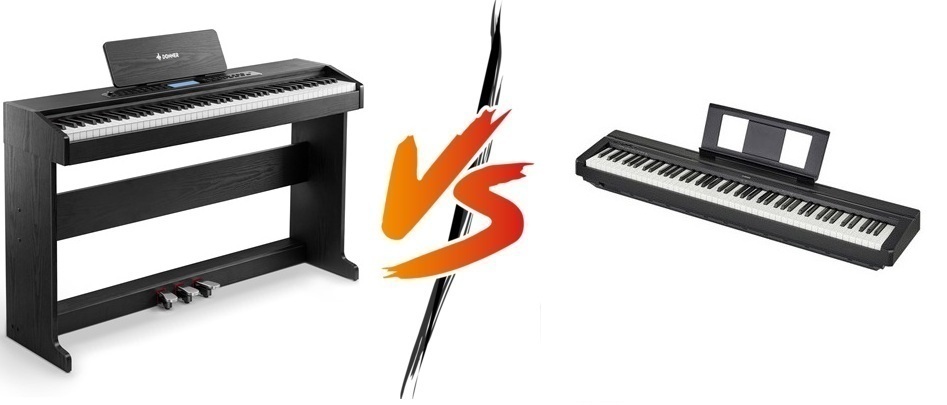
If you’re comparing the Donner DDP-95 and the Yamaha P45, you’re probably trying to find a solid digital piano without overcomplicating things or overspending. On paper, these two models seem to overlap quite a bit. Both offer 88 weighted keys, both are aimed at beginners and intermediate players, and both sit in that affordable entry-level range. But once you look closer, they take very different approaches.
The Donner DDP-95 leans toward a home piano experience, with a furniture-style design, built-in pedals, and a stronger focus on features and presentation. The Yamaha P45, on the other hand, strips things back and focuses almost entirely on the core playing experience, especially key feel and sound quality.
This comparison breaks down those differences in practical terms, so you can decide which one actually fits your needs, not just which one looks better on paper.
Donner DDP-95 vs Yamaha P45 Comparison Chart
If you click the links below, under the product images, you will be redirected to Amazon.com. In case you then decide to buy anything, Amazon.com will pay me a commission. This doesn’t affect the honesty of this review in any way though.
| Feature | Donner DDP-95 | Yamaha P45 |
|---|---|---|
 |  | |
| Check the best price on Amazon | Check the best price on Amazon | |
| Type | Furniture-style digital piano | Portable digital piano |
| Keys | 88 fully weighted keys | 88 fully weighted keys |
| Key Action | Hammer action (heavier feel, adjustable sensitivity) | Graded Hammer Standard (GHS) |
| Touch Sensitivity | Multiple levels (often more granular) | 4 levels (Soft, Medium, Hard, Fixed) |
| Polyphony | Typically higher (often 128 or more) | 64 notes |
| Voices (Sounds) | More variety (multiple instrument sounds) | 10 voices |
| Main Piano Sound Quality | Fuller but less nuanced | More realistic and expressive |
| Speakers | Stronger, cabinet-mounted speakers | 2 × 6W speakers |
| Volume Output | Higher, room-filling | Moderate, best for small rooms |
| Cabinet Design | Built-in stand (furniture style) | Requires separate stand |
| Pedals | 3 built-in pedals (sustain, soft, sostenuto) | 1 basic sustain pedal included |
| Display / Controls | More buttons, easier navigation | Minimal controls, key combinations |
| Modes | Layer, Split, possibly Duo | Layer, Duo (no full split) |
| Metronome | Yes (often more options) | Yes |
| Recording Function | Basic onboard recording (varies by model) | Very limited or none onboard |
| Connectivity (USB/MIDI) | USB MIDI support | USB MIDI support |
| Audio Outputs | Often includes line out options | Headphone output (used as line out) |
| Headphone Jacks | Usually 1–2 | 1 |
| App Compatibility | Works, but may vary slightly | Very reliable with learning apps |
| Weight | Heavier (furniture unit) | Lightweight (~11.5 kg) |
| Portability | Not portable | Portable and easy to move |
| Assembly Required | Yes (cabinet setup) | No (plug and play) |
| Best Use Case | Home setup, all-in-one piano | Learning, portability, simplicity |
| My individual reviews | Donner DDP-95 review | Yamaha P45 review |
Quick Summary
- Donner DDP-95
- Better for a home setup
- Stronger speakers and fuller sound in a room
- More features and built-in pedals
- Less refined in feel and sound nuance
- Yamaha P45
- Better for learning and technique
- More natural key response and sound behavior
- Simpler, more focused experience
- Weaker speakers and fewer features
If you want something that feels like a “real piece of furniture” with everything included, the Donner makes sense.
If you care more about how the piano plays and responds, the Yamaha is usually the better long-term choice.
Design & Build Quality
When people compare digital pianos, design is often treated as a secondary concern. That’s a mistake. The way a piano is built and presented affects how often you use it, where you place it, and even how seriously you take practicing. With the Donner DDP-95 and the Yamaha P45, design isn’t just a cosmetic difference. It reflects two completely different ideas of what a digital piano should be.
Let’s break that down properly.
Overall design philosophy
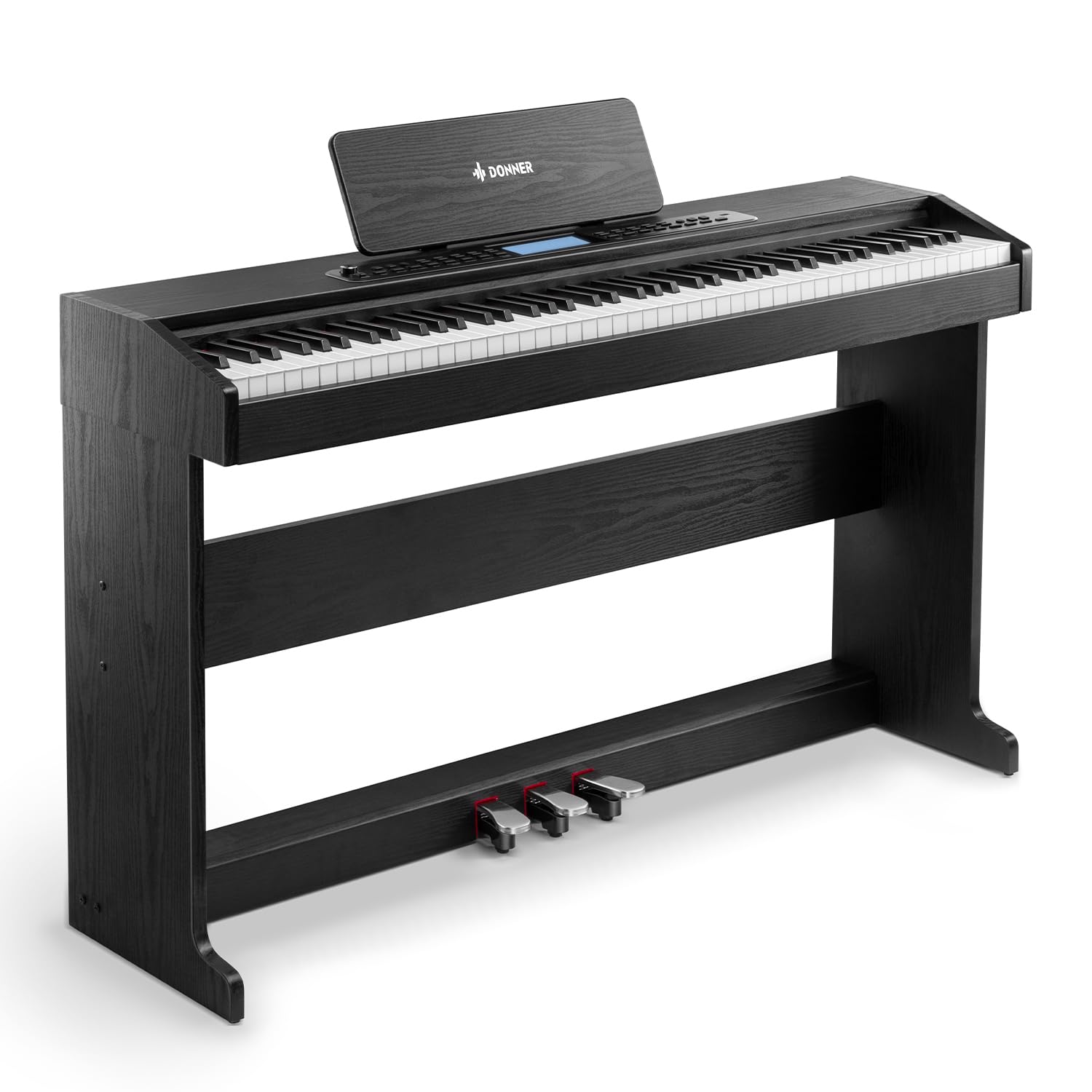
The Donner DDP-95 is designed to mimic a traditional upright piano. It’s a furniture-style instrument with a fixed stand, three pedals, and a cabinet that’s meant to stay in one place. When you look at it, it feels like part of the room rather than a device you can move around.
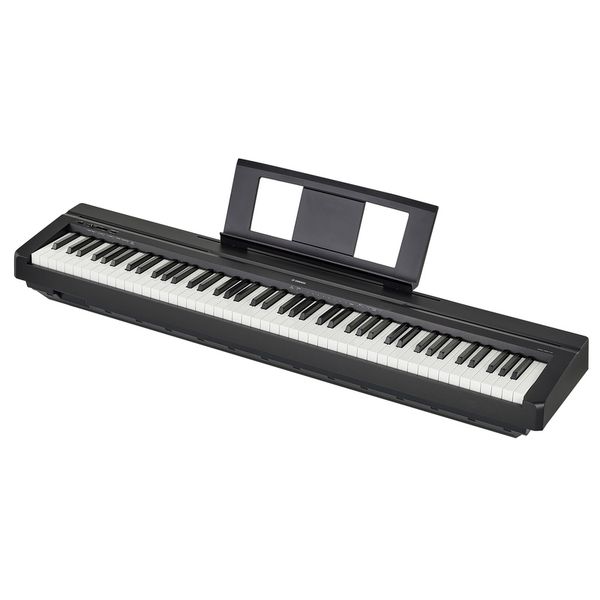
The Yamaha P45 takes the opposite approach. It’s a portable digital piano, sometimes called a “slab” piano. It’s essentially the keyboard itself, with no permanent stand or furniture built in. You place it on a stand or desk, and that’s it.
This difference alone already shapes the kind of player each model suits.
- The Donner is for someone setting up a dedicated space at home
- The Yamaha is for someone who values flexibility and portability
Neither approach is better in absolute terms, but they lead to very different experiences.
Aesthetics and presence
The Donner DDP-95 clearly wins in terms of visual presence. It looks like a proper piano. The wooden cabinet, the integrated pedal unit, and the overall structure give it a sense of permanence. If you care about how your instrument fits into your home, this matters.
It blends well into living rooms, bedrooms, or even small studio setups. It doesn’t scream “electronic keyboard.” Instead, it feels closer to a traditional instrument, which can actually motivate you to play more often. There’s something about sitting down at a piece of furniture that feels intentional.
That said, the finish and materials don’t quite match higher-end digital pianos. The wood is usually a laminate or engineered board rather than solid wood. Up close, you may notice that it’s built to a budget. It still looks good from a normal viewing distance, but it’s not premium.
The Yamaha P45, by comparison, is very minimal. It’s a simple black keyboard with a clean, functional layout. There’s nothing decorative about it. No wood textures, no cabinet, no attempt to mimic an acoustic piano.
At first glance, it can feel a bit underwhelming. But there’s a reason for that simplicity. Yamaha has focused on making something that’s easy to use and easy to move, rather than something that makes a visual statement.
If you put both side by side, the Donner looks like a piano. The Yamaha looks like a tool.
Materials and construction
This is where things start to shift.
The Yamaha P45 is built with durability in mind. Even though it’s lightweight, the plastic chassis is solid and well-assembled. There’s very little flex in the body, and the keys are mounted securely. Yamaha’s manufacturing consistency is one of its biggest strengths, especially at the entry level.
Everything feels tight and predictable. Buttons don’t wobble, connections feel secure, and the overall construction gives you confidence that it will hold up over time.
The Donner DDP-95, while sturdy enough for normal use, doesn’t feel quite as refined. The cabinet adds weight and stability, which is good, but the materials themselves are more budget-oriented.
You might notice:
- Slight inconsistencies in panel alignment
- Less premium finishes
- Components that feel more “assembled” than engineered
None of this makes it unusable. For the price, it’s actually impressive that Donner includes a full cabinet at all. But it does mean the long-term durability may not match Yamaha’s track record.
Another thing worth mentioning is wear over time. Furniture-style pianos like the DDP-95 rely on more physical parts: hinges, panels, and pedal assemblies. These introduce more potential points of wear compared to a simple slab design.
Portability and space considerations
This is one of the biggest practical differences between the two.
The Yamaha P45 is extremely easy to move. At around 11.5 kg, one person can carry it without much effort. You can:
- Store it when not in use
- Move it between rooms
- Take it to lessons or performances
This flexibility is a huge advantage, especially if you don’t have a dedicated music space.
The Donner DDP-95 is not designed to be moved regularly. Once assembled, it becomes a fixed piece of furniture. Moving it usually means partial disassembly, which is time-consuming and inconvenient.
That’s not necessarily a downside. In fact, for some people, it’s a benefit. A fixed instrument encourages consistency. It’s always there, ready to play, with no setup required.
But you need to be sure about where you want it. If your living situation changes often, or if you like rearranging your space, the Donner can quickly become a burden.
Stability and playing position
Here’s an area where the Donner has a clear advantage.
Because it’s a full cabinet, the DDP-95 is very stable. There’s no wobble, no need to adjust stands, and no concern about weight distribution. The pedals are fixed in place, which makes them feel more natural to use.
With the Yamaha P45, stability depends on your setup. If you use a cheap or lightweight stand, you may experience some movement while playing. A good stand solves this problem, but it’s an extra purchase and an extra decision.
The pedal situation is also different. The P45 typically comes with a small, basic sustain pedal. It works, but it’s not anchored, so it can slide around during use. Many players end up upgrading it.
The Donner’s built-in pedal unit feels closer to a real piano. The pedals are fixed, properly spaced, and more comfortable for extended playing.
Controls and user interface
The Yamaha P45 keeps things extremely simple.
There’s no screen, and very few buttons. Most functions are accessed through key combinations. At first, this can feel a bit unintuitive, since you need to remember certain shortcuts. But once you get used to it, it becomes second nature.
The benefit is a clean, distraction-free interface. You sit down and play, without being tempted to tweak settings constantly.
The Donner DDP-95 usually offers a more traditional control layout. Depending on the version, you may get:
- Dedicated buttons for functions
- Clearer labeling
- Easier access to features
This makes it more beginner-friendly in some ways. You don’t need to memorize combinations or refer to a manual as often.
However, it also adds visual clutter. Compared to the Yamaha’s clean look, the Donner feels a bit busier.
Assembly and setup
The Yamaha P45 is essentially plug-and-play.
- Take it out of the box
- Place it on a stand
- Plug it in
You’re ready to go in minutes.
The Donner DDP-95 requires assembly. This typically involves:
- Attaching the stand
- Installing the pedal unit
- Securing the keyboard to the frame
It’s not overly complicated, but it does take time and effort. You’ll probably need basic tools and a bit of patience.
Once assembled, though, it feels like a complete instrument.
Long-term usability
Over time, the differences in design become more noticeable.
The Yamaha P45’s simplicity works in its favor. Fewer parts mean fewer things can go wrong. It’s easy to maintain, easy to move, and easy to adapt to different setups.
The Donner DDP-95 offers a more immersive home experience, but it’s less flexible. If something wears out or breaks, repairs can be more complicated. And if you outgrow it, replacing a full furniture unit is a bigger decision than upgrading a portable keyboard.
Final thoughts on design and build
This category really comes down to priorities.
The Donner DDP-95 is about presence, stability, and completeness. It looks like a piano, feels like a piece of furniture, and creates a more traditional playing environment at home.
The Yamaha P45 is about practicality, consistency, and reliability. It doesn’t try to impress visually, but it delivers a solid, well-built instrument that you can rely on for years.
If your goal is to create a dedicated piano space and you care about aesthetics, the Donner makes a strong case.
If you want something flexible, durable, and straightforward, the Yamaha is the safer and more practical choice.
Keyboard Feel
If there’s one area where you shouldn’t compromise, it’s this one. The keyboard feel is the entire point of a digital piano. You’re not just pressing buttons to trigger sound. You’re training your hands, your fingers, and your sense of control. A good keyboard teaches you proper technique without you even noticing. A bad one quietly builds bad habits.
The Donner DDP-95 and the Yamaha P45 both offer fully weighted, 88-key hammer-action keyboards. On paper, that puts them in the same category. In reality, they feel quite different once you sit down and actually play.
What “weighted keys” really mean
Before comparing the two, it’s worth clarifying something. “Weighted” doesn’t automatically mean “realistic.”
In an acoustic piano, when you press a key, you’re moving a complex mechanical system that ultimately throws a hammer at a string. That system has resistance, momentum, and subtle variations depending on how hard or fast you play.
Digital pianos try to replicate that using weighted mechanisms. The quality of that simulation is what separates a decent keyboard from a great one.
Both the Donner DDP-95 and the Yamaha P45 aim to recreate this experience, but they approach it differently.
Yamaha P45: controlled, consistent, and predictable
The Yamaha P45 uses the company’s Graded Hammer Standard action, often shortened to GHS. This is Yamaha’s entry-level weighted action, but it carries over a lot of the design philosophy from their higher-end models.
The first thing you notice when playing it is consistency.
Every key feels even. There’s no weird variation from one note to another. The resistance is smooth across the entire keyboard, and the transition from bass to treble is gradual and natural. Lower keys feel slightly heavier, higher keys slightly lighter, just like on an acoustic piano.
This matters more than people expect. When keys are consistent, your fingers learn faster. You don’t have to adjust subconsciously to small differences in resistance. That allows you to focus on dynamics and timing instead.
Another strong point is the response to velocity, meaning how the sound changes depending on how hard you press the keys. The P45 does a good job translating finger pressure into sound.
- Play softly, and you get a gentle tone
- Play harder, and the sound becomes brighter and louder
It’s not perfect, but it’s predictable. And predictability is crucial when you’re learning.
The action itself is also relatively quiet. You’ll still hear some mechanical noise, especially in a silent room, but it’s not distracting. That’s important if you plan to practice with headphones while others are nearby.
Where the Yamaha falls short is in complexity. The key action is a bit on the simpler side compared to higher-end models. You don’t get the same sense of depth or “weight progression” that you would on more advanced digital or acoustic pianos.
Some players describe it as slightly springy or linear. It doesn’t fully capture the subtle resistance changes of a real piano key as it moves downward. But at this price point, it’s still one of the better implementations available.
Donner DDP-95: heavier and more physical
The Donner DDP-95 also uses a fully weighted hammer-action system, but the feel is noticeably different.
The first thing most people notice is that it’s heavier. The keys require more force to press, especially compared to the Yamaha. For some players, this immediately feels more “serious” or closer to an acoustic upright.
There’s a certain physicality to it. You feel like you’re working a bit harder, and that can be satisfying at first.
For beginners, this can go both ways.
On the positive side:
- It can help build finger strength
- It encourages deliberate playing
- It feels substantial under your hands
But there are also downsides:
- Fast passages can feel more difficult
- Long practice sessions can become tiring
- Subtle dynamics can be harder to control
Another thing you may notice is that the action isn’t quite as refined. While it’s generally consistent, it doesn’t have the same level of precision as the Yamaha.
Some keys may feel slightly different from others. It’s not always obvious, but over time, you start to notice small inconsistencies.
The response to velocity is also less nuanced. You can still play soft and loud, but the transition between those levels isn’t as smooth. It can feel a bit more binary, like you’re jumping between dynamic levels rather than gliding through them.
This affects expressive playing. If you’re working on pieces that rely on subtle control, you may find it harder to get the exact sound you want.
Dynamic control and expression
This is where the difference becomes more important than it first appears.
On the Yamaha P45, dynamic control is one of its strengths. The keyboard responds in a way that encourages you to explore different levels of touch. You can practice playing softly, building crescendos, and shaping phrases more naturally.
That doesn’t mean it’s perfect, but it gives you the tools to improve.
On the Donner DDP-95, dynamics are still there, but they feel less refined. You can play loud and soft, but the in-between space isn’t as detailed.
For casual playing, this may not matter much. If you’re just enjoying music or learning basic pieces, you might not notice the difference.
But as soon as you start focusing on expression, it becomes more noticeable.
Key surface and tactile feel
This is a smaller detail, but it still affects the overall experience.
The Yamaha P45 has:
- Matte black keys
- Glossy white keys
The matte finish on the black keys helps prevent slipping, especially during longer sessions. The white keys are smooth but not overly slippery.
The Donner DDP-95 typically has a similar setup, though the exact texture can vary slightly depending on the batch or model revision.
In general, both are acceptable in this area. Neither offers premium ivory or ebony-style textures, but they’re comfortable enough for extended use.
Noise and mechanical feel
Mechanical noise is something people often overlook until they start practicing at night.
The Yamaha P45 is relatively quiet for a digital piano. The action produces a soft thud, but it’s controlled and not overly noticeable.
The Donner DDP-95 can be a bit louder. The heavier action sometimes results in more audible key noise, especially if you play aggressively.
This isn’t a deal-breaker, but it’s something to keep in mind if you share a living space or plan to practice late at night.
Long-term learning impact
This is where the choice really matters.
A keyboard isn’t just about how it feels today. It shapes how you develop as a player.
The Yamaha P45’s consistent and predictable action makes it a strong tool for learning. It encourages proper finger control and makes it easier to transfer your skills to an acoustic piano later.
The Donner DDP-95 can still be used for learning, but its heavier and less refined action may slow down certain aspects of development, especially when it comes to dynamic control and speed.
That doesn’t mean you can’t improve on it. You absolutely can. But the Yamaha makes that process smoother.
Who will prefer each keyboard
The Yamaha P45 tends to suit:
- Beginners who want a reliable learning tool
- Players focused on technique and control
- Anyone planning to transition to an acoustic piano
The Donner DDP-95 may appeal more to:
- Players who prefer a heavier key feel
- Casual users who prioritize comfort and presence
- Those who enjoy a more “resistant” keyboard
Final thoughts on keyboard feel
This is one of the clearest differences between the two instruments.
The Yamaha P45 offers a more refined, consistent, and controlled playing experience. It’s not perfect, but it’s dependable, and that makes a big difference over time.
The Donner DDP-95 provides a heavier, more physical feel that some players enjoy, but it lacks the same level of precision and nuance.
If your goal is to learn properly and build good technique, the Yamaha is the safer choice.
If you simply want something that feels solid and satisfying under your fingers without worrying too much about fine control, the Donner can still do the job.
Sound Quality
Sound is where expectations and reality often clash with digital pianos, especially in the entry-level range. Both the Donner DDP-95 and the Yamaha P45 promise a “real piano experience,” but they get there in very different ways.
At first listen, you might not immediately notice the differences. Both can sound good, especially if you’re new to piano. But the more you play, the more the details start to matter. Tone, responsiveness, and how the sound reacts to your touch all shape your experience over time.
Let’s break it down properly.
Core piano tone
The Yamaha P45 focuses heavily on getting the main piano sound right. It uses Yamaha’s AWM (Advanced Wave Memory) sampling, which is based on recordings of a real concert grand piano.
What you hear when you play is a clean, bright, and fairly balanced tone. It has that recognizable Yamaha character, slightly crisp in the highs, clear in the midrange, and controlled in the bass.
It’s not overly warm or deep, but it’s very usable.
- The bass is present but not powerful
- The mids are clear and articulate
- The highs are crisp without being harsh
This kind of tone works well across different styles. Whether you’re playing classical pieces, pop songs, or simple exercises, it stays consistent and predictable.
The Donner DDP-95 takes a different approach. Its piano tone is usually fuller and warmer right out of the box.
- The bass feels bigger
- The overall sound is more “room-filling”
- It can feel richer at first impression
If you sit down and play a few chords, the Donner can sound more impressive initially. It has more body and presence, especially through its built-in speakers.
But there’s a catch. That fullness doesn’t always come with the same level of detail. Over time, you may notice that the tone doesn’t evolve as much with your playing. It can feel a bit static compared to the Yamaha.
Sampling quality and realism
This is where the Yamaha starts to pull ahead.
The P45 may only have a small number of sounds, but the main piano voice is carefully sampled and tuned. The transitions between soft and loud playing are smoother, and the tone changes in a more natural way.
When you press a key lightly, the sound is gentle and slightly muted. As you increase pressure, it becomes brighter and more defined. This shift feels gradual and connected to your touch.
The Donner DDP-95 also uses sampled sounds, but the implementation is less refined.
You still get dynamic variation, but it’s not as nuanced. The difference between soft and loud playing can feel more abrupt. Instead of a smooth transition, it can feel like stepping between levels.
This affects realism. On an acoustic piano, the sound constantly changes depending on how you play. The Yamaha captures more of that behavior, while the Donner captures a simplified version of it.
Dynamic range and expression
Dynamic range is one of the most important aspects of sound quality, and it’s closely tied to the keyboard feel.
On the Yamaha P45, the dynamic range is quite usable for an entry-level instrument. You can play quietly and build up to louder passages with reasonable control.
This makes it easier to:
- Shape musical phrases
- Practice expressive playing
- Develop control over volume and tone
The sound responds in a way that encourages you to experiment with touch.
On the Donner DDP-95, the dynamic range is there, but it feels more limited in practice.
- Soft playing doesn’t always feel as delicate
- Loud playing can feel less controlled
- The transition between levels is less smooth
For casual playing, this might not be a big issue. But if you’re working on expressive pieces, you may find yourself wishing for more control.
Polyphony and note handling
Polyphony refers to how many notes the piano can produce at the same time. It matters more than most beginners realize, especially when using the sustain pedal or playing complex pieces.
The Yamaha P45 offers 64-note polyphony. This is enough for most basic and intermediate playing, but it’s not very high by modern standards.
In practical terms:
- You’re unlikely to notice limitations during simple practice
- In more complex pieces with heavy sustain, some notes may cut off
It’s not a deal-breaker, but it’s something to be aware of as you progress.
The Donner DDP-95 often offers higher polyphony on paper, depending on the version. This can help with fuller sound when playing layered or sustained passages.
However, polyphony isn’t everything. The quality of each note matters just as much as how many notes you can play at once. In this regard, the Yamaha still tends to sound more natural overall.
Additional sounds and variety
This is one area where the Donner has an advantage.
The Yamaha P45 keeps things very simple with around 10 voices:
- Two grand pianos
- Electric pianos
- Organs
- Strings
- A few others
These are basic but usable. Most players will spend the majority of their time on the main piano sound anyway.
The Donner DDP-95 usually includes a wider range of sounds. This can make it more fun to explore, especially for beginners.
You might get:
- More instrument variations
- Different styles of piano tones
- Extra features for experimentation
The trade-off is that these sounds are not always as refined. They’re good enough for casual use, but they don’t have the same level of detail as Yamaha’s core piano voice.
Sound through speakers vs headphones
This is an important distinction that often gets overlooked.
Through built-in speakers, the Donner DDP-95 often sounds more impressive. Its stronger speaker system gives it:
- More volume
- Better bass presence
- A fuller overall sound
In a room, this can make a big difference. The piano feels more alive and engaging.
The Yamaha P45, with its smaller speakers, sounds more modest.
- Clear, but not very powerful
- Limited bass
- Better suited for small spaces
However, things change when you use headphones.
Through headphones, the Yamaha’s sound quality becomes more apparent. The clarity and balance of the samples come through more clearly, and the limitations of the speakers disappear.
The Donner still sounds good through headphones, but the differences in sampling and dynamic response become easier to notice.
Reverb and sound effects
Both pianos include basic reverb effects to simulate different environments.
The Yamaha P45 offers a few simple reverb types, such as room and hall settings. They’re subtle but effective. You can add a bit of space to the sound without overwhelming it.
The Donner DDP-95 also includes reverb and possibly additional effects, depending on the model. These can make the sound feel bigger, but they’re not always as refined.
In general, Yamaha’s effects are more restrained and natural, while Donner’s can feel more noticeable.
Long-term listening experience
This is where the biggest difference shows up.
At first, the Donner DDP-95 can sound more exciting. The fuller tone and stronger speakers create a more immediate impact.
But over time, the Yamaha P45 tends to hold up better.
- The tone remains consistent
- The dynamic response stays engaging
- It doesn’t feel repetitive as quickly
Some players find that simpler, well-crafted sounds are more satisfying in the long run than more complex but less refined ones.
Final thoughts on sound quality
Both pianos are capable of producing enjoyable sound, especially for beginners. But they prioritize different things.
The Yamaha P45 focuses on realism, clarity, and dynamic response. It may not sound as big at first, but it offers a more natural and expressive playing experience over time.
The Donner DDP-95 emphasizes fullness and presence. It sounds bigger and more impressive out of the box, especially through its speakers, but it sacrifices some nuance and detail.
If you care about developing expressive playing and want a sound that grows with you, the Yamaha is the better choice.
If you prefer a richer, more immediate sound and don’t mind giving up some subtlety, the Donner can still be very enjoyable.
Speakers and Volume
Speakers are one of those things people tend to overlook when buying a digital piano. It’s easy to focus on keys and sound engines, but the reality is simple: most of the time, you’ll be hearing the instrument through its built-in speakers. And that can completely change how the piano feels to play.
The Donner DDP-95 and the Yamaha P45 take very different approaches here, and the difference is noticeable almost immediately. This isn’t just about how loud they get. It’s about how the sound fills a room, how it responds at different volumes, and how enjoyable it is to sit and play for longer periods.
Let’s go through it step by step.
Speaker design and power
The Yamaha P45 comes with a relatively modest speaker setup:
- Two speakers
- 6 watts per side (12W total)
This is fairly typical for a portable entry-level digital piano. The goal here isn’t to fill a large space. It’s to provide clear, usable sound for personal practice.
The speakers are built into the main body of the keyboard, facing downward. This design helps keep the instrument compact, but it also affects how the sound projects into the room.
The Donner DDP-95, on the other hand, usually includes a more powerful speaker system built into its cabinet design.
- Higher overall wattage (varies by version, but generally stronger than Yamaha)
- Larger speaker enclosures
- Better physical space for sound resonance
Because it’s a furniture-style piano, it has more room to house a proper speaker system. That alone gives it an advantage in terms of raw output and presence.
Volume levels in real use
Let’s talk about volume in practical terms.
The Yamaha P45 is perfectly fine for:
- Practicing in a bedroom
- Playing in a small living room
- Quiet environments
At low to medium volume, it sounds clean and balanced. There’s no distortion, and the tone remains clear.
But as you push the volume higher, you start to notice its limits.
- It doesn’t get very loud
- The sound doesn’t “project” far
- It can feel a bit thin in larger spaces
If you’re playing in a bigger room or trying to fill a space with sound, it struggles. You’ll often find yourself wishing for just a bit more power.
The Donner DDP-95 is noticeably louder.
- It reaches higher volume levels more easily
- The sound spreads better across the room
- It feels more present and immersive
Even at moderate volume, it can feel fuller and more satisfying, especially if you’re playing for other people or just want a more “live” feel.
Sound projection and room presence
Volume is one thing, but projection is another.
The Yamaha P45’s downward-facing speakers mean the sound tends to reflect off whatever surface it’s sitting on. If you place it on a solid stand or desk, the sound can bounce upward reasonably well.
But if the surface absorbs sound, like a soft stand or carpeted area, the audio can feel muffled.
This makes the setup more important than you might expect. The same piano can sound noticeably different depending on where and how you place it.
The Donner DDP-95 benefits from its cabinet design.
- Speakers are positioned to project more directly
- The body of the piano helps resonate sound
- It fills the room more evenly
This creates a more natural listening experience. You don’t have to think as much about placement. It just works.
When you sit at the Donner, the sound feels like it’s coming from the instrument itself, not from underneath it. That small difference adds a lot to the overall experience.
Bass response and depth
Bass is one of the hardest things for small speakers to reproduce well.
The Yamaha P45 struggles a bit here. The low-end is present, but it lacks depth and power.
- Bass notes can feel thin
- Lower octaves don’t have much weight
- Full chords can sound less rich than expected
This is a limitation of both the speaker size and the overall power. There’s only so much low-frequency energy a small system can produce.
The Donner DDP-95 does better in this area.
- Stronger bass presence
- Fuller low-end response
- More satisfying sound when playing in lower registers
It’s not comparable to a real acoustic piano, but it does a better job of creating that sense of depth.
This becomes especially noticeable when playing pieces that rely heavily on the left hand. The Donner gives those notes more presence, which can make the overall sound feel more balanced.
Clarity at different volumes
Clarity is just as important as volume.
The Yamaha P45 performs well at low to medium levels. The sound is clean, and individual notes are easy to distinguish.
At higher volumes, it still remains clear, but the lack of power becomes more obvious. It doesn’t distort much, but it also doesn’t gain much presence.
The Donner DDP-95 maintains good clarity across a wider volume range.
- At low volumes, it still sounds full
- At higher volumes, it retains more body
However, there’s a subtle trade-off. While it’s fuller, it’s not always as precise. The Yamaha’s sound can feel slightly more focused, even if it’s less powerful.
So you’re choosing between:
- Yamaha: clearer but smaller sound
- Donner: bigger but slightly less defined
Playing experience and immersion
This is where speakers really start to matter.
On the Yamaha P45, the experience is more intimate. It’s great for:
- Focused practice
- Learning pieces
- Playing quietly
But it can feel a bit restrained. The sound stays close to the instrument, and it doesn’t fully surround you.
The Donner DDP-95 feels more immersive.
- The sound fills the space around you
- It feels closer to an acoustic piano experience
- Playing can feel more engaging and satisfying
This can actually influence how often you play. A fuller, more present sound makes the instrument feel more rewarding.
Headphones vs speakers
It’s worth mentioning that all of these differences become less important when you use headphones.
With headphones:
- The Yamaha’s clarity and balance stand out more
- The Donner’s extra power becomes less relevant
Both pianos can sound good through headphones, and in some cases, the Yamaha may even have the edge in terms of detail.
But not everyone wants to play with headphones all the time. If you prefer hearing the piano in the room, the speaker system matters a lot more.
Use cases and practical scenarios
Think about how you’ll actually use the piano.
If you’re mostly:
- Practicing alone
- Playing at low volume
- Using headphones frequently
The Yamaha P45’s speakers are more than enough.
If you want to:
- Fill a room with sound
- Play for others occasionally
- Enjoy a more acoustic-like presence
The Donner DDP-95 has a clear advantage.
External amplification
One thing the Yamaha P45 does well is flexibility.
If you outgrow the built-in speakers, you can connect it to:
- External speakers
- An amplifier
- Studio monitors
This can dramatically improve the sound.
The Donner can also connect to external systems, but because it’s more of a fixed unit, people are less likely to use it that way.
Final thoughts on speakers and volume
This is one of the clearest differences between the two pianos, and it comes down to priorities.
The Yamaha P45 offers clean, reliable sound that works well for personal practice. It’s not powerful, but it’s consistent and controlled.
The Donner DDP-95 delivers a bigger, fuller, and more room-filling sound. It feels more like a traditional piano in terms of presence, even if it sacrifices a bit of precision.
If you care about volume, bass, and immersion, the Donner is the better choice.
If you’re focused on clarity, simplicity, and mostly play at lower volumes, the Yamaha does the job just fine.
Functions and Features
When it comes to functions and features, the Donner DDP-95 and the Yamaha P45 take completely different approaches. This is one of the biggest philosophical splits between the two instruments.
The Yamaha P45 keeps things as simple as possible. It gives you just enough tools to play and practice, and then gets out of the way. The Donner DDP-95 goes in the opposite direction, offering more built-in features, more options, and a more “complete package” feel.
Neither approach is automatically better. It really depends on what you expect from your piano and how you plan to use it day to day.
Overall feature philosophy
The Yamaha P45 is built around the idea that less is more.
Instead of loading the instrument with extra functions, Yamaha focuses on the essentials:
- A few solid sounds
- Basic practice tools
- Simple controls
The idea is that you spend your time playing, not navigating menus or experimenting with settings.
The Donner DDP-95 is designed to offer more variety and flexibility.
- More sounds
- More adjustable settings
- More built-in functionality
It tries to give beginners everything they might want in one package, without needing additional gear or software.
Right away, you can see the trade-off:
- Yamaha prioritizes focus
- Donner prioritizes versatility
Sound selection and voices
The Yamaha P45 keeps things very limited in this area.
You get around 10 voices, including:
- Two acoustic piano tones
- Electric pianos
- Organs
- Strings
- A couple of additional sounds
That’s it.
At first, this might feel restrictive, especially if you’re used to keyboards with hundreds of sounds. But in practice, most players spend the vast majority of their time on one or two piano tones anyway.
The advantage of this approach is simplicity. You’re not constantly switching sounds or getting distracted. You sit down, turn it on, and start playing.
The Donner DDP-95 offers more variety.
Depending on the version, you may get:
- A wider range of instrument voices
- Multiple piano variations
- Additional tones for experimentation
This can be fun, especially for beginners. It encourages exploration and can make practice feel less repetitive.
However, there’s a trade-off. More sounds don’t always mean better sounds. The extra voices on the Donner are useful, but they’re not always as refined as the Yamaha’s core piano tone.
Touch sensitivity and customization
Both pianos offer adjustable touch sensitivity, but the level of control differs.
The Yamaha P45 provides a few preset options:
- Soft
- Medium (default)
- Hard
- Fixed (no sensitivity)
These settings allow you to adjust how responsive the keyboard is to your playing style. It’s simple and effective, even if it’s not highly detailed.
The Donner DDP-95 usually offers more granular control, sometimes with multiple levels of sensitivity beyond just a few presets.
This can be useful if you want to fine-tune the feel of the keyboard. You can adjust it to match your preferences more closely.
That said, most beginners won’t need this level of control. The Yamaha’s simpler system is often enough.
Modes: layer, split, and duo
These modes can expand what you can do with the instrument.
The Yamaha P45 includes a basic layering function. This allows you to combine two sounds, such as piano and strings, to create a richer tone.
It also offers a “duo mode,” which splits the keyboard into two identical halves. This is useful for lessons, allowing a teacher and student to play side by side.
However, it doesn’t include a traditional split mode where you assign different sounds to the left and right hand.
The Donner DDP-95 typically includes more flexibility here.
- Layer mode
- Split mode
- Possibly additional variations
This makes it more versatile for different playing styles. You can, for example, play bass with your left hand and piano with your right.
For casual players and those experimenting with different styles, this can be a big advantage.
Built-in learning tools
This is an area where the Donner often has the edge.
The DDP-95 may include features like:
- Built-in demo songs
- Practice modes
- Learning functions
These are designed to help beginners get started and stay engaged.
They’re not a replacement for proper lessons, but they can be helpful if you’re learning on your own.
The Yamaha P45 is much more minimal here.
- A few demo songs
- Basic metronome
That’s about it.
Yamaha seems to assume that you’ll use external resources, such as apps or teachers, rather than relying on built-in learning tools.
Metronome and practice features
Both pianos include a metronome, which is essential for developing timing.
The Yamaha P45’s metronome is simple but effective. You can adjust the tempo and use it for basic practice.
The Donner DDP-95 may offer additional options, such as:
- More rhythm patterns
- Greater control over tempo settings
These extra features can make practice more interesting, but they’re not strictly necessary.
A basic metronome does the job for most players.
Recording capabilities
Recording is a feature that can be surprisingly useful.
The Yamaha P45 has very limited recording functionality, if any. It’s not designed for capturing performances directly on the instrument.
If you want to record, you’ll typically connect it to a computer or use external software.
The Donner DDP-95 may include basic recording features, allowing you to:
- Record your playing
- Play it back
- Evaluate your performance
This can be helpful for self-learning. Hearing yourself play is one of the best ways to improve.
Control interface and usability
The Yamaha P45 has a very minimal control interface.
- One main button
- Key combinations for functions
At first, this can feel confusing. You need to remember which keys correspond to which functions.
But once you get used to it, it becomes quick and efficient.
The advantage is a clean, distraction-free experience. There’s nothing pulling your attention away from playing.
The Donner DDP-95 usually has a more traditional interface.
- Dedicated buttons
- Clear labels
- Easier access to features
This makes it more beginner-friendly. You don’t need to memorize combinations or refer to a manual as often.
However, it also means more visual clutter and more temptation to adjust settings instead of practicing.
Pedals and integration
The Yamaha P45 typically comes with a basic sustain pedal.
- Lightweight
- Not fixed in place
- Functional but not ideal
Many players choose to upgrade it to a better pedal later.
The Donner DDP-95 includes a built-in three-pedal unit:
- Sustain
- Soft
- Sostenuto
These are integrated into the cabinet, which makes them more stable and realistic.
This is a significant advantage if you want a more traditional piano experience without buying extra accessories.
Expandability and external use
The Yamaha P45 is designed to work well with external devices.
- Connect to a computer
- Use with learning apps
- Control virtual instruments
This expands its capabilities beyond what’s built in.
The Donner DDP-95 also supports connectivity, but its design encourages more standalone use. It’s meant to be a complete system on its own.
Long-term usefulness of features
This is where the difference becomes more important over time.
The Donner’s extra features are appealing at first. They make the piano feel more capable and versatile.
But as you improve, you may find that you use fewer of them. Many players eventually focus on:
- One or two piano sounds
- Basic practice tools
The Yamaha P45 starts with this stripped-down approach. It doesn’t offer much beyond the essentials, but those essentials remain useful as you progress.
Final thoughts on functions and features
The Donner DDP-95 clearly offers more in terms of features. It’s a more complete package, especially for beginners who want variety and built-in tools.
The Yamaha P45 takes a different path. It focuses on simplicity and reliability, giving you just what you need to play and improve.
If you enjoy exploring sounds, using built-in features, and having everything in one place, the Donner is the better choice.
If you prefer a straightforward instrument that keeps you focused on playing, the Yamaha’s minimal approach can actually be a strength rather than a limitation.
Connectivity
Connectivity might not be the first thing you think about when buying a digital piano, but it becomes more important the longer you own the instrument. At first, you just want to sit down and play. But over time, you may want to connect to apps, record your performances, use virtual instruments, or even integrate the piano into a small home studio setup.
This is where connectivity starts to matter, and it’s also an area where the differences between the Donner DDP-95 and the Yamaha P45 are more subtle than dramatic.
Both pianos cover the basics, but they approach connectivity in slightly different ways, reflecting their overall design philosophies.
Basic connectivity overview
At a minimum, a modern digital piano should allow you to:
- Use headphones for silent practice
- Connect to a computer or mobile device
- Send MIDI data for recording or software use
Both the Donner DDP-95 and the Yamaha P45 meet these basic expectations.
However, the way they implement these features, and how easy they are to use in real life, can differ.
Headphone output and silent practice
Let’s start with the most commonly used connection: headphones.
The Yamaha P45 includes a headphone output that allows for silent practice. This is essential for many players, especially if you live with others or practice late at night.
Once you plug in headphones:
- The built-in speakers are muted
- You hear the sound directly, without room acoustics
- You can focus more on detail and dynamics
The quality through headphones is generally better than through the built-in speakers. You get clearer stereo separation and more detail in the sound.
The Donner DDP-95 also includes headphone outputs, often with similar functionality.
In some versions, you may even get dual headphone jacks, which can be useful for:
- Teacher-student practice
- Playing together with someone else
In terms of basic headphone use, both pianos perform well. There’s no major difference here, and both are perfectly suitable for silent practice.
USB connectivity and MIDI functionality
This is where things start to matter more, especially if you plan to use technology alongside your piano.
The Yamaha P45 includes a USB-to-host port. This allows you to connect the piano directly to a computer or compatible mobile device.
Once connected, the P45 can function as a MIDI controller.
This means:
- You can use it with music software (DAWs)
- You can control virtual instruments
- You can record your playing as MIDI data
This is a powerful feature, even if it doesn’t seem like it at first. It effectively expands the capabilities of the piano beyond its built-in sounds.
For example, you can connect it to a laptop and access high-quality piano libraries that sound far more advanced than what’s built into the instrument.
The Donner DDP-95 also typically includes USB MIDI connectivity.
In practice, this means both pianos can do similar things:
- Connect to a computer
- Work with music software
- Interface with learning apps
However, Yamaha tends to have an edge in terms of compatibility and reliability. Their USB implementation is generally very stable, and it works smoothly with most devices and software.
Donner’s connectivity works, but it may require a bit more setup or troubleshooting depending on your system.
Compatibility with learning apps
One of the most common uses for connectivity today is learning apps.
Apps like Simply Piano, Flowkey, and others rely on MIDI input to track your playing and provide feedback.
The Yamaha P45 works well in this context.
- Easy to connect via USB
- Recognized by most apps
- Reliable performance
This makes it a strong choice for beginners who plan to use digital learning tools.
The Donner DDP-95 can also be used with these apps, but the experience may vary slightly depending on the app and device.
In general, both pianos are capable here, but Yamaha’s broader compatibility and established reputation give it a slight advantage.
Audio outputs and external sound systems
This is an area where things start to diverge a bit more.
The Yamaha P45 is somewhat limited in terms of dedicated audio outputs. It doesn’t include standard line-out jacks. Instead, you typically use the headphone output as a workaround if you want to connect to external speakers or an amplifier.
This works, but it’s not ideal.
- You may need adapters
- Signal quality can be slightly compromised
- Volume control can be less precise
For casual use, it’s fine. But if you’re thinking about performing or using external audio gear regularly, it’s not the most convenient setup.
The Donner DDP-95 often includes more flexible audio output options.
Depending on the model, you may get:
- Dedicated line outputs
- Easier connection to external speakers
- More straightforward integration with audio systems
This makes it a better choice if you plan to:
- Play through external speakers
- Connect to a home audio system
- Use the piano in a small performance setting
Pedal connectivity and expansion
The Yamaha P45 comes with a basic sustain pedal, which connects via a standard pedal jack.
You can upgrade this pedal easily, replacing it with a more realistic one if needed.
However, the P45 doesn’t support a full three-pedal unit without additional accessories or modifications.
The Donner DDP-95 includes a built-in three-pedal system as part of its cabinet design.
This isn’t exactly “connectivity” in the traditional sense, but it’s still part of how the instrument integrates with your playing setup.
Because the pedals are built in:
- No extra connections are needed
- Everything is fixed and stable
- It feels more like an acoustic piano
This gives the Donner an advantage in terms of out-of-the-box completeness.
Integration with recording setups
If you’re interested in recording your playing, connectivity becomes more important.
With the Yamaha P45, you’ll typically record via MIDI.
- Connect to a computer
- Use recording software
- Capture your performance digitally
This allows for a lot of flexibility. You can edit your performance, change sounds, and experiment with different instruments.
However, if you want to record actual audio (not just MIDI), you’ll need additional equipment.
The Donner DDP-95 may offer slightly more options here, especially if it includes line outputs. This makes it easier to connect directly to recording devices or audio interfaces.
Still, both pianos are primarily designed for MIDI-based workflows rather than professional audio recording.
Ease of use and setup
The Yamaha P45 is very straightforward when it comes to connectivity.
- Plug in a USB cable
- Connect to your device
- Start using it
There’s very little setup required, and it works reliably in most cases.
The Donner DDP-95 is also relatively easy to use, but depending on the model and your setup, it may require a bit more effort to get everything working smoothly.
This isn’t a major issue, but it’s something to keep in mind if you prefer a plug-and-play experience.
Long-term flexibility
Over time, connectivity becomes more important as your needs evolve.
The Yamaha P45’s strength is its simplicity and compatibility. It integrates well with external tools, making it a good foundation for expanding your setup.
The Donner DDP-95 offers more built-in options, but it’s slightly less focused on external integration.
So the question becomes:
- Do you want to expand your setup over time?
- Or do you want everything built into the piano from the start?
Real-world usage scenarios
Here’s how the differences play out in real life.
If you’re:
- Using learning apps
- Connecting to a computer
- Exploring virtual instruments
The Yamaha P45 is often the smoother experience.
If you’re:
- Playing through speakers
- Setting up a home piano station
- Using the instrument as a standalone unit
The Donner DDP-95 may feel more convenient.
Final thoughts on connectivity
Both the Donner DDP-95 and the Yamaha P45 cover the essentials when it comes to connectivity. You won’t feel completely limited with either one.
The Yamaha P45 stands out for its reliability, simplicity, and strong compatibility with external devices and software. It’s a great choice if you plan to use apps, record via MIDI, or expand your setup over time.
The Donner DDP-95 offers a more self-contained experience, with potentially better audio output options and a more complete setup out of the box.
If you see your piano as part of a larger digital or recording setup, the Yamaha has the edge.
If you prefer a standalone instrument that works well on its own without needing extra gear, the Donner fits that role more naturally.
Conclusion
Choosing between the Donner DDP-95 and the Yamaha P45 comes down to what you actually want from a digital piano. On the surface, they look similar. Both are affordable, both have 88 weighted keys, and both are aimed at beginners and casual players. But once you spend time with them, the differences are clear.
The Yamaha P45 is all about the basics done right. It focuses on key feel, sound quality, and consistency. The keyboard is more predictable, the sound responds better to your touch, and the overall experience encourages proper technique. It’s not flashy, and it doesn’t try to be. But it gives you a solid foundation that holds up as you improve.
The Donner DDP-95 takes a different route. It offers more features, a stronger speaker system, and a more traditional cabinet design. It feels more like a complete home piano setup right out of the box. For some people, that matters a lot. It’s more visually appealing, more powerful in a room, and more flexible in terms of built-in options.
If your main goal is to learn properly and build skills that translate to an acoustic piano, the Yamaha P45 is the safer choice. It’s simple, reliable, and focused.
If you care more about having a full-featured instrument with stronger speakers and a furniture-style presence, the Donner DDP-95 is worth considering.
Neither is perfect. But both can do the job. The right choice depends on what matters more to you when you sit down to play.