
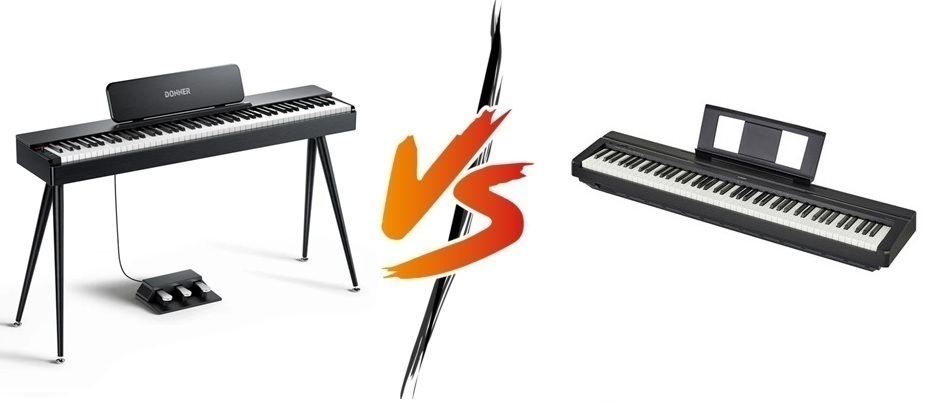
Shopping for a first digital piano can feel overwhelming. On paper, many models look similar. They all promise weighted keys, realistic sound, and a “true piano experience.” But once you start digging into the details, the differences become clearer. That’s exactly the case with the Donner OURA S100 and the Yamaha P45.
At first glance, they sit in a similar price range and target beginners or casual players. Both offer 88 weighted keys and aim to replicate the feel of an acoustic piano. But they approach that goal in very different ways. The Donner leans toward a modern, furniture-style design with updated features like Bluetooth and higher polyphony. The Yamaha sticks to a more traditional, stripped-down approach backed by decades of brand reputation.
In this review, we’ll break down every meaningful difference so you can decide which instrument actually fits your space, your playing style, and your long-term goals.
Donner OURA S100 vs Yamaha P45 Comparison Chart
If you click the links below, under the product images, you will be redirected to Amazon.com. In case you then decide to buy anything, Amazon.com will pay me a commission. This doesn’t affect the honesty of this review in any way though.
| Feature | Donner OURA S100 | Yamaha P45 |
|---|---|---|
 |  | |
| Check the best price on Amazon | Check the best price on Amazon | |
| Keys | 88 weighted keys | 88 weighted keys |
| Key Action | Graded Hammer Standard | Graded Hammer Standard (GHS) |
| Touch Sensitivity | Adjustable | Adjustable |
| Polyphony | 256 notes | 64 notes |
| Number of Voices | 15 built-in tones | 10 built-in voices |
| Speaker System | 2 × 10W speakers | 2 × 6W speakers |
| Bluetooth MIDI | Yes | No |
| Bluetooth Audio | Yes | No |
| USB to Host (MIDI) | Yes | Yes |
| Aux Input | Yes | No |
| Line Output | Yes (varies by region/model) | No (uses headphone output) |
| Headphone Jacks | Dual headphone outputs | Single headphone output |
| Pedal System (Included) | Triple pedal (sustain, soft, sostenuto) | Basic sustain pedal |
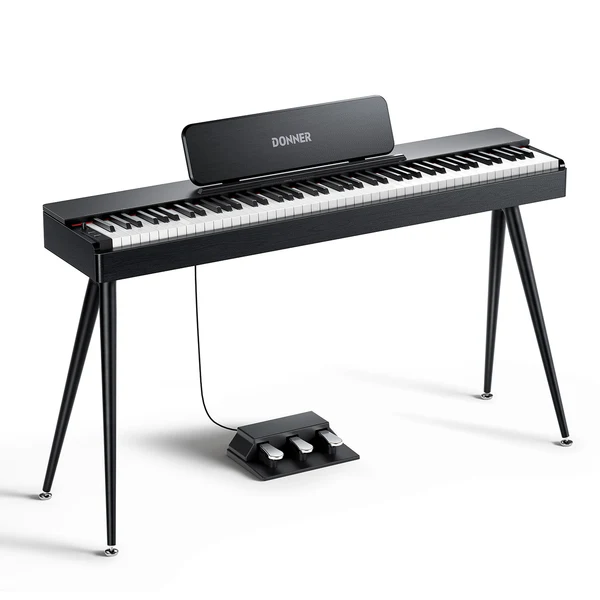
| Cabinet / Stand Included | Yes (furniture-style cabinet) | No (keyboard only) |
| Split Mode | Yes | Limited |
| Dual / Layer Mode | Yes | Yes |
| Metronome | Yes | Yes |
| Recording Function | Yes | Yes (basic internal recording) |
| Dimensions (Assembled) | Larger, cabinet-style footprint | Compact slab design |
| Weight | Heavier (cabinet design) | Approx. 11.5 kg (25 lbs) |
| Intended Use | Home digital piano | Portable/stage beginner piano |
| My individual reviews | Donner OURA S100 review | Yamaha P45 review |
Quick Observations
- Polyphony: The OURA S100 has a major advantage (256 vs 64 notes).
- Connectivity: Donner clearly offers more modern options with Bluetooth MIDI and audio.
- Speakers: Donner provides more power and fuller projection.
- Pedals & Setup: The OURA S100 includes a full three-pedal cabinet; Yamaha requires additional purchases for that setup.
- Portability: Yamaha is lighter and easier to move.
Design & Build Quality
When you’re buying a digital piano, design might seem secondary to sound and key feel. But in real life, design affects how often you actually sit down and play. A piano that fits your space, feels stable under your hands, and looks good in your room becomes part of your daily routine. One that feels flimsy or out of place can quietly discourage you. This is one of the biggest areas where the Donner OURA S100 and the Yamaha P45 take very different approaches.
Overall Design Philosophy
The Donner OURA S100 is designed to look like a home piano. It isn’t trying to be a stage keyboard. It’s clearly meant to live in your living room, bedroom, or studio as a semi-permanent piece of furniture. The cabinet-style frame, integrated stand, and triple-pedal unit give it a presence that resembles a slim upright. It looks intentional. It looks finished.
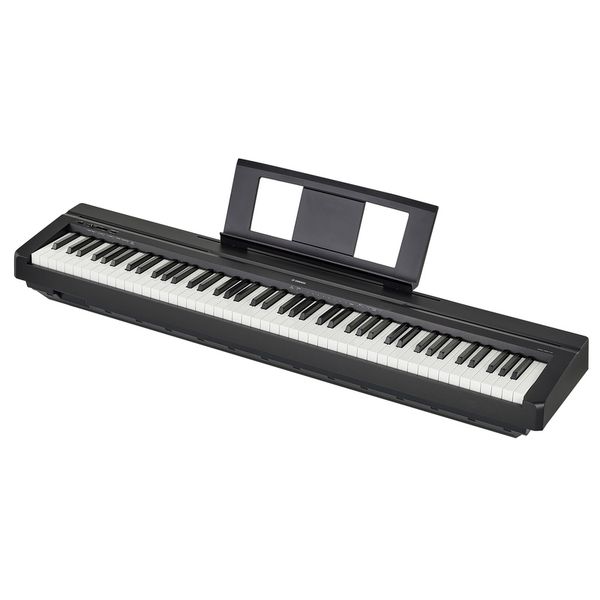
The Yamaha P45, on the other hand, is unapologetically minimal. It’s a slab-style digital piano. Out of the box, it’s essentially just the keyboard itself. If you want it to resemble a traditional piano, you’ll need to buy a separate stand and pedal unit. Yamaha’s focus here is portability and simplicity. It’s a stage piano that can live at home.
Neither approach is wrong. They simply serve different priorities. The Donner feels like furniture first, instrument second. The Yamaha feels like an instrument first, furniture never.
Aesthetic Appeal
The OURA S100 has a modern, almost Scandinavian-inspired look. Clean lines. Soft edges. Neutral color options. It blends easily into contemporary spaces. If you care about interior design, this matters. It doesn’t scream “music gear.” It feels more like a minimalist upright piano.
That can be especially appealing if the piano will be in a shared space. A partner or roommate is much more likely to accept something that looks refined rather than technical. It doesn’t dominate a room, but it does anchor it.
The Yamaha P45 is simple black plastic. Functional. No frills. The control panel is discreet, with minimal buttons. It’s not ugly, but it’s clearly a keyboard. In a studio or practice room, this isn’t an issue. In a styled living room, it may look temporary or out of place unless paired with a proper stand.
One advantage of the Yamaha’s simple design is that it ages well. There are no trendy elements. Ten years from now, it will look the same as it does today.
Footprint and Space Requirements
The Donner OURA S100 takes up more dedicated floor space because it includes the stand and three-pedal system as part of the structure. Once assembled, it becomes a stationary piece. You won’t casually move it around the house. It’s meant to stay put.
That’s a plus if you want stability and a permanent setup. It’s a minus if you live in a small apartment or need flexibility.
The Yamaha P45 is significantly more adaptable. You can place it on a desk, a table, a basic X-stand, or a furniture stand. You can slide it into a closet when not in use. You can transport it to lessons or rehearsals without too much hassle. It’s lighter and easier to manage overall.
If portability matters at all, Yamaha clearly wins this category.
Materials and Construction
Let’s talk about what these instruments actually feel like up close.
The OURA S100 uses a combination of engineered wood for the stand and plastic for the keyboard housing. The cabinet gives it structural stability. Once assembled properly, it feels solid. There’s minimal wobble if the floor is level. The pedal unit is integrated, which improves stability compared to standalone pedals that can slide around.
The Yamaha P45 is built almost entirely from high-quality plastic. That might sound like a drawback, but Yamaha’s plastics tend to be durable and well-molded. The casing feels sturdy for its weight. There’s no creaking or flex when pressing hard on the keys. Still, without a furniture stand, the overall setup can feel less grounded depending on what you mount it on.
In terms of longevity, Yamaha has a long track record for durable entry-level models. Donner has improved its build quality over the years, but Yamaha’s reputation here is stronger simply because of history.
Stability During Play
Stability affects your playing more than you might expect.
On the OURA S100, because the stand and pedal system are integrated, everything feels cohesive. The pedals don’t slide. The frame doesn’t shift when you press harder passages. For beginners learning proper pedaling technique, this is a real benefit. It mimics the experience of sitting at a traditional upright.
With the Yamaha P45, stability depends heavily on your stand choice. A cheap X-stand can introduce wobble. A proper furniture stand improves things significantly, but that’s an additional purchase. The included sustain pedal is a small plastic footswitch style. It works, but it doesn’t feel like a real piano pedal. It can move around unless secured.
If realism in the physical setup matters, Donner provides more out of the box.
Control Layout and User Interface
The Donner OURA S100 leans into modern simplicity. The control panel is streamlined and often integrated subtly into the design. Some versions rely on button combinations for deeper functions, which keeps the exterior clean but can require checking the manual.
The Yamaha P45 uses Yamaha’s typical minimalist interface. Few physical buttons. Many functions are accessed via key combinations. It’s simple but not always intuitive. Beginners may need to reference the manual when adjusting settings like touch sensitivity or voices.
In both cases, these are not feature-heavy control centers. They’re designed to stay out of the way. Neither piano overwhelms you with screens or complicated menus.
Pedal System
This is one area where the difference is immediate.
The OURA S100 includes a triple-pedal unit built into the cabinet. You get sustain, soft, and sostenuto pedals. For classical learners, this is important. It allows proper technique development from day one.
The Yamaha P45 typically includes only a basic sustain pedal in the box. If you want a three-pedal setup, you’ll need to purchase a compatible furniture stand and pedal unit separately. That increases total cost.
If you’re serious about classical repertoire or want the most authentic feel under your feet, Donner’s included system adds practical value.
Assembly and Setup
The Yamaha P45 wins in simplicity here. Take it out of the box, place it on a stand, plug it in, and you’re ready. Minimal assembly required.
The Donner OURA S100 requires more setup. You’ll assemble the stand, attach the pedal unit, and secure the keyboard to the frame. It’s not overly complicated, but it takes time and space. Once done, though, it feels like a finished instrument rather than a temporary arrangement.
Long-Term Practicality
Think about your life six months from now.
If you move often, rearrange furniture, or plan to gig, the Yamaha’s lighter, modular design makes more sense.
If this piano is going to live in one spot and serve as your primary home instrument, the Donner’s furniture build feels more complete and satisfying long term.
Final Thoughts on Design & Build
The Donner OURA S100 delivers a more polished, furniture-style experience right out of the box. It feels like a home piano. It looks intentional. The integrated pedals and cabinet add realism and stability.
The Yamaha P45 is more versatile, portable, and proven in durability. It doesn’t try to impress visually. It focuses on practicality.
If aesthetics, realism in setup, and an all-in-one solution matter most, the Donner takes the lead in design and build. If flexibility, simplicity, and brand reliability matter more, Yamaha holds its ground.
Your choice really comes down to whether you want a permanent piano presence or a flexible instrument that can adapt to your lifestyle.
Keyboard Feel & Action
If there’s one area that truly defines a digital piano, it’s the keyboard action. You can work around average speakers. You can use headphones if the onboard sound isn’t perfect. You can ignore extra features. But the way the keys feel under your fingers? That’s something you experience every single time you play. It directly affects technique, dynamics, finger strength, and even motivation.
Both the Donner OURA S100 and the Yamaha P45 offer 88 fully weighted keys with graded hammer action. On paper, they sound similar. In practice, they feel noticeably different.
What “Graded Hammer Action” Actually Means
Before comparing them directly, it helps to understand what graded hammer action is supposed to replicate. On an acoustic piano, lower notes feel heavier because the hammers are larger and the strings thicker. As you move up the keyboard, the keys gradually feel lighter.
Both of these digital pianos aim to simulate that effect electronically and mechanically. Neither contains real hammers like an acoustic upright, but both use weighted key mechanisms that attempt to mimic the resistance curve across the keyboard.
The question is not whether they are weighted. They are. The real question is how convincing and comfortable that weight feels.
Yamaha P45: GHS Action
The Yamaha P45 uses Yamaha’s GHS (Graded Hammer Standard) action. This is one of the most widely used entry-level weighted key mechanisms on the market. It has been around for years and appears in multiple Yamaha models.
The first thing you notice when playing the P45 is that the keys feel firm. Not stiff, but definitely substantial. There’s a clear sense of resistance when pressing down. Compared to many budget digital pianos, the Yamaha’s action feels deliberate and controlled.
For beginners, this can be both good and challenging. The firmness encourages proper finger strength development. You can’t get away with lazy playing. If you play softly, you really have to control the pressure. That’s closer to an acoustic upright experience.
However, some players find the GHS action slightly heavy for long practice sessions, especially children or players transitioning from lighter keyboards. Fast repeated passages can feel a bit demanding. It’s not sluggish, but it’s not the fastest action either.
The key return speed is decent, though not exceptional. Advanced players who rely on very rapid repetition may notice its limitations. For beginners and early intermediate players, it’s more than adequate.
Donner OURA S100: Graded Hammer Standard
The Donner OURA S100 also uses a graded hammer system, often described as a graded hammer standard action. The overall weight is slightly lighter compared to the Yamaha.
When you first sit down at the S100, the keys feel smooth and accessible. There’s resistance, but it’s a bit more forgiving. For absolute beginners, this can feel welcoming. It doesn’t fight back as much as the Yamaha.
The lighter action can make faster passages easier at first. Trills and quick note repetitions feel a bit more fluid. For casual players, that can be enjoyable.
However, some experienced pianists might notice that the key response doesn’t feel quite as solid or “grounded” as Yamaha’s GHS. There’s slightly less depth in the resistance curve. The bottom of the key press can feel softer, less defined.
This doesn’t make it bad. It simply feels less traditional.
Realism Compared to Acoustic Pianos
Neither of these actions will fully replicate the complexity of a high-end acoustic piano. That’s expected at this price level.
The Yamaha P45 leans slightly closer to an upright acoustic feel. The weight distribution feels more convincing across the bass and treble. The firmness gives you a sense of mechanical resistance that feels piano-like.
The Donner S100 prioritizes comfort and approachability. It still offers graded weight, but it doesn’t try as hard to emulate the heavier side of acoustic resistance.
If your long-term goal is transitioning to an acoustic piano for lessons or performances, Yamaha’s action may prepare your fingers slightly better.
If your goal is relaxed home playing, songwriting, or casual learning, Donner’s lighter touch may feel more enjoyable.
Key Surface and Texture
This is a subtle but important detail.
The Yamaha P45 uses matte-finish black keys and slightly textured white keys. They’re not premium synthetic ivory, but they do resist slipping better than glossy plastic. During longer sessions, especially if your hands get slightly sweaty, this texture helps maintain control.
The Donner OURA S100’s keys are generally smooth, with a standard plastic finish. They feel clean and modern, but slightly slicker than Yamaha’s. This isn’t a major issue, but side-by-side, Yamaha’s surface feels a bit more refined.
Over time, textured keys tend to age better in terms of grip.
Noise and Mechanical Sound
Digital piano actions produce some mechanical noise when pressed, especially in quiet rooms.
The Yamaha P45 produces a muted thump typical of GHS actions. It’s noticeable if you’re playing with headphones in a silent room, but not distracting. The action feels mechanically consistent.
The Donner S100’s action is relatively quiet as well, though in some units, the key noise can feel slightly more hollow. It’s not loud, but it has a slightly different acoustic character when unamplified.
In practical terms, both are quiet enough for apartment use.
Dynamic Control and Sensitivity
Touch sensitivity determines how well the piano responds to soft versus hard playing.
The Yamaha P45 provides reliable dynamic response. Soft playing produces gentle tones. Hard strikes produce strong volume. The dynamic range feels predictable and linear. This makes it easier to practice expressive playing.
The Donner OURA S100 also offers good velocity sensitivity. However, some players feel the transition between soft and medium dynamics is slightly less nuanced compared to Yamaha. It responds well, but the curve feels a bit less detailed.
For beginners, the difference may not be obvious. For players working on advanced dynamic control, Yamaha’s action feels slightly more precise.
Fatigue Over Long Practice Sessions
Here’s something many reviews ignore.
A heavier action like Yamaha’s can build strength but may cause fatigue for younger players or complete beginners. Practicing for an hour on GHS can feel physically demanding at first.
The Donner’s lighter action tends to be less tiring. For casual evening sessions or relaxed playing, it may feel more comfortable.
There’s no universal “better” here. It depends on your hands and your goals.
Pedal Interaction with Action
The feel of the keys interacts with the pedal system.
Because the Donner OURA S100 includes a proper triple-pedal unit, the overall physical experience feels more integrated. When you press the sustain pedal and play chords, the combination feels cohesive.
On the Yamaha P45, if you’re using the included basic sustain pedal, the experience feels less authentic. The action itself is solid, but the foot interaction is less satisfying unless you upgrade the pedal setup.
Durability of the Action
Yamaha’s GHS has years of proven reliability. Many P45 units and similar models have held up well over time with consistent performance.
Donner’s action has improved significantly in recent years, but it doesn’t have the same long-term track record as Yamaha. That doesn’t mean it won’t last. It simply means Yamaha has more history behind it.
Final Thoughts on Keyboard Feel & Action
If you want an action that feels closer to a traditional upright piano, with firm resistance and proven reliability, the Yamaha P45 has a slight edge. It encourages proper technique and feels mechanically grounded.
If you prefer a slightly lighter, more forgiving touch that feels comfortable and easy to play, especially for beginners or casual players, the Donner OURA S100 delivers a pleasant experience.
In the end, this category isn’t about which one is objectively better. It’s about which feel aligns with your hands, your goals, and how you like to play.
Sound Quality
If keyboard action is what connects you physically to the instrument, sound is what connects you emotionally. You can tolerate average features. You can live with basic connectivity. But if the piano tone doesn’t inspire you, you won’t play as often. That’s just the truth.
The Donner OURA S100 and the Yamaha P45 take noticeably different approaches to sound design. One leans toward variety and modern specifications. The other focuses on a traditional, stripped-down piano experience. Let’s break this down carefully.
Core Piano Tone
The Yamaha P45 uses Yamaha’s Advanced Wave Memory (AWM) stereo sampling. In simple terms, Yamaha sampled a real acoustic grand piano and mapped those recordings across the keyboard. This technology has been around for years, and while it’s not cutting-edge anymore, it’s dependable.
The first thing you notice with the P45 is clarity. The tone is clean and focused. The midrange has a pleasant warmth, and the treble has a gentle brightness without sounding harsh. For beginner and intermediate classical pieces, it does the job well. It sounds like a piano. It doesn’t try to be flashy.
However, it’s not deeply complex. The tonal layers are somewhat limited. When you play very softly, the sound is delicate but not incredibly nuanced. When you play aggressively, it gets louder, but you don’t hear a dramatic shift in tonal character the way you would on a higher-end digital piano. It’s dynamic, but within a controlled range.
The Donner OURA S100 approaches things differently. It offers 256-note polyphony and a modern sampling engine that aims to create a fuller, more contemporary sound. The main piano tone tends to feel slightly richer and more spacious through its built-in speakers.
The bass range on the S100 feels a bit broader and rounder compared to the Yamaha. Chords in the lower register carry more weight. The treble is smooth and slightly softer than Yamaha’s brighter top end. Some players may prefer Yamaha’s crispness for classical repertoire, while others might enjoy the Donner’s warmer character for pop and ballads.
Polyphony and Note Handling
Polyphony refers to how many notes the piano can produce at once before older notes start cutting off. This matters more than many beginners realize.
The Yamaha P45 offers 64-note polyphony. For simple pieces, that’s fine. Even many intermediate compositions will play without obvious issues. But once you start using sustain heavily, layering sounds, or playing complex classical passages with overlapping harmonies, you can reach that limit.
When polyphony runs out, older notes disappear quietly. It’s subtle, but in dense music, you might notice sustained notes fading earlier than they should.
The Donner OURA S100 offers 256-note polyphony. That’s a major difference on paper. In practice, it means you’re extremely unlikely to hit the ceiling during normal playing. Sustained chords, layered voices, and pedal-heavy passages maintain clarity without notes dropping out.
For beginners, the difference may not be immediately noticeable. For advancing players, higher polyphony provides peace of mind.
Dynamic Expression
Dynamic response is about more than volume. It’s about tonal change when you vary your touch.
The Yamaha P45 does a solid job of translating touch into dynamic volume shifts. When you press gently, the sound is soft and controlled. When you dig in, it becomes stronger. However, the tonal color doesn’t change dramatically. It mostly scales in volume rather than character.
The Donner S100 feels slightly more expressive in the mid-dynamic range. There’s a bit more tonal variation as you move from soft to medium intensity. That said, it’s not a dramatic leap in realism. Neither piano reaches the detailed dynamic modeling of higher-end instruments.
Still, the S100’s broader polyphony and slightly fuller tonal body give it a sense of openness that some players find more immersive.
Sound Through Headphones
This is critical. Many people practice with headphones.
The Yamaha P45 often sounds better through headphones than through its built-in speakers. The stereo sampling becomes more noticeable. The tone feels clearer and more detailed. If you primarily practice with headphones, the P45’s limitations in speaker depth become less relevant.
The Donner OURA S100 also performs well through headphones. Because of its higher polyphony and slightly more modern sampling approach, it maintains fullness even in dense passages. The sound feels spacious and less compressed.
Side by side with good headphones, the differences narrow. Yamaha feels focused and clean. Donner feels a bit wider and warmer.
Built-In Voices and Variety
Here’s where the two instruments diverge more clearly.
The Yamaha P45 is minimalistic. It offers a small selection of voices beyond the main piano sound. A couple of electric pianos, organ tones, strings, and a few variations. The selection is basic and functional. The focus remains squarely on piano.
The Donner OURA S100 includes 15 built-in tones. In addition to acoustic piano, you’ll find electric pianos, organs, bass, and other common sounds. These aren’t studio-grade emulations, but they’re usable and fun.
If you’re strictly focused on classical training, extra voices may not matter. But if you enjoy experimenting, songwriting, or playing different genres, the Donner’s variety adds value.
Speaker Output and Tonal Projection
Sound quality isn’t just about the sample. It’s also about how the speakers project it.
The Yamaha P45 has modest built-in speakers. They’re clear but not powerful. The low end lacks depth. The overall projection is somewhat narrow. In a small room at moderate volume, it works fine. In a larger space, it can feel thin.
The Donner OURA S100, with its cabinet-style build and 2 x 10W speakers, produces a fuller sound in the room. The bass feels more present. The cabinet helps project the sound outward rather than straight up. It creates a more immersive experience, especially without headphones.
If you plan to rely heavily on onboard speakers, the Donner has an edge.
Tonal Character by Genre
For classical music, Yamaha’s focused and slightly brighter tone cuts through well. It works nicely for Bach, Mozart, and lighter romantic pieces. It feels precise and articulate.
For pop, film music, and softer ballads, the Donner’s warmer tone may feel more inviting. The slightly rounder bass supports chord-based playing nicely.
For jazz, both are usable, though Yamaha’s clarity in the midrange may help with articulation in complex voicings.
Realism Compared to Acoustic Pianos
Neither of these instruments competes with high-end digital pianos or acoustic uprights in terms of harmonic complexity. You won’t hear advanced string resonance modeling or intricate pedal noise simulation.
That said, Yamaha’s decades of acoustic piano manufacturing give its sample a certain authenticity. It sounds like a simplified acoustic piano.
Donner’s sound is slightly more modern and perhaps less traditionally “acoustic” in character. It’s pleasant, but purists may lean toward Yamaha’s tonal identity.
Long-Term Listening Fatigue
A piano that sounds harsh can become tiring over time.
The Yamaha P45’s brightness may feel slightly sharp at higher volumes through speakers, though it’s generally balanced. The Donner’s warmer tone may feel easier on the ears during long sessions.
Through headphones, both are comfortable if paired with decent-quality headphones.
Final Thoughts on Sound Quality
If you prioritize a focused, traditional piano tone with a clean and reliable character, the Yamaha P45 delivers exactly that. It’s simple but dependable.
If you want a fuller onboard sound, higher polyphony, and more tonal variety, the Donner OURA S100 offers greater flexibility and a slightly richer in-room presence.
In the end, neither one sounds bad. The difference is about tonal flavor, projection, and how much flexibility you want beyond the core piano voice.
Speakers & Volume
When people compare digital pianos, they often focus on key action and sound samples, but speakers matter more than you might think. The speaker system determines how the instrument actually feels in the room. It affects immersion, realism, perceived tone depth, and even motivation. A great sample played through weak speakers can feel underwhelming. A decent sample played through a fuller system can feel inspiring.
The Donner OURA S100 and the Yamaha P45 differ noticeably in this area. Not dramatically. But enough that your experience at home could feel quite different depending on which one you choose.
Let’s break it down carefully.
Speaker Configuration and Power
The Yamaha P45 is equipped with a modest built-in speaker system. It uses two small speakers powered at relatively low wattage. They’re positioned to project upward through the keyboard body.
The goal here is clarity and efficiency, not room-filling sound. Yamaha designed the P45 primarily as a compact, portable instrument. The speakers are functional, not ambitious.
The Donner OURA S100 features dual 10-watt speakers built into a cabinet-style body. On paper, that already suggests more output potential. But the bigger difference isn’t just wattage. It’s the enclosure design.
Because the S100 sits in a more substantial furniture-style frame, the cabinet itself contributes to how sound resonates. The structure allows for broader projection compared to a thin, slab-style keyboard.
In simple terms, the Donner has more physical space to move air. And that matters.
Volume Range in a Small Room
In a bedroom or small practice space, both pianos can reach sufficient volume for comfortable solo practice.
The Yamaha P45 performs well at low to moderate volume levels. It stays clear and controlled. You won’t feel like it’s struggling. But once you approach higher volume settings, you may notice that the sound becomes a bit compressed. The bass doesn’t deepen much, and the overall sound feels somewhat contained.
The Donner OURA S100, in contrast, feels more open as you increase the volume. It maintains a fuller presence in the low and midrange frequencies. The cabinet helps distribute sound more evenly across the room rather than concentrating it directly above the keys.
At similar volume levels, the Donner often feels slightly more immersive.
Bass Response
Bass response is one of the most noticeable differences between entry-level digital pianos.
The Yamaha P45’s speakers deliver clear mids and highs, but the bass is limited. Lower octaves are audible and defined, but they lack depth. When playing left-hand-heavy pieces or big chord progressions, the sound can feel somewhat thin.
This doesn’t mean it sounds bad. It just doesn’t replicate the physical resonance you’d feel from an acoustic upright or a larger digital piano.
The Donner OURA S100 offers noticeably more low-end presence. The bass feels rounder and more substantial. When you play full chords in the lower register, there’s more body to the sound.
If you enjoy cinematic pieces, pop ballads, or anything with sustained bass notes, this added warmth can make a meaningful difference in how satisfying the instrument feels.
Sound Projection and Room Fill
Projection is about how the sound spreads in a space.
The Yamaha P45 projects upward and slightly outward. The sound tends to stay close to the instrument. In a small room, that’s perfectly fine. In a larger living room, it may feel localized.
The Donner S100 projects more broadly due to its cabinet design. The sound spreads outward and feels less directional. When sitting at the instrument, you experience more of a surrounding tone rather than a narrow source directly under your hands.
This makes a difference if others are listening in the room. The Donner feels more like a small upright piano in terms of presence.
Clarity at Higher Volumes
At higher volume levels, entry-level speakers can distort or lose clarity.
The Yamaha P45 maintains clarity fairly well within its limits. However, because it’s not designed for high-output performance, pushing it near maximum volume reveals its modest speaker size. The sound can feel thinner rather than louder.
The Donner OURA S100 handles higher volume levels with slightly more stability. It doesn’t transform into a stage piano, but it retains warmth and balance better at louder settings.
Still, neither instrument is designed to fill a hall or handle performance-level amplification through built-in speakers alone. For that, external speakers are recommended.
Headphone Experience vs Speaker Experience
It’s important to separate the headphone experience from the speaker experience.
The Yamaha P45 often sounds better through headphones than through its built-in speakers. The stereo sampling becomes clearer, and the limitations of the onboard speakers disappear. If you primarily practice with headphones, the speaker difference becomes less important.
The Donner S100 also performs well through headphones. In fact, the tonal fullness you hear through its speakers carries over nicely in headphone mode. Because of its higher polyphony and broader tonal presence, it maintains richness even in dense passages.
If you plan to use headphones most of the time, both pianos perform well. If you plan to play mostly through speakers, Donner has the edge.
Speaker Placement and Player Perspective
Another subtle factor is how the sound feels from the player’s position.
With the Yamaha P45, the speakers are built into the top panel. When seated, the sound travels upward and toward you. It feels direct but somewhat close.
With the Donner OURA S100, the cabinet structure changes how the sound reflects in the room. There’s more interaction between the instrument and the surrounding space. It feels less like a keyboard emitting sound and more like a small acoustic instrument projecting.
This doesn’t make it dramatically more realistic, but it does enhance immersion.
Suitability for Casual Gatherings
If you plan to occasionally play for family or small gatherings, the speaker system matters.
The Yamaha P45 can handle intimate settings but may feel underpowered in open living spaces. It’s fine for background playing, but it doesn’t command attention.
The Donner OURA S100, thanks to its fuller output and broader projection, handles casual home performances more confidently.
Again, we’re not talking about professional gig volume. Just enough presence to feel satisfying in a room.
Longevity and Speaker Quality Over Time
Both Yamaha and Donner use durable speaker components appropriate for their price range.
Yamaha’s long history in manufacturing audio equipment gives confidence in consistent quality control. The speakers may be small, but they’re reliable.
Donner’s speaker system is more ambitious for the price range. As long as you avoid constantly pushing it to maximum volume, it should perform well long term.
When External Speakers Change the Equation
It’s worth mentioning that connecting either piano to external monitors or an amplifier dramatically changes the experience.
If you plan to use studio monitors or a PA system, the onboard speaker differences become less relevant. In that case, your decision should focus more on sound engine and action rather than speaker power.
However, many buyers in this price range rely heavily on built-in speakers. For those users, the difference is meaningful.
Real-World Summary
In practical daily use:
- The Yamaha P45 delivers clear, controlled sound suitable for focused practice in small rooms.
- The Donner OURA S100 delivers fuller, warmer sound with better bass presence and room projection.
If you value immersion and don’t plan to invest in external amplification, Donner’s speaker system provides a more satisfying standalone experience.
If portability, simplicity, and headphone practice are your main priorities, Yamaha’s more modest speakers won’t hold you back.
Ultimately, speakers don’t define the entire instrument, but they absolutely shape how inspiring it feels when you sit down and play.
Features & Functions
When you’re shopping for a digital piano in this price range, features can either feel like a bonus or a distraction. Some players want nothing but a great piano sound and weighted keys. Others appreciate modern conveniences like Bluetooth, layering options, recording tools, and expanded connectivity.
The Donner OURA S100 and the Yamaha P45 represent two very different philosophies here. The Yamaha keeps things stripped down and focused. The Donner leans into flexibility and modern integration. Neither approach is wrong. It really depends on what kind of player you are.
Let’s break it down in detail.
Sound Selection and Voice Options
The Yamaha P45 keeps things simple. It offers a small set of built-in voices: a few acoustic piano variations, electric pianos, organ tones, strings, and a couple of additional basic sounds. The emphasis is clearly on the main piano tone. The extra voices are functional, not expansive.
This minimal approach has benefits. You won’t get lost scrolling through dozens of sounds. There’s no menu diving. You pick a tone and start playing. For classical learners or purists, this simplicity feels clean and distraction-free.
The Donner OURA S100 includes 15 built-in tones. While that’s not a massive number compared to higher-end digital pianos, it’s noticeably more flexible than the Yamaha. In addition to acoustic piano, you get electric pianos, organs, bass, and other common instrumental sounds.
These voices won’t replace professional virtual instruments or stage keyboards, but they add creative possibilities. If you’re a beginner experimenting with styles, or a casual player who enjoys variety, the Donner offers more to explore.
Polyphony and Layering
Polyphony was discussed in the sound section, but it also affects functionality. The Yamaha P45 offers 64-note polyphony. That’s sufficient for most beginner pieces and straightforward playing. However, it becomes more limiting if you use heavy sustain or layering.
The Donner OURA S100 offers 256-note polyphony. This gives you far more headroom when combining sustained chords, layered sounds, or complex passages. Even if you never consciously think about polyphony, higher limits reduce the risk of dropped notes.
Layering, often called dual mode, allows you to combine two sounds at once. For example, piano and strings together. The Yamaha P45 supports basic dual mode, but because of its lower polyphony, heavy layering can use up note capacity faster.
The Donner handles layering more comfortably thanks to its higher polyphony. If you enjoy richer textures, this becomes a practical advantage.
Touch Sensitivity Settings
Both instruments allow you to adjust touch sensitivity. This is important for adapting the keyboard response to your playing style.
On the Yamaha P45, you can select different touch curves, such as soft, medium, or hard. These settings change how the instrument responds to velocity. It’s a simple but effective way to customize feel, especially for beginners who may find the default response too heavy.
The Donner OURA S100 also offers adjustable touch sensitivity. The options allow you to tailor the dynamic response to your preference. In practice, both pianos provide enough flexibility here for most users.
The difference is not in availability but in overall depth of customization. Neither offers highly advanced curve editing. They stick to practical presets.
Metronome and Practice Tools
Both pianos include built-in metronomes, which are essential for developing timing and rhythm.
The Yamaha P45’s metronome is straightforward. You can adjust tempo and time signature. It’s functional and easy to access once you learn the key combinations.
The Donner OURA S100 also includes a metronome, with similar control over tempo. Some users may find the interface slightly more modern, depending on the control layout.
Neither instrument includes advanced lesson modes or interactive learning systems built into the piano itself. They rely more on external apps for structured learning.
Recording Functionality
The Yamaha P45 includes a simple internal recording feature. You can record one song internally and play it back. It’s basic but useful for practice. You can listen back to your performance and identify mistakes.
The Donner OURA S100 also supports recording functionality. In some cases, it may integrate more easily with external devices via USB or Bluetooth MIDI, which expands recording possibilities beyond the instrument itself.
For players who plan to record directly into a computer or tablet, connectivity matters more than internal memory.
Split Mode
Split mode allows you to divide the keyboard into two sections, each with a different sound. This is useful for playing bass in the left hand and piano or electric piano in the right hand.
The Yamaha P45 does not strongly emphasize split functionality. Its feature set is limited compared to more advanced stage pianos.
The Donner OURA S100 generally offers more flexibility in this area, depending on configuration. While not as advanced as professional workstations, it supports practical split or dual functions that expand creative use.
If you enjoy experimenting with arrangements or playing in small ensembles, Donner’s flexibility may be appealing.
Bluetooth Integration
This is one of the biggest differences between the two.
The Yamaha P45 does not include built-in Bluetooth. If you want to connect it to learning apps, tablets, or smartphones, you must use a USB connection and possibly adapters. It works, but it’s not seamless.
The Donner OURA S100 includes Bluetooth connectivity for MIDI and audio. This allows you to connect wirelessly to learning apps, digital audio workstations, or even stream audio from your phone through the piano’s speakers.
For modern learners who use apps like flowkey, Simply Piano, or other digital platforms, Bluetooth makes setup easier and cleaner. No cables running across the room.
This single feature alone may influence tech-oriented buyers.
USB and External Connections
The Yamaha P45 includes a USB-to-host port for MIDI connection to computers and tablets. It also includes a sustain pedal jack and headphone output. That’s essentially it.
There is no dedicated line-out for connecting to external speakers without using the headphone jack. That’s a limitation for players who want a clean external audio setup.
The Donner OURA S100 typically includes USB-MIDI, auxiliary input/output options, and dual headphone jacks. This broader connectivity makes it easier to integrate into home studios or external sound systems.
If you plan to expand your setup over time, Donner provides more flexibility.
Pedal Support
The Yamaha P45 comes with a basic sustain pedal. It works, but it’s a small, lightweight unit. If you want a full three-pedal system, you need to purchase additional accessories and a compatible stand.
The Donner OURA S100 includes a built-in triple pedal system. Sustain, soft, and sostenuto are integrated into the cabinet. This supports more advanced repertoire without additional purchases.
For classical students, this is a significant advantage in terms of completeness.
User Interface Simplicity
One area where Yamaha shines is simplicity. The P45 has very few buttons. The layout is clean. Once you learn the function key combinations, operation is straightforward.
The Donner OURA S100, while still simple, includes slightly more feature depth. That means a slightly higher learning curve when accessing advanced functions. It’s not complicated, but it offers more.
Some players prefer fewer options. Others prefer flexibility.
Real-World Practicality
In everyday use, the Yamaha P45 feels like a focused practice instrument. It does what it needs to do and stays out of the way.
The Donner OURA S100 feels like a more modern, multi-purpose home instrument. It supports creative experimentation, app integration, and expanded connectivity.
If you’re buying your first piano and want something that can grow with you technologically, Donner’s feature set may offer more long-term flexibility.
If you want a straightforward, reliable digital piano experience without extra distractions, Yamaha’s simplicity may be more appealing.
Ultimately, features only matter if you’ll use them. The best choice depends on how you plan to interact with your instrument beyond just pressing the keys.
Connectivity
Connectivity is one of those categories that many beginners overlook at first. You might think, “I just want to play piano. Why does connectivity matter?” But once you start using learning apps, recording software, external speakers, or even simple backing tracks, you quickly realize how important the available ports and wireless options are.
The Donner OURA S100 and the Yamaha P45 reflect two different eras of digital piano design. The Yamaha feels rooted in a more traditional, minimal approach. The Donner feels built for a modern, connected environment. Neither is automatically better, but the differences are significant depending on how you plan to use your instrument.
Let’s look at this carefully and practically.
USB to Host (MIDI Connection)
Both the Yamaha P45 and the Donner OURA S100 include a USB-to-host connection. This allows you to connect the piano directly to a computer, tablet, or smartphone for MIDI communication.
In simple terms, MIDI doesn’t transmit sound. It transmits performance data. When you press a key, the piano sends information about which key you pressed and how hard you pressed it. This allows you to control virtual instruments in music production software or learning apps.
The Yamaha P45’s USB implementation is straightforward. Plug it into your computer, and it works as a MIDI controller. For beginners experimenting with GarageBand, Logic, Ableton, or similar software, this is enough to get started.
The Donner OURA S100 also supports USB MIDI. Functionally, this part is similar to Yamaha. Both allow you to use the piano as a controller for virtual instruments or notation software.
So in terms of basic USB MIDI capability, they are comparable.
Bluetooth MIDI
This is where things start to diverge.
The Yamaha P45 does not include built-in Bluetooth. If you want wireless MIDI connectivity, you would need to purchase an external Bluetooth MIDI adapter and connect it through the USB port. That adds cost and extra setup complexity.
The Donner OURA S100 includes Bluetooth MIDI built in. That means you can connect wirelessly to a tablet or smartphone without cables. For players who use learning apps regularly, this makes setup much easier.
You sit down, open your app, connect via Bluetooth, and start playing. No adapters. No extra cables across the floor.
For modern learners, especially younger players or casual hobbyists, this feature alone can significantly improve convenience.
Bluetooth Audio
In addition to MIDI, the Donner OURA S100 typically supports Bluetooth audio streaming. This allows you to play music from your phone or tablet through the piano’s speakers.
Practically speaking, you can stream a backing track from Spotify or YouTube and play along without needing an external speaker system.
The Yamaha P45 does not offer Bluetooth audio. If you want to play along with music, you’ll need an external speaker, headphones with a splitter, or additional audio equipment.
This might not seem critical, but for home players who enjoy jamming with songs or using online tutorials, Bluetooth audio is a genuinely useful feature.
Auxiliary Input and Output
The Yamaha P45 has a headphone output, but it does not offer dedicated line outputs. If you want to connect it to external speakers or a PA system, you typically use the headphone jack.
While that works, it’s not ideal. The signal can be less clean compared to a dedicated line-out connection. It’s functional for small setups but not professional-grade routing.
The Donner OURA S100 often includes auxiliary input and output options. Auxiliary input allows you to connect an external device (like a phone or music player) via cable if you don’t want to use Bluetooth. Auxiliary output allows you to send audio cleanly to external speakers or recording devices.
For players who plan to use studio monitors or occasionally connect to a sound system, Donner’s additional routing flexibility is useful.
Headphone Connectivity
Both pianos support headphone connections, which is essential for quiet practice.
The Yamaha P45 typically includes a single headphone jack. That’s sufficient for solo practice.
The Donner OURA S100 usually includes dual headphone outputs. This allows two people to listen simultaneously. For teachers and students practicing together, or parents helping children learn, this is a practical advantage.
It’s a small detail, but it reflects the Donner’s more home-focused design philosophy.
Pedal Connectivity
The Yamaha P45 includes a sustain pedal jack and ships with a basic sustain pedal. If you want a triple-pedal system, you must purchase a compatible stand and pedal unit separately.
The Donner OURA S100 integrates a triple-pedal system directly into its cabinet. This reduces the need for additional connections or expansion.
From a connectivity perspective, Yamaha gives you flexibility but requires additional purchases. Donner provides a more complete out-of-the-box solution.
Integration with Learning Apps
Modern piano learning often involves apps.
With the Yamaha P45, you can connect via USB to apps like Simply Piano, Flowkey, or other MIDI-compatible platforms. It works reliably, but you’ll need the correct adapter if you’re connecting to certain tablets or phones.
With the Donner OURA S100, Bluetooth MIDI simplifies this process. Wireless connection reduces cable clutter and speeds up setup.
For tech-oriented beginners, this difference can influence daily convenience more than they initially expect.
Recording and Home Studio Use
If you’re planning to build a small home studio setup, both pianos can function as MIDI controllers.
However, the Donner’s expanded connectivity options, including auxiliary outputs and Bluetooth, provide more routing flexibility. You can more easily integrate it into a broader setup without relying solely on the headphone jack.
The Yamaha P45 is perfectly capable in a studio environment, but it feels more basic in its connectivity infrastructure.
Portability vs Permanence
Connectivity also relates to physical setup.
The Yamaha P45, being lighter and more portable, can be moved easily between rooms or taken to rehearsals. Its simple connection layout makes it easy to plug in and go.
The Donner OURA S100, with its cabinet design, is more stationary. While it offers more connectivity features, it’s less likely to be transported frequently.
If you plan to move your piano often, Yamaha’s simpler, modular design might feel more practical.
Future-Proofing
Technology evolves quickly. Bluetooth connectivity, app integration, and wireless workflows are becoming more standard.
The Yamaha P45 represents an earlier generation of digital piano connectivity. It works well within traditional setups but doesn’t emphasize modern wireless convenience.
The Donner OURA S100 feels more aligned with current expectations. Built-in Bluetooth MIDI and audio streaming reduce reliance on adapters and cables.
If you value future flexibility and app integration, Donner’s connectivity feels more forward-looking.
Real-World Scenarios
Let’s imagine a few common situations.
If you’re a classical student taking lessons and primarily practicing solo repertoire, Yamaha’s basic USB MIDI and headphone output may be completely sufficient.
If you’re a hobbyist who streams backing tracks, uses learning apps daily, records into software, and values wireless simplicity, Donner’s connectivity features may improve your experience significantly.
If you’re a parent buying a piano for a child who will use interactive learning apps, Bluetooth MIDI may reduce technical frustration.
If you’re a minimalist who wants fewer features and fewer settings to worry about, Yamaha’s simplicity may feel reassuring.
Final Thoughts on Connectivity
Connectivity may not be the most glamorous category, but it shapes how your piano fits into your life beyond basic playing.
The Yamaha P45 offers solid, traditional connectivity that covers the essentials. It connects via USB MIDI and supports headphone use without complication.
The Donner OURA S100 expands on that foundation with Bluetooth MIDI, Bluetooth audio, auxiliary routing options, and dual headphone outputs. It feels more integrated into modern digital ecosystems.
The right choice depends on how much you plan to interact with technology while playing. If you want a simple, focused instrument, Yamaha’s approach works well. If you want a piano that easily connects to today’s devices and workflows, Donner provides more flexibility.
Conclusion
Choosing between the Donner OURA S100 and the Yamaha P45 ultimately comes down to priorities. On paper, they compete in a similar price range. In reality, they serve slightly different types of players.
The Yamaha P45 is the safer, more traditional choice. It focuses on the fundamentals: solid weighted keys, a clean and recognizable piano tone, and straightforward operation. Yamaha’s GHS action has a long track record. It feels firm, consistent, and reliable. In terms of durability, Yamaha benefits from decades of manufacturing experience. The plastics feel sturdy, the internal components are proven, and long-term reliability is one of its strongest selling points. If you want something dependable, simple, and built around core piano practice, the P45 is hard to criticize.
The Donner OURA S100, on the other hand, feels more modern and lifestyle-oriented. It offers stronger built-in speakers, higher polyphony, Bluetooth connectivity, and a full triple-pedal cabinet setup right out of the box. Its furniture-style build provides greater physical stability during play. The integrated stand and pedal unit make it feel more like a permanent home instrument rather than a portable keyboard. That added stability improves the overall experience, especially for beginners learning proper pedaling technique.
In terms of durability, Donner has improved significantly in recent years, and the S100 feels solid when properly assembled. Still, Yamaha’s long-term reputation gives it a slight edge in proven reliability over time. That said, if handled with care, the S100 should serve most home players well for years.
If your goal is serious piano study with a focus on traditional feel and brand reliability, the Yamaha P45 makes sense. If you want a more immersive home setup with modern connectivity and fuller in-room sound, the Donner OURA S100 offers more features for the money.
Neither choice is wrong. The better piano is the one that fits your space, your playing habits, and your long-term goals.