
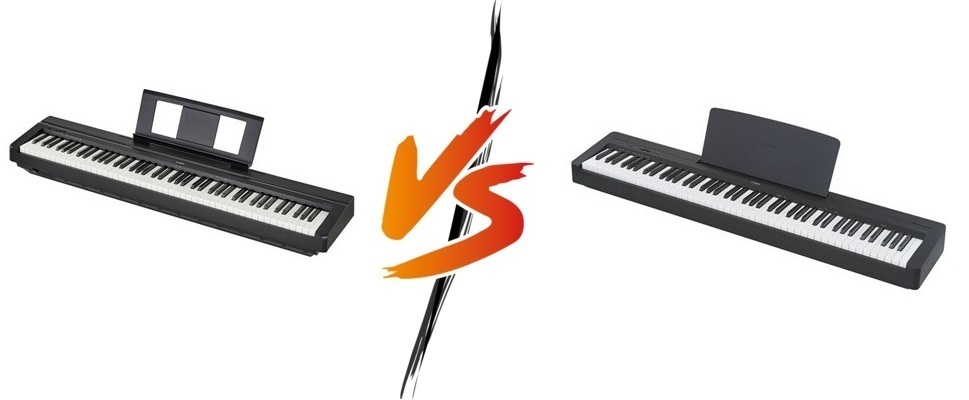
If you’re shopping for your first digital piano, or looking for a simple, reliable 88-key keyboard to practice on at home, there’s a good chance you’ve come across the Yamaha P-45 and the Yamaha P-145. For years, the P-45 has been one of the most popular entry-level digital pianos on the market. Teachers recommend it, beginners buy it, and it’s earned a reputation as a safe, no-nonsense choice. The P-145, on the other hand, is its modern replacement. Yamaha didn’t reinvent the concept, but they did update some important details: a new key action, improved sound engine, slimmer design, and better connectivity.
At first glance, they look very similar. Both are compact, portable 88-key digital pianos aimed at students and casual players. But once you start comparing them closely, the differences become more meaningful. In this review, I’ll break everything down clearly so you can decide which one truly fits your needs.
Here’s a clear side-by-side specification comparison to help you quickly see the differences between the two models:
Yamaha P-45 vs Yamaha P-145 Comparison Chart
If you click the links below, under the product images, you will be redirected to Amazon.com. In case you then decide to buy anything, Amazon.com will pay me a commission. This doesn’t affect the honesty of this review in any way though.
| Feature | Yamaha P-45 | Yamaha P-145 |
|---|---|---|
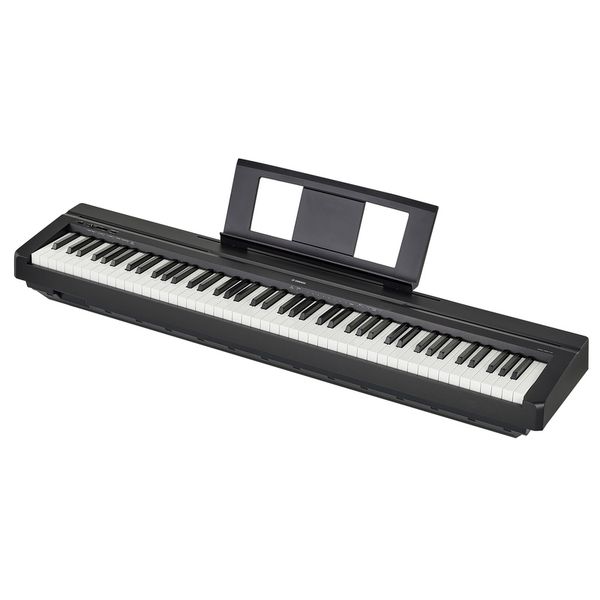 | 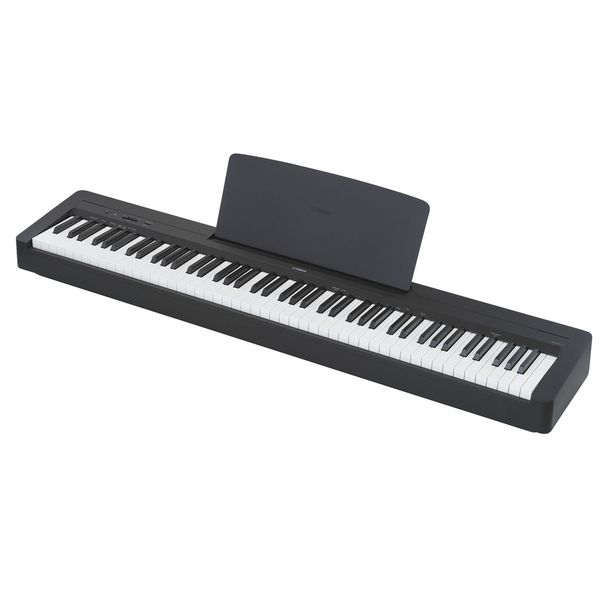 | |
| Check the best price on Amazon | Check the best price on Amazon | |
| Release Year | 2015 | 2023 |
| Keys | 88 keys | 88 keys |
| Key Action | Graded Hammer Standard (GHS) | Graded Hammer Compact (GHC) |
| Touch Sensitivity | Hard / Medium / Soft / Fixed | Hard / Medium / Soft / Fixed |
| Sound Engine | AWM Stereo Sampling | CFIIIS Concert Grand Sampling |
| Polyphony | 64 notes | 64 notes |
| Number of Voices | 10 | 10 |
| Reverb | Yes (4 types) | Yes (Improved reverb processing) |
| Dual Mode (Layering) | Yes | Yes |
| Duo Mode | Yes | Yes |
| Metronome | Yes | Yes |
| Transpose | ±6 semitones | ±6 semitones |
| Tuning | Yes | Yes |
| Internal Recording | Basic 1-song recorder | Basic 1-song recorder |
| Speakers | 6W + 6W | 7W + 7W |
| Speaker Configuration | Standard upward projection | Redesigned projection system |
| Headphone Output | 1 x 1/4″ stereo | 1 x 1/4″ stereo |
| USB Connectivity | USB-to-Host (MIDI only) | USB-to-Host (Audio + MIDI) |
| Bluetooth | No | Optional (P-145BT version) |
| App Compatibility | No Smart Pianist support | Smart Pianist compatible |
| Sustain Pedal Input | Yes (included footswitch) | Yes (included footswitch) |
| Optional Stand | Yamaha L-85 | Yamaha L-100 |
| Dimensions (W x D x H) | Approx. 1326 x 295 x 154 mm | Approx. 1326 x 268 x 129 mm |
| Weight | Approx. 11.5 kg (25.3 lbs) | Approx. 11.1 kg (24.5 lbs) |
| Target Market | Beginners, budget buyers | Beginners, modern home users |
| My individual reviews | Yamaha P45 review | Yamaha P-145 review |
Design & Build Quality
When you’re buying an entry-level digital piano, design and build quality might not seem like the most exciting factors. Most people focus on sound and key action first. That makes sense. But design matters more than you might think. A piano that looks good in your space, feels solid under your hands, and holds up over time will naturally encourage you to play more often. And when you compare the Yamaha P-45 and the Yamaha P-145 side by side, the differences in design philosophy become surprisingly clear.
Let’s break this down piece by piece.
Overall Aesthetic and First Impressions
The Yamaha P-45 has a very straightforward, almost utilitarian design. It’s matte black, simple, and clearly built with function over flair in mind. There are no fancy curves or visual accents. The edges are slightly rounded, but the overall look is boxy. It doesn’t try to stand out.
To be clear, that’s not necessarily a bad thing. In fact, one of the reasons the P-45 became so popular is because it blends in anywhere. Dorm room, bedroom, small studio apartment, music classroom. It doesn’t demand attention. It just quietly does its job.
The P-145, on the other hand, feels like Yamaha stepped back and asked, “How can we modernize this without raising the price too much?” The result is subtle but noticeable. The body is slimmer. The proportions feel more refined. It still carries that minimalist P-series identity, but it looks cleaner and more intentional.
If you put both pianos on the same stand, most people would immediately identify the P-145 as the newer model. It simply looks more current.
Size, Weight, and Portability
Portability is a big selling point in this price range. Not everyone has space for a full console-style digital piano.
The Yamaha P-45 weighs around 25 pounds (11.5 kg). That’s manageable. You can carry it with two hands without too much strain. It’s not featherlight, but it’s realistic for moving between rooms or taking to a lesson.
The P-145 is slightly lighter and noticeably more compact. Yamaha redesigned the internal structure and reduced the depth of the instrument. The difference isn’t dramatic on paper, but in person, it’s meaningful. It takes up less visual space and feels easier to position on a desk or narrow stand.
If you live in a small apartment, that extra slimness actually matters. The P-145 feels less bulky against a wall. It also fits more naturally in tighter setups, especially if you’re pairing it with a computer desk for home recording or online lessons.
For gigging musicians who need something portable but fully weighted, both models work. However, the P-145 feels like it was designed with modern home setups in mind. It integrates better into multipurpose spaces.
Materials and Surface Quality
Both pianos use durable plastic chassis, which is expected in this price range. You’re not getting wooden panels or premium finishes here. But Yamaha has always been good at making plastic feel solid.
The P-45’s surface is slightly textured matte black plastic. It resists fingerprints reasonably well. After years of use, it tends to hold up without discoloration or shine spots, assuming normal care.
The P-145 feels just a bit more refined in its molding and surface finish. The seams are cleaner. The edges feel slightly smoother. The casing feels tighter overall. This isn’t night-and-day quality difference, but it’s there. When you tap on the body or lift the instrument, the P-145 feels more cohesive.
Neither piano creaks under normal playing pressure. That’s important. Some ultra-budget keyboards flex slightly when you dig in hard. Both of these Yamahas remain stable on a stand.
Control Layout and Interface Design
This is where the generational difference becomes clearer.
The P-45 has a very minimal control panel. You get a power button and a volume knob. That’s it. Everything else is accessed using key combinations. Want to change voices? You hold down the “Function” button and press specific keys on the keyboard.
This keeps the top panel clean, but it’s not intuitive. Beginners often need to keep the manual nearby at first. It’s not complicated once you memorize the layout, but it does feel slightly dated in today’s app-driven world.
The P-145 continues the minimal design, but it integrates better with Yamaha’s Smart Pianist app. That changes the experience. Instead of memorizing key combinations, you can adjust settings on your phone or tablet.
Physically, the panel remains simple and uncluttered. Yamaha didn’t add unnecessary buttons or screens. That’s a good decision. Cheap digital displays can sometimes make entry-level pianos look more toy-like. Both models avoid that problem.
However, the P-145 feels like its simplicity is intentional and modern, whereas the P-45’s simplicity feels more like a cost-saving measure.
Keybed Construction and Mechanical Noise
While key action is usually discussed under “keyboard feel,” it also impacts build quality.
The P-45 uses Yamaha’s older Graded Hammer Standard (GHS) action. It’s sturdy, but it can produce a slightly louder mechanical thump during fast repetition. Not terrible, just noticeable in quiet rooms.
The P-145 introduces the newer Graded Hammer Compact (GHC) action. One of its benefits is reduced mechanical noise. When playing softly at night with headphones off, the P-145 feels quieter and more refined.
This doesn’t mean the P-45 is fragile. It has proven itself over many years in schools and homes. But the P-145 feels like a small evolution in engineering. The key return is smoother. The action noise is slightly dampened.
Long term durability on both is strong. Yamaha’s entry-level actions are known for reliability. Neither feels flimsy.
Speaker Placement and Structural Layout
On the P-45, the speakers are positioned in a way that projects sound upward and slightly outward. It works fine, but the projection isn’t particularly immersive.
The P-145 redesign includes repositioned speakers that project more efficiently. This ties into build structure. Yamaha rearranged internal components to accommodate the slimmer body while maintaining sound dispersion.
The P-145 feels like it was engineered as a cohesive redesign rather than a minor update.
Stability on Stands
Both pianos are commonly paired with X-stands or Yamaha’s optional furniture-style stands.
The P-45 feels stable and balanced, though slightly deeper front-to-back. The P-145’s slimmer body gives it a cleaner silhouette on a stand, especially on Yamaha’s matching L-100 style stand.
Neither instrument wobbles under normal play. If you’re an aggressive player, you’ll want a solid stand regardless of model.
Long-Term Practicality
Over time, design affects more than just looks. Dust buildup, ease of cleaning, and how the instrument ages all matter.
The matte surfaces on both models resist scratches fairly well. The P-145’s slightly refined finish feels marginally more premium and modern, which might make it feel “new” for longer.
If you plan to keep the instrument for several years, the P-145’s updated design may age better visually. The P-45 already looks like a product from an earlier generation. It’s not ugly, but it’s clearly older in design language.
Final Thoughts on Design & Build
Here’s the honest summary.
The Yamaha P-45 is functional, durable, and proven. It doesn’t try to impress you visually. It focuses on being affordable and reliable.
The Yamaha P-145 feels like a thoughtful modernization. Slimmer body. Cleaner construction. Quieter action. Better integration with modern devices. It simply feels more current.
If budget is extremely tight and the P-45 is significantly cheaper, you’re not sacrificing structural integrity. It’s still solid.
But if the price difference is reasonable, the P-145 offers a more refined physical experience. It looks better in a modern home. It feels slightly more polished in everyday use. And over years of ownership, those small improvements add up.
Design won’t make you a better pianist. But it will affect how much you enjoy sitting down to play. And in that sense, the P-145 clearly edges ahead.
Keyboard & Playing Feel
If there’s one area that truly defines a digital piano, it’s the keyboard action. You can live with average speakers. You can work around limited onboard sounds. But if the keys don’t feel right under your fingers, the whole experience falls apart.
Both the Yamaha P-45 and the Yamaha P-145 are built around fully weighted 88-key actions. That alone puts them in a different category than lightweight keyboards. They’re designed to simulate the feel of an acoustic piano, with heavier keys in the lower register and lighter keys in the upper register.
On paper, that sounds similar. In practice, there are important differences.
The Core Technology: GHS vs GHC
The Yamaha P-45 uses Yamaha’s long-standing Graded Hammer Standard (GHS) action. This action has been around for years and has appeared in many entry-level Yamaha models. It’s proven, reliable, and widely accepted as a solid beginner action.
The P-145 introduces a newer action called Graded Hammer Compact (GHC). This isn’t just a marketing rename. Yamaha redesigned the internal structure to make it more compact while aiming to preserve the realism of traditional graded hammer feel.
So what does that actually mean when you sit down and play?
Key Weight and Resistance
The P-45’s GHS action is known for being slightly on the heavier side compared to other entry-level digital pianos. Some players like this because it feels closer to certain upright acoustic pianos. There’s noticeable resistance when you press down, especially in the bass.
For beginners building finger strength, that can be a good thing. It encourages proper technique and control. However, some players find it just a little stiff, especially during long practice sessions or fast passages.
The P-145’s GHC action feels a bit lighter and more fluid. Not dramatically lighter, but enough that you notice it. The resistance curve feels smoother from bottom to top. It still has proper grading across the keyboard, but the transition feels more refined.
If you play scales up and down the full 88 keys, the P-145 feels slightly more consistent in response. The P-45 sometimes feels a bit more mechanical in comparison.
Speed and Repetition
One of the real tests of a digital piano action is how it handles repetition. Try playing fast repeated notes, trills, or quick classical passages.
On the P-45, the action performs well for its class, but you can sometimes feel the mechanical return of the key. There’s a slight sense of the mechanism resetting. It’s not bad, but it reminds you that you’re on an entry-level action.
The P-145 feels smoother in repetition. The keys return slightly faster and with less audible mechanical noise. Fast passages feel a bit more controlled and less clunky.
Neither of these models matches the responsiveness of Yamaha’s higher-end actions, of course. But within the entry-level range, the P-145 feels more modern and polished.
Mechanical Noise
This is something many buyers don’t consider until they’re practicing late at night.
The P-45’s GHS action produces a mild thumping sound when played aggressively. In a quiet room without headphones, you can hear the mechanical components more clearly, especially during staccato playing.
The P-145’s GHC action is noticeably quieter. Yamaha worked to reduce internal mechanical noise. If you practice with headphones, especially at low volume, this makes a difference. The instrument feels less intrusive in a quiet household.
It’s not silent, but it’s clearly improved.
Key Surface and Texture
Both models feature matte black keys rather than glossy plastic. That’s important because glossy keys can become slippery during long sessions.
The white keys on both pianos are smooth plastic with a light matte finish. They don’t have synthetic ivory texture like higher-end models, but they don’t feel cheap either.
In terms of touch, there isn’t a dramatic difference between the two models. The P-145 may feel marginally smoother in finish consistency, but functionally they’re similar.
Your fingers won’t slip. They won’t feel overly grippy either. It’s a neutral, practical surface.
Dynamic Control and Expressiveness
Now we get into something more important than mechanical feel: control over dynamics.
Both pianos offer multiple touch sensitivity settings. That means you can adjust how the sound responds to how hard you play.
On the P-45, dynamic control is solid but slightly limited by the older sound engine. You can play soft and loud, but the transition between dynamic layers can sometimes feel stepped rather than fully seamless.
On the P-145, dynamic response feels more nuanced. The combination of improved action and updated sound sampling gives you slightly more expressive control. Pianissimo playing feels softer and more delicate. Forte passages feel clearer and less compressed.
This doesn’t transform the instrument into a concert grand. But it does make expressive playing more satisfying.
If you’re working on pieces that rely heavily on dynamic contrast, like Chopin or Debussy, you’ll likely appreciate the P-145’s improved subtlety.
Fatigue Over Long Practice Sessions
If you practice for 10 to 20 minutes at a time, you may not notice much difference between these two actions.
But during longer sessions, the differences become more apparent.
The P-45’s slightly heavier resistance can lead to mild finger fatigue, especially for beginners who are still building strength. Some players prefer that heavier feel because it trains the fingers more aggressively. Others find it tiring.
The P-145’s smoother, slightly lighter feel tends to be more comfortable over extended practice. It strikes a balance between realism and playability.
For younger students or adult beginners, the P-145 may feel more approachable.
Acoustic Piano Comparison
Neither action perfectly replicates a grand piano. That’s expected at this price point.
The P-45’s GHS action leans toward the feel of a heavier upright piano. It’s firm, slightly mechanical, and straightforward.
The P-145’s GHC action feels closer to a compact upright with smoother regulation. It doesn’t feel as heavy, and transitions between registers feel more natural.
If you regularly practice on an acoustic piano elsewhere, the P-145 may offer a slightly easier transition back and forth.
Stability and Build Under Pressure
When you play forcefully, neither keyboard flexes or rattles. That’s important. Yamaha has a strong reputation for durability, even in entry-level models.
The P-45 has already proven itself in schools and homes for years. It holds up well.
The P-145, while newer, feels equally solid. The compact redesign doesn’t sacrifice structural integrity. The keybed feels stable, even during aggressive playing.
Pedal Interaction
Both pianos support sustain pedal input, and both come with a basic footswitch-style pedal.
The key action interacts predictably with sustain. However, neither model supports advanced pedal features like half-pedaling unless upgraded with compatible pedals. Even then, functionality is basic compared to higher-end instruments.
For beginners, this is not a dealbreaker. But advanced players may eventually want more nuanced pedal control.
Learning and Skill Development
For someone starting from scratch, both actions are appropriate for building proper technique. They are fully weighted, graded, and responsive enough for serious early development.
The P-45 will not hold a beginner back.
The P-145 simply makes the process slightly more enjoyable and refined.
If you’re an intermediate player, the P-145 feels less like a compromise. The smoother repetition and quieter action make practice more pleasant.
Final Thoughts on Keyboard & Playing Feel
Here’s the honest breakdown.
The Yamaha P-45 offers a reliable, slightly heavier action that has stood the test of time. It’s solid, predictable, and perfectly suitable for beginners and casual players.
The Yamaha P-145 improves on that foundation. The GHC action is smoother, quieter, and a bit more refined. Fast passages feel cleaner. Dynamic control feels more expressive. Long sessions feel more comfortable.
Is the difference massive? No.
Is it noticeable? Yes, especially if you spend real time playing both.
If price is nearly identical, the P-145 clearly offers the better playing experience. If the P-45 is significantly cheaper, it still remains a very respectable option.
But purely in terms of keyboard feel, the P-145 is the more modern and satisfying instrument to play.
Sound Quality & Voices
When people ask me what matters most in a digital piano, I usually say two things: the feel of the keys and the quality of the main piano sound. Everything else is secondary. You can live without 200 built-in rhythms. You can ignore most of the extra voices. But if the core piano tone doesn’t inspire you, you won’t feel connected to the instrument.
Both the Yamaha P-45 and the Yamaha P-145 are entry-level models. That means we’re not dealing with multi-gigabyte sample libraries or complex modeling engines. Still, Yamaha has a strong reputation for acoustic piano tone, even in its affordable instruments. The difference between these two models comes down to refinement.
The Core Piano Sound
The Yamaha P-45 uses Yamaha’s Advanced Wave Memory (AWM) stereo sampling. This has been the backbone of Yamaha’s entry-level digital pianos for years. It’s a straightforward sampling engine that captures recordings of a Yamaha grand piano at different dynamic levels and maps them across the keyboard.
The result is a clean, balanced piano tone. It’s bright without being harsh. The low end has decent body. The midrange is clear. For beginners especially, it sounds “right.” It doesn’t feel artificial or toy-like. That’s one reason the P-45 became so popular. It simply delivers a convincing basic piano sound at a low price.
However, when you compare it directly to the P-145, you start to hear the generational gap.
The Yamaha P-145 uses samples derived from the Yamaha CFIIIS concert grand piano. This is a higher-end acoustic instrument, and Yamaha has refined how that sound is captured and processed. The tone feels more open and more detailed. The high notes shimmer a little more. The midrange feels slightly richer. The bass has a bit more clarity and depth.
It’s not a dramatic night-and-day difference. If you’re playing casually, you might not notice immediately. But if you sit with headphones and switch back and forth, the P-145 sounds more modern and expressive.
Dynamic Range and Expression
One of the biggest differences between entry-level and higher-end digital pianos is how they handle dynamics. When you play softly, does the sound feel truly soft? When you play hard, does it open up naturally, or does it just get louder?
On the P-45, dynamic response is good but somewhat limited. There are multiple velocity layers, but transitions between them can feel slightly stepped. When you increase pressure gradually, you can sometimes sense where one sample layer ends and another begins. Again, this is normal for the price range.
The P-145 handles dynamics more smoothly. The transition between soft and loud playing feels more seamless. Pianissimo passages have more subtlety. Forte passages feel less compressed and more expansive. This makes a difference in expressive music.
If you’re practicing classical repertoire that relies on dynamic shading, the P-145 gives you a bit more room to shape phrases. If you’re playing pop chords or simple exercises, the P-45 is perfectly adequate.
Tone Character: Bright vs Warm
Yamaha pianos are often described as bright compared to brands like Roland or Kawai. That general character carries through here.
The P-45 has a clear, somewhat bright tone. It cuts through well. This can actually be helpful for beginners because articulation is easy to hear. Every note is defined.
The P-145 retains that clarity but adds a touch more warmth and realism. It feels slightly less “digital” in its upper registers. High notes ring more naturally instead of sounding thin.
In the lower register, the P-145’s bass feels tighter and more controlled. The P-45’s bass is fine, but it can sound a bit flatter when you play big left-hand chords.
If you’re sensitive to tone color, the P-145 will likely feel more satisfying.
Polyphony
Polyphony refers to how many notes the piano can produce simultaneously. Both instruments are designed for entry-level use, and their polyphony counts reflect that.
In real-world playing, both models handle standard repertoire without obvious note dropouts. However, when you use sustain pedal heavily or layer voices, the P-145 manages overlapping notes more gracefully.
For beginners, this may not matter much. For intermediate players working with sustained passages or complex harmonies, the improved handling in the P-145 offers a smoother experience.
Built-In Voices
Let’s talk about extra sounds. While most buyers focus on the acoustic piano tone, both instruments include additional voices.
The P-45 offers a small selection: typically a couple of acoustic pianos, electric piano, organ, strings, and possibly a harpsichord. It’s a basic lineup. The sounds are usable but clearly secondary to the main piano tone.
The P-145 includes 10 built-in voices, similar in number but updated in quality. The electric pianos feel slightly more polished. The strings sound a bit fuller. The organs are cleaner.
These aren’t professional stage-quality sounds, but they’re enjoyable for practice and casual playing. For example, using a soft electric piano voice for jazz chords can be surprisingly satisfying on the P-145.
Neither instrument is designed to replace a full synthesizer or stage piano. The extra voices are there to add variety, not to serve as a production tool.
Speaker Interaction with Sound
Sound quality isn’t just about the samples. It’s also about how they’re projected.
The P-45’s speakers are adequate for small rooms. At moderate volume, the tone is clear. However, at higher volume levels, the sound can become slightly compressed and less detailed.
The P-145’s speaker system is slightly more powerful and better positioned. This gives the sound more presence and clarity in a room. When playing at medium volume, the tone feels more open.
With headphones, the difference becomes even clearer. The P-145’s improved sampling and dynamic range stand out more through headphones than through speakers.
If you practice primarily with headphones, the P-145 offers a noticeably better listening experience.
Reverb and Effects
Both models include basic reverb settings to simulate different room environments. The P-45’s reverb is simple but effective. It adds space without overwhelming the tone.
The P-145’s reverb feels slightly more refined. The decay blends more naturally with the piano tone. It’s subtle, but when you play sustained chords, the P-145 feels more immersive.
Neither instrument offers advanced sound editing. You won’t find deep EQ settings or complex effect chains. That’s expected in this category.
Recording and USB Audio
The P-145 has an important advantage in modern workflows: USB audio capability. This allows you to send digital audio directly to a computer without needing an external audio interface.
From a sound perspective, this matters because what you hear is what gets recorded. The signal remains clean and consistent.
The P-45 typically supports USB MIDI but not direct audio streaming. That means if you want to record its internal sound, you need extra equipment.
If you plan to record covers, create content, or use online lessons that capture your playing, the P-145 is clearly more convenient.
Overall Sound Impression
Here’s the honest summary.
The Yamaha P-45 sounds good. It delivers a reliable, clean acoustic piano tone that’s more than acceptable for beginners and casual players. For its price, it has earned its reputation.
The Yamaha P-145 sounds better. Not radically different, but noticeably improved. The piano tone feels more detailed. The dynamics are smoother. The bass is tighter. The overall sound feels more modern and refined.
If you’re highly budget-conscious and simply need a solid practice instrument, the P-45 will not disappoint.
If sound quality is a top priority and the price difference isn’t huge, the P-145 justifies the upgrade. It feels closer to a mid-range instrument in tone quality, even though it’s still positioned as entry-level.
At the end of the day, sound is what keeps you inspired. And in this category, the P-145 has the edge.
Speakers & Amplification
When people compare digital pianos, speakers don’t always get the attention they deserve. Most buyers focus on the sound engine or the key action. That makes sense. But speakers are what translate that digital piano sample into something you actually hear and feel in the room. A great sound engine can still feel underwhelming if the speakers don’t project well.
The Yamaha P-45 and the Yamaha P-145 are both compact entry-level instruments. That means neither has massive, room-filling speaker systems. They’re designed primarily for home practice, small spaces, and personal use. Still, there are meaningful differences in how each model handles amplification.
Speaker Power and Configuration
The Yamaha P-45 is equipped with a 6W + 6W stereo speaker system. That’s 12 watts of total output. For a beginner piano in this size category, that’s fairly standard. It’s enough to fill a small bedroom or practice space comfortably. At moderate volumes, the sound is clear and balanced.
The Yamaha P-145 increases the output slightly to 7W + 7W, giving you 14 watts of total power. On paper, that doesn’t seem like a big jump. Two extra watts doesn’t sound dramatic. But in small speaker systems, even small increases in power can make a noticeable difference in projection and clarity.
In practice, the P-145 feels just a bit stronger and more confident at medium to high volumes. It doesn’t distort as quickly when you push it.
Speaker Placement and Projection
Wattage is only part of the story. Speaker placement matters just as much.
The P-45’s speakers are mounted in a fairly traditional position within the body. They project upward and slightly outward. This works fine when the piano is placed on a stand in an open room. However, when placed against a wall or in tighter spaces, projection can feel slightly restricted.
The P-145 benefits from a redesigned cabinet structure. Yamaha reworked the internal layout, and part of that redesign included adjusting how sound projects from the instrument. The result is a more open and natural dispersion.
When you sit at the P-145, the sound feels like it’s coming from a slightly broader space rather than a narrow point. It fills the immediate area more evenly.
If you’re practicing in a small apartment, this matters. The sound feels less boxed in.
Volume Headroom
Most beginners won’t play at maximum volume. But it’s still important to know how the speakers behave as you increase the level.
On the P-45, volume is clean and pleasant up to about 70 or 80 percent. Beyond that, especially when playing loud chords in the lower register, you may notice slight compression. The bass can feel less defined at higher volumes.
The P-145 handles higher volumes with more stability. The bass remains clearer, and the overall sound doesn’t feel as strained. It still won’t compete with external amplification, but for a compact home piano, it performs well.
If you occasionally play for friends or family in a living room setting, the P-145 will project a bit more confidently.
Bass Response
Low-end response is one of the biggest challenges for compact digital pianos. Deep bass frequencies require space and proper resonance to sound full.
The P-45’s bass is respectable but somewhat limited by its cabinet size. Left-hand chords can sound slightly thin when compared to higher-end models. The notes are clear, but they don’t have a lot of physical depth.
The P-145 shows improvement here. The redesigned internal structure helps the bass feel tighter and more controlled. It doesn’t magically create subwoofer-level depth, but it feels more balanced across the keyboard.
When you play pieces that rely on strong left-hand accompaniment, the P-145 sounds a bit more grounded.
Clarity in the Midrange and High Register
Both instruments handle midrange frequencies well. That’s where most melodies and chords live, and Yamaha has always done a good job maintaining clarity in this range.
The P-45 sounds clean and articulate in the middle of the keyboard. The P-145 sounds slightly more open and detailed. The difference is subtle, but it becomes clearer when playing expressive passages.
In the high register, the P-45 can sound slightly sharp at higher volumes. The P-145 smooths this out a bit. High notes shimmer without becoming brittle.
Again, this isn’t a radical transformation. It’s refinement.
Speaker Performance at Low Volume
Many people practice late at night or in shared living spaces. In those situations, low-volume clarity matters more than maximum output.
At low volumes, the P-45 performs decently. The sound remains balanced, but it can lose some presence. Quiet passages may feel slightly flat through the speakers.
The P-145 maintains better clarity at low levels. Even when you turn the volume down significantly, notes retain definition. This makes soft practice sessions more satisfying.
That said, both instruments really shine through headphones for quiet practice.
Headphone Output
Both the P-45 and P-145 include headphone outputs for silent practice. This is arguably more important than built-in speaker power for many users.
The P-45’s headphone sound is clean and free of obvious noise. However, the older sound engine means the tone may feel slightly less detailed.
The P-145 benefits from its updated sampling and processing. Through good-quality headphones, it sounds noticeably richer and more expressive than the P-45.
If you primarily practice with headphones, the speaker differences matter less. But the improved audio processing of the P-145 still gives it an advantage.
External Amplification Options
Neither model includes dedicated line outputs. This is typical at the entry level.
If you want to connect either piano to external speakers or a PA system, you’ll likely use the headphone output. That works, but it’s not ideal compared to proper line outs found on more advanced models.
The P-145’s USB audio capability adds flexibility for recording and connecting to computers. While this doesn’t directly increase speaker power, it expands your amplification and recording options.
For casual home use, built-in speakers are enough. For live performance, you’ll want external amplification regardless of model.
Room Size Considerations
Both pianos are best suited for small to medium rooms. Bedrooms, practice rooms, apartments, and small living rooms are ideal environments.
In a large room, both will struggle to fill the space without external speakers.
If you plan to perform regularly in larger spaces, neither model should be your primary sound system. They are practice instruments first.
Speaker Noise and Distortion
At normal levels, both instruments are free from noticeable speaker hiss or background noise.
When pushed to maximum volume, the P-45 can exhibit mild distortion in the lower register. The P-145 handles this slightly better, maintaining clarity longer.
This isn’t a major issue for most players, but it’s another example of incremental improvement.
Real-World Experience
Here’s what matters in practical terms.
If you’re a beginner practicing at home, the P-45’s speakers are sufficient. You’ll hear yourself clearly. You’ll develop proper dynamics. You won’t feel limited.
If you’re slightly more experienced or sensitive to tonal depth, the P-145 feels more satisfying. The sound fills the space better. The bass feels more grounded. The overall projection feels more natural.
It’s not about volume alone. It’s about how complete the sound feels in the room.
Final Thoughts on Speakers & Amplification
The Yamaha P-45 delivers solid performance for its class. Its 6W + 6W speakers are perfectly adequate for home practice. For years, they’ve served beginners well.
The Yamaha P-145 improves on that foundation with slightly more power, better projection, and a clearer, more balanced sound across the keyboard.
Is the difference dramatic? No.
Is it noticeable in side-by-side comparison? Yes.
If you’re on a tight budget and mostly play at moderate volumes, the P-45 will serve you well.
If you want a bit more depth, clarity, and headroom, the P-145 justifies its position as the updated model.
In short, both are functional. The P-145 simply sounds more refined and confident in the room.
Functions & Connectivity
When you’re shopping for an entry-level digital piano, it’s easy to assume that functions and connectivity don’t matter much. After all, these aren’t high-end stage pianos with hundreds of sounds and deep editing menus. But in 2026, even beginners expect a certain level of integration with phones, apps, and computers.
This is one area where the generational gap between the Yamaha P-45 and the Yamaha P-145 becomes very clear.
The P-45 was designed in a time when simplicity and low cost were the primary goals. The P-145 was designed in a world where players expect seamless connection to learning apps, recording software, and digital devices. That difference shapes the entire user experience.
Let’s break it down carefully.
Onboard Functions
At their core, both pianos are intentionally simple. Yamaha didn’t overload either model with complicated menus.
On the P-45, the onboard functions are basic but practical. You get:
- 10 built-in voices
- Dual mode (layer two sounds together)
- Duo mode (split the keyboard into two equal pitch ranges for teacher/student use)
- Metronome
- Transpose function
- Fine tuning
The catch is that almost all of these functions are accessed using button-and-key combinations. There’s no screen. No labeled function panel. You hold down a function button and press specific keys to trigger settings.
Once you memorize the layout, it’s manageable. But at first, it feels slightly clunky. Many beginners end up keeping the manual nearby for reference.
The P-145 keeps the onboard feature set similarly streamlined. You still get the essential voices, layering, duo mode, metronome, transpose, and tuning controls.
However, the way you interact with those features is much more modern.
Smart Pianist App Integration
One of the biggest upgrades in the P-145 is compatibility with Yamaha’s Smart Pianist app.
This changes everything.
Instead of memorizing key combinations, you can connect your phone or tablet and control the piano through a clean graphical interface. You can select voices, adjust reverb, change touch sensitivity, manage metronome settings, and more, all visually.
For beginners, this is a huge quality-of-life improvement. It removes friction. Instead of feeling like you’re programming a device from the 1990s, you’re interacting with a modern app.
The P-45 does not offer this level of integration. You’re limited to physical controls and manual-based navigation.
If you’re someone who appreciates intuitive digital interfaces, the P-145 immediately feels more accessible.
USB Connectivity
The Yamaha P-45 includes USB-to-Host connectivity. This allows you to connect the piano to a computer or compatible device for MIDI communication.
MIDI means the piano can send and receive note data. You can use it as a controller for virtual instruments or record MIDI into music software.
However, the P-45 typically does not send digital audio over USB. If you want to record the actual internal sound of the piano, you need an external audio interface and cables.
The P-145 improves on this significantly.
It supports USB audio and MIDI. That means you can connect a single USB cable to your computer and record both MIDI data and the piano’s actual audio directly.
For content creators, online teachers, or anyone experimenting with recording, this is a major advantage. It simplifies setup and reduces extra equipment costs.
In practical terms, if you want to record a piano cover for YouTube, the P-145 makes the process much easier.
Bluetooth (P-145BT Variant)
Some versions of the P-145 include Bluetooth capability.
This is optional depending on the exact model, but when available, it allows wireless MIDI and audio streaming.
With Bluetooth audio, you can stream backing tracks from your phone directly through the piano’s speakers. That’s convenient for practice. You can play along with songs without needing extra cables.
With Bluetooth MIDI, you can connect to learning apps wirelessly. This keeps your setup clean and cable-free.
The P-45 does not include Bluetooth. If wireless integration matters to you, it’s simply not an option on the older model.
Recording Capabilities
Both pianos are limited in onboard recording features. They are not multi-track recorders.
The P-45 offers very basic recording functionality. You can record a simple performance internally, but editing options are minimal.
The P-145 keeps things similarly simple in terms of internal recording. However, thanks to USB audio and MIDI support, external recording becomes much more powerful.
In 2026, most players record through apps or computers anyway. The P-145 aligns better with that workflow.
Pedal Inputs and Expansion
Both models include a sustain pedal input and come with a basic footswitch-style pedal.
Neither model offers advanced multi-pedal inputs out of the box like higher-end digital pianos do. If you want triple-pedal functionality, you’ll need compatible stands and accessories.
In this category, both are comparable.
Headphone Connectivity
Both instruments include headphone outputs for silent practice.
This is essential for home use, especially in apartments or shared living spaces.
There’s no significant difference in basic headphone connectivity between the two. However, because the P-145’s sound engine is more refined, the headphone experience feels slightly more detailed.
Computer and DAW Integration
If you plan to use the piano with digital audio workstations (DAWs) like Logic, Ableton, or GarageBand, both instruments can function as MIDI controllers.
The P-45 works fine as a simple MIDI controller. It sends velocity-sensitive note data, which is enough for triggering software instruments.
The P-145 does the same but adds the convenience of integrated USB audio. This makes it more versatile in a recording setup.
For students studying music production or experimenting with home recording, the P-145 is clearly the better long-term tool.
Simplicity vs Modern Flexibility
Here’s where philosophy comes into play.
The P-45 represents pure simplicity. Turn it on. Select a voice. Play. It’s focused on being a digital piano, not a hybrid tech device.
For some people, that’s appealing. No apps. No updates. No wireless connections. Just a straightforward instrument.
The P-145 represents modern integration. It still keeps the piano experience front and center, but it acknowledges that players today use apps, online lessons, and recording software.
Neither approach is wrong. It depends on what kind of user you are.
Learning Experience
If you’re using interactive learning apps, the P-145 provides a smoother experience. App integration feels natural rather than like an afterthought.
With the P-45, you can still use MIDI-based learning software, but the setup is less streamlined. It feels more technical.
For younger students who are comfortable with tablets and phones, the P-145 feels more aligned with how they already interact with technology.
Future-Proofing
Technology changes quickly. While both instruments will remain playable for years, connectivity features influence long-term flexibility.
The P-45 is already somewhat dated in its connectivity approach. It still works, but it lacks newer conveniences.
The P-145 feels more future-proof. USB audio, app integration, and optional Bluetooth make it better suited for evolving digital environments.
If you plan to keep your instrument for five to ten years, this matters.
Final Thoughts on Functions & Connectivity
The Yamaha P-45 offers essential functions and basic USB MIDI connectivity. It’s simple, reliable, and focused purely on playing.
The Yamaha P-145 expands on that foundation with app control, USB audio support, improved integration with digital devices, and optional Bluetooth.
If you just want to practice piano without caring about recording or apps, the P-45 is enough.
If you want flexibility, modern convenience, and easier integration with technology, the P-145 clearly leads.
In this category, the difference isn’t subtle. The P-145 feels like a product built for today’s digital ecosystem. The P-45 feels like a product from the previous generation.
And for many buyers, that alone can tip the scale.
Conclusion
If you strip everything back, both the Yamaha P-45 and the Yamaha P-145 succeed at their core mission: delivering an affordable, fully weighted 88-key digital piano from a brand with a strong reputation. Neither is a bad choice. In fact, both are capable, reliable instruments that can support a beginner from their first lesson through several years of steady progress.
The difference lies in refinement and modernization.
The P-45 is the safe, proven classic. It offers solid key action, a clean and usable piano tone, and just enough features to cover the essentials. If you find it at a significantly lower price than the P-145, it still represents very good value. For someone who simply wants to practice piano without worrying about apps, recording, or advanced connectivity, it does the job well.
The P-145, however, is clearly the evolution. The newer GHC action feels smoother and quieter. The piano sound is more detailed and expressive. The speakers project a bit better. Most importantly, the connectivity is more in line with how people learn and create music today. USB audio, Smart Pianist app integration, and optional Bluetooth make it more flexible long term.
If the price difference is small, the P-145 is the smarter investment. It feels more modern, more refined, and slightly more inspiring to play. But if budget is tight and the P-45 is meaningfully cheaper, you’re not settling for something inadequate.
In the end, the best choice is the one that fits your budget and makes you want to sit down and play every day.