
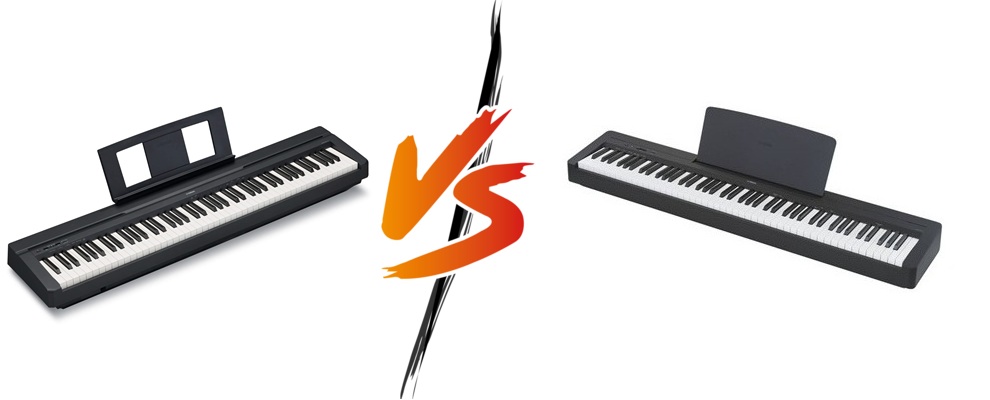
If you’re shopping for an entry-level digital piano, Yamaha is one of the first brands most people encounter. They’ve been making quality keyboards and acoustic instruments for decades, and they’re widely respected in both beginner and pro circles.
Two models that often come up in this category are the Yamaha P71 and the Yamaha P-145. On the surface, they look similar: compact, affordable, beginner-friendly digital pianos with weighted keys and basic functions. But dig deeper and you’ll find clear differences in design, features, and overall value.
In this review, I’ll walk you through every meaningful aspect of both pianos. My goal is to help you make a confident, informed decision about which one is right for you.
Yamaha P71 vs Yamaha P-145 Comparison Chart
If you click the links below, under the product images, you will be redirected to Amazon.com. In case you then decide to buy anything, Amazon.com will pay me a commission. This doesn’t affect the honesty of this review in any way though.
| Specification | Yamaha P71 | Yamaha P-145 |
|---|---|---|
 |  | |
| Check the best price on Amazon | Check the best price on Amazon | |
| Piano Type | Portable digital piano | Portable digital piano |
| Intended Level | Beginner / casual | Beginner to early-intermediate |
| Number of Keys | 88 full-size keys | 88 full-size keys |
| Key Action | Graded weighted action | Graded weighted action (improved feel) |
| Touch Sensitivity | Adjustable | Adjustable (better dynamic control) |
| Key Surface | Smooth plastic | Smooth plastic (slightly improved grip) |
| Polyphony | Approx. 64 notes | Approx. 128 notes |
| Piano Sound Engine | Basic Yamaha piano sampling | Updated Yamaha sound engine |
| Built-in Voices | Limited selection | Larger, higher-quality selection |
| Dual / Layer Mode | Yes | Yes (easier to use) |
| Split Mode | Yes | Yes |
| Built-in Songs | Very limited or none | Limited practice/demo songs |
| Metronome | Yes | Yes (more accessible controls) |
| Recording Function | No onboard recording | Basic recording support (model-dependent) |
| Speakers | Basic stereo speakers | Improved stereo speakers |
| Speaker Power | Modest | Stronger and fuller |
| Bass Response | Limited | Noticeably better |
| Headphone Jacks | 1 x 1/4″ | 1 x 1/4″ |
| USB Connectivity | USB-to-host (MIDI only) | USB-to-host (better MIDI integration) |
| USB Audio | No | Limited / model-dependent |
| MIDI Support | Basic | More reliable and flexible |
| Sustain Pedal | Included (basic footswitch) | Included (slightly better quality) |
| Half-Pedaling Support | Limited / not supported | Better compatibility with upgraded pedals |
| External Pedal Unit Support | Limited | Better support |
| Stand Included | No | No |
| Optional Furniture Stand | Third-party or Yamaha optional | Third-party or Yamaha optional |
| Dimensions (approx.) | Slim, compact | Similar footprint, slightly sturdier |
| Weight (approx.) | ~25 lbs (11.5 kg) | ~28–29 lbs (13 kg) |
| Finish | Matte black | Matte black |
| Overall Build Feel | Lightweight, budget-oriented | More solid and refined |
| Typical Price Range | Lower | Slightly higher |
Design & Build Quality
Design and build quality might not be the first things beginners think about when buying a digital piano, but they matter more than most people realize. You’re going to see this instrument every day. You’re going to touch it constantly. You might move it around, set it on a stand, plug things in and out, and possibly transport it between rooms or locations. Over time, small design choices make a big difference in how enjoyable and practical the piano feels to live with.
The Yamaha P71 and Yamaha P-145 both aim for a clean, no-nonsense design, but they approach it from slightly different angles. One feels clearly budget-focused, while the other feels like Yamaha took a step toward refinement without overcomplicating things.
Overall Aesthetic and First Impressions
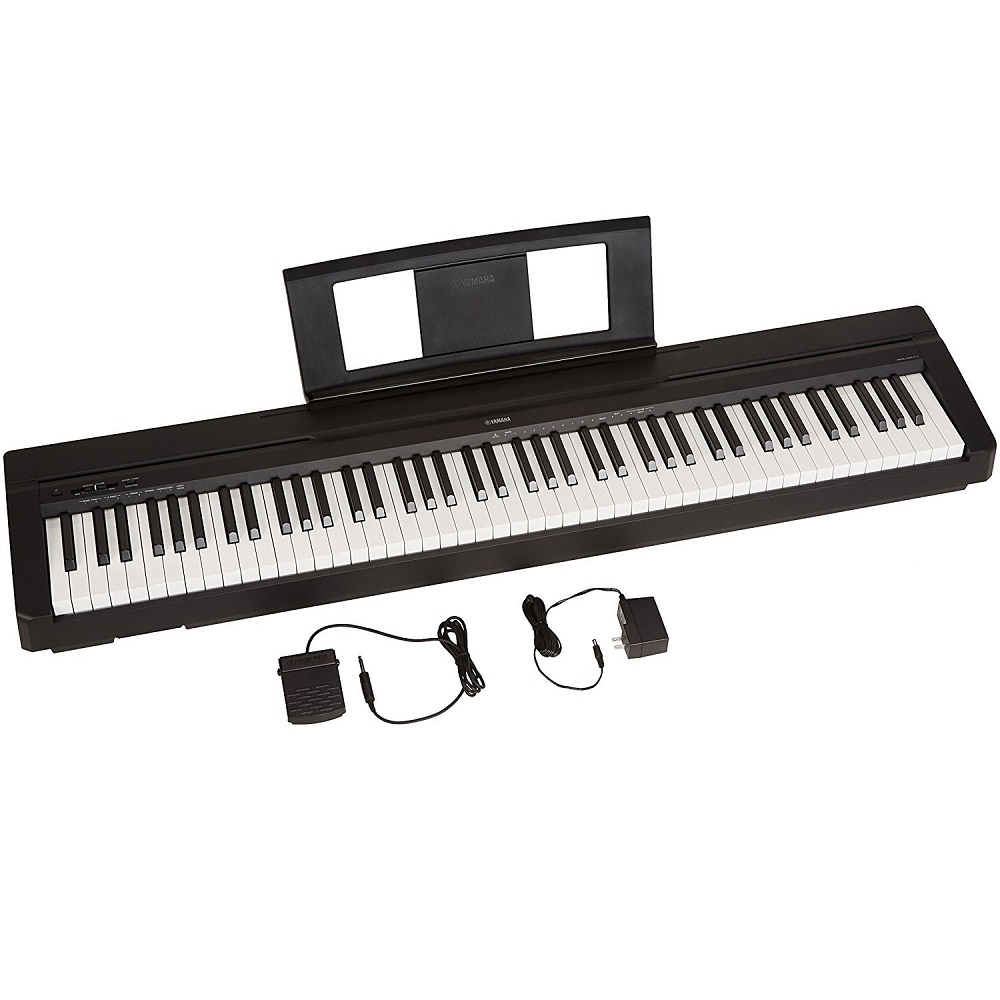
The Yamaha P71 has a very straightforward look. It’s slim, rectangular, and understated. There’s nothing flashy about it, and Yamaha didn’t try to dress it up to look like a piece of furniture. It looks exactly like what it is: a portable digital piano designed primarily for beginners.
The matte black finish is practical and neutral. It won’t clash with your room, and it doesn’t draw attention to itself. From a distance, it looks fine. Up close, though, you can tell this is a cost-conscious design. The plastic casing is lightweight and functional, but not luxurious. There’s a slight “hollow” feel if you tap on the body, which is common in this price range.
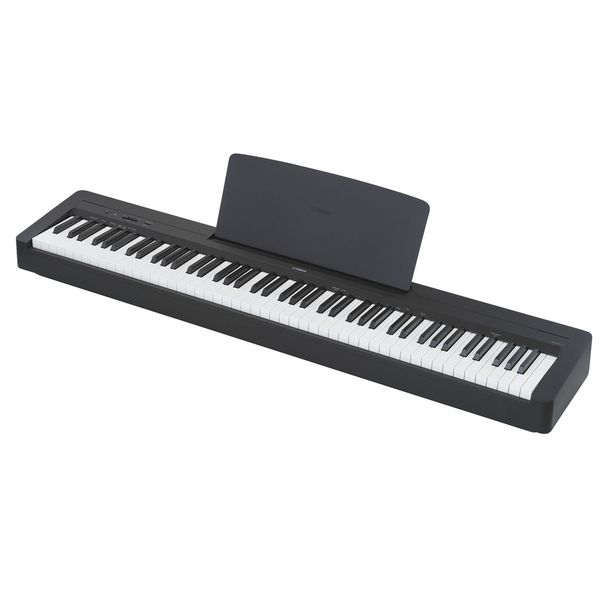
The P-145, on the other hand, immediately feels a bit more deliberate in its design. It’s still minimalist and modern, but the proportions feel more balanced. The edges are slightly cleaner, and the casing feels denser and more solid. It doesn’t suddenly look like a high-end stage piano, but it does feel like a more thoughtfully finished product.
If you care about how your piano looks in your living space, the P-145 simply feels more polished. It’s still subtle and professional, but it doesn’t scream “entry-level” in the same way the P71 sometimes does.
Size, Weight, and Portability
Both models are designed to be portable, but there are differences in how they feel when you actually pick them up and move them.
The Yamaha P71 is very light for a fully weighted digital piano. This makes it easy to move around the house, store in a closet, or transport to lessons. If portability is a top priority, this is one of the P71’s biggest strengths. You can carry it without feeling like you’re wrestling a piece of furniture.
That lightness does come with a trade-off, though. When placed on a cheaper or less stable stand, the P71 can feel a bit less planted. It doesn’t usually move while playing, but the light build is noticeable, especially if you’re used to heavier instruments.
The P-145 is slightly heavier, and that extra weight actually works in its favor. It still qualifies as a portable digital piano, but it feels more grounded when set up. On a stand, it sits more confidently, with less sense that the instrument might flex or shift.
For players who plan to keep the piano in one place most of the time, the added weight of the P-145 feels like a benefit. For players who need to carry the instrument frequently, the P71’s lighter body may be more appealing.
Materials and Construction
Neither piano uses premium materials, and that’s expected at this price level. Both rely mostly on molded plastic for the outer shell. The difference lies in how that plastic feels and how well everything fits together.
On the P71, the casing does its job, but it feels thin in places. There’s a bit of flex if you press down on certain areas of the top panel, and the overall impression is “functional but basic.” It’s not fragile, and it won’t fall apart under normal use, but it doesn’t inspire confidence in the way more solid instruments do.
The P-145 feels more rigid. The plastic is thicker, and the construction feels tighter overall. Buttons sit more firmly in the panel, and there’s less creaking or flex when handling the instrument. Over long-term ownership, this kind of solidity matters, especially if the piano is moved occasionally or used frequently.
Another small but important detail is how the keys are mounted. On the P-145, the keybed feels more securely integrated into the chassis. On the P71, the keys are fine, but the surrounding frame feels slightly less robust. Again, nothing is wrong or broken, but the difference is noticeable if you pay attention.
Control Layout and Usability
The Yamaha P71 keeps things extremely simple. There are very few buttons, and most secondary functions are accessed using key combinations. This design choice has clear pros and cons.
On the positive side, it keeps the interface uncluttered. Beginners won’t feel overwhelmed by options, and there’s almost no learning curve just to turn the piano on and start playing. The downside is that once you want to use features like split mode, transpose, or different voices, you’ll need to remember which key combinations do what. Without labels or a screen, this can feel unintuitive over time.
The P-145 improves this experience. While it still avoids a screen and excessive controls, the buttons are better labeled and more logically laid out. Accessing functions feels more natural, and you’re less likely to forget how to use features you don’t touch every day.
This matters more than it sounds. Over months or years of ownership, small usability frustrations add up. The P-145 simply feels easier to live with.
Stands, Placement, and Everyday Practicality
Neither the P71 nor the P-145 comes with a built-in stand. They’re both meant to be paired with an X-stand, Z-stand, or optional furniture-style stand sold separately.
The P71 works fine on most stands, but because it’s so light, the overall setup depends heavily on the quality of the stand. On a cheap stand, the whole setup can feel a bit wobbly.
The P-145, thanks to its slightly heavier and more solid build, tends to feel more stable even on mid-range stands. If you’re planning to practice daily, this stability improves comfort and confidence while playing.
Long-Term Durability Expectations
Yamaha has a strong reputation for reliability, and both of these pianos benefit from that. Even though the P71 feels more basic, it’s still built to Yamaha’s standards. With normal home use, it should last many years without issues.
That said, the P-145 feels better suited for long-term ownership. Its sturdier build, more secure components, and refined design suggest it will hold up better over time, especially if used frequently or by more serious students.
Design & Build Quality Verdict
The Yamaha P71 delivers exactly what you’d expect from a budget-friendly digital piano. It’s lightweight, simple, and functional. Nothing about its design is offensive or poorly thought out, but it clearly prioritizes affordability over refinement.
The Yamaha P-145 takes the same basic concept and improves it in meaningful ways. It feels sturdier, looks more polished, and offers a more user-friendly control layout. These aren’t dramatic differences, but they’re the kind that matter the longer you own the instrument.
If design and build quality are low on your priority list and portability matters most, the P71 will serve you just fine. If you want something that feels a bit more substantial and enjoyable to live with day after day, the P-145 is the stronger choice.
Keyboard Action & Playability
Keyboard action and playability are the most important parts of any digital piano. You can forgive limited features, basic speakers, or a plain design, but if the keyboard doesn’t feel right under your fingers, the instrument will quickly become frustrating to play. This is especially true for beginners, because the feel of the keys directly affects technique, finger strength, and long-term progress.
Both the Yamaha P71 and Yamaha P-145 use Yamaha’s graded weighted action, which is a major selling point in this price range. That said, the way these actions feel in real-world use is not identical, and the differences become more noticeable the longer you play.
What “Graded Weighted Action” Really Means
Before comparing the two, it’s worth clarifying what graded weighted action actually does. On an acoustic piano, the keys in the lower register feel heavier than the keys in the higher register. This is due to the size and weight of the hammers inside the instrument. A good digital piano tries to replicate this behavior.
Both the P71 and P-145 simulate this effect by making the bass keys heavier and the treble keys lighter. This is critical for developing proper piano technique. It encourages correct finger control and prepares players for transitioning to an acoustic piano later.
Neither model uses Yamaha’s top-tier action, but both are far superior to non-weighted or semi-weighted keyboards often found in cheaper instruments.
Yamaha P71 Key Feel in Practice
The Yamaha P71’s keyboard action is best described as serviceable and beginner-friendly. When you first sit down and play it, the keys feel reassuringly weighted. There’s enough resistance to give you the sense that you’re playing a real piano rather than a synth.
The downward motion of the keys is smooth and consistent. There’s no obvious grinding or unevenness, which is something cheaper digital pianos sometimes struggle with. The graded weighting is noticeable, especially when playing scales across the full range of the keyboard.
However, once you spend more time with the P71, certain limitations become apparent. The keys feel slightly springy on the return, and the action lacks subtlety. Soft playing is possible, but controlling very quiet dynamics requires more effort. The difference between medium and very soft touches isn’t always as clear as it should be.
For beginners, this usually isn’t a dealbreaker. In fact, some beginners prefer a slightly lighter, less demanding action because it’s easier on the fingers early on. But as your technique improves, you may start to feel that the keyboard is holding you back from fully expressive playing.
Yamaha P-145 Key Feel in Practice
The Yamaha P-145 builds on the same basic idea but refines it. The action feels a little more substantial, with slightly more resistance and better control throughout the key travel.
When you press a key on the P-145, the movement feels more deliberate. There’s a stronger sense of weight at the bottom of the keystroke, which makes it easier to control dynamics. Pianissimo passages are easier to manage, and louder playing feels more stable and predictable.
The return of the keys also feels more natural. Instead of snapping back quickly, the keys come back in a way that feels closer to an acoustic piano. This improves repetition and makes fast passages more comfortable to play.
The difference between the P71 and P-145 is not dramatic, but it’s noticeable. If you play both side by side, the P-145 simply feels more controlled and refined.
Touch Sensitivity and Dynamic Range
Touch sensitivity determines how accurately the piano responds to changes in how hard or soft you play. Both the P71 and P-145 support multiple touch sensitivity levels, allowing you to adjust how the keyboard responds to your playing style.
On the P71, touch sensitivity works well at a basic level. You can play quietly and loudly, and the piano responds accordingly. However, the dynamic range feels slightly compressed. There’s less distinction between “very soft” and “medium soft” playing, which limits expressive control.
The P-145 handles dynamics better. It offers a wider usable range, meaning small changes in finger pressure translate more clearly into changes in volume and tone. This makes expressive playing easier, especially in slower pieces or music that relies heavily on phrasing.
For students working on classical repertoire or expressive pop ballads, this improved dynamic response is a meaningful advantage.
Key Surface and Texture
Neither piano uses textured or synthetic ivory key surfaces. Both have smooth plastic keys, which is typical at this price point.
The P71’s keys feel smooth and slightly slippery, especially if your hands tend to get warm during long practice sessions. This isn’t a major issue, but some players may find their fingers sliding more than they’d like.
The P-145’s keys feel marginally better in this regard. While still plastic, they seem to offer a bit more grip. It’s a subtle difference, but over longer practice sessions, it can make the keyboard feel more comfortable and controlled.
Noise and Mechanical Feel
Key noise is something many beginners don’t think about until they experience it. On digital pianos, this refers to the sound of the keys themselves moving, not the sound coming from the speakers.
The P71 produces a soft mechanical noise when keys are pressed and released. It’s not loud or distracting, but in very quiet environments, you can hear it. This is common for lighter, more budget-oriented actions.
The P-145 is quieter and feels more damped. The action absorbs motion better, resulting in less mechanical noise. This is particularly noticeable when practicing with headphones late at night.
Playing Fast Passages and Repetition
Fast passages, trills, and repeated notes expose weaknesses in keyboard action quickly.
On the P71, fast repetition is possible, but the action can feel a bit bouncy. The keys return quickly, but without the sense of control you’d want for more advanced playing. Rapid repeated notes can feel slightly uneven.
The P-145 performs better here. The improved key return and added resistance make fast passages feel more stable. Repeated notes respond more predictably, and the keyboard feels less “jumpy.”
This doesn’t turn the P-145 into a professional instrument, but it does make it more forgiving as your playing improves.
Suitability for Different Skill Levels
For absolute beginners, both keyboards are perfectly usable. The P71’s lighter action can even be an advantage in the early stages, as it reduces finger fatigue and makes learning basic coordination easier.
For advancing beginners and intermediate players, the P-145 becomes the more attractive option. Its improved control, better dynamic response, and more realistic feel support technical development more effectively.
Students planning to transition to an acoustic piano in the future will likely find the P-145 to be the better stepping stone.
Long-Term Playability
One of the most important questions is how the keyboard will feel after months or years of use. Will it still be enjoyable, or will it start to feel limiting?
The P71 works well as a starter instrument, but many players outgrow it. As musical demands increase, the limitations in expression and control become more apparent.
The P-145 has more staying power. While it’s still an entry-to-mid-level digital piano, its action holds up better over time. It encourages better technique and remains satisfying longer.
Keyboard Action & Playability Verdict
The Yamaha P71 offers a solid, approachable keyboard action that’s well-suited for beginners and casual players. It delivers the essential feel of a weighted piano without being demanding or intimidating.
The Yamaha P-145 takes that foundation and improves it in meaningful ways. The action feels more controlled, the dynamics are more expressive, and the overall playing experience is closer to that of an acoustic piano.
If you’re just starting out and want something forgiving and simple, the P71 does the job. If you’re serious about learning and want an instrument that will grow with you, the P-145 clearly offers the better keyboard action and long-term playability.
Sound Quality & Engine
Sound quality is where a digital piano either inspires you to play more or quietly pushes you away over time. You can adapt to a basic design or limited features, but if the sound coming out of the speakers doesn’t feel musical or responsive, practice becomes less enjoyable. This is especially important for beginners, because the tone of the instrument shapes how you hear music and how motivated you feel to keep playing.
Both the Yamaha P71 and Yamaha P-145 rely on Yamaha’s long experience with acoustic piano sampling, but they are not equal in how that experience is translated into sound. While both instruments sound unmistakably “Yamaha,” the depth, realism, and flexibility of that sound differ in meaningful ways.
Yamaha’s Sound Philosophy at This Price Level
Yamaha tends to favor clarity and brightness over warmth, especially in its entry-level instruments. This approach has advantages. Notes cut through clearly, melodies are easy to hear, and beginners can easily distinguish what they’re playing. The downside is that overly bright or simplified sampling can sound a bit sterile or thin, especially when compared to more advanced digital pianos or real acoustic instruments.
Both the P71 and P-145 follow this philosophy, but the P-145 benefits from newer sound processing and more detailed samples.
Yamaha P71 Sound Engine in Real Use
The Yamaha P71 uses a basic digital piano sound engine that focuses on delivering a clean, usable piano tone without unnecessary complexity. When you press a key, the sound is immediate and consistent. There’s no noticeable latency, which is important for beginners who are still developing timing and coordination.
The main piano voice on the P71 is bright and clear. In the mid and upper registers, melodies come through nicely, and chords are easy to hear. This makes it suitable for classical beginner pieces, simple pop songs, and basic practice routines.
However, the limitations become apparent as soon as you listen more closely. The tone lacks depth in the lower registers, where bass notes can sound a bit thin and less resonant. Sustained chords don’t bloom the way they would on an acoustic piano or a more advanced digital instrument. Instead, the sound feels somewhat flat and uniform.
The P71’s polyphony is adequate for simple playing, but it can be stretched when using the sustain pedal heavily. In pieces with dense chords or fast arpeggios, notes can sometimes cut off earlier than you’d expect. Beginners may not notice this at first, but intermediate players often do.
Dynamic Response and Expression on the P71
The P71 responds to changes in touch, but the expressive range is limited. Playing softly produces a quieter sound, and playing harder produces a louder sound, but the tonal variation between those dynamics is subtle.
On an acoustic piano, softer playing changes not only volume but also the color of the tone. The P71 mostly changes volume, with less variation in timbre. This makes expressive phrasing harder to achieve, especially in slow or emotional pieces.
For basic practice and learning note accuracy, this isn’t a major problem. For expressive performance, it’s a clear limitation.
Additional Voices on the P71
The P71 includes a small selection of additional voices, such as electric piano, organ, and strings. These are functional but not particularly detailed.
The electric piano sounds are usable for casual playing but lack the warmth and character of dedicated electric piano instruments. The organ and string sounds are serviceable for layering or experimentation, but they feel like secondary features rather than core strengths.
These voices are fine for beginners who want to explore different sounds, but they’re unlikely to impress more experienced players.
Yamaha P-145 Sound Engine in Real Use
The Yamaha P-145 steps things up noticeably in the sound department. While it still uses Yamaha’s bright, clean tonal character, the sound feels fuller and more dimensional.
The main piano voice on the P-145 has more depth, particularly in the lower and mid registers. Bass notes carry more weight, and chords feel more balanced across the keyboard. There’s a greater sense of resonance, even through the built-in speakers.
Sustained notes decay more naturally, and the transitions between dynamics feel smoother. This makes the instrument more satisfying to play, especially for longer practice sessions or expressive pieces.
Improved Polyphony and Note Handling
One of the biggest practical differences between the two instruments is how they handle complex passages. The P-145’s sound engine is better at managing polyphony, allowing more notes to ring out naturally without cutting each other off.
This matters when using the sustain pedal, playing layered sounds, or performing music with rich harmonies. The P-145 maintains clarity even when many notes are sounding at once, which helps preserve musicality.
Dynamic Range and Tonal Variation on the P-145
The P-145 offers a wider dynamic range and more noticeable tonal changes across that range. Soft playing sounds genuinely softer and slightly warmer, while louder playing becomes brighter and more assertive.
This makes phrasing easier and more intuitive. You can shape melodies more naturally, and the instrument responds in a way that feels closer to an acoustic piano.
For students working on expressive control, this is a significant improvement over the P71.
Additional Voices on the P-145
The P-145 includes a broader selection of voices, and they’re generally of higher quality. The electric piano tones have more character, the strings sound smoother, and the overall balance between voices is better.
While these voices are still not professional-grade, they’re more enjoyable to use and less likely to feel like afterthoughts. For players who like to experiment or compose, this added quality makes the instrument more versatile.
Realism vs. Simplicity
One of the key differences between the P71 and P-145 is how they balance realism and simplicity. The P71 prioritizes simplicity. Its sound engine is easy to understand and predictable, which can be comforting for beginners.
The P-145 leans slightly more toward realism. It still avoids overwhelming the player with options, but it provides more nuance and musical depth. This makes it a better long-term instrument for players who care about tone.
Headphones vs. Speakers
It’s worth noting that both instruments sound better through headphones than through their built-in speakers. However, the P-145 benefits more from good headphones because its sound engine has more detail to reveal.
On the P71, headphones improve clarity but can also highlight the flatness of the sound. On the P-145, headphones bring out the richer dynamics and more natural decay, making practice more immersive.
Sound Quality & Engine Verdict
The Yamaha P71 delivers a clean, functional piano sound that’s perfectly acceptable for beginners and casual players. It’s clear, consistent, and easy to work with, but it lacks depth, richness, and expressive nuance.
The Yamaha P-145 offers a more refined sound engine with better dynamics, fuller tone, and improved polyphony. It feels more musical and rewarding, especially as your playing becomes more expressive.
If sound quality is a major factor in your decision, the P-145 is the clear winner. It doesn’t just sound better on paper; it feels better to play, and that makes a real difference in how much you enjoy practicing and performing.
Speakers & Amplification
Speakers and amplification are often overlooked when shopping for a digital piano, especially by beginners who assume they’ll mostly practice with headphones. In reality, the built-in speaker system has a huge impact on how an instrument feels day to day. The speakers shape the character of the sound, influence how dynamic the piano feels, and determine whether playing without headphones is enjoyable or disappointing.
The Yamaha P71 and Yamaha P-145 both include onboard speakers, but the quality and effectiveness of those systems are noticeably different. While neither piano is designed to fill a large room or replace a dedicated amplifier, the way they handle sound projection and clarity can significantly affect your overall experience.
The Role of Speakers in a Digital Piano
In a digital piano, speakers are responsible for translating the sound engine into something you actually hear and feel. Even a great sound engine can seem lifeless if the speakers are weak or poorly tuned. Conversely, decent speakers can make a modest sound engine feel more engaging.
Good speakers should deliver:
- Clear note definition across the keyboard
- Enough low-end presence to support bass notes
- Balanced volume between soft and loud playing
- Minimal distortion at higher volumes
This is where the P71 and P-145 begin to separate.
Yamaha P71 Speaker System Overview
The Yamaha P71 uses a basic onboard speaker system designed primarily for practice in small spaces. The speakers are relatively small and modestly powered, which keeps the instrument lightweight and affordable.
At low to moderate volumes, the P71 sounds fine. Notes are clear, and melodies come through without issues. For solo practice in a bedroom or apartment, the speakers do their job. They don’t buzz or distort at normal practice levels, which is important.
However, the limitations become obvious as soon as you push the volume or play more demanding material. The low end lacks weight, so bass notes don’t feel grounded. Chords can sound thin, especially in the lower register. When playing louder, the sound tends to compress rather than expand, which makes dynamic playing feel less rewarding.
Volume and Headroom on the P71
Headroom refers to how much volume a speaker can produce before it starts to sound strained or distorted. The P71 has limited headroom. You can turn it up, but it never feels powerful.
At higher volumes, the sound becomes flatter and less detailed. This isn’t so much distortion as it is a lack of fullness. The speakers simply aren’t designed to move enough air to deliver a convincing piano sound at higher levels.
For background playing or quiet practice, this is acceptable. For expressive playing or playing for others, it can feel underwhelming.
Projection and Room Filling Ability
The P71’s speakers project sound upward and outward in a fairly narrow way. This works fine when you’re sitting directly in front of the instrument, but the sound doesn’t fill a room evenly.
If you move a few steps away or stand up, the piano can sound noticeably quieter and less present. This reinforces the idea that the P71 is a personal practice instrument rather than a performance tool.
Yamaha P-145 Speaker System Overview
The Yamaha P-145 features a more capable speaker system that immediately feels like an upgrade. While still compact, the speakers are better tuned and more powerful, allowing the piano’s sound to breathe more naturally.
From the first notes, the P-145 sounds fuller. There’s more presence in the low and mid frequencies, which gives the piano a stronger foundation. Chords feel more balanced, and melodies sit more comfortably on top of the harmony.
The difference isn’t subtle if you play both instruments side by side. The P-145 sounds more like a piano and less like a keyboard.
Volume and Headroom on the P-145
The P-145 has noticeably better headroom than the P71. You can turn it up to a moderate volume without the sound collapsing or becoming unpleasant.
Louder playing feels more dynamic. Instead of compressing, the sound opens up slightly, allowing you to feel the contrast between soft and loud passages more clearly. This makes the instrument more satisfying for expressive playing.
While it still won’t replace a PA system or stage monitor, the P-145 is much more capable for home use without external speakers.
Bass Response and Low-End Presence
One of the most noticeable differences between the two pianos is bass response. On the P71, low notes are audible but lack weight. You hear them, but you don’t really feel them.
The P-145 does a better job of supporting the lower register. Bass notes have more body, and left-hand parts feel more grounded. This makes a big difference in classical pieces, jazz voicings, and accompaniment patterns where the left hand plays a key role.
Even at lower volumes, the P-145 maintains a more satisfying low-end presence.
Clarity and Note Separation
Both instruments offer decent clarity, but the P-145 separates notes more effectively when playing dense chords or fast passages.
On the P71, complex harmonies can blur together slightly through the speakers. This isn’t severe, but it can make certain pieces feel less articulate.
The P-145 handles these situations better. Individual notes remain more distinct, and the overall sound feels cleaner, especially when using the sustain pedal.
Playing Without Headphones
This is where the difference between the two really matters in daily use.
Playing the P71 without headphones is fine for short sessions, but over time, the thinness of the sound can become fatiguing. Many players end up defaulting to headphones because they simply sound better.
The P-145, by contrast, is genuinely enjoyable to play through its speakers. You don’t feel the immediate need to plug in headphones to get a satisfying sound. This encourages more spontaneous playing and practice.
Late-Night Practice and Low Volume Performance
At very low volumes, both pianos perform reasonably well, but the P-145 retains more clarity and balance. On the P71, turning the volume down too far can make the sound feel lifeless.
The P-145 maintains better tonal balance even at whisper-quiet levels, which is helpful for late-night practice in shared living spaces.
External Speakers and Line Outputs
Neither piano is designed as a performance stage piano, but both can be connected to external systems in limited ways.
The P71 relies primarily on its headphone output for external sound, which works but isn’t ideal for consistent amplification.
The P-145 offers more flexibility and tends to integrate better with external speakers or audio interfaces, making it easier to upgrade your sound setup later.
Speakers & Amplification Verdict
The Yamaha P71’s speakers are functional and adequate for basic practice. They get the job done, but they don’t elevate the sound of the instrument. If you plan to use headphones most of the time, this may not matter much.
The Yamaha P-145’s speaker system is a clear step up. It delivers fuller sound, better bass response, improved clarity, and more satisfying dynamics. It makes playing without headphones genuinely enjoyable.
If onboard speakers matter to you, the P-145 is the stronger choice by a wide margin. It feels more like a self-contained piano and less like a keyboard that happens to have speakers attached.
Features & Functions
Features and functions often determine how flexible a digital piano is beyond simply playing notes. While sound and keyboard feel matter most, the right set of features can make practicing more effective, learning more structured, and long-term ownership more satisfying. At the same time, too many features can overwhelm beginners or distract from actual playing.
The Yamaha P71 and Yamaha P-145 take different approaches here. The P71 is intentionally minimal, while the P-145 expands functionality in a way that feels purposeful rather than excessive. Understanding how these features work in real use is key to deciding which instrument fits your needs.
Yamaha P71 Feature Set Overview
The Yamaha P71 is designed to be simple. Yamaha clearly prioritized ease of use over versatility, and that philosophy shows in its feature set.
Out of the box, the P71 focuses on:
- Core piano functionality
- A limited selection of voices
- Basic practice tools
There’s no screen, no complex menu system, and very few dedicated buttons. Most secondary features are accessed using key combinations, where you hold a function button and press specific keys on the keyboard.
This design keeps the interface clean, but it also makes some features feel hidden or inconvenient.
Built-In Voices on the P71
The P71 includes a small number of instrument voices beyond the main acoustic piano sound. These typically include variations like electric piano, organ, strings, and sometimes a second piano tone.
The voices are usable, but they’re clearly secondary. They exist to give beginners a bit of variety rather than to serve as deep, expressive alternatives. Switching between them requires remembering key combinations, which can be frustrating if you don’t use them regularly.
For players who just want to practice piano, this isn’t a big issue. For those who like to experiment with sound, the limitations become noticeable.
Dual Mode and Split Mode on the P71
The P71 supports basic dual mode, allowing you to layer two sounds together, such as piano and strings. It also supports split mode, where different sounds are assigned to the left and right hands.
These features are useful, especially for teaching and creative exploration. However, accessing and controlling them isn’t very intuitive. Without a display or clearly labeled buttons, it’s easy to forget how to activate or deactivate these modes.
Once set, the modes work reliably, but they feel like bonus features rather than integrated tools.
Metronome and Practice Tools on the P71
The built-in metronome on the P71 is simple and effective. It helps beginners develop timing and rhythm, which is essential early on.
However, adjusting the tempo and time signature again requires using key combinations. There’s no visual feedback, so you’re relying entirely on memory and listening. For some players, this is fine. For others, it becomes tedious.
There are no built-in lesson modes, rhythm accompaniments, or advanced practice tools. The P71 assumes you’ll either practice traditionally or use external learning apps.
Recording and Playback on the P71
The P71 does not include a dedicated onboard recording function in the traditional sense. You can’t easily record a performance and play it back directly on the instrument.
If recording is important to you, you’ll need to connect the P71 to a computer or mobile device and use software. This works, but it adds complexity and requires additional equipment.
Yamaha P-145 Feature Set Overview
The Yamaha P-145 expands the feature set in ways that feel logical and useful. It still avoids a screen and complicated menus, but it offers more dedicated controls and better-organized functionality.
The P-145 is clearly designed to support not just beginners, but also advancing players who want more tools at their disposal.
Built-In Voices on the P-145
The P-145 includes a wider selection of voices, and they’re generally higher quality than those on the P71. In addition to improved piano sounds, you’ll find better electric pianos, strings, and other basic instrument tones.
Switching between voices is easier, thanks to clearer labeling and more intuitive controls. You’re less likely to forget how to access sounds you don’t use every day.
These additional voices aren’t just for fun. They can be useful for ear training, composition, and exploring different musical styles.
Dual, Split, and Layering Functions on the P-145
The P-145 handles dual and split modes more smoothly. Layering sounds feels more intentional, and balancing them is easier.
Split mode is especially useful for teachers and students. For example, you can assign a bass sound to the left hand and a piano sound to the right, which helps illustrate harmony and accompaniment techniques.
Because the controls are clearer, these features are more likely to be used rather than ignored.
Metronome and Practice Support on the P-145
The metronome on the P-145 is more flexible and easier to control. Adjusting tempo feels more straightforward, and the instrument responds more intuitively.
While it still doesn’t include advanced lesson modes or rhythm patterns, the P-145 provides enough support to make daily practice more structured and efficient.
For players who practice regularly, this small improvement in usability makes a big difference over time.
Recording and Learning Tools on the P-145
One of the more meaningful upgrades on the P-145 is its ability to support basic recording functions, depending on configuration. This allows players to record their performances and listen back, which is an incredibly valuable learning tool.
Being able to hear yourself play reveals timing issues, uneven dynamics, and phrasing problems that are easy to miss while playing.
Even when recording is done via external devices, the P-145’s integration is smoother and more user-friendly.
Function Accessibility and Everyday Use
One of the biggest differences between the two pianos is how accessible their features feel.
On the P71, features exist, but they’re hidden behind key combinations. This often leads to a situation where players stop using them simply because they’re inconvenient.
On the P-145, features feel like part of the instrument rather than afterthoughts. You’re more likely to explore and actually benefit from what the piano offers.
Simplicity vs. Flexibility
The P71’s minimalism can be a strength for absolute beginners. There’s very little to distract from playing. You turn it on, sit down, and practice.
The downside is that as your needs grow, the instrument doesn’t grow with you very well.
The P-145 strikes a better balance. It remains approachable, but it offers enough flexibility to support growth. You don’t outgrow it as quickly.
Compatibility with External Learning Apps
Both pianos can be used with learning apps and external software, but the P-145 integrates more smoothly. Its expanded feature set and better connectivity make it easier to combine traditional practice with modern learning tools.
This is especially valuable for self-taught players or students without regular access to a teacher.
Features & Functions Verdict
The Yamaha P71 focuses on the basics. Its feature set is intentionally limited, which keeps the instrument simple and approachable. For beginners who want a no-frills piano experience, this can be a positive.
The Yamaha P-145 offers a richer and more usable set of features without becoming overwhelming. Its improved voice selection, better control layout, and added recording and practice tools make it more versatile and future-proof.
If you want an instrument that does just enough and nothing more, the P71 fits that role. If you want features that genuinely support learning and long-term enjoyment, the P-145 is the better choice.
Connectivity & Expandability
Connectivity is one of those areas that doesn’t seem important until you need it. Many beginners assume they’ll never connect their digital piano to anything else, but over time, most players end up wanting to use learning apps, recording software, external speakers, or additional accessories. When that moment comes, the connectivity options of your piano suddenly matter a lot.
The Yamaha P71 and Yamaha P-145 both offer basic connectivity, but they differ significantly in how flexible and future-proof they are. One is clearly designed as a standalone practice instrument, while the other is better prepared to integrate into a modern digital music setup.
Why Connectivity Matters in a Digital Piano
Connectivity determines how easily your piano can grow with you. It affects:
- Whether you can use learning and notation apps
- How easily you can record your playing
- Whether you can connect external speakers or amplifiers
- How well the piano integrates with computers, tablets, and smartphones
Even if you don’t plan to use these features today, having them available can extend the useful life of the instrument.
Yamaha P71 Connectivity Overview
The Yamaha P71 keeps connectivity to a minimum. This fits its overall design philosophy: simple, affordable, and focused on basic piano playing.
The primary connection options on the P71 include:
- Headphone output
- Sustain pedal input
- USB connection for basic MIDI functionality
That’s essentially it. There are no dedicated line outputs, no audio input, and no advanced MIDI controls built into the panel.
USB and MIDI Functionality on the P71
The USB connection on the P71 allows it to send MIDI data to a computer or mobile device. This means you can use it with piano learning apps, notation software, or digital audio workstations.
In practice, this works reasonably well. You can connect the P71 to a computer and use it as a MIDI controller, which is useful for beginners exploring music software.
However, the P71’s MIDI implementation is basic. You don’t get much control over MIDI channels, and there’s no direct audio over USB. This means if you want to record the piano’s sound, you’ll need to rely on MIDI and software instruments or record audio through the headphone output.
For simple learning apps, this is fine. For more serious recording or production, it’s limiting.
Headphone Output as a Workaround
The headphone output on the P71 serves double duty. In addition to headphones, it’s often used as a line output to connect external speakers or recording equipment.
While this works, it’s not ideal. The signal is designed for headphones, not line-level audio, which can lead to volume and quality inconsistencies. You also lose the ability to easily monitor with headphones while sending sound elsewhere.
This reinforces the idea that the P71 is meant to be a self-contained instrument rather than part of a larger setup.
Expandability and Accessories on the P71
In terms of expandability, the P71 is limited. You can connect a sustain pedal, but support for more advanced pedal units is often restricted or nonexistent.
If you want a full three-pedal setup like an acoustic piano, you’ll likely need to upgrade to a different model or accept workarounds. This can be a drawback for students progressing into more advanced repertoire that uses sostenuto or soft pedals.
Yamaha P-145 Connectivity Overview
The Yamaha P-145 offers a more modern and flexible approach to connectivity. While still not a professional stage piano, it includes enough options to support learning, recording, and moderate expansion.
Typical connectivity options on the P-145 include:
- USB-to-host for MIDI communication
- Headphone output
- Sustain pedal input
- Improved support for external audio and software integration
The P-145 is clearly designed with modern usage in mind.
USB and MIDI on the P-145
The USB connection on the P-145 is more versatile. In addition to basic MIDI, it integrates more smoothly with computers and mobile devices.
This makes it easier to:
- Use piano learning apps
- Record MIDI performances
- Control software instruments
- Sync with notation and composition software
In some setups, the P-145 also supports more advanced USB functionality, reducing the need for additional audio interfaces.
Recording and DAW Integration
One of the biggest advantages of the P-145 is how easily it integrates into recording setups. While it may not output audio over USB in all configurations, it works more reliably with external audio interfaces and DAWs.
This makes it much easier to record clean performances, either as MIDI or audio. For players interested in composition, arranging, or self-assessment through recording, this is a major advantage.
External Speakers and Amplification Options
The P-145 handles external amplification better than the P71. While still compact, its output options are more suitable for connecting to speakers or monitors.
This means you can upgrade your sound later without replacing the piano. Whether you want louder volume, better bass, or stereo separation, the P-145 supports this kind of expansion more gracefully.
Pedal Expandability on the P-145
Pedal support is another area where the P-145 improves on the P71. While both include a basic sustain pedal, the P-145 is more compatible with upgraded pedal units.
This matters for players studying classical music, where half-pedaling and nuanced pedal control become important. The P-145’s better pedal response and compatibility make it a more realistic practice instrument.
Mobile Devices and App Integration
Modern piano learning increasingly relies on apps, and the P-145 is better suited for this ecosystem. Its connectivity makes pairing with tablets and smartphones easier and more reliable.
Whether you’re using sheet music apps, interactive lessons, or recording tools, the P-145 fits more naturally into a modern digital workflow.
Future-Proofing Your Purchase
One of the biggest differences between these two pianos is how long they remain useful as your needs evolve.
The P71 does what it was designed to do, but it doesn’t leave much room for growth. Once you want better recording options, more advanced pedal control, or easier integration with external gear, you’ll start to hit limitations.
The P-145 offers more breathing room. It’s not limitless, but it supports enough expansion to remain relevant as you advance.
Connectivity & Expandability Verdict
The Yamaha P71 provides only the essentials. Its connectivity is adequate for basic learning and casual use, but it’s clearly not designed for expansion or integration into larger setups.
The Yamaha P-145 offers a more flexible and modern connectivity package. It integrates better with software, supports recording more effectively, and allows for greater expansion through external speakers and pedals.
If you want a piano that stays mostly self-contained, the P71 is sufficient. If you want an instrument that can grow with your skills and adapt to different use cases, the P-145 is the stronger and more future-proof choice.
Pedals and Accessories
Pedals and included accessories often don’t get much attention, but they play a bigger role in the overall piano experience than many people expect. A good pedal can dramatically affect how expressive your playing feels, and the availability of compatible accessories can influence how closely a digital piano can replicate the experience of an acoustic instrument.
The Yamaha P71 and Yamaha P-145 are similar in what they include out of the box, but there are some important differences in how well they support upgrades over time.
Included Sustain Pedal
Both the Yamaha P71 and P-145 typically come with a basic sustain pedal. This pedal is functional but very simple. It’s usually a lightweight, plastic, footswitch-style pedal rather than a full piano-style pedal.
In practical terms, this means it works as an on/off switch. You either have sustain engaged or you don’t. There’s no half-pedaling or nuanced control. For beginners, this is perfectly acceptable. It allows you to learn basic pedaling technique and use sustain where appropriate in beginner pieces.
However, as your playing becomes more advanced, this basic pedal can start to feel limiting, especially in classical music where subtle pedaling is important.
Pedal Feel and Responsiveness
The pedal included with the P71 tends to feel lighter and less stable. It can slide around on hard floors unless you place it on a rug or use a non-slip mat. The response is reliable, but it feels more like a button than a piano pedal.
The P-145’s included pedal is often slightly better in terms of feel and responsiveness. While still basic, it tends to feel a bit sturdier and more consistent. This doesn’t transform the playing experience, but it’s a small improvement that adds up over time.
Compatibility with Upgraded Pedals
This is where the P-145 has a clear advantage. While both pianos support external sustain pedals, the P-145 is generally more compatible with upgraded pedal units, including piano-style pedals that support half-pedaling.
For students who plan to take lessons or work through more advanced repertoire, this compatibility matters. Being able to upgrade to a more realistic pedal setup extends the usefulness of the instrument.
The P71 is more limited in this regard. While you can replace the basic pedal, support for more advanced pedaling features is often restricted.
Stands, Benches, and Other Accessories
Neither the P71 nor the P-145 comes with a stand or bench by default. Both are designed to be paired with third-party X-stands or Yamaha’s optional furniture-style stands.
The P-145 tends to feel more stable on a wider range of stands due to its slightly heavier and sturdier build. This can make a difference in overall comfort and confidence while playing.
Pedals and Accessories Verdict
Both pianos include only the basics, which is expected at this price level. The P71 covers the essentials but offers limited upgrade potential. The P-145 provides better pedal compatibility and a more solid foundation for expanding your setup over time.
If you plan to stay casual, either will work. If you want room to grow, the P-145 is the better long-term option.
Conclusion
Choosing between the Yamaha P71 and the Yamaha P-145 ultimately comes down to how serious you are about playing piano and how long you expect the instrument to serve you. Both models are clearly aimed at beginners and casual players, but they represent two different philosophies within that space.
The Yamaha P71 is a straightforward, budget-conscious digital piano. It focuses on the essentials and avoids unnecessary complexity. For absolute beginners, casual hobbyists, or anyone who simply wants a weighted keyboard to practice on without spending much, it does its job well. The key action is decent, the sound is clean, and the instrument is easy to use right out of the box. Its limitations become noticeable only as your skills and expectations grow.
The Yamaha P-145, by contrast, feels like a more complete and thoughtful instrument. It improves on nearly every area that affects long-term enjoyment: keyboard feel, sound quality, speaker performance, feature accessibility, connectivity, and expandability. None of these improvements are dramatic on their own, but together they create a noticeably better playing experience. The P-145 feels more musical, more responsive, and more rewarding the longer you spend with it.
If you know that piano will be a short-term experiment or a casual pastime, the P71 is a sensible and economical choice. It gives you a solid Yamaha foundation without overcommitting.
If you’re planning to practice regularly, take lessons, use learning apps, or progress beyond the basics, the P-145 is the smarter investment. It offers more room to grow and is less likely to feel limiting after a year or two.
In short, the P71 is good enough to start. The P-145 is good enough to stick with.