
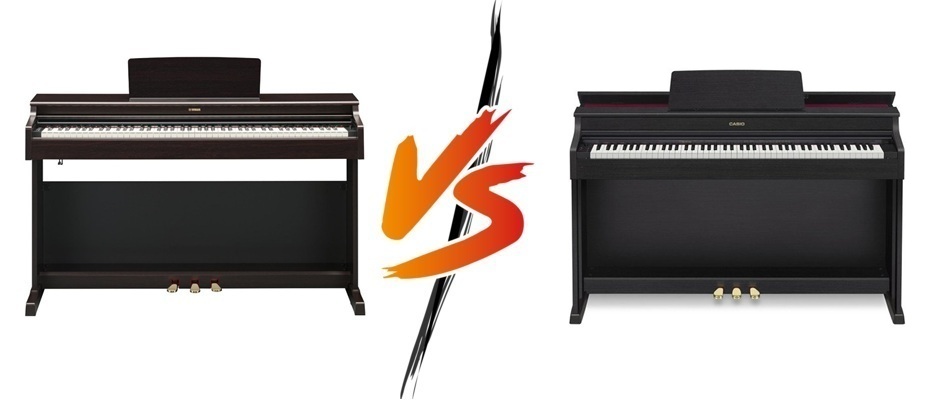
Shopping for a home digital piano in the mid-range category can be surprisingly tricky. Models start to look very similar on paper, prices overlap, and brand loyalty often clouds objective judgment. The Yamaha YDP-165 and the Casio AP-470 are perfect examples of this dilemma. Both are console-style digital pianos aimed at serious beginners and intermediate players. Both come from respected manufacturers with decades of piano-making experience. And both promise an “acoustic-like” playing experience without the cost or maintenance of a real upright.
But while they compete in the same space, they approach the idea of a digital piano differently. Yamaha focuses heavily on traditional piano feel and tone, while Casio tends to pack in more features and flexibility. This review takes a deep, practical look at how these differences actually matter in daily use. The goal isn’t to crown a universal winner, but to help you decide which piano makes more sense for your playing style, space, and expectations.
Yamaha YDP-165 vs Casio AP-470 Comparison Chart
If you click the links below, under the product images, you will be redirected to Amazon.com. In case you then decide to buy anything, Amazon.com will pay me a commission. This doesn’t affect the honesty of this review in any way though.
| Feature | Yamaha YDP-165 | Casio AP-470 |
|---|---|---|
 |  | |
| Check the best price on Amazon | Check the best price on Amazon | |
| Piano Type | Console / Home Digital Piano | Console / Home Digital Piano |
| Keys | 88 keys | 88 keys |
| Keyboard Action | GH3 (Graded Hammer 3) | Tri-Sensor Scaled Hammer Action II |
| Key Surface | Synthetic ivory | Synthetic ebony & ivory |
| Graded Action | Yes | Yes |
| Triple Sensor | Yes | Yes |
| Piano Sound Source | Yamaha CFX concert grand samples | Multi-Dimensional Morphing AiR |
| Polyphony | 192 notes | 256 notes |
| Number of Voices | 10 | 22 |
| Acoustic Piano Voices | 1 main concert grand | Multiple grand piano variations |
| String / Damper Resonance | VRM Lite | String, damper, key-off resonance |
| Speaker System | 2 speakers | 4 speakers (woofers + tweeters) |
| Amplifier Power | 2 × 20 W (40 W total) | 2 × 20 W (40 W total) |
| Cabinet Style | Traditional upright-style | Traditional with adjustable lid |
| Adjustable Lid | No | Yes |
| Pedals | 3 (damper, sostenuto, soft) | 3 (damper, sostenuto, soft) |
| Half-Pedal Support | Yes | Yes |
| Recording | Basic MIDI recording | Multi-track MIDI + audio recording |
| Built-in Songs | Limited demo songs | 60 built-in + concert play songs |
| Duet Mode | Yes | Yes |
| Layer / Split Mode | Layer | Layer + Split |
| Metronome | Yes | Yes |
| Transpose / Tuning | Yes | Yes |
| USB to Host (MIDI) | Yes | Yes |
| USB Audio Interface | Yes (audio + MIDI over USB) | No |
| USB Flash Drive Support | No | Yes |
| Bluetooth | No | No |
| App Support | Yamaha Smart Pianist | Casio Chordana Play |
| Headphone Outputs | 2 | 2 |
| Finish Options | Black, white, rosewood | Black, white, rosewood |
| Included Bench | Depends on region | Usually included |
| Target Player | Piano-focused students & purists | Learners, hobbyists, feature-focused players |
| My individual reviews | Yamaha YDP-165 review |
Design & Aesthetic Presence
When people talk about digital pianos, design often gets treated as an afterthought. Sound and keyboard action usually dominate the conversation, which makes sense, but for a home digital piano, looks actually matter more than many buyers expect. These instruments are not portable stage keyboards that get folded up and hidden away. They live in your home, often in a living room or shared space, and they’re meant to stay there for years. In that context, both the Yamaha YDP-165 and the Casio AP-470 are clearly designed to feel like permanent fixtures rather than temporary gadgets. Still, they approach that goal in slightly different ways.
Overall cabinet style and first impressions
At a glance, both pianos follow the classic console-style digital piano formula. They’re shaped like slim upright pianos, complete with a fixed stand, integrated pedal unit, and a full-height cabinet that encloses the speakers and electronics. Neither piano tries to look modern or flashy, and that’s a good thing. They’re aiming to resemble traditional acoustic uprights, not consumer electronics.
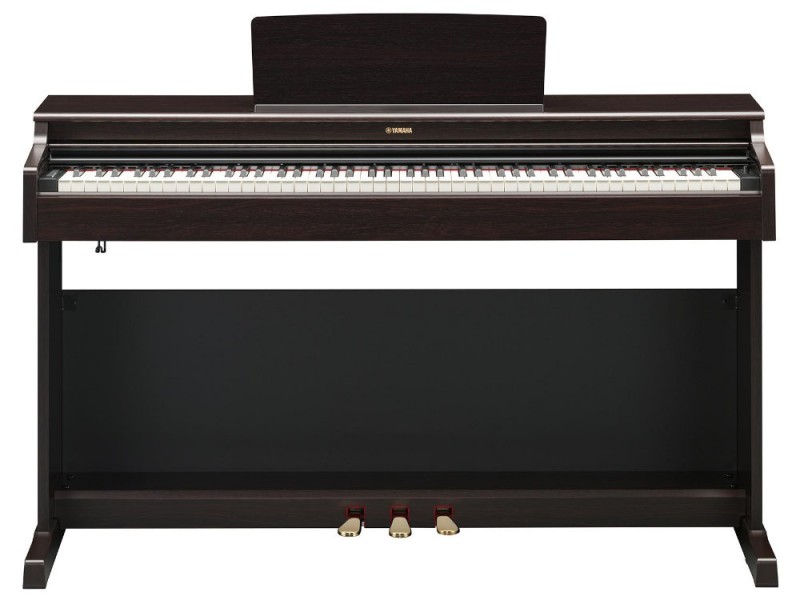
The Yamaha YDP-165 leans more heavily into that traditional look. Its lines are clean and conservative, with a rectangular, upright profile that wouldn’t look out of place in a music teacher’s studio or a formal living room. The proportions feel very deliberate. The cabinet is neither too bulky nor too thin, which helps it strike a balance between visual presence and subtlety. It looks like a piano first, and a digital instrument second.
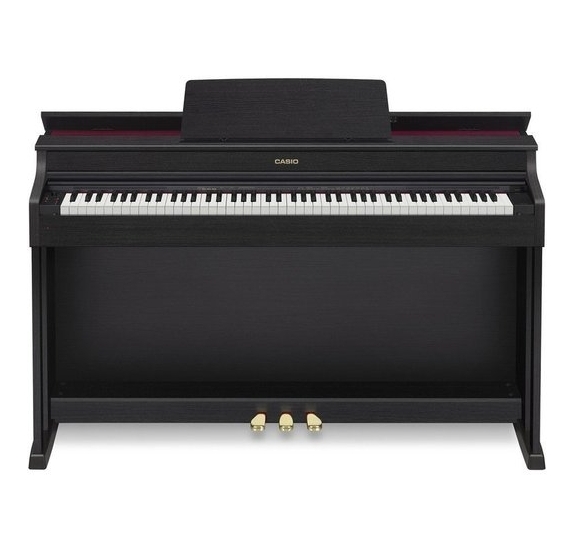
The Casio AP-470 also adopts an upright-inspired design, but it feels slightly more modern in its overall execution. The edges are a bit softer, and the cabinet has a lighter visual footprint, especially when viewed from the side. It still reads clearly as a piano, but there’s a hint of contemporary furniture design in the way the panels and lid are shaped. Some people will appreciate this fresher look, while others may prefer Yamaha’s more traditional approach.
Finish options and surface quality
Finish quality is one of those things that doesn’t always come across in photos but becomes very obvious once the piano is in your home. Both Yamaha and Casio offer their pianos in familiar finishes such as black, white, and rosewood-style tones, designed to blend into a wide range of interiors.
The Yamaha YDP-165 tends to feel slightly more refined in this area. The surfaces have a consistent, furniture-grade finish that resists looking plasticky, even though the cabinet is made from engineered materials rather than solid wood. The matte and semi-gloss finishes are subtle and tasteful, and fingerprints aren’t overly noticeable unless you go for a high-gloss black version. Overall, Yamaha’s finish choices reinforce the impression that this is a long-term piece of home furniture.
Casio’s AP-470 also offers solid finishes, and in fairness, they’ve improved a lot in recent years. The surfaces feel smooth and well-assembled, but they can sometimes come across as a little lighter or less dense compared to Yamaha’s cabinet. This doesn’t mean cheap, just slightly less substantial in hand. In most real-world living rooms, the difference will be minor, but if you’re particularly sensitive to furniture quality, Yamaha’s cabinet may feel more reassuring.
Key cover and lid design
Both pianos include a sliding key cover, which is an essential feature for a home instrument. It protects the keys from dust and adds to the acoustic piano illusion. The Yamaha YDP-165’s key cover slides smoothly and quietly, with a solid feel that matches the rest of the instrument. When closed, it sits flush with the cabinet, creating a clean, uninterrupted front surface.
Casio’s AP-470 also features a sliding key cover, but it adds something extra: an adjustable top lid. This lid can be opened or closed to subtly affect the sound projection, mimicking the behavior of an acoustic piano’s lid. From a design perspective, this is a nice touch. Visually, it adds depth and character to the instrument, and practically, it lets you tailor the sound output slightly depending on room size and volume.
The Yamaha doesn’t offer an adjustable lid, sticking to a simpler, more traditional digital piano layout. Some players won’t miss it at all, but others may appreciate the Casio’s added realism and visual interest.
Pedal unit and lower cabinet
The pedal area is another design detail that often reveals how much care went into a digital piano. Both the YDP-165 and AP-470 include a full three-pedal unit, permanently attached to the cabinet. Visually, both look appropriate and well-integrated, with pedals spaced and shaped like those on an acoustic piano.
The Yamaha pedals feel slightly more robust underfoot, and the entire lower cabinet gives off a sturdier impression. The base doesn’t flex, and the piano feels firmly planted on the floor, even when played energetically. This sense of stability contributes to the overall feeling that the instrument is a serious, permanent piano.
The Casio pedal unit is also solid and functional, but again, the cabinet as a whole feels a touch lighter. This isn’t necessarily a negative. In smaller rooms or upstairs apartments, the slightly less bulky design can actually be an advantage. Still, if you’re looking for maximum physical presence and stability, Yamaha has a small edge here.
Control layout and visual simplicity
Neither of these pianos overwhelms you with buttons, which is exactly what you want in a home digital piano. Yamaha places its controls discreetly, often on the left side of the keyboard or subtly integrated into the panel. This keeps the front view clean and uncluttered. When the key cover is closed, the instrument looks almost indistinguishable from a simple upright piano.
Casio’s controls are also neatly arranged, though they’re a bit more visible. That makes sense given the AP-470’s broader feature set. You get more buttons and functions, and while they’re still tastefully integrated, the piano does look slightly more “digital” upon close inspection. For many users, this is a non-issue, and some will even prefer the easier access to features.
Size, weight, and room presence
In terms of physical dimensions, both pianos are similar, but the Yamaha YDP-165 tends to feel a bit heavier and more substantial once assembled. That extra mass contributes to its acoustic-like presence. It feels like a piece of furniture you arrange your room around.
The Casio AP-470 is slightly lighter and a bit easier to move during assembly or relocation. If you anticipate needing to reposition your piano occasionally, this could be a small but meaningful advantage. Visually, it occupies slightly less space, making it easier to fit into tighter rooms without dominating the environment.
Long-term aesthetic appeal
Perhaps the most important design question is how these pianos age visually. Will you still like how they look in five or ten years?
The Yamaha YDP-165’s conservative, traditional styling gives it an edge in long-term appeal. It’s unlikely to feel dated because it doesn’t follow trends. It simply looks like a piano.
The Casio AP-470, while still fairly timeless, leans a bit more toward modern design cues. That can be appealing now, but tastes change. Whether that matters to you depends on how you view the piano: as a functional tool or as a lasting piece of home décor.
Design verdict
From a purely aesthetic and design-focused perspective, the Yamaha YDP-165 feels like the safer, more traditional choice. It prioritizes solidity, understatement, and furniture-like presence. The Casio AP-470 counters with a slightly more modern look, a lighter cabinet, and thoughtful extras like the adjustable lid.
Neither is poorly designed, and both look good in a home setting. The real difference comes down to preference. If you want your digital piano to look and feel as close to a classic upright as possible, Yamaha delivers that experience more convincingly. If you prefer a piano that blends tradition with a touch of modern practicality, the Casio AP-470 offers a compelling alternative.
Keyboard Action & Feel
If there’s one area where digital pianos truly earn or lose a player’s trust, it’s the keyboard action. You can forgive average speakers or a limited feature set, but if the keys don’t feel right under your fingers, the instrument becomes hard to enjoy long-term. For anyone planning to practice regularly, especially students working on technique, keyboard action matters just as much as sound. Both the Yamaha YDP-165 and the Casio AP-470 take this seriously, but they arrive at slightly different results.
Why action matters more than most specs
When people talk about “realistic piano feel,” they’re usually referring to several things at once: key weight, resistance, key travel, responsiveness, and how the action behaves at different dynamics. On an acoustic piano, all of this is handled mechanically. On a digital piano, it’s simulated through weighted keys, sensors, and internal algorithms. The closer this simulation gets to the real thing, the easier it is to develop proper technique and expressive control.
This is especially important for players who plan to transition to an acoustic piano later. A keyboard that’s too light, too springy, or too shallow can encourage bad habits. In that context, both Yamaha and Casio aim for realism rather than comfort or “easy playing.”
Yamaha YDP-165: GH3 graded hammer action
The Yamaha YDP-165 uses Yamaha’s GH3 (Graded Hammer 3) action, which is one of the company’s most trusted keybeds in this price range. “Graded” means the keys are heavier in the bass and gradually get lighter as you move up the keyboard, mirroring the behavior of an acoustic piano. This alone makes a big difference compared to ungraded or semi-weighted actions.
In practice, the GH3 action feels solid and deliberate. There’s a noticeable resistance when you press into the keys, especially in the lower octaves. For beginners, this can feel a little heavy at first, but that weight is part of what makes the action realistic. Over time, it encourages finger strength and control, which pays off if you ever sit down at an acoustic instrument.
Key travel on the YDP-165 is reasonably deep for a digital piano in this class. The keys don’t bottom out abruptly, and the return feels controlled rather than bouncy. This gives fast passages a sense of stability, even if you’re playing repeated notes or trills.
Responsiveness and repetition on the Yamaha
One of the strengths of the GH3 action is its triple-sensor design, which allows the piano to register repeated notes without the key fully returning to its resting position. This mimics the escapement behavior of an acoustic piano and makes techniques like rapid note repetition and legato playing feel more natural.
In real-world use, this translates to better control at soft dynamics. Pianissimo passages feel easier to manage because the keys respond predictably, even when you’re barely pressing them. For expressive playing, especially classical repertoire, this kind of responsiveness is crucial.
That said, some players might find the GH3 action slightly on the firm side. If you’re used to very light digital keyboards or synth actions, the Yamaha can initially feel demanding. But for most serious players, that firmness is a feature, not a flaw.
Casio AP-470: Tri-Sensor Scaled Hammer Action II
Casio equips the AP-470 with its Tri-Sensor Scaled Hammer Action II, which is also a graded, fully weighted action designed to emulate acoustic piano mechanics. Like Yamaha’s system, it uses three sensors per key to improve responsiveness and repetition accuracy.
Out of the box, the Casio action often feels a bit lighter than Yamaha’s, especially in the middle and upper registers. The keys still offer resistance, but the overall touch is slightly more forgiving. This can be appealing to beginners or players who prefer a less physically demanding action during long practice sessions.
The textured key surfaces, designed to simulate ebony and ivory, add a nice tactile element. Your fingers don’t slide around as easily during extended playing, which can be especially helpful under warm lighting or in humid environments.
Key travel and mechanical feel on the Casio
Compared to the Yamaha, the Casio’s key travel is a touch shorter. The keys bottom out a bit more quickly, and the return can feel slightly faster. This gives the AP-470 a more agile, responsive feel for certain styles, especially lighter classical pieces or pop playing.
However, this is also where some players notice a more “digital” sensation. The action can feel a bit knockier when played forcefully, and the physical feedback isn’t quite as cushioned as Yamaha’s. It’s not unpleasant, but side-by-side, the Yamaha tends to feel more refined and closer to an acoustic upright.
Casio’s action does shine in repeated notes and fast passages. The tri-sensor system works well, and the keyboard keeps up with demanding playing without missing notes or feeling sluggish.
Dynamic control and expressiveness
Both pianos offer good dynamic control, but they express it differently. On the Yamaha, dynamics feel more weight-dependent. The harder you play, the more resistance you feel, which naturally shapes your phrasing. Soft playing requires careful finger control, but the reward is a very expressive tonal response.
On the Casio, dynamics feel a bit more velocity-based and forgiving. It’s easier to produce sound at lower effort levels, which can be encouraging for less experienced players. However, some advanced pianists might find that this reduces the sense of physical connection between touch and tone.
Neither approach is objectively better, but they cater to slightly different playing styles and expectations.
Noise and mechanical realism
Another often overlooked aspect of keyboard action is mechanical noise. When playing quietly at night, especially with headphones off, key noise can become noticeable.
The Yamaha YDP-165 is relatively quiet mechanically. The action feels well-damped, and key presses don’t produce much audible noise beyond the sound engine itself. This contributes to a more acoustic-like illusion.
The Casio AP-470 is still quiet, but the action can produce a bit more physical sound, especially when playing with force. Again, this isn’t a dealbreaker, but it’s something you’re more likely to notice during silent practice or in very quiet rooms.
Long-term playing comfort
Over longer practice sessions, comfort becomes important. Yamaha’s heavier action can be more tiring at first, but many players find that it becomes comfortable as their technique improves. It encourages proper hand position and controlled movement.
Casio’s slightly lighter action is easier on the hands initially and may feel more approachable for casual players or those with smaller hands. If you’re practicing for hours every day, personal comfort will play a big role in your preference.
Keyboard action verdict
In the end, both keyboard actions are very capable and far above entry-level quality. The Yamaha YDP-165 offers a more traditional, acoustic-leaning experience with a firmer, more substantial feel. It’s especially well-suited for students and players focused on classical technique and expressive control.
The Casio AP-470 counters with a slightly lighter, more agile action that’s responsive and comfortable, with excellent sensor performance and textured keys. It may feel a bit more “digital,” but it’s also more forgiving and accessible.
If your priority is realism and long-term technical development, Yamaha has the edge. If you value comfort, responsiveness, and a slightly easier playing feel, the Casio AP-470 may be the better fit.
Sound Quality & Tone Engines
Sound is ultimately what turns a digital piano from a practice tool into a musical instrument you actually enjoy playing. You can have the best keyboard action in the world, but if the tone feels flat, artificial, or uninspiring, the experience quickly falls apart. Both the Yamaha YDP-165 and the Casio AP-470 are designed to deliver a convincing piano sound in a home setting, but they take noticeably different approaches in how they generate and shape that sound. Understanding those differences goes a long way toward choosing the right instrument for your ears and your musical goals.
Yamaha YDP-165: CFX-based sampling and tonal character
Yamaha builds the YDP-165 around samples taken from its flagship CFX concert grand piano. This is a full-sized concert instrument designed for large halls, and Yamaha’s goal here is to capture its tonal balance and dynamic range in a more affordable home piano.
In practice, the YDP-165’s piano sound is clean, focused, and very recognizable as “Yamaha.” The tone is clear without being harsh, with a strong midrange presence that helps melodies stand out. Bass notes feel controlled rather than overly boomy, which works well in smaller rooms where excessive low end can quickly overwhelm the space.
One of the standout qualities of the Yamaha sound engine is its consistency across the keyboard. Transitions between registers feel smooth, and the tone doesn’t suddenly change character as you move up or down the keys. This makes longer pieces feel cohesive and predictable in a good way.
Expressiveness and dynamic response on the Yamaha
The YDP-165 handles dynamics particularly well. Soft playing produces a warm, rounded tone, while harder strikes introduce brightness without turning brittle. This makes expressive phrasing feel natural and rewarding, especially for classical and acoustic-style music.
Yamaha also includes Virtual Resonance Modeling Lite (VRM Lite), which simulates sympathetic string resonance and damper interactions. While this is a simplified version of the VRM found in higher-end models, it still adds depth to sustained chords and makes the instrument feel more alive. You won’t always consciously notice it, but when it’s missing, the sound tends to feel flatter.
For headphone use, Yamaha’s binaural sampling and Stereophonic Optimizer technology deserve special mention. Playing through headphones on the YDP-165 feels surprisingly spacious, with the sound seeming to come from in front of you rather than directly inside your head. This is a big plus for late-night practice.
Limitations of the Yamaha sound engine
Where the YDP-165 is more restrained is in tonal variety. Yamaha includes a relatively small selection of voices, focusing heavily on acoustic pianos with a few electric pianos, organs, and strings added in. These extra sounds are usable, but they’re clearly secondary to the main piano tone.
There’s also limited ability to tweak the sound beyond basic settings like brilliance and reverb. Yamaha’s philosophy here is very much “set it and play,” which some players will appreciate and others may find restrictive.
Casio AP-470: AiR sound source and tonal flexibility
Casio takes a different approach with the AP-470 by using its Multi-Dimensional Morphing AiR (Acoustic and Intelligent Resonator) sound source. Instead of relying on a single flagship piano identity, Casio focuses on recreating the behavior of an acoustic piano through multiple layers of sampling and modeling.
The result is a sound that feels rich and detailed, with a bit more complexity in the overtones compared to the Yamaha. The AP-470 includes multiple grand piano voices, each with its own character. One might be brighter and more assertive, while another feels warmer and more intimate.
This flexibility allows players to tailor the sound to different styles or personal tastes. If you enjoy experimenting or play a wide range of music, this variety can be a real advantage.
Resonance, decay, and realism on the Casio
Casio puts a lot of emphasis on simulating the mechanical aspects of an acoustic piano. The AP-470 models damper resonance, string resonance, key-off behavior, and even hammer response. These details contribute to a more complex and sometimes more realistic decay of notes, especially when using the sustain pedal.
Chords tend to bloom nicely and evolve over time, rather than simply fading out. This gives sustained passages a sense of movement that can be very satisfying, particularly for romantic-era music or cinematic playing styles.
The higher polyphony count also helps here. With more notes available at once, the AP-470 is less likely to cut off sounds during dense passages, heavy pedaling, or layered playing.
Tonal character and personal taste
The biggest difference between these two pianos comes down to tonal character. The Yamaha YDP-165 sounds clean, focused, and slightly conservative. It’s the kind of tone that works well for structured practice and traditional repertoire. It doesn’t draw attention to itself, which is often exactly what pianists want.
The Casio AP-470, by contrast, sounds a bit more expressive and colorful. The added resonance and tonal options can make it feel more emotionally engaging, especially for players who enjoy shaping sound and exploring different moods.
That said, some purists may find the Casio sound slightly less “pure” or a bit more processed, particularly at higher volumes. Yamaha’s tone tends to remain stable and controlled even when pushed.
Non-piano voices and usability
Both pianos include additional sounds beyond acoustic piano, but Casio clearly puts more emphasis here. The AP-470 offers a broader selection of electric pianos, strings, organs, and layered combinations. These sounds are generally good quality and useful for casual playing, songwriting, or teaching.
Yamaha’s extra voices are fewer and more basic. They’re fine for occasional use but unlikely to satisfy players looking for sound exploration. Again, this reflects Yamaha’s piano-first philosophy.
Sound in real-world playing environments
In a typical home environment, both pianos sound convincing and musical. The Yamaha tends to sit nicely in a room without overwhelming it. Its tone is easy to live with and rarely fatiguing, even during long sessions.
The Casio fills the room more assertively, especially when using its richer tones and resonance features. This can be inspiring, but it also means you may need to be more mindful of volume and room acoustics.
Sound quality verdict
Choosing between these two sound engines is less about quality and more about character. The Yamaha YDP-165 delivers a polished, traditional piano sound that emphasizes clarity, balance, and reliability. It’s an excellent choice for focused practice and classical playing.
The Casio AP-470 offers greater tonal depth, flexibility, and expressive nuance. It rewards experimentation and caters to players who enjoy a more dynamic, evolving sound.
If you value consistency and a classic piano voice, Yamaha will likely resonate with you. If you want more color, resonance, and customization in your sound, Casio’s approach may feel more inspiring.
Amplification & Speakers
Speakers are one of the most underrated parts of a digital piano. People tend to focus on sound engines and sample sources, but none of that matters much if the built-in amplification can’t translate those sounds into the room convincingly. For a home digital piano, the speaker system is what you hear most of the time. Headphones are useful, but day-to-day playing usually happens through the onboard speakers. This makes amplification a critical factor in how realistic, inspiring, and enjoyable a piano feels in real use.
Both the Yamaha YDP-165 and the Casio AP-470 are designed to fill small to medium-sized rooms without external speakers, but they do it in slightly different ways.
Yamaha YDP-165 speaker system overview
The Yamaha YDP-165 uses a two-speaker system rated at 20 watts per side, for a total output of 40 watts. The speakers are mounted inside the cabinet and fire downward and outward, using the piano’s enclosure to help shape and distribute the sound.
On paper, this might sound fairly standard, but Yamaha’s strength lies in how well these speakers are tuned to the instrument’s sound engine. The output is balanced, controlled, and predictable. You don’t get exaggerated bass or hyped treble. Instead, the sound feels natural and proportioned, much like a small acoustic upright in a domestic setting.
At moderate volumes, the Yamaha delivers a clear and focused tone that projects well without becoming intrusive. This makes it easy to practice in shared living spaces where you want presence without overwhelming the room.
Sound projection and room interaction on the Yamaha
One of the Yamaha’s strengths is how evenly it projects sound. Because the speakers are integrated into a solid cabinet, the sound doesn’t feel like it’s coming from a single point. Instead, it spreads naturally across the space in front of the piano.
This contributes to the illusion of playing a real acoustic instrument. Notes feel grounded, and chords have a defined center without excessive boom. In smaller rooms, this controlled projection is especially important, as too much low-end energy can quickly muddy the sound.
The downside of this approach is that the Yamaha doesn’t sound particularly dramatic. If you’re expecting a room-filling, concert-like experience, the YDP-165 may feel a bit restrained. However, that restraint is often what makes it pleasant to live with day after day.
Volume range and clarity
The Yamaha maintains good clarity across its volume range. At low volumes, the sound remains full and usable, which is ideal for quiet practice. At higher volumes, the tone stays relatively clean, though you can hear the limits of the speakers if you push them hard. They don’t distort easily, but they also don’t add much extra depth or power beyond a certain point.
For most home users, this won’t be an issue. The Yamaha is clearly optimized for realistic, everyday playing rather than maximum loudness.
Casio AP-470 speaker system overview
The Casio AP-470 also delivers a total of around 40 watts, but it uses a more complex speaker configuration. Instead of relying on two full-range speakers, Casio employs a multi-speaker system with separate drivers for different frequency ranges. This typically includes woofers for low and mid frequencies and tweeters for higher frequencies.
In practical terms, this gives the AP-470 a broader, more expansive sound. The bass feels deeper, and the high frequencies have a bit more sparkle. When you first play the Casio, it often sounds bigger and more impressive than the Yamaha, especially at higher volumes.
This setup is clearly designed to enhance immersion and create a more enveloping listening experience.
Bass response and fullness on the Casio
One of the most noticeable differences between the two pianos is bass response. The Casio AP-470 delivers more low-end presence, which makes left-hand passages feel weightier and chords sound fuller. This can be very satisfying, especially for romantic or cinematic music.
However, this extra bass can also be a double-edged sword. In smaller or acoustically reflective rooms, the low end can become dominant if you’re not careful with volume settings. Players who prefer a tighter, more controlled bass may find the Casio slightly overbearing in certain environments.
That said, Casio gives you more tools to shape the sound, including tone adjustments and lid positioning, which can help tailor the output to your room.
High frequencies and detail
The tweeter-based design of the Casio helps bring out upper harmonics and detail in the sound. This adds clarity to melodic lines and makes the instrument feel more lively. Fast passages and bright playing styles benefit from this extra definition.
Compared to the Yamaha, the Casio sounds more open and airy in the upper register. The trade-off is that, at higher volumes, the highs can sometimes feel a bit more forward or bright, depending on the chosen tone and room acoustics.
Projection and spatial feel
The AP-470’s speaker system does a good job of filling the room. The sound spreads widely and feels more immersive, particularly when using resonance-heavy piano tones. This makes solo playing feel more engaging and can give the impression of a larger instrument.
The adjustable lid on the Casio also plays a role here. Opening the lid slightly changes how the sound escapes the cabinet, adding another layer of realism and control. While the effect is subtle, it contributes to a more interactive playing experience.
Comparing realism and fatigue
Over long playing sessions, speaker voicing becomes important. The Yamaha’s more neutral tuning tends to be less fatiguing over time. It doesn’t draw attention to any specific frequency range, which makes it comfortable for extended practice.
The Casio’s richer, more detailed sound can be inspiring, but it may also require occasional adjustment to avoid listening fatigue, especially at higher volumes or with bright tones selected.
Headphones vs speakers
While this section focuses on speakers, it’s worth noting how each piano transitions between speaker and headphone use. Yamaha’s speaker voicing aligns closely with its headphone sound, making the switch feel natural. Casio’s more expansive speaker sound contrasts a bit more with headphone playback, though both handle this reasonably well.
Amplification verdict
In terms of sheer presence and fullness, the Casio AP-470 has the edge. Its multi-speaker system delivers a larger, more immersive sound that can make playing feel exciting and emotionally engaging.
The Yamaha YDP-165 counters with balance, clarity, and long-term listenability. Its speakers may not impress immediately, but they support consistent, realistic playing without overpowering the room.
If you want your digital piano to feel bold and room-filling, Casio’s amplification will likely appeal more. If you value subtlety, control, and a sound that’s easy to live with every day, Yamaha’s speaker system may ultimately prove more satisfying.
Functions, Features & Extras
Once you move beyond the basics of keys and sound, the differences between digital pianos often come down to features. This is where manufacturers decide who their instrument is really for. Some aim for simplicity and focus, while others try to pack in as much functionality as possible. The Yamaha YDP-165 and the Casio AP-470 sit on opposite ends of that spectrum, and understanding this contrast is key to choosing the right piano for your needs.
Yamaha YDP-165: focused and piano-centric
Yamaha has a long history of designing instruments that prioritize playing experience over extras, and the YDP-165 reflects that philosophy clearly. Its feature set is intentionally restrained. Everything included serves a practical purpose for piano practice, teaching, or performance, without drifting into entertainment territory.
The control layout is minimal, with most functions accessed through simple button combinations. This keeps the instrument visually clean and avoids distractions. For players who want to sit down and play without thinking about menus or modes, this approach is refreshing.
Core practice features on the Yamaha
The YDP-165 includes all the essential tools you’d expect for serious practice. A built-in metronome helps with timing and rhythm, while transpose and tuning functions allow you to adjust pitch for different playing contexts or ensemble work.
There’s also a dual mode that lets you layer two sounds, such as piano and strings, which can add depth for certain pieces. Duet mode splits the keyboard into two equal ranges, making it easier for teacher and student to sit side by side and play together. This is especially useful for lessons and demonstrations.
Yamaha also includes a selection of built-in demo songs and piano pieces. These aren’t extensive, but they serve as useful references and practice material.
Recording and connectivity on the Yamaha
One of the YDP-165’s most practical features is its USB-to-host connection. This allows the piano to send MIDI and audio directly to a computer or compatible device using a single cable. For students and content creators, this is a major advantage. You can record high-quality digital audio without needing an external audio interface.
Internal recording on the YDP-165 is more limited. It supports basic song recording, but it’s not designed as a full production tool. Yamaha clearly expects users who need more advanced recording to rely on external software via USB.
App integration and learning tools
Yamaha’s Smart Pianist app adds a layer of functionality without cluttering the instrument itself. Through the app, you can control sounds, adjust settings, view sheet music, and access additional learning tools. The app interface is clean and intuitive, though it doesn’t go as deep as some competitors in terms of interactive lessons.
The key point here is that the app is optional. You can ignore it entirely and still enjoy the piano fully, which fits Yamaha’s philosophy of keeping the core instrument simple and self-contained.
Casio AP-470: feature-rich and flexible
Casio takes a much more expansive approach with the AP-470. This piano is clearly designed to do more than just replicate an acoustic playing experience. It includes a wide range of features aimed at learners, hobbyists, and players who enjoy experimenting with sound and structure.
The control panel is still relatively tidy, but there are more buttons and options available directly on the instrument. This makes advanced features more accessible without relying on external devices.
Learning and performance features on the Casio
One of the standout features of the AP-470 is Concert Play. This mode allows you to play along with orchestral recordings, simulating the experience of performing a concerto. For students, this can be both motivating and educational, helping develop timing and musical awareness.
The AP-470 also includes a larger library of built-in songs compared to the Yamaha. These can be used for listening, practice, or as play-along material. Combined with duet mode, this makes the Casio particularly appealing for teaching environments and shared learning.
Recording capabilities and internal memory
Casio equips the AP-470 with a more advanced built-in recorder. You can record multiple tracks, making it easier to capture layered performances or separate left and right hands for practice. Recordings can be saved internally or exported via USB, which is useful for archiving progress or sharing performances.
This standalone recording capability means you don’t need a computer to make meaningful recordings, which is a big plus for users who prefer an all-in-one solution.
Sound shaping and effects
The AP-470 offers a range of sound-shaping options that go beyond basic reverb. These include chorus effects, brilliance adjustment, and a hall simulator that changes the perceived acoustic environment. You can make the piano sound like it’s in a small room, a recital hall, or a larger performance space.
Yamaha includes some basic sound adjustments as well, but Casio clearly gives you more creative control. For players who enjoy customizing their sound or adapting it to different genres, this flexibility can be very appealing.
App support and external control
Casio’s Chordana Play app provides deep integration with the AP-470. Through the app, you can access digital sheet music, lesson features, and sound controls in a more visual and interactive way. The app is particularly useful for beginners and intermediate players working through structured learning material.
Like Yamaha’s app, Chordana Play is optional, but it unlocks more of the piano’s potential if you choose to use it.
Connectivity and expansion
Both pianos offer USB connectivity, but Casio focuses more on file management and standalone use. You can save recordings to a USB flash drive, load songs, and manage data directly from the piano. Yamaha’s strength lies in seamless computer integration, especially for recording and music production.
Neither piano includes built-in Bluetooth audio as standard, which is a limitation compared to some newer models. However, this is less of an issue for players focused on piano performance rather than multimedia playback.
Ease of use vs depth
This is where the biggest philosophical difference appears. The Yamaha YDP-165 is designed to disappear once you start playing. Its features support practice without pulling your attention away from the keys.
The Casio AP-470 invites exploration. It encourages you to try different modes, sounds, and setups. For some players, this makes practice more engaging. For others, it can feel like unnecessary complexity.
Functions verdict
If you want a digital piano that behaves like an acoustic instrument with just enough digital convenience, the Yamaha YDP-165 gets it right. It provides all the essential tools without clutter or distraction.
If you enjoy features, recording, play-along modes, and sound customization, the Casio AP-470 offers significantly more to explore. It’s better suited for learners, teachers, and hobbyists who appreciate variety and flexibility.
Ultimately, the choice here depends on how you plan to use your piano. Yamaha emphasizes focus and purity. Casio emphasizes versatility and engagement.
Connectivity
Connectivity is one of those aspects of a digital piano that you might not think much about at first, but it often becomes more important over time. Even if you start out just playing for yourself, many players eventually want to record their performances, use learning apps, connect to notation software, or integrate the piano into a small home studio setup. In this area, the Yamaha YDP-165 and the Casio AP-470 take noticeably different approaches, reflecting their overall design philosophies.
Yamaha YDP-165: streamlined and modern connectivity
Yamaha’s approach to connectivity on the YDP-165 is clean, modern, and very practical. The centerpiece is its USB-to-host port, which serves multiple roles at once. Through a single USB cable, the piano can send MIDI data and digital audio directly to a computer, tablet, or smartphone.
This is a big deal for anyone interested in recording or using music software. You don’t need an external audio interface, special drivers, or additional hardware. Plug the piano into your computer, open your recording or notation software, and you’re ready to go. For beginners and intermediate players, this simplicity removes a lot of technical barriers.
MIDI over USB and software integration
The Yamaha functions as a class-compliant USB MIDI device, meaning it works with most modern operating systems without extra setup. This makes it compatible with popular DAWs, notation programs, and learning platforms. You can use the YDP-165 as a MIDI controller to trigger virtual instruments or analyze your playing in real time.
This is particularly useful for students working with teachers online or using interactive learning software. The responsiveness and reliability of Yamaha’s MIDI implementation are generally excellent, with low latency and consistent performance.
Digital audio output via USB
One of Yamaha’s standout connectivity features is its ability to send digital audio over USB. This means the actual sound of the piano, not just MIDI data, can be recorded directly into your computer at full quality.
For content creators, this is a huge advantage. You can record performances, tutorials, or compositions without worrying about microphone placement, room acoustics, or background noise. The resulting audio is clean and consistent.
Casio does not offer the same level of built-in USB audio output on the AP-470, which gives Yamaha a clear edge for players interested in recording and streaming.
Traditional audio connections
Both pianos include standard headphone jacks, which also double as line outputs. This allows you to connect external speakers, amplifiers, or mixers if needed. Yamaha typically includes dual headphone outputs, making it easier for teacher and student to listen simultaneously.
The headphone outputs are clean and well-amplified, and Yamaha’s headphone sound optimization helps maintain a natural listening experience.
Casio AP-470: versatile and standalone-friendly
Casio’s connectivity philosophy is more about flexibility and independence. The AP-470 includes USB-to-host connectivity for MIDI, similar to Yamaha, but it places more emphasis on file management and standalone operation.
You can connect the piano to a computer or mobile device to use MIDI-based apps and software. Casio’s MIDI implementation is solid and responsive, making the AP-470 suitable as a controller for virtual instruments or learning tools.
USB-to-device and file handling
One of Casio’s strengths is its support for USB flash drives. The AP-470 allows you to save recordings, load MIDI files, and manage data directly on a USB drive. This makes it easy to transfer performances without involving a computer at all.
For users who prefer a self-contained workflow, this is a big plus. Teachers can record student performances and hand them over immediately, and players can archive their progress with minimal fuss.
Audio recording and playback
The Casio AP-470 includes built-in audio recording features that allow you to capture performances internally and export them. While this audio isn’t streamed digitally over USB in the same way Yamaha handles it, it still provides a convenient way to create and share recordings.
Playback of audio and MIDI files is also straightforward, making the Casio useful for accompaniment and practice.
App connectivity and mobile devices
Both pianos support companion apps, but Casio tends to offer deeper integration in this area. The Chordana Play app connects to the AP-470 via USB and provides access to sheet music, lesson tools, and sound controls.
This app-centric approach makes the Casio particularly appealing to learners and teachers who use tablets during lessons. The interface is intuitive and encourages interactive practice.
Yamaha’s Smart Pianist app also works well, but its feature set is more focused on sound control and basic learning tools rather than full lesson programs.
Bluetooth considerations
Neither the Yamaha YDP-165 nor the Casio AP-470 includes built-in Bluetooth audio or MIDI as standard. This is worth noting, as some competing models do offer wireless connectivity.
In practical terms, this means you’ll need a cable to connect to devices. For most serious players, this isn’t a major issue, and wired connections are often more reliable. However, if wireless convenience is high on your priority list, this limitation could influence your decision.
Latency, stability, and reliability
In everyday use, both pianos are stable and reliable when connected to external devices. Yamaha’s USB audio and MIDI performance is especially robust, making it well-suited for recording and live streaming.
Casio’s MIDI connectivity is also dependable, though users relying heavily on computer-based audio workflows may miss Yamaha’s direct USB audio feature.
Who each connectivity approach suits best
The Yamaha YDP-165 is ideal for players who want seamless integration with computers and recording software. If you plan to record often, stream, or use DAWs, Yamaha’s USB audio functionality is a major advantage.
The Casio AP-470 is better suited for players who value independence and flexibility. Its USB storage support, built-in recording, and strong app integration make it a great choice for learners, teachers, and casual composers who prefer not to rely on a computer.
Connectivity verdict
Connectivity is a clear area where philosophy matters more than raw specifications. Yamaha prioritizes modern, streamlined digital workflows, making the YDP-165 an excellent hub for software-based music creation.
Casio prioritizes versatility and self-contained operation, giving the AP-470 strong standalone capabilities and practical file handling.
Neither approach is objectively better, but depending on how you plan to use your piano beyond simple playing, one will likely suit your workflow far better than the other.
Conclusion
Choosing between the Yamaha YDP-165 and the Casio AP-470 ultimately comes down to what you expect from a home digital piano and how you plan to use it day to day. Both instruments are well-built, reliable, and capable of supporting years of practice and musical growth. There’s no bad choice here, but there is a better fit depending on your priorities.
The Yamaha YDP-165 feels like it was designed for players who want the most authentic piano experience possible in this price range. Its keyboard action is firm and deliberate, its sound is clean and traditional, and its overall presentation stays focused on playing rather than features. It’s the kind of piano that quietly encourages good technique and disciplined practice. If your main goal is to study piano seriously, work on classical repertoire, or transition smoothly to an acoustic instrument, the Yamaha makes a strong case for itself.
The Casio AP-470 takes a more expansive view of what a digital piano can be. Its sound engine is richer and more flexible, its speaker system is more immersive, and its feature set is deeper. It’s especially appealing for learners, hobbyists, and players who enjoy experimenting with sound, recording, and play-along functions. The slightly lighter keyboard action and fuller speaker output make it immediately enjoyable, even if it sacrifices a bit of traditional realism.
In the end, the Yamaha YDP-165 rewards focus and long-term development, while the Casio AP-470 rewards versatility and engagement. Think about how you’ll actually use the piano, not just how it looks on paper. That honest self-assessment will lead you to the right choice.